essay
The Role of Free Enterprise
A Case For Economic Democracy
FORUM OF FREE ENTERPRISE, "Sohrab House", 235, Dr. Dadabhai Naoroji Road, Bombay 1. · Bombay · 1956
4 pages
The Role of Free Enterprise
By M. R. Masani
Summary
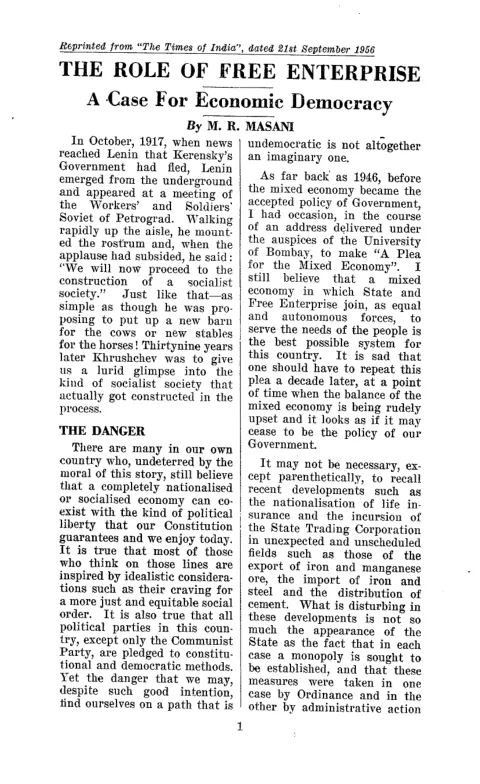
This four-page Forum of Free Enterprise leaflet reprints M. R. Masani’s article ‘The Role of Free Enterprise — A Case For Economic Democracy’, originally published in The Times of India on 21st September 1956. Masani opens with the image of Lenin in October 1917 vowing to proceed to the construction of a socialist society, and Khrushchev’s later disclosures, to warn that nationalised or socialised economy is incompatible with the kind of political liberty India’s Constitution guarantees. While most who favour nationalisation are idealists committed to constitutional and democratic methods, the danger is that good intentions lead onto a path that ends in concentrated power.
The core of Masani’s argument is that economic power must be dispersed if political liberty is to survive. He recalls that he had, as far back as 1946, argued for ‘A Plea for the Mixed Economy’ in which State and free enterprise join as equal and autonomous forces, and laments that the balance of the mixed economy is being rudely upset — citing the nationalisation of life insurance, the State Trading Corporation, and unscheduled fields such as the export of iron and manganese ore and the import of iron and steel. He frames industrial management as the centre of a triangle of pressures from worker, investor and consumer, and contends that only the discipline of the market — the law of supply and demand — protects the freedom of choice of all three; under a State monopoly the bureaucrat decides for them.
Masani draws on the ancient Indian maxim ‘Jhan Raja Vyapari, Tyan Praja Bhikhari’ (where the King trades, the people are paupers), on Karl Marx’s recognition that those who own property are free and those who do not are not free, and on Gandhi’s warning that Swaraj must not mean the replacement of a white bureaucracy by a brown one. He approvingly notes the existence of autonomous ‘social forces’ — peasant proprietors, professions, trade unions, businessmen, newspapers, priests and educationists — that stand on their own legs as a check on the State, citing Stalin’s liquidation of such countervailing power as the warning. The article closes by welcoming the establishment of the Forum of Free Enterprise as a body that proposes to put the case for free enterprise before the public and educate people about the threat to individual and political liberty from the ‘creeping paralysis’ of the Welfare State.
Key points
-
The work reprints M. R. Masani’s 21 September 1956 Times of India article as an FFE leaflet.
-
Masani argues that a nationalised/socialised economy is incompatible with the political liberty guaranteed by India’s Constitution.
-
He recalls his 1946 ‘A Plea for the Mixed Economy’, proposing State and free enterprise as equal, autonomous forces.
-
He warns the balance of the mixed economy is being upset (life insurance, State Trading Corporation, iron/steel and cement controls).
-
Industrial management sits at the centre of a triangle of pressures from worker, investor and consumer; only the market preserves all three’s freedom of choice.
-
Dispersed economic power and autonomous ‘social forces’ are presented as essential countervailing checks on the State.
-
He cites the maxim ‘where the King trades, the people are paupers’, Marx on property and freedom, and Gandhi on Swaraj.
-
The article ends by welcoming the Forum of Free Enterprise and warning against the ‘creeping paralysis’ of the Welfare State.
Generated by the v1.5 extraction pipeline. Awaiting editorial review.
Metadata and summary are AI-extracted from the source PDF and reviewed for editorial accuracy. The original work is available via the Read PDF tab above (where present); paragraph-level citation inside the PDF is deferred to a future engagement.