edited volume · anthology
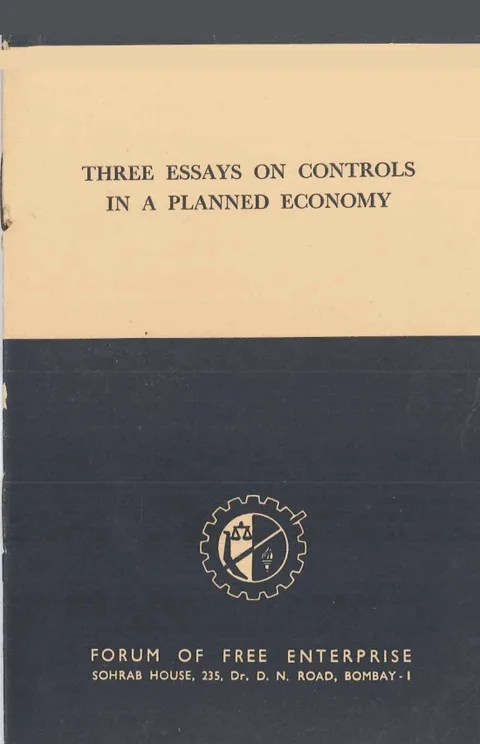
Three Essays on Controls in a Planned Economy
By K. S. VARGHESE, dr-gvk-rao, S. JOSEPH
Published by M. R. Pai, for Forum of Free Enterprise, "Sohrab House," 235, Dr. Dadabhai Naoroji Road, Bombay 1, and printed by S. Krishnamoorthy at Western Printers & Publishers (Prop. K. S. Mistry), 15/23, Hamam Street, Bombay 1. · Bombay · 1961
12 pages
Three Essays on Controls in a Planned Economy
Summary
This Forum of Free Enterprise booklet collects the three prize-winning essays from FFE’s 1960 all-India college essay competition on the theme “Controls in a Planned Economy”. An editorial Introduction (printed p.1) names the judges (Prof. R. K. Amin, Mr. R. V. Murthy, and FFE Secretary M. R. Pai) and the three winners, and the essays follow in prize order. Across all three, the argumentative centre is a critique of pervasive State controls in India’s planned economy and an admiring contrast with West Germany’s post-war “social market economy” under Ludwig Erhard. The essayists concede that some measure of planning and indirect control is inevitable in an under-developed economy, but argue that direct, detailed controls breed black-markets, bureaucratic regimentation, and inefficiency, and that competition and the free price mechanism are the surer route to growth.
Key points
-
This Forum of Free Enterprise booklet collects the three prize-winning essays from FFE’s 1960 all-India college essay competition on ‘Controls in a Planned Economy’, judged by Prof. R. K. Amin, Mr. R. V. Murthy and FFE Secretary M. R. Pai.
-
First-prize winner K. S. Varghese argues that planning need not mean collectivism and points to West Germany’s post-war ‘economic miracle’ under Ludwig Erhard as proof that a free economic order outperforms socialisation.
-
Varghese contends that nationalised industry subordinates commercial efficiency and consumer interest to political control, and that the democratic state’s proper role is to supervise and encourage rather than itself operate services.
-
Second-prize winner G. Ranga Rao distinguishes direct controls such as rationing and licensing, which distort the price system and feed the black market, from preferable indirect fiscal and monetary checks.
-
Ranga Rao documents India’s money supply rising from Rs. 1,803.79 crores in 1951-52 to Rs. 2,497.87 crores by 1958-59 across the successive Five-Year Plans.
-
Third-prize winner S. Joseph traces the eclipse of laissez-faire since the Great Depression and calculates the administrative cost of rationing to government at Rs. 9.5 crores in 1952-53 alone.
-
Joseph notes that Mahatma Gandhi himself deprecated controls for impairing self-reliance, and that deficit financing administered through the Reserve Bank failed to adequately check the price level.
-
All three essayists hold up West Germany’s market-led recovery under Erhard as the contrasting model India’s planners should study, even while conceding that some planning remains inevitable in an under-developed economy.
Essays
Controls in a Planned Economy
By K. S. VARGHESE
K. S. Varghese’s first-prize essay argues that while some planning and State restraint is desirable in an under-developed country, planning need not mean collectivism, and a planned economy can still rest on a self-generating private sector. He marshals West Germany’s “economic miracle” under Erhard as documentary evidence that a free economic order outperforms socialisation, and warns that nationalised industry tends to subordinate commercial efficiency and consumer interest to political control. He concludes that the proper role of the democratic, planned State is to supervise, encourage, check and initiate — not itself to operate services — closing with the warning that what is nationalised may be hard to reverse.
- Planning is a framework of co-ordination; in an under-developed country it must take an active part in building up overheads and heavy industry while checking the stagnant economy.
- A planned economy need not be a controlled economy in the full sense; control does not necessarily mean collectivism.
- West Germany’s recovery under the ‘social market economy’ is offered as proof that a free economic order beats socialisation at raising national wealth.
- State ownership tends to subordinate commercial efficiency and consumer interest because public accountability sits poorly with commercial efficiency.
- The duty of the democratic, planned State is to supervise, encourage, check and initiate — not itself to operate services.
[Essay II]
By G. RANGA RAO
G. Ranga Rao’s second-prize essay opens from Robbins’s observation that economic activity involves planning, then argues that totalitarian planning carries irresistible dogmatic appeal and narrows individual enterprise, whereas Germany’s democratic planning succeeded precisely because it did not extend to the processes of production. He distinguishes direct from indirect controls and contends that direct controls — rationing, licensing, scarce-material allocation — distort the price system and drive transactions into the black-market, while indirect fiscal and monetary checks are preferable. Reviewing India’s record of mounting money supply and deficit financing across the Plans, he holds that direct controls are needed only because of the asymmetry between supply and demand under planning, and presses for the German lesson of stabilising the currency and freeing investment.
- Totalitarian planning has an irresistible dogmatic appeal but depredates individual liberty; Germany’s democratic planning worked because it left production processes free.
- Controls divide into direct (rationing, licensing, scarce-material allocation) and indirect (fiscal and monetary) — direct controls distort the price system.
- India’s successive Plans unleashed inflationary forces; money in circulation rose from Rs. 1,803.79 crores (1951-52) to Rs. 2,497.87 crores (1958-59).
- Direct controls breed black-markets, permits, concessions and licences while the State condemns them as anti-social.
- The remedy is to stabilise the currency, run budget surpluses, and free voluntary investment — the path taken in Germany.
[Essay III]
By S. JOSEPH
S. Joseph’s third-prize essay traces the eclipse of laissez-faire since the Great Depression and the rise of conscious planning, conceding that almost everyone now agrees on the need to plan while disagreeing on the manner. Surveying the visible run of this essay, he reviews direct and indirect controls, the inelasticity of India’s revenue and expenditure under the Second Plan, deficit financing administered through the Reserve Bank, and the danger that price controls and rationing impose heavy administrative cost and corrode public morale. He contrasts India’s experience with West Germany’s market-led recovery under Erhard and questions whether controls over population and production can substitute for the discipline of the price mechanism.
- Since the Great Depression, laissez-faire has been replaced by conscious planning; the dispute is over the manner, not the need, to plan.
- Direct controls entail colossal expenditure on administration — the cost of rationing to Government in 1952-53 was Rs. 9.5 crores.
- Deficit financing was administered through the Reserve Bank to keep the price level under check, but the cumulative effect on prices was inadequate.
- Price controls and rationing breed black-markets and corrode public morale; Mahatma Gandhi deprecated controls because they impaired self-reliance.
- West Germany’s market-led recovery under Erhard is held up as the contrasting model India should learn from.
Generated by the v1.5 extraction pipeline. Awaiting editorial review.
Metadata and summary are AI-extracted from the source PDF and reviewed for editorial accuracy. The original work is available via the Read PDF tab above (where present); paragraph-level citation inside the PDF is deferred to a future engagement.