
book
WE INDIANS
By Minoo Masani
OXFORD UNIVERSITY PRESS, DELHI CALCUTTA MADRAS · Bombay · 1989
118 pages
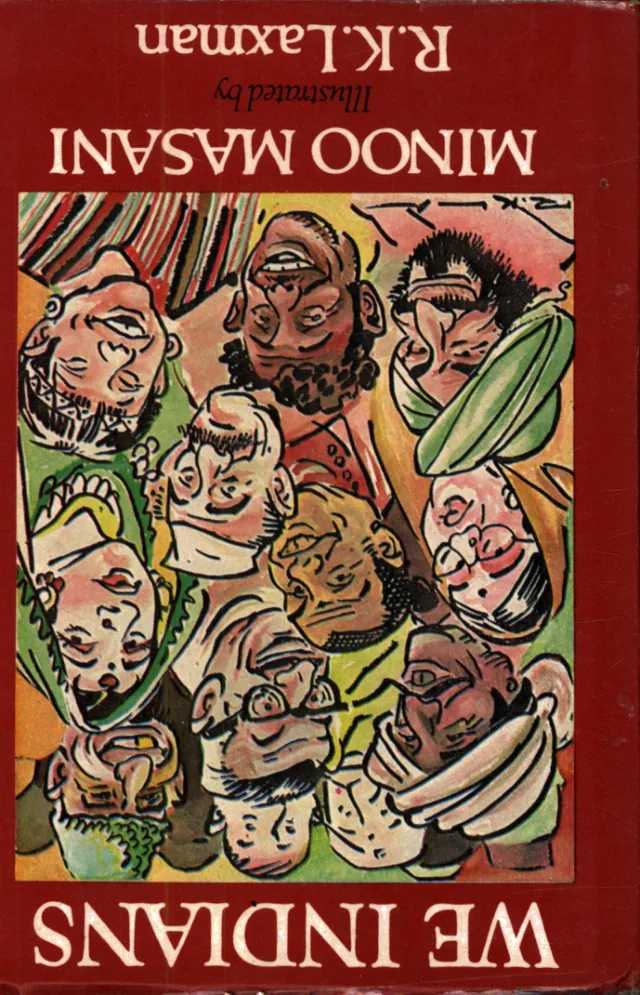
WE INDIANS
Summary
We Indians is a short illustrated book for young readers, written by Minoo Masani and illustrated by R. K. Laxman, published by Oxford University Press in Bombay in 1989. It is the companion to Masani’s earlier children’s book Our India. The preface explains why it exists. Our India could not simply be revised, because its hope that India would flow with milk and honey once the foreign rulers left was a dream that had been lost, so Masani and his Oxford publisher began planning a companion volume instead. He shelved the project in 1963 under the pressure of his work as General Secretary of the Swatantra Party and as an MP, and finished it a quarter of a century later. The 21 chapters fall into three movements. Chapters 1 to 9 are a quick, plainly told account of where Indians come from: race, language and religion, then the family, the village, the city and the ancient kingdoms and republics. Chapters 10 to 12 are an audit of the country, followed by an argument for a reformation and a renaissance. Chapters 13 to 21 are short moral lessons addressed directly to the child.
The opening chapters take apart the idea of racial purity. Masani separates race from nationality and from language, calls the ‘Aryan race’ a myth and an error that Max Muller later retracted, and cites Julian Huxley and a UNESCO study to argue that all great nations are melting pots. He then sketches the Caucasian, Dravidian, Mongoloid and Scythian strands in the Indian population with Risley’s seven types and a lively account of Dravidian and Indus Valley civilization. He rejects the view that Caucasians brought civilization to India, and describes the later arrival of Greeks, Huns, Jews, Parsis, Christians and Muslims, while admitting repeatedly that he is simplifying and guessing. The chapters on religion, philosophy and languages cover the Vedic religion, Brahminism and the caste system, Buddhism and Ashoka, Jainism, Shankaracharya, the Upanishads, bhakti and Sikhism, and the poet-saints, whom he compares to the Protestants in Europe. The chapters on the family, the village, the city and the state present settled agriculture as the source of the patriarchal family, the village samiti as an early democratic body, and the ancient ganarajya republics, with elected kings who could be removed. Masani’s point is that democracy is an old Indian inheritance and not a recent import.
Chapter 10 asks whether Indians live up to that heritage and gives a frank balance sheet for roughly 1947 to 1987, with figures. In 1981 illiteracy stood at 68.3 per cent. About 273 million people, or 36.9 per cent of the population, were below the poverty line in 1984-85. Infant mortality was high and life expectancy low. The chapter also covers neglected agriculture and irrigation, radio and television that the government controls, a more lively press, and the continuing subordination of women, including a sati in Rajasthan in 1987. Masani praises Indian intelligence, entrepreneurship and industry, which he says advanced in spite of laws and policies that were extremely unhelpful, but he concludes as a management consultant that India has been badly managed. Chapter 11 says India needs a Reformation, which would loosen religious taboos, caste and untouchability and the rigid patriarchal family, and a Renaissance that would spread beyond a privileged few. Chapter 12 describes India as a nation in the making, praises mixed marriages, notes that Indians abroad do not mix, and expects the sovereign nation state to give way to world unity.
The later chapters turn didactic, as the book itself admits. Honesty (ch. 13) covers white lies, a Bob Hope film, and the corruption that Gandhi’s teaching on truth would have prevented. What Is a Commitment? (ch. 14) uses unpunctuality, Rajaji and Gandhi as models, Brazil’s ‘hora inglesa’ and Masani’s habit of sending late interview candidates away, and it criticises treating the Five Year Plans’ targets as achievements. Discipline (ch. 15) distinguishes imposed from self-imposed discipline, with examples from the Leslie Sawhny training centre, traffic and Parliament. Saying ‘No’ (ch. 16) treats dissent as the mark of a free person, attacks sycophancy (including the flattery that he says changed Nehru in office), and endorses Gandhi’s view that conscience outranks an unjust law. Work (ch. 17) denounces India’s many holidays and the short working year of government employees and calls for a work ethic. Too Many People (ch. 18) attacks population growth and proposes tax and promotion incentives, not force. Are You a Good Neighbour? (ch. 19) lists noise, rubbish and cleanliness, and The Golden Rule (ch. 20) asks readers to turn the searchlight inwards. The closing chapter, The Future Is Yours, is explicitly not meant to preach. Masani says his own generation has made such a mess of the country’s affairs that it has no right to preach to the young, which reads as a confession of that generation’s failure. After Rajaji’s story of the ADC who forgot to shave, he argues that Indians are talented but lack encouragement, opportunity and discipline and that envy has been glorified into a vice. He closes with a list of sayings attributed to Abraham Lincoln, such as ‘you cannot help the poor by destroying the rich’, and hands the future to the children. The book ends by asking them whether they will build it.
Notable passages
"No race is therefore ‘pure’, nor is any nation."
"So let us be grateful that we are a nation with many racial origins mixed in different proportions."
"Contrary to Hitler and some others, race is not really of much importance."
"If anyone tells you that they know who the original inhabitants of India were, don’t you believe it. Nobody really knows. We can only guess."
"It is a myth that it was the Caucasians who brought civilization to India when they came on the scene some 4000 years ago."
Metadata and summary are AI-extracted from the source PDF and reviewed for editorial accuracy. The original work is available via the Read PDF tab above (where present); paragraph-level citation inside the PDF is deferred to a future engagement.