Summary
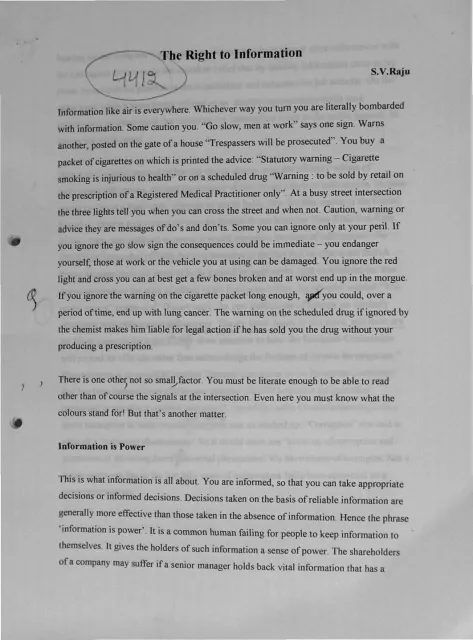
In the rendered pages, S. V. Raju argues that access to information is essential to informed decision-making, accountable government, democratic participation, and effective local self-government. He connects the right to information to literacy: citizens must be able to read, understand, and use the information that surrounds them. The essay contrasts India’s weak and fragmented legal arrangements with examples from the United States, where public reports are generally available on request, and with the need for a stronger central Freedom of Information law in India.
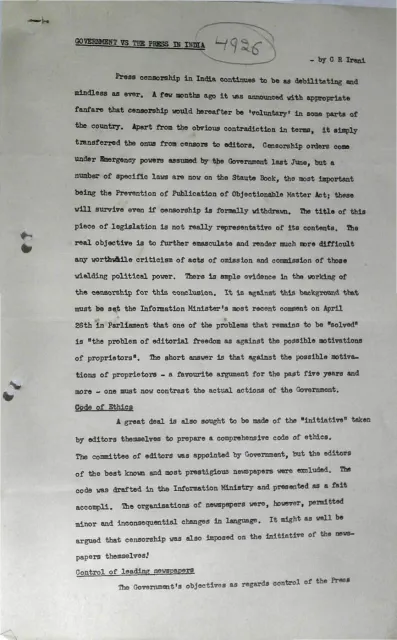
In the rendered pages, Raju criticises state secrecy, official control of All India Radio and Doordarshan, press censorship during the Emergency, the Official Secrets Act, and government attempts to influence newspapers through newsprint and advertising. He discusses the proposed Freedom of Information Bill, the relationship between privacy and disclosure, the role of voluntary organisations and the women of Rajasthan in securing information, and the importance of publishing audit reports. The conclusion returns to literacy and information technology, arguing that information becomes power only when it leads to knowledge and action.
Key points
- Information is presented as a precondition for knowledge, action, informed decisions, and democratic participation.
- Literacy is necessary for citizens to interpret and use the information available around them.
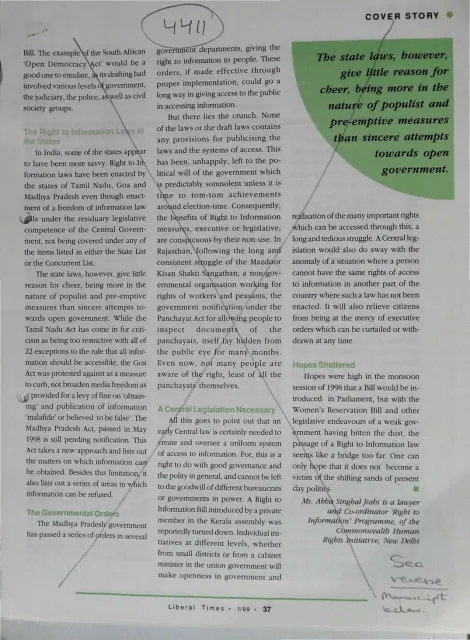
- The state-level right-to-information laws discussed are portrayed as restrictive, poorly publicised, or weakly implemented.
- The essay calls for central legislation establishing a uniform and enforceable system of access to government information.
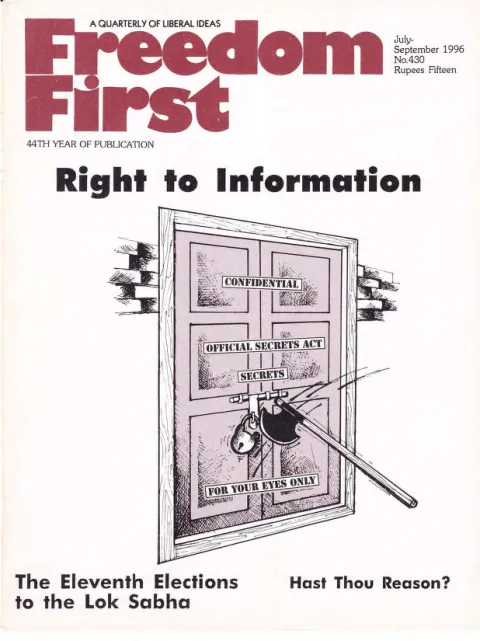
- State monopolies over broadcasting, press censorship, and the Official Secrets Act are criticised as instruments of secrecy and political control.
- The United States Freedom of Information Act is offered as a contrasting example of public access to government reports.
- Privacy is treated as the necessary counterpart to the right to information, especially when information concerns individuals.
- Citizen groups, voluntary organisations, local bodies, and information technology are presented as resources for improving transparency and accountability.
Metadata and summary are AI-extracted from the source PDF and reviewed for editorial accuracy. The original work is available via the Read PDF tab above (where present); paragraph-level citation inside the PDF is deferred to a future engagement.