Summary
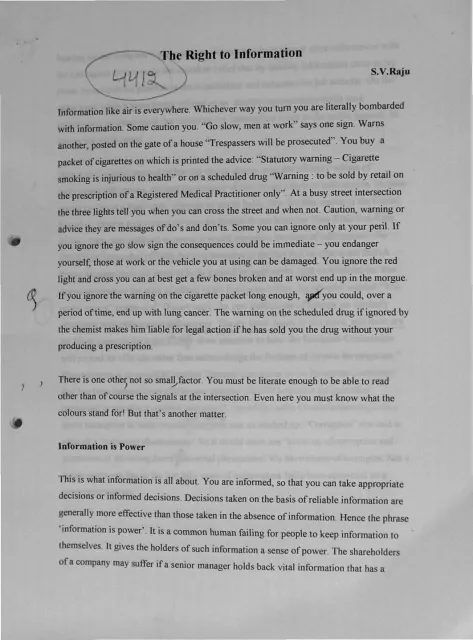
In the rendered pages, S. V. Raju presents access to information as a practical precondition for individual safety, informed choice, and democratic citizenship. Everyday warnings and signals illustrate that information only becomes useful when people can read and understand it; literacy, therefore, is treated as a necessary foundation of the right to information. The essay then argues that information confers power, and that withholding it can harm shareholders, employees, citizens, and the public good. Raju consequently frames a citizen’s right to information as a safeguard against arbitrary secrecy by officials and institutions.
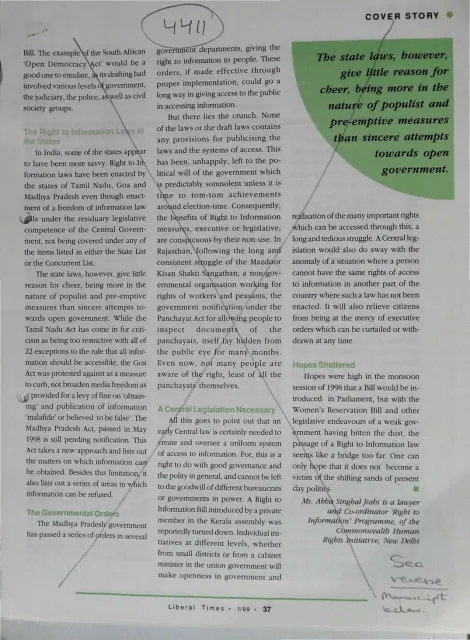
In the rendered pages, the argument turns to the relationship between information, free speech, and media freedom. Raju criticises the state monopoly over All India Radio and Doordarshan, describes governmental pressure on the press, and recalls the Emergency-era censorship that deprived Indira Gandhi’s government of honest feedback. He discusses a proposed Freedom of Information Bill, compares India’s position with the United States Freedom of Information Act, and links transparency to decentralisation, anti-corruption efforts, and judicial relief. The closing pages balance the right to information against privacy, arguing that both rights must be considered together, while urging civil society, voluntary organisations, television channels, and the internet to help citizens obtain information. The essay ends by returning to literacy: information is abundant, but it cannot function as a right unless people can read, interpret, and use it.
Key points
- Information is pervasive, but literacy and comprehension determine whether people can act on it.
- Withholding information creates power imbalances and can damage both private organisations and the public good.
- A citizen’s right to information is presented as a legal and democratic protection against arbitrary secrecy.
- State control of All India Radio and Doordarshan, press pressure, and censorship are described as barriers to informed public participation.
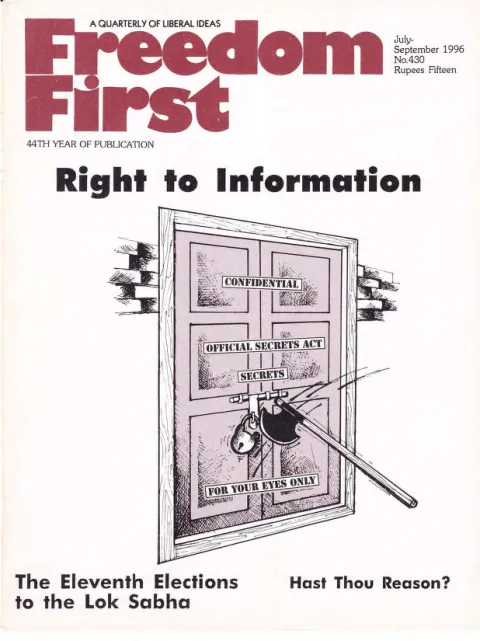
- The proposed Indian Freedom of Information Bill is presented as a possible replacement for or constraint on the Official Secrets Act.
- The United States Freedom of Information Act is offered as a comparative example of government disclosure on citizen request.
- Transparency is connected to decentralisation, public auditing, anti-corruption, environmental concerns, and access to courts.
- The right to information must be balanced with privacy, while education remains necessary for citizens to exercise either right meaningfully.
Metadata and summary are AI-extracted from the source PDF and reviewed for editorial accuracy. The original work is available via the Read PDF tab above (where present); paragraph-level citation inside the PDF is deferred to a future engagement.