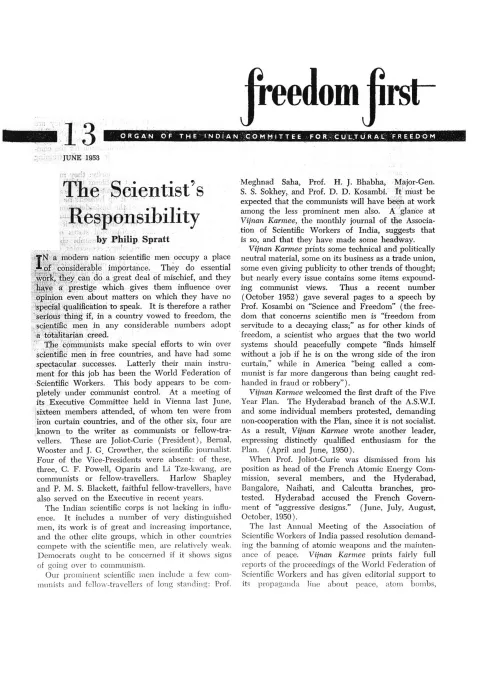
periodical issue
Freedom First
Edited by Faiz S. Noorani; printed & published by Prabhakar Padhye at The Kanoda Press, 109 Parsi Bazaar Street, Bombay 1. · Bombay · 1954
12 pages
Freedom First
Summary
This is issue No. 24 (May 1954) of Freedom First, the monthly bulletin of the Indian Committee for Cultural Freedom (affiliated to the Congress for Cultural Freedom / World Movement for Cultural Freedom), edited by Faiz S. Noorani and printed and published by Prabhakar Padhye at The Kanada Press, Bombay. In the rendered pages, the issue opens with Padhye’s lead essay defending the Committee against charges of being a pro-American or Western stooge organisation, arguing instead that its anti-totalitarian stance is dictated by principle rather than any ‘moral neutralism’ between free and communist societies. This is followed by a Notes section commenting on the hydrogen bomb controversy and the Soviet-aligned Women’s International Democratic Federation; short pieces on the Colombo Conference, famine in China, cooperative-movement jubilee celebrations, Jayaprakash Narayan’s turn to Bhoodan, C. Rajagopalachari’s political future, and a complaint about pro-communist reporting in the Times of India; a literary essay on W. H. Auden by Yatin Gaznavi; an extract from Dr. James T. Shotwell’s poem ‘The Way’ read at the dedication of the Carnegie Endowment International Center; a books/review section covering works on Soviet forced labour and worker coercion, a report titled ‘Communist Conspiracy At Madurai’, and brief notices of several other books and the journal Encounter; the American Committee for Cultural Freedom’s May Day statement; C.C.F. News notes on international activities; the continuation of Padhye’s opening essay; and a closing page, ‘With Many Voices’, collecting contemporary press quotations on communism, Cold War alignment, and Indian politics, alongside a membership enrolment form for the Indian Committee for Cultural Freedom.
Key points
-
Prabhakar Padhye’s lead essay rebuts the charge that the Indian Committee for Cultural Freedom is a Western/American stooge organisation, arguing its criticism of Indian “moral neutralism” reflects principle, not pro-American bias, and noting the Committee declined financial contributions from the Paris-based international movement.
-
The “Notes” section argues Soviet objections to US hydrogen bomb tests are opportunistic, and reports the UN’s withdrawal of consultative status from the Communist-aligned Women’s International Democratic Federation.
-
Further notes discuss the Colombo Conference, an officially admitted Chinese famine affecting roughly 200 million people, and honour Jayaprakash Narayan’s renunciation of Marxism for Vinoba Bhave’s Bhoodan Yagna movement.
-
Yatin Gaznavi’s “W. H. Auden: A View” surveys Auden’s poetry on his 1953 Bollingen Prize, arguing he uniquely absorbed Freudian and Groddeckian psychoanalysis rather than merely adopting fashionable posture.
-
Dr. James T. Shotwell’s poem “The Way,” read at the Carnegie Endowment International Center’s dedication, calls for global unity and justice transcending national loyalties.
-
Zafar Futehally reviews two David Rousset pamphlets on Soviet police-state and forced-labour methods, and a review of “Communist Conspiracy At Madurai” describes a secret CPI “Tactical Line” document proposing violent overthrow disguised as a “Government of Democratic Unity.”
-
The American Committee for Cultural Freedom’s May Day statement calls for lifting the Iron Curtain while affirming it is “morally monstrous” to equate American conditions with Soviet totalitarianism.
Essays
The Committee And America
By Prabhakar Padhye
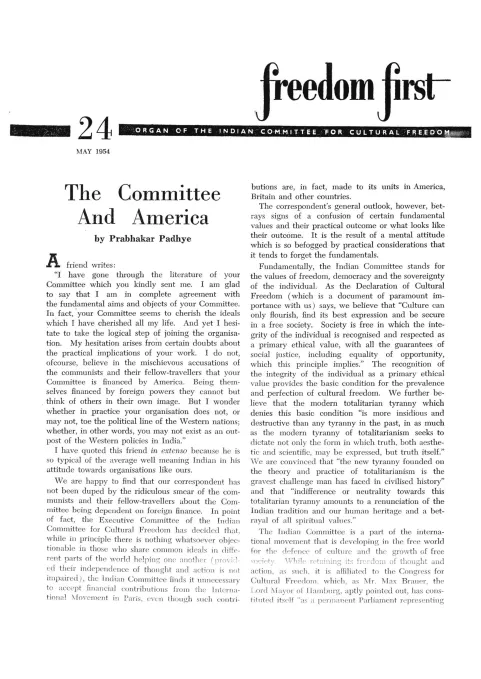
Prabhakar Padhye’s lead article responds to a reader who, while sympathetic to the Indian Committee for Cultural Freedom’s aims, worries the organisation may function as a Western/American policy outpost. Padhye rebuts the charge, explains that the Committee declined financial contributions from the international movement in Paris even though such aid would have been unobjectionable in principle, and sets out the Committee’s core commitment: freedom, democracy, and the ‘sovereignty of the individual’ as expressed in the Declaration of Cultural Freedom. He argues that modern totalitarianism is more insidious than any past tyranny because it seeks to dictate not just how truth is expressed but truth itself, and that the Committee judges issues by their bearing on this world struggle rather than by narrow national or pro-Western allegiance. The essay’s continuation (rendered on page 11) argues that India’s ‘moral neutralism’-refusing to judge between the moral and immoral in international affairs-betrays the legacy of Mahatma Gandhi, who, despite opposing violence, never withheld moral judgment from the Axis powers during the Second World War. Padhye contrasts this with what he sees as contemporary India’s selective outrage (protesting the non-admission of Red China to the U.N. while staying silent on Ceylon and Japan) and insists the Committee’s criticisms of neutralist policy are not anti-American but a defence of universal democratic values against a national malaise of moral indifference.
- Padhye responds to a reader’s suspicion that the Indian Committee for Cultural Freedom is a covert instrument of Western/American policy.
- The Committee’s Executive Committee declined financial contributions from the Paris-based International Movement even though accepting them would not, in principle, have been objectionable.
- The Committee’s foundational commitment, per the Declaration of Cultural Freedom, is to the ‘integrity of the individual’ as a primary ethical value and to a free society as the precondition for cultural flourishing.
- Modern totalitarianism is framed as uniquely dangerous because it seeks to dictate not only the expression of truth but truth itself.
- The Committee is affiliated with the Congress for Cultural Freedom, described (quoting Hamburg’s Lord Mayor Max Brauer) as a ‘permanent Parliament’ of the free world’s spirit.
- The Committee criticizes Indian ‘moral neutralism’-illustrated by the U.N. Forced Labour Report controversy-as a betrayal of the Gandhian tradition of moral judgment, not a sign of pro-American bias.
- Padhye contrasts India’s outrage over China’s U.N. exclusion with its silence on Ceylon’s and Japan’s non-admission, attributing the asymmetry to the Soviet veto and a biased ‘apparatus of thought’ in the External Affairs Ministry.
Notes (The H. Bomb Racket; Women Dupes of the Communists)
A short editorial ‘Notes’ section. ‘The H. Bomb Racket’ argues that international communist-led protests against U.S. hydrogen bomb testing are hypocritical, contending the Soviets themselves raced to develop the bomb and only began complaining once the U.S. pulled ahead technologically; it cites reported Soviet budget cuts to hydrogen bomb research as evidence the USSR quietly abandoned the weapon as impractical, and blames the Kremlin’s obstruction of U.N. atomic-inspection powers for the ongoing arms danger. ‘Women Dupes of the Communists’ reports the U.N. Economic and Social Council’s withdrawal of consultative status from the Women’s International Democratic Federation (W.I.D.F.) for anti-U.N. propaganda, links the W.I.D.F. and the Indo-Soviet Cultural Society to Cominform front operations, and warns Indian women being courted for a ‘Goodwill Delegation’ to Moscow that they risk serving Communist Party interests.
- The piece argues Soviet and communist objections to U.S. hydrogen bomb tests are opportunistic, mirroring the earlier Stockholm Peace Appeal against the atom bomb when the USSR lagged behind.
- It claims reports show the Soviet cabinet slashed hydrogen bomb development spending by 3,820 million roubles between December 20-29 of the prior year, diverting resources to cosmic ray research.
- It blames the Soviet government for blocking an effective International Atomic Energy Commission with real inspection powers, calling this the root of ongoing nuclear danger.
- The W.I.D.F. lost its U.N. consultative status by a 10-3 vote for ‘spreading propaganda against the U.N. and its work.’
- The Indo-Soviet Cultural Society, headed by Dr. A. V. Baliga, is identified as successor to the banned ‘Friends of the Soviet Union’ and accused of recruiting Indian women for Moscow ‘Goodwill Delegations’ as a Communist Party front operation.
- Mrs. Monica Felton, a Stalin Prize recipient, is cited as a W.I.D.F. spokesperson who visited India and defended communist conduct in Korea.
Test at Colombo / Famine in China / Dr. Matthai’s Reminder
A cluster of short editorial notes. ‘Test at Colombo’ discusses the retreat of French imperialism in Indo-China under U.S. pressure, praises Philippine President Magsayay’s linkage of Indo-China’s independence to Pacific Pact participation, and calls on the upcoming Colombo Conference of South Asian Prime Ministers to build a regional collective-security system rather than rely on outside powers. ‘Famine in China’ reports an officially admitted food shortage affecting roughly 200 million people (half of China’s population) and describes coercive state measures against peasants, arguing this disproves communist claims of having solved the agricultural problem. ‘Dr. Matthai’s Reminder’ praises Dr. John Matthai’s presidential address to the Indian Institute of Science warning against a purely utilitarian, vocational approach to education that neglects the humanities.
- French imperialism is described as being forced, under U.S. persuasion, to release its grip on Indo-China, with lingering effects still visible in Tunisia and Pondicherry.
- The piece calls for South and South-East Asian nations to form their own regional collective-security system at the Colombo Conference rather than rely on outside intervention.
- China’s food shortage is reported at 200 million people affected (half the population), per the official New China News Agency, with coercive measures against peasants including bans on private grain trading.
- Dr. John Matthai warns that science education alone risks producing ‘spiritual ignorance and poverty’ without a parallel grounding in the humanities and a sense of values.
Co-operative Movement / Jeevan Dan / Rajaji’s Future Role / Fostering Asian Discord
Further short notes. ‘Co-operative Movement’ marks the cooperative movement’s golden jubilee, inaugurated by the Prime Minister in Bombay, praising cooperatives as a ‘new way of life’ distinct from both competitive free enterprise and state control, while noting the movement remains underdeveloped in production and distribution. ‘Jeevan Dan’ pays tribute to Jayaprakash Narayan’s renunciation of Marxism (referencing his 1952 Freedom First article ‘Incentives For Goodness’) and his dedication to Vinoba Bhave’s Bhoodan Yagna land-gift movement. ‘Rajaji’s Future Role’ reflects on C. Rajagopalachari’s retirement as Chief Minister of Madras, expressing confidence he will remain influential in public life. ‘Fostering Asian Discord’ criticizes correspondent G. K. Reddy of the Times of India for derogatory and pro-communist reporting on Far Eastern affairs, noting a formal protest from the Philippines’ Minister Plenipotentiary in India.
- The cooperative movement, celebrating its golden jubilee (fifty years), is praised as a middle path between free enterprise and state-controlled economic life, though still confined mainly to credit supply rather than production or distribution.
- Jayaprakash Narayan is honored for renouncing Marxism (‘that “False Goddess” of Dialectical Materialism’) and dedicating himself to Vinoba Bhave’s Bhoodan Yagna movement; Dada Dharmadhikari renamed the All India Sarvodaya Sammelan in Bodh Gaya as ‘Jayaprakash Sammelan’ in his honor.
- C. Rajagopalachari’s retirement from Madras chief ministership is treated as a loss to public life, with the Manchester Guardian quoted on his stature.
- G. K. Reddy, Delhi correspondent for Blitz and a Times of India contributor, is accused of pro-communist bias and derogatory coverage of Asian affairs, prompting a formal protest from the Philippines’ diplomatic representative in India.
W. H. Auden: A View
By Yatin Gaznavi
Yatin Gaznavi’s literary essay, written on the occasion of W. H. Auden receiving the 1953 Bollingen Prize in Poetry, surveys the intellectual background and technical range of Auden’s poetry. Gaznavi traces the ‘thirties’ generation’s ambivalent debt to Marx and Freud, arguing Auden was exceptional among his contemporaries for genuinely absorbing psychoanalytic ideas (citing his acknowledged debt to Freud and Groddeck) rather than merely adopting a fashionable posture. The essay discusses Auden’s 1930 poetry collection as a landmark that helped spawn the New Signatures anthology group in 1932, his stylistic range across cabaret jazz rhythms, ballad forms, and iambic metre, and his eventual return to Anglo-Catholicism. It closes by examining Auden’s distinctive, unsettling use of childhood/nursery-rhyme imagery compared to de la Mare and Edith Sitwell, arguing that for Auden childhood symbols reflect buried terror rather than Victorian wholesomeness.
- Gaznavi questions whether ‘thirties’ poets truly absorbed Marx and Freud or merely constructed generalized pictures of them, as the Elizabethans did with Machiavelli.
- Auden is singled out as the exception who shows a ‘profound and thorough knowledge of psycho-analysis’ and explicitly acknowledged debts to Freud and Groddeck.
- The 1930 publication of Auden’s poems is called a landmark that gave rise to the New Signatures anthology group (1932) and jolted a moribund Georgian poetic tradition.
- Auden’s technical range is praised across cabaret jazz rhythm, ballad, and iambic metre, with his early social-criticism poetry still holding up as ‘readable’ and ‘delightful.’
- By 1941 Auden’s poetry shows him ‘eagerly in search of an absolute,’ alongside his later return to Anglo-Catholicism.
- Auden’s use of nursery-rhyme and childhood imagery is contrasted with de la Mare and Sitwell: for Auden childhood symbols are ‘reflections from a world of terror and mystery,’ not merely ‘wholesome.‘
The Way
By Dr. James T. Shotwell
An extract from Dr. James T. Shotwell’s poem ‘The Way,’ read by Sir Cedric Hardwicke at the dedication of the Carnegie Endowment International Center in New York on October 19, 1953. The poem calls for global unity, justice, and a world order that transcends national loyalties and the ‘ancient right of war,’ invoking Biblical imagery (the Sermon on the Mount, Jerusalem) and the Golden Rule as the true foundation for lasting peace, and warns that neither wishful thinking nor rigid enforced law alone can secure it.
- The poem was read by Sir Cedric Hardwicke at the dedication of the Carnegie Endowment International Center in New York, October 19, 1953.
- It frames humanity’s central task as uniting ‘variant breeds’ under justice while banishing war and violence.
- It invokes the Sermon on the Mount (‘a sunlit mount by a sea’) as the essential guidance for building a safe and free world.
- It states the Golden Rule as the ‘missing fulcrum’ needed to lift the weight of ancient hatred.
- It cautions that peace cannot be achieved by wishful thinking or by rigid law enforced by a world police alone, but requires nations to surrender the ‘ancient right of war’ by joint consent.
Review: Police State Methods in the Soviet Union / Coercion of the Worker in the Soviet Union
By Zafar Futehally
The Review section. Zafar Futehally reviews two Beacon Press pamphlets by David Rousset (distributed by Popular Book Depot, Bombay)-‘Police State Methods in the Soviet Union’ and ‘Coercion of the Worker in the Soviet Union’-prepared by the International Commission against Concentration Camp Practices. The review stresses that Soviet tyranny is disturbing precisely because it operates through law rather than lawless abuse of power, detailing the G.P.U./N.K.V.D.’s judicial powers since 1934 and USSR labour laws restricting workers’ job mobility, especially in ‘Key Industries.’ A second review covers ‘Communist Conspiracy At Madurai’ (Democratic Research Service, Popular Book Depot), a report on the Communist Party of India’s Third Congress at Madurai, which is said to reveal internal Party divisions and a secret ‘Tactical Line’ document proposing a peasant-and-worker-led violent overthrow of the established order disguised as a ‘Government of Democratic Unity.’ The page also carries brief notices (‘Books in Brief’ and short reviews) of The Ontology of Existence by Michael Wyschogrod, Encounter issue 7, and works including The Diaries of Lewis Carroll, James Laver’s The First Decadent (on Huysmans), Basil Taylor’s The Impressionists And Their World, Philip Woodruff’s The Founders, and Max Scheler’s The Nature of Sympathy.
- Rousset’s pamphlets argue Soviet tyranny is especially troubling because it is grounded in and conforms to the country’s own laws, not merely abuse of power.
- The review traces the G.P.U./N.K.V.D. secret police’s arrogation of Supreme Court-like functions since 1934 and Soviet labour laws restricting worker mobility, job assignment, and promotion, especially in ‘Key Industries.’
- ‘Communist Conspiracy At Madurai’ is presented as revealing sharp internal divisions within the CPI up to its politburo, and a secret tactical document proposing peasant/worker-led violent revolution under the guise of a ‘Government of Democratic Unity.’
- R. Ramamurti’s reply to Dr. Jaisooriya (P.D.F. leader in Hyderabad), accusing him of ‘imperialist’ and ‘anti-communist slander’ rhetoric, is cited as evidence of the CPI’s international loyalties.
- Brief notices cover Michael Wyschogrod’s The Ontology of Existence (on Heidegger and Kierkegaard’s influence on modern ontology), Encounter issue 7 (praising Woodrow Wyatt on Churchill and an Auden guest editorial), and various other new books in brief.
Communist Conspiracy At Madurai
By Mukkanna
The American Committee for Cultural Freedom’s May Day statement (prepared by an ad hoc subcommittee of James T. Farrell, Norbert Muhlen, and William Phillips) reaffirms faith in freedom and calls for lifting the Iron Curtain, liberating political prisoners, and restoring freedoms of opinion, speech, worship, assembly and strike everywhere, while insisting that criticizing conditions in America itself is compatible with the moral case against Soviet totalitarianism. A following ‘C.C.F. News’ column reports on Congress for Cultural Freedom activities: an International Music Conference in Rome (April 4-15) with composers including Auric, Dallapiccola, Malipiero, Petrassi, and Stravinsky; American Committee discussion forums featuring Norman Thomas, Sidney Hook, and W. H. Auden among others; a $1000 award for the best manuscript on ‘Cultural Freedom’; the Madras Group’s celebration of ‘T.K.C. Day’ honoring T. K. Chidambaratha Mudaliar; an informal function honoring short-story prize winners Gangadhar Gadgil and Chunilal Madia; and a visit to India by David Rousset and Professor Balachowsky of the International Commission Against Concentration Camp Practices, who addressed meetings in Calcutta, Benares, Delhi and Bombay.
- The American Committee’s May Day statement calls for lifting the Iron Curtain, free exchange of ideas, and liberation of political prisoners, while affirming it is ‘morally monstrous’ to equate conditions in America with those under Soviet totalitarianism yet also acknowledging ‘dangerous and repressive tendencies’ exist in all countries including the U.S.
- The Congress for Cultural Freedom organised an International Music Conference in Rome (April 4-15) on ‘Music in the XXth Century’ with composers including Auric, Dallapiccola, Malipiero, Petrassi, Roland Manuel, Sanget, and Stravinsky.
- American Committee discussion forums included participants Norman Thomas, George S. Counts, Harry Schwartz, Bertram D. Wolfe, Sidney Hook, and W. H. Auden.
- The Madras Group of the I.C.C.F. celebrated ‘T.K.C. Day’ honoring Tamil poet T. K. Chidambaratha Mudaliar, with tributes from R. Krishnamurthy (Kalki), P. Acharya, and Somasundaram.
- David Rousset and Professor Balachowsky of the International Commission Against Concentration Camp Practices visited Calcutta, Benares, Delhi, and Bombay, addressing meetings including under the Alliance Francaise, Indian Council of World Affairs, and Praja Socialist Party auspices.
The Ontology Of Existence (review)
By R. H.
The closing page, ‘With Many Voices’ (epigraph from Tennyson), is a compilation of contemporary press quotations on communism, Cold War alignment, and Indian politics, drawn from sources including the Hindustan Times, Blitz, the Eastern Economist, Free Economic Review, Free Press Bulletin, Times of India, The Hindu, The New Age, Indian Express, Dawn, and Janata (all dated February-April 1954). Quoted figures include Deputy Minister Raj Bahadur on Communist Party loyalty screening, R. K. Karanjia on demands for a hawkish foreign policy toward Goa, Pondicherry, and China, U.S. Secretary of State Dulles, Sir John Kotelawala of Ceylon on fearing Communist Party bribery and on democracy’s vulnerabilities, Jayaprakash Narayan comparing Chinese land reform unfavourably to MacArthur’s land reform in Japan, and Morarji Desai on dealing with Red Flag protesters. The page ends with a membership enrolment form for the Indian Committee for Cultural Freedom and the issue’s colophon naming Faiz S. Noorani as editor and Prabhakar Padhye as printer/publisher at The Kanada Press, Bombay.
- The page compiles press quotations from a range of Indian and international outlets (Feb-Apr 1954) on communism, Cold War policy, and domestic politics.
- Sir John Kotelawala of Ceylon is quoted twice: fearing Communist Party bribery of Sri Lankan citizens, and criticizing democracy’s vulnerability to abuse of freedom.
- Jayaprakash Narayan is quoted (from The New Age) telling a Gaya Bhoodan meeting that Chinese land reform was ‘no match’ to Japan’s land reform carried out under MacArthur.
- Morarji Desai is quoted threatening Red Flag protesters who disrupted his meeting.
- The issue’s colophon identifies Faiz S. Noorani as editor and Prabhakar Padhye as printer and publisher, at The Kanada Press, 109 Parsi Bazaar Street, Bombay 1.
- A membership enrolment form for the Indian Committee for Cultural Freedom (127 Mahatma Gandhi Road, Bombay 1) appears alongside the quotations, listing an annual fee of Rs. 3/-.
Generated by the v1.5 extraction pipeline. Awaiting editorial review.
Metadata and summary are AI-extracted from the source PDF and reviewed for editorial accuracy. The original work is available via the Read PDF tab above (where present); paragraph-level citation inside the PDF is deferred to a future engagement.