periodical issue
Freedom First
No. 87 — August 1959
Edited by V. B. Karnik and printed at Inland Printers, 55 Gamdevi Road, Bombay 7 and published for the Democratic Research Service by B. K. Desai at 127 Mahatma Gandhi Road, Bombay 1. · Bombay · 1959
12 pages
Freedom First
Summary
This is issue No. 87 of Freedom First (August 1959), the classical-liberal monthly edited by V. B. Karnik and published for the Democratic Research Service in Bombay. The issue is dominated by the political crisis in Communist-ruled Kerala: Philip Spratt’s lead essay ‘Communism Without Dictatorship’ offers an extended, first-hand account of the anti-Communist agitation (the ‘liberation struggle’ against the E. M. S. Namboodiripad ministry), tracing the government’s early popularity, the Education Bill controversy, party-cell corruption, and the mounting opposition campaign, and concludes that a communist government cannot rule India without either resorting to dictatorship or collapsing under mass resistance. A companion feature, ‘With Many Voices’, assembles contemporary newspaper and political quotations (Nehru, Indira Gandhi, Khrushchev, K. M. Munshi, Mannath Padmanabhan and others) largely on the same Kerala crisis and on Sino-Indian relations. The issue also carries an early analytical piece on the newly formed Swatantra Party by the pseudonymous ‘Apaksha’, weighing its promise against its ideological vagueness and its uneasy synthesis of Forum of Free Enterprise economics with Gandhian Sarvodaya language; a legal-constitutional essay by A. Ranganathan on the erosion of the right to property under Article 31 amendments; a foreign-affairs report by French journalist Robert Guillain on the origins of the Chinese people’s communes and Mao Tse-tung’s political manoeuvring around them; and the concluding half of Hemalata Acharya’s field-study essay on co-operative farming societies in Nasik district, Gujarat and elsewhere, which argues for a pragmatic, non-doctrinaire approach to co-operative farming rather than treating it as an ideological cure-all.
Key points
-
Philip Spratt’s “Communism Without Dictatorship” reports from Kerala on the “liberation war” against the Namboodiripad ministry, tracing its Education Bill controversy and Communist Party “cells” allegedly running a parallel administration, and concludes a communist government cannot function constitutionally without exercising terror.
-
Writing as “Apaksha,” an essay on the newly formed Swatantra Party praises its Gandhian anti-statist programme and leadership under Rajaji and Masani, while judging its synthesis of Forum of Free Enterprise economics with Sarvodaya trusteeship incoherent given big business’s poor record of honouring trusteeship.
-
A. Ranganathan’s “The Right To Property” argues India’s Constitution lacks an American-style Due Process Clause, and that the April 1955 amendment removing judicial review of compensation adequacy leaves private enterprise vulnerable to appropriation “at any price it desires.”
-
Robert Guillain’s report affirms Mao Tse-tung’s personal authorship of China’s people’s communes despite the Central Committee’s collectively-signed decision, detailing the disorganisation and failed blast-furnace campaigns that followed and Mao’s subsequent, still-unresolved succession as President.
-
Hemalata Acharya concludes her field study of co-operative farming societies in Nasik district, finding a Tenant Farming Society succeeded where members had independent means while Collective Farming Societies largely failed from scattered plots and absentee members, concluding co-operative farming is “good in parts” rather than a panacea.
-
The closing “With Many Voices” quotes K. M. Munshi criticising the use of Section 144 in Kerala as evidence communists are uninterested in genuine order, and Mannath Padmanabhan demanding communists be barred from contesting elections elsewhere in India.
Essays
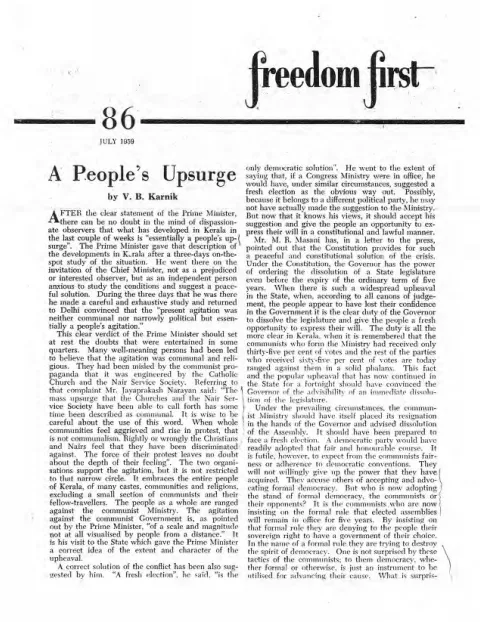
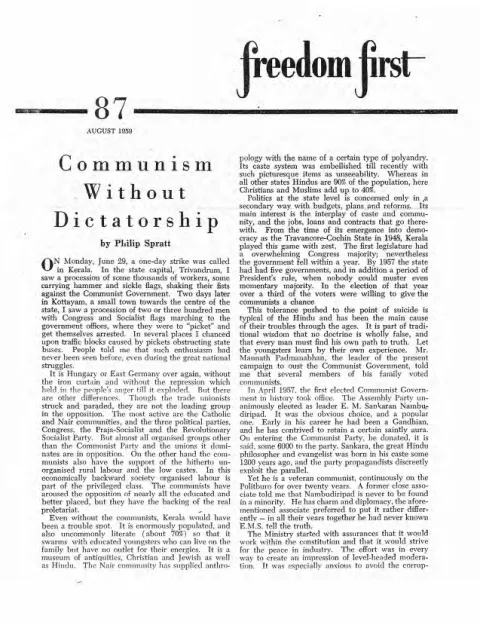
Communism Without Dictatorship
By Philip Spratt
Philip Spratt reports from Kerala on the anti-Communist agitation against the E. M. S. Namboodiripad government, elected in April 1957. He describes processions and strikes in Trivandrum and Kottayam, situates Kerala’s instability in its caste and communal politics (Nair and Catholic communities, high literacy, educated unemployment), and narrates the ministry’s early moderation, its release of prisoners and pay rises for lower-grade employees, and its 1958 by-election victory at Devikolam despite Congress mobilisation. He then traces the turn: failure to win over organised labour (dominated by Congress-aligned INTUC and the Revolutionary Socialist Party unions), stagnant food production, the Education Bill (which threatened private, mostly Christian and Hindu-managed schools’ control over staffing and fees), and the resulting ‘liberation war’ (vimochana samara) uniting Christian, Nair (via the Nair Service Society under Mannath Padmanabhan) and Congress opposition. The essay’s second half (continued on pages 10-11) documents financial scandals, the Andhra rice deal, and the Communist Party’s parallel administrative ‘cells’ which Spratt says have supplanted courts and civil administration in many areas, extracting fees and quashing prosecutions of party members; he cites comparisons to Djilas’s The New Class. He closes arguing the episode proves a communist government cannot function within a parliamentary/constitutional framework without exercising terror against opponents, but that Namboodiripad’s inability to exercise terror against his own followers (to curb cell corruption and violence) is what is bringing the ministry down.
- Kerala’s political instability (five governments in nine years, president’s rule) predates the Communists and stems from caste/communal fragmentation, not ideology alone.
- The Namboodiripad ministry initially built popularity via prisoner releases, pay hikes for junior staff, and police non-intervention in strikes, capped by the May 1958 Devikolam by-election win.
- The ministry failed to make headway with organised labour, which remained loyal to Congress-run INTUC and Revolutionary Socialist Party unions.
- The Education Bill (transferring fee collection and staffing power from private, mostly Christian-run schools to the state) triggered a cross-communal ‘liberation war’ joining Christian, Nair, and Congress opposition.
- Party financial scandals (Rs. 25 lakhs collected in a year; the Andhra rice deal judicial inquiry) undercut the Communists’ claimed ascetic integrity.
- Communist Party ‘cells’ are alleged to run a parallel administration nationwide in Kerala, demanding fees, quashing prosecutions of communists, and being tied to instances of violence and reported killings.
- Spratt concludes a communist government cannot govern constitutionally in India without either using terror on its opponents or collapsing under resistance to terror used by its own rank and file.
Swatantra Party
By “Apaksha”
Writing under the pseudonym ‘Apaksha,’ the author assesses the newly formed Swatantra Party as answering a genuine public appetite for a democratic alternative to Congress rule, appealing especially to the ‘middle class and small man’ against rising bureaucratisation, taxation, and the ‘cult of statism.’ The party’s programme is anti-statist without being anarchist, aiming to guide and regulate rather than abolish or ignore the state, and its leadership (Rajaji, Ranga, Masani, Mody, and others) is praised for integrity and independence. But the essay identifies serious drawbacks: an unresolved tension between defending private property/big business and appealing to the common man; a vague, contradiction-riddled statement of principles indistinguishable from other democratic parties’; visible disagreement among its own leaders (e.g., Rajaji versus Ranga on electoral strategy, and divergent views on Kerala and foreign policy); and an awkward attempt to synthesise Forum of Free Enterprise economic liberalism with Gandhian Sarvodaya/trusteeship rhetoric, which the author doubts is coherent given big business’s poor historical record of honouring trusteeship. The essay ends cautiously optimistic that if the party can tune its economic policy to ordinary people’s needs and develop a genuine labour policy, it could become a credible democratic alternative to Congress.
- The Swatantra Party’s formation answers dissatisfaction with Congress’s socialist drift, rising taxation, bureaucratisation, and nationalisation.
- Its programme appeals broadly (business, middle class, small man, peasant) and opposes ‘totalitarianism’ while explicitly rejecting an anarchist rejection of the state.
- Its leaders (Rajaji, Ranga, Masani, Mody, Cariappa and others) are praised for integrity, courage, and independence from vested interests.
- The party suffers from vague and self-contradictory statements of principle, indistinguishable from other democratic parties.
- Its attempted synthesis of Forum of Free Enterprise economics with Gandhian Sarvodaya/trusteeship ideas is judged incoherent, since big business (per Gandhiji’s own admission) has rarely honoured trusteeship in practice.
- Leaders visibly disagree among themselves, including Rajaji and Ranga on electoral tactics and the party on Kerala and foreign policy.
- The author concludes the party ‘holds out great promise’ if it can develop a genuinely pro-common-man economic and labour policy.
The Right To Property
By A Ranganathan
A. Ranganathan examines the erosion of the constitutional right to property in India, opening with Ivor Jennings’s characterisation of the Indian Constitution as an individualist document whose framers nonetheless thought partly in collectivist terms. He contrasts the American Constitution’s Due Process Clauses, which empower courts to restrain legislative and executive encroachment on property, with India’s lack of an equivalent, leaving property rights subject to parliamentary and executive discretion. He traces the original Article 31 guarantee against uncompensated deprivation of property, and the April 1955 amendment that removed judicial review of the adequacy of compensation, quoting Justice William O. Douglas’s comment that ‘India has broken with one tradition of the law of eminent domain.’ Ranganathan argues this leaves any private enterprise vulnerable to appropriation ‘at any price it desires,’ with compensation effectively set by the executive. He closes (continued from page 5 onto page 9) by linking property rights to individual freedom, invoking Locke, Turgot and Jefferson, and by arguing that Indian planners’ faith in socialism mistakenly equates it with a higher material standard of living, when in practice it produces a ‘gigantomania’ of state projects at the expense of consumer needs, citing the Nagpur resolution on co-operative farming and ‘controlling’ private-sector profits as instances of this drift.
- India’s Constitution lacks an American-style Due Process Clause, leaving property rights without the judicial protection given by the Fifth and Fourteenth Amendments in the US.
- The original Article 31 required authority of law and (in some cases) compensation for compulsory acquisition of property.
- The April 27, 1955 amendment to Article 31(2) removed courts’ ability to review the adequacy of compensation for acquired property.
- Justice William O. Douglas is cited as saying the 1955 Amendment casts a shadow over every private enterprise in India.
- Ranganathan argues this amendment effectively lets the executive fix compensation amounts with no judicial check, unlike the judicially safeguarded American system.
- He links property rights to individual freedom via Locke, Turgot, and Jefferson, arguing socialism’s equation with a higher material standard of living is a mistaken, even materialist, premise.
- He criticises the Nagpur resolution on co-operative farming and Congress Working Committee proposals to ‘control’ private-sector profits as further encroachments on individual economic freedom.
Chinese Communes And Mao Tse-tung
By Robert Guillain
French journalist Robert Guillain investigates the origins of China’s people’s communes and Mao Tse-tung’s role in launching them. He argues that although the Central Committee’s official August 29, 1958 decision formally endorsed the commune movement collectively (shielding Mao from personal blame should it fail), the extensive documentation, including a July Red Flag article by editor Cheng Po-ta, makes clear that Mao’s ‘paternity’ of the communes is undeniable: he had advocated fusing kolkhozes into larger units since 1956, personally toured Hopei, Honan and Shantung to promote the movement, and pushed through the decisive Second Session of the 6th Party Congress in May 1958 despite quiet resistance from more cautious colleagues. Guillain details the subsequent crisis: disorganisation, exhausted workers, failed blast-furnace targets, and the Quemoy bombardment fiasco, culminating in forty days of Central Committee deliberation at Chengchow and Wuhan (concluding December 10, 1958) that continued the communes but moderated their pace and, notably, replaced Mao as President of the Republic (though he retained Party leadership) while officially attributing this to the ‘burdens’ of state office. Guillain is skeptical of the official explanation, noting the long delay in naming and confirming Mao’s successor, ultimately resolved only in May 1959 with Liu Shao-chi’s emergence as the regime’s clear ‘Number Two.’
- Mao Tse-tung’s personal authorship of the commune policy is affirmed by internal Party documentation, notably a July 1958 Red Flag article by Cheng Po-ta, despite the Central Committee’s collectively-authored public decision of August 29, 1958.
- Mao had been advocating fusion of smaller kolkhozes into larger units since 1956, previewed in his preface to ‘The Rise of Socialism in the Countryside.’
- The decisive push came at the May 1958 2nd Session of the 6th Party Congress, where Mao’s speech (never published) set the new policy line.
- Implementing the communes required purges of provincial Party hierarchies resistant to the change, notably in the pilot province of Honan.
- By autumn 1958 the movement produced serious disorganisation: exhausted workers, failed blast-furnace campaigns, and disrupted exchange systems, compounded by the failed Quemoy bombardment.
- A forty-day Central Committee deliberation (Chengchow/Wuhan, ending Dec 10, 1958) continued the commune policy but moderated its pace, rehabilitated some 1957 ‘rightists,’ and stopped extending communes to towns.
- Mao’s decision not to stand for re-election as President of the Republic (retaining Party leadership) is treated skeptically by Guillain, who notes lingering uncertainty about his successor was resolved only in May 1959 with Liu Shao-chi’s emergence as ‘Number Two.‘
Co-operative Farming
By Hemalata Acharya
Hemalata Acharya concludes her two-part field study of co-operative farming societies (the first part having appeared in the previous issue). Drawing on a controlled Agricultural Institute experiment at Anand comparing four five-acre family farms with a 100-acre commercial farm, and on her own June 1957 visits to co-operative societies in Nasik district, she finds mixed results: family farming performs reasonably well when not hindered by organisational or technical constraints, a Tenant Farming Society in Niphad succeeded because its members had independent economic means, while Collective Farming Societies at Ambegaon and elsewhere largely failed due to scattered plots, absentee members, and lack of resources, though the Savargaon Society fared comparatively better despite lacking irrigation. She concludes co-operative farming is ‘good in parts’ rather than a panacea, warns against both doctrinaire promotion and doctrinaire rejection of it, and calls for decentralised, region-specific, pragmatic policy shaped by empirical study rather than ideology, closing with broader reflections on freedom, democracy, and the need to balance economic planning with individual initiative.
- An Agricultural Institute (Anand) controlled study found family farms are not inferior in economic potential to larger commercial farms when not hindered by organisational or technical handicaps.
- Acharya’s June 1957 field visits to Nasik district covered three Collective Farming Societies and one Tenant Farming Society.
- The Tenant Farming Society (whose members had independent economic means) succeeded, owning equipment and infrastructure and collecting rent from members.
- The Collective Farming Society at Ambegaon in Dindori largely failed due to scattered plots across two villages and disengaged membership.
- The Savargaon Collective Farming Society fared comparatively better but still lacked irrigation and adequate productive finance.
- Acharya concludes co-operative farming is ‘good in parts,’ not a cure-all, and warns that forcing collectivisation without addressing economic weakness produces low output, high wages, and distrust.
- She calls for pragmatic, decentralised, region-specific policy based on empirical research rather than doctrinaire commitment for or against co-operative farming.
Communism Without Dictatorship (continued from page 2)
By Philip Spratt
‘With Many Voices’ is a compilation feature (epigraph from Tennyson) gathering short newspaper and political quotations from the weeks around July 1959, chiefly on the Kerala Communist crisis and on Sino-Indian and Sino-Soviet relations following the Tibet uprising and the Quemoy affair. Contributors quoted include Nehru, Indira Gandhi, Nikita Khrushchev, K. M. Munshi, Mannath Padmanabhan, R. K. Karanjia, and several newspapers (Hindustan Times, Times of India, Amrita Bazar Patrika, Blitz, Malabar Herald), reflecting a range of establishment and press opinion on whether India can remain friendly with China, on Namboodiripad’s government, and on the use of Section 144 in Kerala.
- The feature compiles brief quotations from Indian and international newspapers and politicians dated June-July 1959.
- Quotes concern the Kerala Communist government crisis, the Sino-Indian relationship after Tibet, and the Quemoy/China situation.
- Nehru is quoted (Malabar Herald) arguing socialism in a poor country can only equalise poverty rather than produce real wealth.
- K. M. Munshi (Hindustan Times) criticises the use of Section 144 in Kerala as evidence communists are not interested in genuine prevention of disorder.
- Mannath Padmanabhan is quoted demanding the Centre bar communists from contesting elections elsewhere in India and drive the Communist Party out of the country.
Generated by the v1.5 extraction pipeline. Awaiting editorial review.
Metadata and summary are AI-extracted from the source PDF and reviewed for editorial accuracy. The original work is available via the Read PDF tab above (where present); paragraph-level citation inside the PDF is deferred to a future engagement.