periodical issue
Freedom First
By K. M. Munshi
published for the Democratic Research Service by R. K. Desai, [Mahatma Gandhi Road?], Bombay 1; printed at Inland Printers, 55 Gamdevi Road, Bombay 7 · Bombay · 1960
12 pages
Freedom First
Summary
This is the January 1960 issue (No. 92) of Freedom First, the Bombay-based monthly journal of the Democratic Research Service. The issue is dominated by anxiety over Chinese expansionism following the 1959 border clashes and the flight of the Dalai Lama, with the lead editorial, a Munshi essay, and a ‘With Many Voices’ compilation of Parliamentary and press statements all addressing the theme from different angles. Alongside the China-Tibet material, the issue carries notes on Eisenhower’s presidential visit to India, a report on Chinese pressure against Indonesia’s ethnic-Chinese trading minority, restrictions placed on the Dalai Lama during a Bombay visit, a dispatch on a fractious Melbourne peace congress, and two book reviews (one on Soviet consumer conditions, one on Stalin-era Smolensk archives). In the rendered pages, the issue’s argumentative center is a call for India to abandon complacent non-alignment, arm itself, and resist Chinese aggression firmly rather than negotiate indefinitely.
Key points
-
V. B. Karnik’s “Resist Aggression” argues Chou-En-lai’s letters reveal Chinese designs on the whole Himalayan region, welcoming Nehru’s Lok Sabha pledge that no cost is too great to defend India’s honour while criticising government secrecy about recovering lost territory.
-
Notes praise Eisenhower’s visit to India as a popular triumph correcting mutual misconceptions, and report Indonesia’s ban on rural trade by resident aliens as targeting the ethnic-Chinese trading minority, risking civil strife.
-
Tibor Meray’s “Peace Congress In Australia” portrays the Melbourne “Congress for International Cooperation and Disarmament” as effectively steered by Australian Communists, recounting J. B. Priestley’s public protest over the conference’s refusal to condemn Hungary’s imprisonment of writers.
-
K. M. Munshi’s “Chinese Expansionism” calls India’s earlier belief in Sino-Indian friendship “self-deceiving gullibility,” tying Chinese expansionism to control of oil, lead and copper in frontier regions and urging India to become “a nation in arms.”
-
A report describes an Indian Committee for Cultural Freedom photograph exhibition on Kerala’s “Liberation Struggle,” inaugurated by Munshi, who credited the absence of a neighbouring communist army with the movement’s success against the communist ministry.
-
A contributed piece on Soviet society describes Khrushchev acknowledging acute Siberian housing shortages, the nationwide extension of a hire-purchase credit system, and a controversial 1959 debate over taxing unearned inheritance income enjoyed by a Soviet “New Class.”
-
M. Devadas Kini reviews Merle Fainsod’s Smolensk Under Soviet Rule, using captured Party archives to argue Soviet communism produced a new bureaucratic ruling class and that collectivisation raised output only through coercive extraction from a peasantry stripped of freedom.
-
The closing “With Many Voices” juxtaposes Nehru’s pledge to “negotiate, negotiate and negotiate to the bitter end” with Gen. Thimayya’s revelation that 1957 proposals to secure the Sinkiang-Tibet road were rejected because the Defence Minister assumed Pakistan was the only real enemy.
Essays
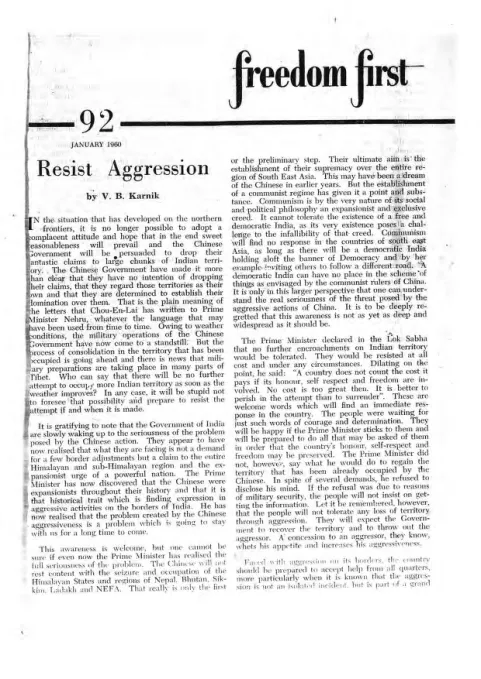
Resist Aggression
By V. B. Karnik
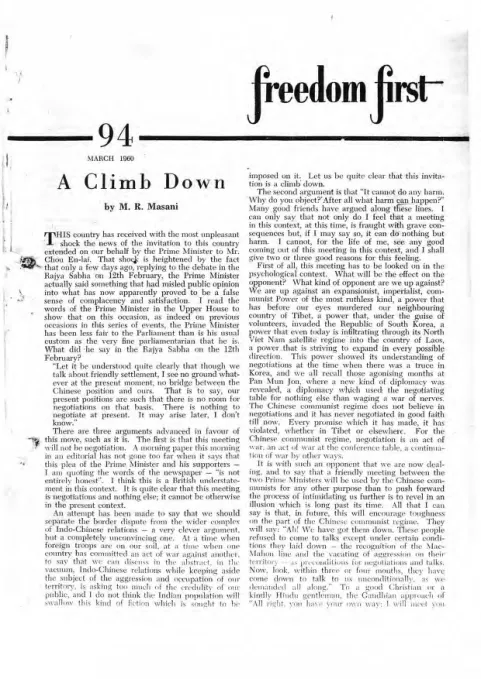
In the unsigned lead editorial ‘Resist Aggression’ (attributed to V. B. Karnik), the author argues that India can no longer treat the Chinese border incursions as a matter of minor adjustment, since Chou-En-lai’s letters and continuing Chinese military build-up in Tibet reveal a design to dominate the entire Himalayan and sub-Himalayan region as a step toward Communist supremacy over South East Asia. The piece praises Nehru’s declaration in the Lok Sabha that no further encroachment will be tolerated and that the country will pay any cost to defend its honour, while criticizing the government for refusing to disclose what it intends to do about territory already lost. It calls for India to accept military aid from any quarter regardless of bloc alignment, to increase agricultural and industrial output to sustain a military effort without over-committing to heavy industrialisation, and to win over the loyalty of border populations threatened by Chinese propaganda. It closes by insisting that only a firm, united national response — not fence-sitting non-alignment — will deter further aggression.
- Chinese claims are not to border adjustments but to the whole Himalayan/sub-Himalayan region, per Chou-En-lai’s letters to Nehru
- Communism’s expansionist character makes it intolerant of a free, democratic India as a rival model for South East Asia
- Nehru’s Lok Sabha pledge that no cost is too great to defend honour and freedom is welcomed as overdue but correct
- Government criticized for secrecy about plans to recover already-occupied territory
- India should accept military aid from any bloc, not just economic aid, without compromising non-alignment as a policy
- Self-help via increased agricultural and industrial output is necessary to sustain the military effort, but should not mean prioritizing heavy industry over defense readiness
- Winning the loyalty of border-region populations against Chinese propaganda is presented as essential to the national defense effort
Notes (U.S. President’s Visit; Chinese Threat to Indonesia; Restrictions on Dalai Lama?)
The ‘Notes’ section opens with a piece praising President Eisenhower’s visit to India as a triumphant, popularly-embraced event that reinforced ideological bonds between the two democracies and helped correct distorted mutual perceptions, framing the visit as a milestone in overcoming Nehru-era assumptions about non-alignment following the shocks of Hungary and Tibet. A second note, ‘Chinese Threat to Indonesia,’ reports rising tension between Peking and Jakarta after Indonesia banned rural trade by resident aliens (effective January 1), a measure aimed at the ethnic-Chinese trading minority who dominate large parts of the Indonesian economy; the note frames this as part of a wider pattern of Chinese assertiveness across South East Asia and warns Indonesia may face civil strife as a result. A third note, ‘Restrictions on Dalai Lama?’, criticizes the Government of India for restricting political access to the Dalai Lama during a brief stay in Bombay, seeing this as evidence of an appeasement posture toward China.
- Eisenhower’s visit is presented as a popular triumph that dispelled Indian misconceptions about America and vice versa
- The visit is tied to a broader Indian re-appraisal of non-alignment after the ‘rape of Tibet’ and Chinese expansionism
- Indonesia’s ban on rural trade by aliens (effective Jan 1) targets the ethnic-Chinese trading minority controlling ~90% of Indonesian economic activity
- Peking is depicted as defending overseas Chinese interests and stoking tension with Jakarta, risking civil strife
- The Government of India is criticized for restricting access to the visiting Dalai Lama in Bombay, seen as appeasement of China
Peace Congress In Australia
By Tibor Meray
Tibor Meray’s ‘Peace Congress In Australia’ reports critically on the ‘Australian and New Zealand Congress for International Cooperation and Disarmament’ held in Melbourne, arguing that despite official denials the conference was substantially organized and steered by Australian Communists and fellow-travellers linked to the Soviet-controlled World Peace Council. Meray recounts how the Australian secret police’s visit to a sponsor, Professor A. K. Stout, triggered his withdrawal and public controversy, describes party delegates blocking resolutions on free dissemination of pacifist propaganda and on Hungarian writers’ imprisonment (including Tibor Dery), and details J. B. Priestley’s public protest, alongside Mulk Raj Anand’s supporting statement, against the conference’s refusal to condemn Hungary’s suppression of writers. Meray concludes that the congress’s ‘Declaration of Hope’ emerged watered-down and evasive on issues like Eastern European independence and the Sino-Indian border, and predicts the episode will have little lasting effect beyond illustrating communist parties’ efforts to build a ‘popular front’ of peace movements in the West.
- The Melbourne peace congress is portrayed as nominally independent but effectively organized by Australian Communists tied to the Soviet World Peace Council
- Professor A. K. Stout withdrew as sponsor after admitting the Australian secret police had shown him documents on the organizers
- Party delegates voted down a resolution calling for free dissemination of pacifist propaganda, fearing it as an ‘anti-Soviet trap’
- A minority addendum noting that writers in some countries lack freedom of expression was seen by party members as a veiled reference to Hungary and was rejected
- J. B. Priestley and his wife Jacquetta Hawkes issued a public protest over the conference’s refusal to speak up for imprisoned Hungarian writers including Tibor Dery
- Mulk Raj Anand issued a supporting statement without going as far as Priestley
- The conference’s final ‘Declaration of Hope’ is described as restrained, avoiding pointed positions on Eastern European independence or the Sino-Indian border dispute
- Meray frames the episode as evidence of a broader trend of communist parties seeking respectability via peace movements in Western countries
Chinese Expansionism
By K. M. Munshi
K. M. Munshi’s ‘Chinese Expansionism’ argues that India’s handling of the Tibet situation has been ‘a crime in history,’ driven by a naive belief — encouraged by Chou-En-lai’s ‘honeymoon’ visit and the doctrine of Panchshila — that India and China could jointly lead a new peaceful Asia. Munshi contends that Han Chinese chauvinism underlies Beijing’s colonisation of Tibet, Sinkiang, and Inner Mongolia alike, driven by the search for oil, lead, copper, and coal in resource-rich frontier regions inhabited by non-Han peoples, and that the same expansionist pressure now bears on Ladakh, Sikkim, Bhutan, Nepal, Vietnam, Laos, Burma, and Indonesia. He rejects the choice between conquest and negotiation as a false dichotomy, insisting that India must build up armed strength (‘a nation in arms’) to make aggression too costly rather than relying on either passive pacifism or hope for negotiated settlement.
- India’s earlier belief in Sino-Indian friendship and Panchshila is characterized as self-deceiving gullibility that ignored China’s real designs on Tibet
- Han Chinese chauvinism is presented as the driving force behind Chinese rule over Tibet, Inner Mongolia, and Sinkiang alike, displacing non-Han peoples
- Chinese expansionism is tied to resource control: 80-90% of China’s oil, 55% of lead, 47% of copper, and 22% of coal lie in frontier regions inhabited by non-Han populations
- Chinese pressure is described as extending to Ladakh, Sikkim, Bhutan, Nepal, Vietnam, Laos, Burma, and against ethnic-Chinese-linked leverage over Indonesia
- Munshi rejects the Defence Minister’s framing of ‘conquest or negotiation’ as a false choice, calling instead for India to become a ‘nation in arms’
- The essay closes by urging citizens to support the Territorial Army and accept foreign military equipment without political strings
A Notable Exhibition
By From Our Correspondent
This unsigned report describes an exhibition of photographs of the Kerala ‘Liberation Struggle’ (the June-July 1959 anti-Communist agitation against the E.M.S. Namboodiripad ministry), organised by the Indian Committee for Cultural Freedom in Bombay from December 19-22. The exhibition depicted the popular enthusiasm of the movement, its cross-community and cross-caste participation, and alleged brutal suppression by the Communist state ministry, including images of beatings, shootings, and grieving relatives of ‘martyrs’. K. M. Munshi inaugurated the exhibition, arguing that Kerala had demonstrated that a communist government, once in power even via democratic means, would undermine democratic institutions and suppress individual liberty, and crediting the absence of a communist army in a neighbouring state (unlike Hungary) as key to the movement’s success.
- The exhibition, organized by the Indian Committee for Cultural Freedom, ran in Bombay from December 19-22 and drew over 1500 visitors
- Photographs depicted meetings, processions, picketing, police beatings of volunteers, shootings, and the funerals of movement ‘martyrs’
- The exhibition emphasized the Liberation Struggle as a state-wide, cross-community, cross-caste mass movement
- K. M. Munshi inaugurated the exhibition and argued Kerala proved that communism in power, even via democratic means, suppresses individual liberty and democratic institutions
- Munshi credited the absence of a neighbouring communist army (unlike Hungary’s position relative to the USSR) as crucial to the movement succeeding against the communist ministry
Soviet Society In Transition
By (Contributed)
This unsigned, contributed piece, ‘Soviet Society In Transition,’ surveys reports from the Soviet press (October 1959) on Khrushchev’s tour of Siberia and the state of Soviet consumer conditions. It describes Khrushchev acknowledging acute housing shortages and shortcomings in supplies among Siberian workers, and details the introduction of a hire-purchase system for consumer goods, expanding from an Ukrainian pilot into a nationwide program, framed as evidence of a shift toward mass consumption despite continued shortages of basic goods. The piece draws on Sovetskaya Rossiya reader letters lamenting the gap between Sputnik-era propaganda and the reality of scarce, poor-quality consumer goods, and on Party Life articles criticizing Communists who exploit unearned income through property speculation, illegal trading, and high rents — closing with discussion of a controversial 1959 inheritance-law debate over taxing or capping unearned wealth passed to heirs, including outsized royalties earned by favoured Soviet authors and composers.
- Khrushchev, touring Siberia in autumn 1959, admitted ‘difficult conditions’ and acute housing shortages among workers there
- A hire-purchase (installment credit) system for consumer goods, first piloted in Ukraine, was extended across the USSR by government order despite earlier propaganda condemning such credit as a capitalist evil
- Reader letters to Sovetskaya Rossiya express frustration at the gap between Sputnik/Luniks propaganda and everyday scarcity of basic consumer goods like shoes
- Party Life criticized Communists in the Zhilevo settlement for profiting from private trade, speculative rents, and high-priced sales of state-assisted housing
- A controversial 1959 Izvestiya debate addressed whether to tax or cap unearned income from inheritance, including on dachas built with embezzled state funds
- Author, composer, and scientist royalties/salaries in the USSR are reported as very high (e.g., a novel’s first edition may earn 250,000 roubles), enabling a ‘New Class’ to accumulate private wealth and pass it to heirs
House That Stalin Built
By M. Devadas Kini
M. Devadas Kini’s review, ‘House That Stalin Built,’ covers Merle Fainsod’s ‘Smolensk Under Soviet Rule’ (Harvard University Press), which draws on a cache of over 500 captured Communist Party files from the Smolensk oblast archive (1917-1938) that fell into Nazi and then American hands. Kini uses the review to argue more broadly that Soviet communism produced a new ruling class of bureaucrats and technocrats exercising totalitarian, state-directed control over all social institutions, citing the Smolensk archive’s evidence of pervasive secret-police surveillance, the destruction of the peasantry via forced collectivisation (targeting kulaks first, then middle and poor peasants), and coerced participation in kolkhozes achieved through intimidation and arrests. The review closes by casting collectivisation as increasing agricultural output only by ruthlessly extracting the maximum from a peasantry stripped of freedom.
- Reviews Merle Fainsod’s ‘Smolensk Under Soviet Rule’ (Harvard University Press, $8.50), based on captured Communist Party archive files covering Smolensk oblast, 1917-1938
- Kini argues Soviet communism substituted a new bureaucratic/technocratic ruling class for the old order rather than eliminating class domination
- Describes total state control of press, education, and public opinion as enabling the regime to mould people ‘into any required shape’
- Details forced collectivisation as proceeding by first isolating and destroying kulaks through tax burdens and confiscation, then coercing middle and poor peasants via seed confiscation, arrest threats, and forced labour
- Quotes a peasant’s letter (signed ‘Polzikov’) describing coerced, non-voluntary kolkhoz enrollment in the village of Podbuzhye
- Concludes that collectivisation raised agricultural output only by maximal, coercive extraction from a stripped-of-freedom peasantry
With Many Voices
The closing feature, ‘With Many Voices,’ is a compilation of quoted statements from Indian politicians, journalists, and news items (mid-to-late December 1959) on the Sino-Indian border dispute, framed by an epigraph from Tennyson. It juxtaposes Nehru’s pledge to ‘negotiate, negotiate and negotiate to the bitter end’ with sharply critical counter-voices: Acharya Kripalani warning that negotiating to the bitter end would mean losing Indian territory and endangering national security; the Indian Express calling for India to be ready to ‘use pistols’ against China; Communist leader P. Ramamurthy praising Nehru’s approach as aligned with Communist Party positions (framed ironically); Kamal Nayan Bajaj contrasting India ‘making history’ with China ‘making geography’ at India’s expense; Dahyabhai Patel alleging Chinese delegations visited India only to spy; and Army Chief Gen. Thimayya’s testimony (via Time magazine) that 1957 proposals to secure the Sinkiang-Tibet road were rejected by the Defence Minister because it was assumed the only real enemy was Pakistan.
- Nehru is quoted pledging to ‘negotiate, negotiate and negotiate to the bitter end’ with China (Times of India, Dec 22)
- Acharya Kripalani warns that negotiating ‘to the bitter end’ risks losing Indian territory and endangering national security (Hindustan Times)
- The Indian Express (Dec 21) argues China must be told firmly that India can ‘flourish and use pistols’ if necessary
- Communist leader P. Ramamurthy is quoted approvingly comparing Nehru’s approach to the Communist Party’s own position (Indian Express, Dec 14)
- Kamal Nayan Bajaj contrasts India ‘making history’ internally and externally with China ‘making geography’ by expanding at India’s expense (Hindustan Times, Dec 23)
- Gen. Thimayya is quoted (via Time magazine) revealing that 1957 proposals to secure the Sinkiang-Tibet road area were rejected by the Defence Minister, who assumed Pakistan was the only relevant enemy
- Dr. Ram Subhag, M.P., criticizes the Defence Ministry for distributing copies of a Delhi weekly deemed sympathetic to China
- Krishna Menon is noted as having described the Chinese occupation of Indian territory merely as an ‘incursion,’ with the compiler implying the word choice understates the seriousness
Generated by the v1.5 extraction pipeline. Awaiting editorial review.
Metadata and summary are AI-extracted from the source PDF and reviewed for editorial accuracy. The original work is available via the Read PDF tab above (where present); paragraph-level citation inside the PDF is deferred to a future engagement.