periodical issue
Freedom First
By M. R. Pai
Printed at Inland Printers, 55 Gamdevi Road, Bombay 7 and Edited and published for the Democratic Research Service by V. B. Karnik at 127 Mahatma Gandhi Road, Bombay 1. · Bombay · 1969
16 pages
Freedom First
Summary
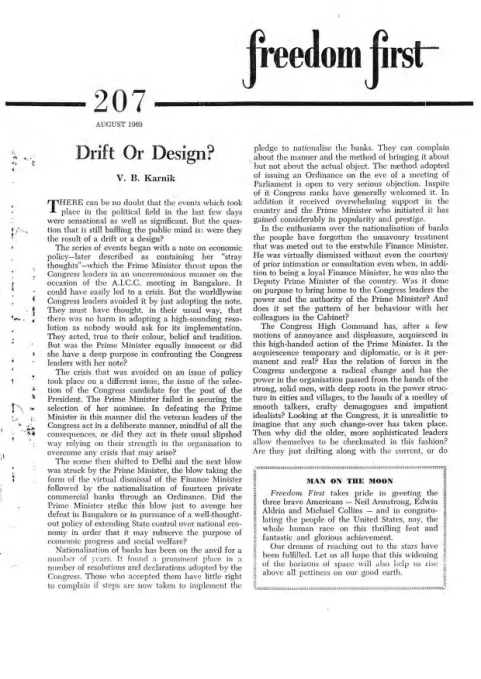
Freedom First No. 207 (August 1969) is a monthly issue of the Bombay-based liberal periodical edited and published by V. B. Karnik for the Democratic Research Service. The issue is dominated by the political fallout of Indira Gandhi’s bank nationalisation move and the wider anxiety, from several contributors, about growing Soviet and Communist influence over Indian politics, the press, and the economy. Karnik’s lead essay questions whether the Prime Minister’s actions (the AICC ‘stray thoughts’ note, the dismissal of the Finance Minister, and the nationalisation ordinance) reflect calculated design or directionless drift. Companion pieces by ‘Atreya’ on the Communist Party of India (Marxist), by ‘Analyst’ on police and United Front politics in West Bengal, and by M. R. Pai on alleged Soviet penetration of Indian institutions extend this anti-authoritarian, anti-Communist thread. The issue also carries a eulogy for Kenyan minister Tom Mboya, a reprinted extract from imprisoned Soviet writer Yuri Daniel, a reprinted editorial on press freedom by South African editor Lawrence Gander, a piece on the state’s poor handling of Dr. Zakir Husain’s funeral, a book review of a study of revolutionary/guerrilla warfare, a letter-to-the-editor exchange on the Hindu-Muslim problem between A. B. Shah and Karnik, and a closing page of press quotations (‘With Many Voices’).
Key points
-
V. B. Karnik’s lead essay “Drift Or Design?” questions whether Indira Gandhi’s AICC “stray thoughts” note, the sidelining of Morarji Desai, and the nationalisation of fourteen banks reflect calculated design or directionless drift, warning that further nationalisation of production and exchange would lead to “anarchy and chaos.”
-
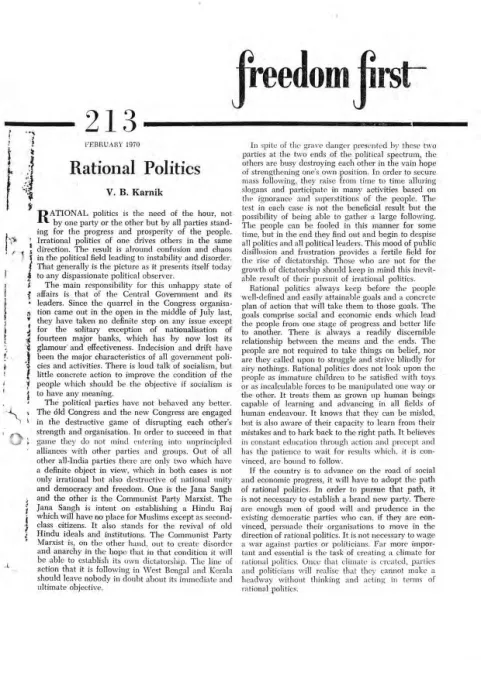
Writing as “Atreya,” an essay on the CPI(Marxist) cites B. T. Ranadive’s London statement that the party’s real aim in Kerala and West Bengal is to sharpen class struggle rather than relieve the people, and reports M. R. Masani’s parliamentary opposition to the Banking Companies Nationalisation Bill, comparing Indira Gandhi’s path to Nkrumah’s Ghana and Sukarno’s Indonesia.
-
Writing as “Analyst,” a piece surveys a month of administrative breakdown in West Bengal, including an attack on the Ananda Bazar Patrika and Statesman offices by CPM-aligned “student” groups likened to Nazi storm-troopers.
-
M. R. Pai’s “India - An Asian Czechoslovakia?” catalogues alleged Soviet infiltration of Indian press, education and economic planning, naming ministers he considers pro-Soviet including Dinesh Singh, I. K. Gujral and P. N. Haksar, and warns India risks becoming “a Soviet economic colony.”
-
A reprinted extract from Soviet dissident writer Yuri Daniel’s prison letter describes the euphemistic “special language” of the Soviet camp system, where starvation rations are called “education.”
-
A reprinted editorial by South African editor Lawrence Gander, convicted for reporting prison brutality, defends the press’s duty to publish unwelcome truths, closing with Jefferson’s preference for newspapers without government.
-
A letter exchange between A. B. Shah and V. B. Karnik disputes Karnik’s earlier characterisation of Hamid Dalwai’s Muslim Politics in India and the roots of Muslim separatism.
-
A book review covers Strategies of Revolutionary Warfare, connecting its relevance to India via reports that China trained over 1,000 Naga insurgents in Yunnan.
Essays
Drift Or Design?
By V. B. Karnik
V. B. Karnik’s lead editorial essay asks whether the sensational political events of the preceding weeks — Indira Gandhi’s ‘stray thoughts’ economic policy note sprung on Congress leaders at the Bangalore AICC meeting, her defeat over the choice of Congress presidential candidate, the virtual dismissal of the Finance Minister (Morarji Desai), and the nationalisation of fourteen private banks by ordinance — were the product of a deliberate design or mere drift. Karnik argues the Congress old guard acted true to its ‘usual slipshod way,’ while the Prime Minister’s motives remain ambiguous: was nationalisation a well-thought-out policy to extend state control for economic progress and social welfare, or a political stunt to outwit rivals and concentrate personal power? He warns against wholesale nationalisation of production, distribution and exchange as a road to ‘anarchy and chaos,’ and closes by urging the government to formulate real economic and social ‘design’ rather than continue drifting, since ‘socialism has been more a mirage and a deceptive slogan than a realistic socio-economic programme.’
- Questions whether Indira Gandhi’s political moves (AICC note, bank nationalisation ordinance, sidelining of the Finance Minister) reflect design or drift
- Criticises the Congress High Command’s acquiescence to the Prime Minister’s increasingly personalised authority
- Frames bank nationalisation as a possible move to concentrate power rather than a genuine welfare measure
- Warns that further nationalisation of production, distribution, and exchange would lead to ‘anarchy and chaos’
- Calls for orderly, vigorous economic ‘design’ in place of continued policy drift
Marxist Communists Mean Business
By “Atreya”
A short unsigned note congratulating Neil Armstrong, Edwin Aldrin, and Michael Collins on the Apollo 11 Moon landing, expressing hope that the widened human horizon in space will also help humanity ‘rise above all pettiness on our good earth.’
- Congratulates the Apollo 11 astronauts and the American people on the Moon landing
- Frames the achievement as a triumph for the whole human race
- Expresses hope that space exploration will inspire humanity to rise above earthly pettiness
Nationalisation of Banks
A brief tribute marking the assassination of Kenyan Minister for Economic Planning and Labour Tom Mboya, describing him as a young, vigorous, cosmopolitan modernising figure whose violent death is a loss to the world democratic movement.
- Mourns the assassination of Tom Mboya, Kenya’s Minister for Economic Planning and Labour
- Praises his cosmopolitan outlook and many friendships in India
- Frames his death as a loss to the ‘world democratic movement’
U.F. Police And Courts
By Analyst
A reprinted extract from a letter written from his prison cell by the Russian writer Yuri Daniel, describing the euphemistic ‘special language’ used by Soviet camp authorities — where starvation rations are called ‘education’ and solitary confinement is called ‘re-education’ — and reflecting bitterly on the hunger strike as a last resort against injustice.
- Extracts a prison letter by Soviet dissident writer Yuri Daniel
- Describes the euphemistic ‘special language’ of the Soviet camp system
- Notes that starvation rations are termed ‘education’ and punitive isolation is called ‘re-education’
- Reflects on hunger strikes as the last resort when ‘all the thinkable and unthinkable means’ have failed
India - An Asian Czechoslovakia?
By M. R. Pai
Writing under the pseudonym ‘Atreya,’ this essay argues that the CPI (Marxist) has openly declared its objective in Kerala and West Bengal is not to relieve the people but to sharpen class struggle and create conditions for revolutionary subversion of the Indian Constitution, as confirmed by B. T. Ranadive’s London statement and echoed by E. M. S. Namboodiripad and A. K. Gopalan. The author contrasts this candour with the ‘bovinely sloppy’ complacency of Congress and other democratic parties, criticises S. A. Dange and the CPI (Right) for their opportunistic conformism, and notes the Marxist Communists’ withdrawal of prosecutions against Naxalites in Kerala and West Bengal as evidence of their operational seriousness. The essay pivots to a report on M. R. Masani’s Lok Sabha speech opposing the Banking Companies Nationalisation Bill, in which Masani warned against following the authoritarian path of Nkrumah and Sukarno, argued the bill was a political move to concentrate power in Delhi, and called the debate improper while the matter was sub judice before the Supreme Court.
- CPI (Marxist) leader B. T. Ranadive’s London statement reveals the party’s real aim: to sharpen contradictions, not relieve the people, in Kerala and West Bengal
- E. M. S. Namboodiripad and A. K. Gopalan confirm and reiterate Ranadive’s position
- The Marxist Communists have withdrawn prosecutions against Naxalite-accused persons in both states as a show of revolutionary solidarity
- S. A. Dange and the CPI (Right) are accused of being ‘bailed out’ by Indira Gandhi’s Congress in a mutual arrangement of convenience
- M. R. Masani opposed the Banking Companies Nationalisation Bill in the Lok Sabha, comparing Indira Gandhi’s path to Nkrumah’s Ghana and Sukarno’s Indonesia
- Masani argued nationalisation would damage foreign confidence, scare depositors, and concentrate political and economic power in Delhi
Democracy And Free Press
Writing under the pseudonym ‘Analyst,’ this piece surveys a month (mid-June to mid-July 1969) of political and administrative breakdown in West Bengal under the United Front government: a cold war between the Home Minister and the Police Association following the Durgapur Engineering College incidents; the CPM’s attempt to form a parallel, more pliant police association; gheraos of officials; a High Court judgment rebuking the executive for defying judicial orders; an attack on the offices of Ananda Bazar Patrika and The Statesman by CPM-linked ‘student’ storm-troopers; the CPM’s capture of school and college managing committees; and the withdrawal of prosecutions against Naxalite-accused persons. It closes by describing Chief Minister Ajoy Mukherjee’s political impotence, worsening industrial unrest, and rising talk of ‘conspiracies’ and a possible role for the Industrial Security Force.
- Chronicles administrative paralysis and a police-vs-Home-Ministry standoff in West Bengal following the Durgapur Engineering College incidents
- Describes CPM attempts to build a rival, more compliant police association and to capture schools and colleges by installing party nominees
- Reports a High Court judgment rebuking the West Bengal executive for failing to respect judicial authority
- Details an attack on the Ananda Bazar Patrika and Statesman offices by CPM-aligned ‘student’ groups likened to Nazi storm-troopers
- Portrays Chief Minister Ajoy Mukherjee as increasingly powerless within the United Front government
- Notes rising industrial unrest, gheraos, and fears of prolonged strikes in jute, engineering, and tea industries
Dr. Zakir Husain’s Funeral
By M. R. Pai
M. R. Pai argues that India risks becoming ‘an Asian Czechoslovakia’ — a country subverted from within through Soviet-backed ‘Pressure from Below’ and ‘Pressure from Above,’ as theorised by Czech communist Jan Kozak and previously attempted in India via the Ranadive thesis before being replaced by the more successful gradualist Czech model under Indira Gandhi’s premiership. Pai catalogues Soviet infiltration across multiple domains: mass Soviet publications outnumbering British and American publications combined; Soviet delegations and cultural exchanges; press subsidies and Novosti syndication deals; alleged Soviet influence over education, the Planning Commission’s economic model (via P. C. Mahalanobis, Pitamber Pant, and D. R. Gadgil), and the ‘Rupee Payment’ trade arrangement that Pai says leaves India dependent on overpriced Soviet goods and machinery (citing Romesh Thapar’s critique of Bokaro Steel and the ‘Central Engineering and Design Bureau’). He names a roster of ministers and officials he considers pro-Soviet — Dinesh Singh, Nandini Satpathy, Bhagwat Jha Azad, I. K. Gujral, Fakhruddin Ali Ahmed, Raghunath Reddy, V. K. R. V. Rao, T. N. Kaul, P. N. Haksar — and singles out Indira Gandhi and Dinesh Singh as ‘No. 1’ pro-communist figures in the Congress, closing with a warning that India risks becoming ‘a Soviet economic colony as drawers of water and hewers of wood’ unless believers in freedom and liberal democracy act in concert.
- Compares India’s trajectory under Indira Gandhi to the Soviet subversion of Czechoslovakia, citing Jan Kozak’s thesis of ‘Pressure from Below’ and ‘Pressure from Above’
- Cites Home Ministry data (given Sept 9, 1968) showing USSR publishing 41 Indian-language periodicals versus 3 by UK and 6 by USA
- Describes Soviet cultural, media, and educational penetration, including the Novosti syndication deal and joint Gandhi/Lenin centenary celebrations
- Criticises the ‘Rupee Payment’ trade arrangement and Soviet-model Five Year Plans as economically damaging, citing Romesh Thapar on Bokaro Steel
- Names a list of ministers and officials (Dinesh Singh, Nandini Satpathy, I. K. Gujral, T. N. Kaul, P. N. Haksar and others) as pro-Soviet actors within government
- Concludes with a warning that India risks becoming ‘a Soviet economic colony’ without concerted resistance from liberal democrats
false information
A reprinted editorial written by Lawrence Gander, Editor-in-Chief of the Rand Daily Mail, after his conviction and fine in the Rand Supreme Court for publishing ‘false information’ about brutality and bad hygiene in South African prisons. Freedom First’s own editor’s note frames the case as a defence of press courage, noting Gander continued Edgar Wallace’s liberal editorial tradition and presented the plight of black South Africans as a human situation. Gander’s editorial itself defends the free press’s right and duty to publish unwelcome truths, invoking the historical precedent of Crimean War reporting and closing with Thomas Jefferson’s preference for ‘newspapers without a government’ over ‘a government without newspapers.’
- Reprints Lawrence Gander’s editorial defending press freedom after his conviction in the Rand Supreme Court over prison-conditions reporting
- Freedom First’s introductory note frames Gander as continuing the Rand Daily Mail’s liberal tradition under Edgar Wallace
- Gander argues a free press must report unwelcome truths even at cost to ‘national interest’
- Cites the Crimean War Times correspondent as a historical instance where critical reporting ultimately served reform
- Closes with Thomas Jefferson’s dictum preferring newspapers without government to government without newspapers
Essay 9
R. Srinivasan criticises the Indian government’s poor handling of public mourning and media coverage following the death of President Dr. Zakir Husain, arguing that the Films Division and All India Radio failed to rise to the occasion. He contrasts India’s threadbare radio dirges and thin documentary coverage unfavourably with the dignified public funerals of Kennedy and Churchill, laments the absence of a prepared national elegy (unlike the independence-era songs by Bankim Chandra, Dwijendranath, and Tagore), and calls for the government to commission proper documentaries and dirges in advance of future national occasions rather than scrambling reactively.
- Criticises All India Radio and the Films Division for their inadequate coverage of Dr. Zakir Husain’s death and funeral
- Contrasts India’s handling unfavourably with the dignified public funerals of Kennedy and Churchill
- Notes the absence of a prepared national musical tradition of mourning, unlike patriotic songs composed around 1947
- Recommends commissioning documentaries and dirges for prominent leaders in advance, not only after death
- Criticises poor photography and coverage of the public’s reaction during the funeral procession
Review: Strategies of Revolutionary Warfare
By (Lt-Col.) M. R. Chandvadkar
A book review, unsigned in its opening portion but concluded and signed by (Lt-Col.) M. R. Chandvadkar, of ‘Strategies of Revolutionary Warfare’ edited by Jerry M. Tinker (published by S. Chand & Co., New Delhi). The reviewer praises it as the first comprehensive Indian-published study analysing the strategies and tactics of revolutionary/guerrilla warfare since 1945, covering the theories of Lenin, Mao Tse-tung, General Giap, General Alberto Bayo, Che Guevara and General Nasution, and organised into sections on the growth, technique, and government counter-measures against revolutionary warfare. The reviewer connects the book’s relevance to India’s own vulnerability, citing reports of Chinese training of Naga insurgents in Yunnan province and East Pakistan, and recommends the book as a potential textbook for training army, police, and civilians in counter-insurgency.
- Reviews ‘Strategies of Revolutionary Warfare,’ edited by Jerry M. Tinker, calling it the first comprehensive Indian-published study of revolutionary warfare strategy since 1945
- Summarises the book’s coverage of Lenin, Mao Tse-tung, General Giap, General Alberto Bayo, Che Guevara, and General Nasution as theorists of guerrilla warfare
- Notes the book’s three-part structure: growth of revolutionary warfare, insurgent technique, and government counter-measures
- Connects the book’s relevance to India via reports that China has trained over 1,000 Naga insurgents in Yunnan and set up camps in East Pakistan
- Recommends the book as a potential textbook for Army Schools, Police Training Schools, and civilian counter-insurgency training
Letter to the Editor: Hindu-Muslim Problem
By A. B. Shah / V. B. Karnik (reply)
A letter-to-the-editor exchange on the ‘Hindu-Muslim Problem.’ A. B. Shah, President of the Indian Secular Society, challenges V. B. Karnik’s earlier article on Hamid Dalwai’s book Muslim Politics in India (Freedom First, March 1969), arguing Karnik misrepresents Dalwai’s nuanced views as blanket condemnation of Muslims, and that Karnik’s justification of the Pakistan demand ignores the earlier history of Muslim separatism going back to Sir Syed Ahmad Khan and Sir Syed Ameer Ali. Shah also disputes Karnik’s claim that Hindu and Muslim societies are equally obscurantist, citing examples of Hindu self-criticism (of the Shankaracharya of Puri) versus what he calls the near-total silence of eminent Muslims over the demonstration against a Toynbee article at the Statesman’s Calcutta office. Karnik replies, accepting Shah’s assurance about Dalwai’s actual views, but maintaining that a historian should seek to understand rather than to assign blame, and that his own analysis of the roots of Partition differs in emphasis from Shah’s, without conceding fault.
- A. B. Shah, writing as President of the Indian Secular Society, disputes Karnik’s March 1969 characterisation of Hamid Dalwai’s book Muslim Politics in India
- Shah traces Muslim separatism to Sir Syed Ahmad Khan’s 1880s call for a separate Muslim nation, predating the causes Karnik cites
- Shah contrasts Hindu self-criticism of the Shankaracharya of Puri with the near-total silence of prominent Muslims over anti-Toynbee demonstrations at the Statesman’s Calcutta office
- Karnik’s reply accepts that Dalwai does not condemn the whole Muslim community but maintains his own differing assessment of historical responsibility for communal division
With Many Voices
The closing ‘With Many Voices’ page reprints a selection of press quotations from July 1969 on the themes of Soviet influence, bank nationalisation, the Naxalites, and the Moon landing, drawn from The Indian Express, The Statesman, Swarajya, Janata, Thought, Times of India, Current, and Economic Times, with commentators including G. L. Mehta, S. Nihal Singh, Girilal Jain, D. F. Karaka, Jyoti Basu, Jayaprakash Narayan, C. D. Deshmukh, Arthur C. Clarke, and President Nixon. The page closes the issue with the masthead statement that it is printed at Inland Printers, Bombay, and edited and published for the Democratic Research Service by V. B. Karnik.
- Compiles press quotations from July 1969 on Soviet influence, bank nationalisation, and the Moon landing
- Includes Jayaprakash Narayan’s view that nationalisation of banks would only enhance the power of rulers and bureaucrats, not solve economic ills
- Includes C. D. Deshmukh’s assessment that India’s political choice now lies only between the Extreme Left and an almost-as-extreme Left
- Includes Jyoti Basu’s characterisation of Naxalites as ‘part politicians and part anti-socials’
- Closes with the issue’s colophon: printed at Inland Printers, Bombay; edited and published for the Democratic Research Service by V. B. Karnik
Generated by the v1.5 extraction pipeline. Awaiting editorial review.
Essay 11
No summary was extracted for this article. Listed for completeness.
Essay 12
No summary was extracted for this article. Listed for completeness.
Metadata and summary are AI-extracted from the source PDF and reviewed for editorial accuracy. The original work is available via the Read PDF tab above (where present); paragraph-level citation inside the PDF is deferred to a future engagement.