periodical issue
Freedom First
A Journal of Liberal Ideas
By A. G. Noorani, J. R. Patel, N. L. Panjwani, Brig. Dalvi, Geeta Doctor, Lt. Col. M. R. Chandvadkar, V. B. Karnik
Published for the Democratic Research Service by J. R. Patel, Associate Editor, Freedom First at 127 M. Gandhi Road[, Bombay] · Bombay · 1972
16 pages
Freedom First
Summary
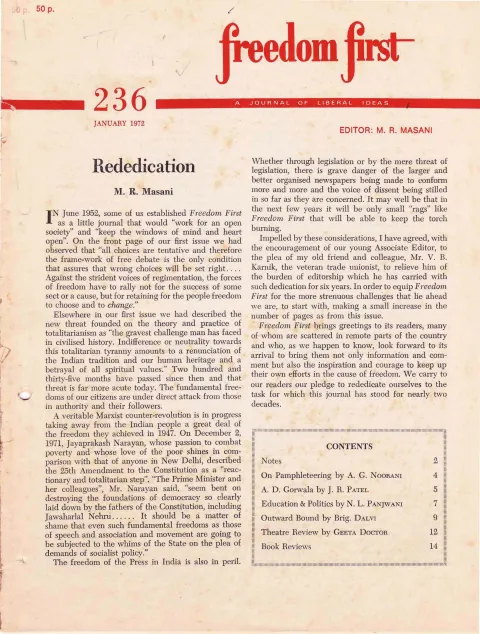
Freedom First No. 236 (January 1972), edited by M. R. Masani, opens with an editorial titled “Rededication” marking the journal’s approaching twentieth year and announcing that Masani is resuming the editorship from V. B. Karnik, with a modest increase in page count. The editorial frames the issue against a backdrop of what Masani calls a “Marxist counter-revolution” eroding civil liberties, citing Jayaprakash Narayan’s criticism of the 25th Constitutional Amendment and warning of press freedom coming under threat. The unsigned notes column, “Between You & Me and The Lamp Post,” covers land-ceiling politics (via a statement by Maharashtra law minister A. R. Antulay), a satirical juxtaposition of Life magazine’s shifting portrayals of Chou En-lai, and a jab at J. K. Galbraith’s admitted errors, plus a brief obituary for D. P. Sethna of the Democratic Research Service. The remaining contributions are a mix of political-cultural commentary and reviews: A. G. Noorani laments the decline of Indian pamphleteering; J. R. Patel profiles the veteran editor and former ICS officer A. D. Gorwala; N. L. Panjwani argues that Indian politics, not education, is responsible for the crisis in student unrest; Brigadier J. P. Dalvi describes the Leslie Sawhny Programme’s Outward Bound-style leadership training; Geeta Doctor reviews a student production of Vijay Tendulkar’s “Silence! The Court Is in Session!”; and book reviews cover Nari Rustomji’s memoir of the Northeast frontier and a scholarly study of the Sarvodaya movement’s Bhoodan-Gramdan leadership. The issue closes with a page of quoted aphorisms and press clippings, “With Many Voices.”
Key points
-
M. R. Masani’s “Rededication” editorial marks Freedom First’s approaching twentieth year, warns of a “Marxist counter-revolution” eroding civil liberties, and announces Masani’s resumption of the editorship from V. B. Karnik.
-
The “Notes” column reads Maharashtra minister A. R. Antulay’s land-ceiling remarks as an admission that full land nationalisation is the real Congress goal, and mocks Galbraith’s admitted planning errors.
-
A. G. Noorani’s “On Pamphleteering” laments the decline of committed Indian political writing since the era of Naoroji, Tilak and the Congress Socialist Party generation.
-
J. R. Patel profiles veteran editor A. D. Gorwala, tracing his ICS career, his 1948 resignation over food-price decontrol, and his uneconomically priced weekly Opinion.
-
N. L. Panjwani’s “Education Should Invade Politics” rejects the claim that politics has newly “invaded” education, arguing the system has always been shaped by the country’s political and economic structure.
-
Brigadier J. P. Dalvi’s “Outward Bound” describes the Leslie Sawhny Programme’s incorporation of UK-style physical leadership training for youth and trade-union leaders.
-
Geeta Doctor reviews an Elphinstone College production of Tendulkar’s “Silence! The Court Is in Session!”, and further reviews cover Nari Rustomji’s Northeast-frontier memoir and a study of the Sarvodaya movement’s Bhoodan-Gramdan leadership.
Essays
recounts the founding of Freedom First in June 1952 to
By M. R. Masani
M. R. Masani’s editorial “Rededication” recounts the founding of Freedom First in June 1952 to “work for an open society” and reaffirms that pledge two decades on, arguing that the totalitarian threat identified in the first issue is “far more acute today.” He cites Jayaprakash Narayan’s December 1971 description of the 25th Constitutional Amendment as a “reactionary and totalitarian step” and warns that press freedom is imperilled, with larger newspapers being pressured into conformity while only “small rags” like Freedom First may keep dissent alive. Masani closes by announcing he is resuming the editorship from his associate V. B. Karnik after six years, with a small increase in the journal’s page count to meet the challenges ahead.
- Frames the issue as marking nearly twenty years since Freedom First’s 1952 founding.
- Argues a ‘veritable Marxist counter-revolution’ is eroding freedoms won in 1947.
- Quotes Jayaprakash Narayan’s condemnation of the 25th Amendment as ‘reactionary and totalitarian’.
- Warns of press freedom being throttled through legislative threat and pressure on larger newspapers.
- Announces Masani is resuming editorship from V. B. Karnik, with a modest increase in page count.
Notes
The unsigned notes column covers several short items. “Cat out of the Bag” argues that land-ceiling reform proposed by the new Congress Party is a disguised step toward full land nationalisation and collective farming, citing a statement by Maharashtra law minister A. R. Antulay that ceilings are merely a ‘stopgap’ pending eventual nationalisation of all land; it invokes Stalin’s liquidation of the kulaks as a warning of the violence such policies can entail. “Chou En-lai—Then and Now” contrasts Life magazine’s flattering 1971 profile of the Chinese premier with its damning 1954 portrayal of him as a gangster responsible for a 1931 mass murder, to illustrate the malleability of journalistic reputation-making. “Political Defections” critiques a Committee of Governors report that found constitutional obstacles to anti-defection legislation, arguing the Committee’s reasoning is legally strained given existing provisions for reasonable restrictions on association. “Broadminded Galbraith” mocks J. K. Galbraith for admitting error in his earlier enthusiasm for planning and ‘post office socialism’ in India and Ceylon while noting he has yet to acknowledge a failed prediction that the South Vietnamese government would collapse within a week. A boxed notice mourns the death of D. P. Sethna, a solicitor long associated with the Democratic Research Service.
- ‘Cat out of the Bag’ reads Maharashtra minister A. R. Antulay’s remarks on land ceilings as an admission that full land nationalisation is the real Congress goal.
- Invokes Stalin’s liquidation of kulaks as a historical warning against collectivisation drives.
- ‘Chou En-lai—Then and Now’ contrasts Life magazine’s 1971 flattering profile of Chou with its 1954 depiction of him as a murderous ‘gangster’.
- ‘Political Defections’ disputes the Committee of Governors’ finding that anti-defection legislation would be unconstitutional.
- ‘Broadminded Galbraith’ criticises Galbraith for admitting some errors on planning while ignoring his failed prediction on South Vietnam.
- A tribute notes the death of D. P. Sethna, solicitor and long-time supporter of the Democratic Research Service.
On Pamphleteering
By A. G. Noorani
A. G. Noorani’s “On Pamphleteering” laments the decline of quality in Indian public discourse, arguing that the poor state of pamphleteering both reflects and reinforces this decline. He traces a lost lineage of committed political writing from Dadabhai Naoroji, Gokhale, Tilak, and Aurobindo Ghose’s Bande Mataram through the British tradition of Junius, Burke, and Bentham, and the founding of the Edinburgh Review in 1802, which he credits with beginning the ‘organised intellectuals as a force in British politics.’ Gandhi is praised for having brought politics to the masses through Young India and Harijan without neglecting the intelligentsia, and Nehru, Rajaji, and Subhas Bose are named as prolific pamphleteers of that era, alongside the Congress Socialist Party’s J. P., M. R. Masani, Asoka Mehta, Lohia, and Achyut Patwardhan. Noorani contrasts this with the present, quoting Nirad C. Chaudhuri’s harsh verdict that Indian writers are self-interested and disengaged from public affairs, incapable of the ‘primary requisite for writing effectively.’
- Argues the decline of Indian public life and the decline of pamphleteering are intimately related.
- Traces a tradition of committed political writing from Naoroji, Gokhale, Tilak, and Aurobindo Ghose to the Congress Socialist Party generation.
- Credits the Edinburgh Review (1802) with beginning the organised intellectual as a political force in Britain.
- Praises Gandhi’s Young India and Harijan for bringing politics to the masses without abandoning the intelligentsia.
- Quotes Nirad C. Chaudhuri’s severe indictment of contemporary Indian writers as self-interested and uninvolved in public life.
A. D. Gorwala
By J. R. Patel
J. R. Patel’s profile “That Irrepressible Gadfly—A. D. Gorwala” begins by reviewing Gorwala’s short-story collection ‘The Queen of Beauty and Other Tales,’ whose fictional assistant collector in Sind closely mirrors Gorwala’s own career as an ICS officer posted there in 1924. Patel then narrates Gorwala’s biography: born in Quetta to a family of modest means, educated in Bombay and at St. Xavier’s, selected for the ICS in the first exam held in India in 1922, and trained at Cambridge before serving in Sind, Delhi, and Bombay, resigning in 1948 in protest over food price decontrol. After a stint as a Bombay Dyeing director, he turned to journalism, founding the weekly Opinion in May 1960, which continues at a loss-making price of Rs. 2 out of principle. Patel portrays him, at 71, as an uncompromising ‘Socrates of our troubled times,’ living a spartan bachelor existence, still writing caustic editorials that have at times gotten him refused publication.
- Reviews Gorwala’s short-story collection ‘The Queen of Beauty and Other Tales,’ inspired by his ICS service in Sind.
- Traces his biography from Quetta birth through Cambridge training after passing the first India-held ICS exam in 1922.
- Notes his 1948 resignation from government service in protest over food price decontrol.
- Describes founding of his weekly Opinion in 1960, still priced at an uneconomical Rs. 2 out of principle.
- Portrays his current spartan, solitary lifestyle and his reputation for fearless, sometimes refused, editorials on politicians.
Education & Politics
By N. L. Panjwani
N. L. Panjwani’s “Education Should Invade Politics” opens with a fictional dialogue from K. Bhaskara Rao’s novel ‘Candle Against the Wind’ illustrating the devaluation of humanities education relative to science. Panjwani rejects V. B. Kulkarni’s claim (in the Indian Express) that politics has ‘invaded’ education and caused student unrest, arguing instead that the education system has always been shaped by the political and economic structure of society, from feudal apprenticeship to the colonial clerk-producing system. He cites salary disparities (a university lecturer earning Rs. 700 versus a hotel head waiter’s Rs. 1,500) and the 1951 Sargent Committee’s complaint of poor planning in university education—used to show that politics has ‘invaded’ education for decades, not just recently. Presenting a chart from the Economic and Political Weekly on rising student violence from 1958–1966, Panjwani concludes that education should indeed invade politics, so that the underlying causes of student unrest can be properly understood.
- Opens with a fictional dialogue from K. Bhaskara Rao’s ‘Candle Against the Wind’ on the devaluation of humanities study.
- Rejects V. B. Kulkarni’s Indian Express thesis that politics ‘invaded’ education, arguing education has always been politically and economically determined.
- Cites salary disparities—lecturers earning Rs. 700 vs. hotel head waiters earning Rs. 1,500—as evidence of misplaced political priorities.
- Notes the 1951 Sargent Committee report already found poor planning in university education, undercutting claims of a recent politicisation.
- Presents an Economic and Political Weekly chart showing rising rates and severity of student unrest, 1958-1966, correlated with Naxalite influence after 1967.
Outward Bound
By Brig. Dalvi
Brigadier J. P. Dalvi’s “Outward Bound: The Challenge of Adventure” describes the Leslie Sawhny Programme of Training for Democracy, launched April 1968 in memory of Col. Leslie Sawhny to train political and social workers, youth leaders, and trade unionists in liberal-democratic citizenship and organisation. Dalvi details how, from 1970, the programme incorporated UK-style ‘Outward Bound’ physical training—obstacle courses, mountaineering, rock-climbing, and community service placements—to build character, teamwork, and leadership through adversity, citing camps at Nagarjunasagar, Ranchi (with Adivasi participants), and Nasik. He reports that by March 1973 the programme will have run over 100 courses and 15 seminars reaching over 2,500 alumni, and closes by arguing that continued growth depends on industry patronage and funding, drawing a parallel to UK industry’s roughly £55-per-participant contribution, and proposing that Outward Bound-style evaluation reports could serve industrial staff selection and development.
- Describes the Leslie Sawhny Programme, launched 1968, training political/social workers and youth leaders in liberal democracy and organisation.
- Details incorporation of UK ‘Outward Bound’ physical and character-building exercises from 1970 onward.
- Recounts camps at Nagarjunasagar, Ranchi (with young Adivasi participants), and Nasik, each emphasising community service alongside physical challenge.
- Reports program scale: over 100 courses and 15 seminars by March 1973, reaching 2,500+ alumni across 11 states.
- Calls for industry patronage and a permanent site/staff, citing UK industry’s roughly £55-per-participant funding model as precedent.
Theatre Review
By Geeta Doctor
Geeta Doctor’s theatre review “Treading a New Path” covers the Elphinstone College English Dramatic Society’s production of Vijay Tendulkar’s Marathi play ‘Shantata! Court Chalu Ahe!’, staged in English translation as ‘Silence! The Court Is in Session!’ Doctor situates Tendulkar as an ‘avant-garde’ Marathi playwright, winner of the 1970 Sangeet Natak Akademi prize, and describes the play’s plot: a group of amateur actors rehearsing a mock trial in a village schoolroom turn their game against one of their own, schoolteacher Miss Leela Benare, gradually exposing and publicly shaming her for an unmarried pregnancy, in a psychological unraveling Doctor compares to Edward Albee’s ‘Who’s Afraid of Virginia Woolf?’ She praises Priya Adarkar’s translation and the cast’s performances (Sukhatme as the Lawyer, Priti as Mrs. Kashikar, Manjula as Miss Benare) while noting the play’s slow first act and the amateurish quality introduced by staging it in the Elphinstone College Hall itself.
- Reviews Elphinstone College’s English-language production of Tendulkar’s ‘Shantata! Court Chalu Ahe!’ (‘Silence! The Court Is in Session!’).
- Describes the play’s central device: a mock trial game that turns into a real, cruel exposure of schoolteacher Miss Benare’s pregnancy.
- Draws a comparison to Edward Albee’s ‘Who’s Afraid of Virginia Woolf?’ for its unity of time, place, and psychological intensity.
- Praises Priya Adarkar’s English translation for preserving the Marathi idiom naturally.
- Notes the production’s defects: a dreary first act and an amateurish quality from staging in the college hall itself.
Book Reviews
No summary was extracted for this article. Listed for completeness.
Essay 8
Lt. Col. M. R. Chandvadkar reviews Nari Rustomji’s memoir ‘Enchanted Frontiers’ (Oxford University Press, 1971), covering the author’s decades as a senior ICS officer and administrator of Sikkim, Bhutan, and the North-Eastern tribal frontier (NEFA), from his youth as a Cambridge-trained classicist through the Chinese invasion of 1962. The review recounts Rustomji’s close contact with figures such as the Naga politician Phizo, Rani Gaidinliu, the Dalai and Panchen Lamas, Nehru, Indira Gandhi, Father Verrier Elwin, and the royal families of Sikkim and Bhutan, and quotes an anecdote of Nehru and Indira Gandhi’s yak trek to Bhutan. Chandvadkar praises Rustomji’s prose and his deep identification with tribal welfare, situating the 1962 Chinese invasion of NEFA as the emotional and narrative turning point of the book, and closes noting the author’s stated aim was to develop a ‘practical philosophy of work’ rather than a mere factual record.
- Reviews Nari Rustomji’s ‘Enchanted Frontiers,’ a memoir of his ICS career administering Sikkim, Bhutan, and NEFA.
- Recounts Rustomji’s contact with Naga politician Phizo, Rani Gaidinliu, the Dalai and Panchen Lamas, and the royal families of Sikkim and Bhutan.
- Quotes an anecdote of Nehru’s yak trek to Bhutan with Indira Gandhi, including a comic moment of impromptu acrobatics.
- Frames the 1962 Chinese invasion of NEFA and the 1964 assassination of Bhutan’s PM Jigme Dorji as the book’s emotional turning points.
- Notes Rustomji’s stated purpose was less to marshal facts than to develop a personal and practical philosophy of administrative work.
Essay 9
V. B. Karnik reviews ‘The Gentle Anarchist’ by G. Ostergaard and Melville Currell (Oxford University Press, London), a scholarly study of the Sarvodaya movement’s leadership based on questionnaire responses from 192 of 400 leaders surveyed. Karnik summarises the book’s profile of a ‘Sarvodaya leader’ as it emerges from the data, focusing on the movement’s central Bhoodan and Gramdan land-gift campaigns, which the authors present as an effective, non-violent path to social revolution earning the leaders the label ‘gentle anarchists’ for their vision of a stateless society achieved peacefully. Karnik is critical of the book’s approach, arguing that after all the scholarship invested in analysing leaders’ motives, the movement’s practical results in Bhoodan and Gramdan have borne little fruit and that a study of the movement’s actual impact on villages would have been more valuable than an analysis of leaders’ thoughts and motives alone.
- Reviews ‘The Gentle Anarchist’ by G. Ostergaard and Melville Currell, a data-driven study of 192 Sarvodaya movement leaders.
- Summarises the book’s focus on Bhoodan and Gramdan as the movement’s central non-violent, anarchist-inflected campaigns.
- Notes the authors’ framing of Sarvodaya leaders as ‘gentle anarchists’ aiming at a peacefully-attained stateless society.
- Critiques the book for not examining whether Bhoodan and Gramdan actually changed village conditions.
- Concludes sympathetic observers would have preferred an analysis of the movement’s real-world results over its leaders’ motives.
Generated by the v1.5 extraction pipeline. Awaiting editorial review.
Metadata and summary are AI-extracted from the source PDF and reviewed for editorial accuracy. The original work is available via the Read PDF tab above (where present); paragraph-level citation inside the PDF is deferred to a future engagement.