periodical issue
Freedom First
A Journal of Liberal Ideas
Published for the Democratic Research Service by J. R. Patel, Associate Editor, Freedom First at 127, M. Gandhi Road, Bombay 1 ('Phone: 273914) and printed by him at Inland Printers, 55 Gamdevi Road, Bombay 7. · Bombay · 1976
16 pages
Freedom First
Summary
This is the complete 16-page issue of Freedom First No. 284 (July 1976), edited by M. R. Masani and published by the Democratic Research Service, Bombay, during the Emergency. The lead feature is S. V. Raju’s sympathetic-but-critical analysis of the draft policy and programme of the new opposition party being formed from elements of Congress (O), the Socialist Party, the Jan Sangh, and the Bharatiya Lok Dal, which he judges a well-intentioned but ‘hastily assembled’ and internally contradictory document. The issue also carries Eldridge Cleaver’s column attacking Third World and Arab-bloc racism and defending Israel/Zionism at the UN; an extract of Alexander Solzhenitsyn’s BBC broadcast denouncing socialism as an emotional myth that ends in coercion; the regular ‘Between You & Me and The Lamp Post’ and ‘World News’ columns compiling press clippings on press freedom, Soviet and Rhodesian censorship, British politics, and Spain’s transition from dictatorship; a news report on Acharya Kripalani’s successful High Court petition against Emergency censorship; two book reviews (of Soli Sorabjee’s Law of Press Censorship in India and of a Third World hunger study); a reader’s letter opposing the ‘Socialist Republic’ clause proposed for the Constitution; and a closing page of press quotations, ‘With Many Voices.’ The volume’s throughline is a defence of civil liberties and free markets against Emergency-era censorship, socialist planning, and one-party centralisation.
Key points
-
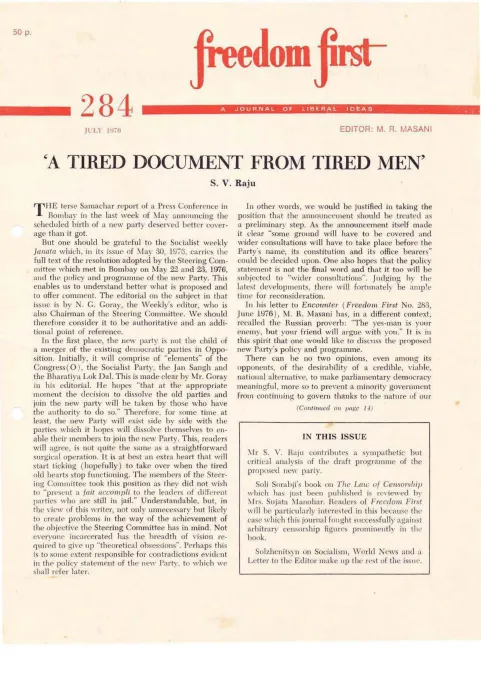
S. V. Raju’s “‘A Tired Document from Tired Men’” critiques the Steering Committee’s draft policy for a new united opposition party merging Congress (O), the Socialist Party, the Jan Sangh and the Bharatiya Lok Dal, endorsing its civil-liberties points but criticising an arbitrary 1:10 income-ratio commitment and vague “total plan” language as Gosplan-like patchwork.
-
The “Between You & Me and the Lamp Post” column cites a Kultura article showing East Bloc resistance to Third World aid demands at UNCTAD Nairobi and mocks Brezhnev’s praise of Congress’s public-sector industrialisation policy as responsible for India’s economic plight.
-
Eldridge Cleaver, writing from a California prison cell, attacks the UN resolution branding Zionism as racism, arguing from personal experience that Arab states practice racism toward black Africans including literal slavery.
-
An extract from Solzhenitsyn’s BBC broadcast argues socialism functions as an emotionally satisfying “worldly religion” whose logical expression, not distortion, is forced labour and the Gulag.
-
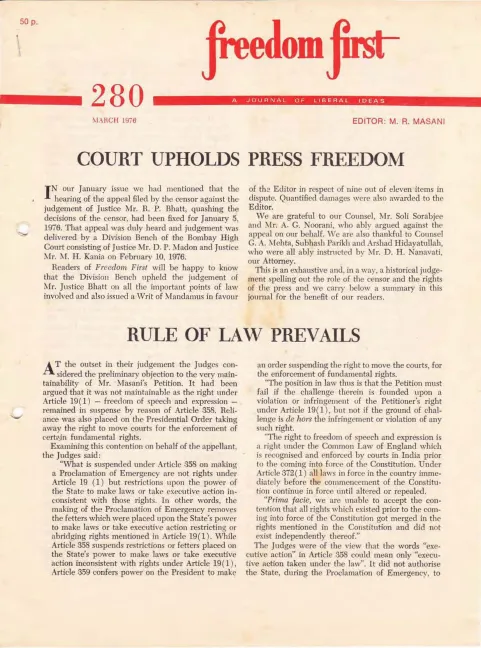
A legal correspondent reports Justice Kania’s admission of Acharya Kripalani’s writ petition challenging the Emergency censor’s suppression of a March 1976 opposition-unity resolution, with the maintainability question referred to a Division Bench.
-
Sujata Manohar reviews Soli Sorabjee’s Law of Press Censorship in India, highlighting the Bombay High Court’s finding in M. R. Masani vs. Binod Rao that nine of eleven censored Freedom First items were wrongly banned.
-
Fredoon Antia reviews World of Hunger: A Strategy for Survival, questioning the authors’ faith in global redistribution given their own admission that “working adults keep the largest share of available food for themselves” even within families.
-
A reader’s letter by P. L. Mayekar objects to the Swaran Singh Committee’s proposal to designate India a “Socialist Republic” in the Constitution, warning the imprecise term would confer unearned respectability and pave the way for enforced ideological conformity.
Essays
’A Tired Document from Tired Men’
By S. V. Raju
S. V. Raju offers a sympathetic but pointed critique of the draft resolution and ‘Ten Point’ policy programme adopted by the Steering Committee (chaired by N. G. Goray) for a new opposition party intended to unite elements of Congress (O), the Socialist Party, the Jan Sangh, and the Bharatiya Lok Dal. Raju argues the slide toward the Emergency began not in June 1975 but with the 1967 general election and the failure of opposition parties to read the electorate’s verdict, and faults the Steering Committee for treating the Emergency as the origin of India’s problems rather than their result. He praises the first six of the ten policy points (restoring civil liberties, setting up Constitutional and electoral-reform commissions) as sound and ‘totally acceptable to any liberty loving democrat,’ but criticises the document’s later ‘patchwork’ language — an ill-defined commitment to ‘egalitarian’ society, an arbitrary 1:10 minimum-to-maximum income ratio, and a vague ‘total plan covering all… departments of national life’ that he likens to an improved Gosplan. He also warns against gheraos and bundhs as illegitimate tactics, citing Rajaji’s teaching that only peaceful satyagraha is constitutionally acceptable. Raju concludes the strategy of contesting a free election under present conditions may not be realistic, though the underlying critique is his primary focus.
- Analyses the Steering Committee’s resolution (Bombay, 22-23 May 1976) for a new unified opposition party, as reported by the Socialist weekly Janata.
- Argues the crisis in Indian democracy predates the Emergency, tracing it to the 1967 general election and subsequent opposition disarray.
- Endorses the first six of the ten policy points (restoring civil liberties, Constitutional review commission, electoral reform commission) as pragmatic and broadly acceptable.
- Criticises later sections as a ‘patchwork’ of vague egalitarian commitments, including an arbitrary 1:10 income ratio and an undefined ‘total plan’ for national life.
- Invokes C. Rajagopalachari’s teaching that peaceful satyagraha, not gheraos or bundhs, is the legitimate constitutional method of protest.
- Concludes by questioning whether contesting a ‘free election under present conditions’ is a realistic strategy for the proposed party.
Third World Racism at U.N.
By Eldridge Cleaver
Eldridge Cleaver, the Black Panther leader and author of Soul on Ice, writes from a California prison cell (having returned from exile in Algiers) to attack the UN General Assembly’s resolution branding Zionism as racism. He argues that having lived among Arabs for years, he found them to be deeply racist toward black Africans, including practicing literal slavery, and that the Communist and Arab dictatorships condemning Israel are themselves undemocratic. He questions why small, undemocratic states should have a UN vote equal to that of the United States, and criticises the West’s guilt-driven credulity toward Third World rhetoric.
- Cleaver argues the UN resolution equating Zionism with racism is a ‘travesty upon the truth’ given Jewish scholars’ historic contributions to studying and refuting racism.
- Recounts personal experience in Mali and Algeria of Arab racism toward black Africans, including ongoing domestic slavery.
- Contends Communist dictatorships and Arab regimes are united by shared authoritarianism rather than by any principled solidarity.
- Proposes reexamining whether small, undemocratic member states should hold a UN vote equal in weight to the United States.
- Frames the piece from his own prison cell as evidence that the fight for democracy and freedom must be waged everywhere, including from within US prisons.
Solzhenitsyn on Socialism
By Alexander Solzhenitsyn
An extract from Alexander Solzhenitsyn’s celebrated BBC broadcast argues that the ‘misty phantom of socialism’ has hastened the decline of contemporary thought by offering an emotionally satisfying but logically empty vision of equality that in practice requires coercion. He contends socialism is never studied seriously, is defended ‘with a passionate lack of reason,’ and that its historical antecedents (from Thomas More to Marx) reveal a totalitarian core once one actually reads them. He identifies forced labour as intrinsic to all socialist programmes, not an aberration, and warns that the West’s guilt-ridden self-doubt leaves it unable to recognise the danger closing in on it, drawing on the suffering of Russia and Eastern Europe as a warning the West has refused to heed.
- Argues socialism functions as a ‘worldly religion’ accepted on faith rather than examined through its founding texts.
- Cites Academician Igor Shafarevich’s study showing socialist doctrines recur across history as reactions against individualism, not as modern innovations.
- Asserts that ‘ideal’ equality under socialism necessarily requires compulsion and the levelling of individual personality.
- States that forced labour is ‘part of the programme of all prophets of socialism, including the Communist manifesto’ and that the Gulag Archipelago is not a distortion of the ideal but its logical expression.
- Warns the West has lost the capacity to recognise mortal danger and refused to heed the warnings of those who suffered under socialism in the East.
Reviews: The ‘Freedom First’ Case (Law of Press Censorship in India by Soli J. Sorabjee)
By Sujata Manohar
Sujata Manohar reviews Soli J. Sorabjee’s Law of Press Censorship in India (N. M. Tripathi, Rs. 35), which analyses the Emergency-era censorship order under Rule 48 of the Defence of India Rules through three key judgments: M. R. Masani vs. Binod Rao, Y. D. Lokurkar vs. Binod Rao (both Bombay High Court), and a Gujarat High Court case. She highlights that the Bombay High Court, in Masani’s petition challenging censorship of eleven items from Freedom First’s August 1975 issue, held nine of the eleven banned items to have been wrongly banned, with Justice Madon’s judgment emphasizing that the press is a vehicle for moulding public opinion and that true democracy requires a free clearinghouse of competing ideologies. She finds the book valuable as a reference but faults it for being largely a compilation of reprinted judgments and statutes with only a brief original introduction and commentary, lacking deeper critical analysis of press censorship law.
- Reviews Soli J. Sorabjee’s Law of Press Censorship in India, covering the Emergency censorship order under Rule 48 of the Defence of India Rules, 1971.
- Highlights the Bombay High Court judgment in M. R. Masani vs. Binod Rao, which found nine of eleven banned Freedom First items (August 1975 issue) to have been wrongly banned.
- Quotes Justice Madon’s holding that the press is ‘a powerful medium of moulding public opinion’ and that democracy requires ‘a free clearing-house of competing ideologies and philosophies.’
- Notes the book also covers Y. D. Lokurkar vs. Binod Rao and a Gujarat High Court ‘Bhoomiputra’ case.
- Criticises the book for consisting mainly of reprinted judgments and statutory texts, with the author’s original contribution limited to an introduction and commentary.
Reviews: World of Hunger: A Strategy for Survival
By Fredoon Antia
Fredoon Antia reviews Jonathan Power and Anne-Marie Holenstein’s World of Hunger: A Strategy for Survival (Maurice Temple Smith, London), which argues world hunger stems from mal-distribution of food (rich countries consuming 2,000 lbs of cereals per capita versus 400 lbs for the Third World) rather than absolute production shortfalls. Antia is skeptical of the authors’ faith in worldwide redistribution given evidence of selfishness even within families, and notes their own admission that structural change threatens ‘the privileged of their own influential upper class’ in the Third World. He summarizes their advocacy of a Gandhian, village-centred development strategy focused on small independent farmers and criticises the Green Revolution’s bias toward large landowners at the expense of small farmers, while praising the book’s grounding in UN, FAO, and World Bank data despite awkward referencing and organisation.
- Reviews Jonathan Power and Anne-Marie Holenstein’s World of Hunger: A Strategy for Survival, focused on Third World hunger including India, Pakistan, and Bangladesh.
- Summarises the authors’ thesis that hunger stems from global mal-distribution of food rather than shortfalls in total production.
- Questions the authors’ faith in global altruism, given their own admission that ‘working adults keep the largest share of available food for themselves’ even within families.
- Notes the authors’ advocacy of a Gandhian return to village-centred, small-farmer-based development as the solution to hunger and population pressure.
- Critiques the Green Revolution as favouring large landowners while pushing small farmers toward landlessness, and calls for technology suited to peasant proprietorship.
- Praises the book’s grounding in authoritative UN/FAO/World Bank data but faults its poor organisation, lack of an index, and endnote-heavy referencing.
Letter: ‘Socialist’ Republic?
By P. L. Mayekar
In a letter to the editor, P. L. Mayekar objects to the Swaran Singh Committee’s proposal to formally designate India a ‘Socialist Republic’ in the Constitution, arguing that the imprecise, contested term would confer unearned respectability on self-styled socialists and pave the way for enforced ideological conformity. He illustrates the danger with a parable about a ‘capitalist society’ that, having voted itself capitalist, forces all citizens to publicly identify with the ruling party’s doctrine and forbids any experimentation with alternatives — arguing the same danger applies if ‘socialist’ is substituted for ‘capitalist.’
- Mayekar argues the goal of reducing poverty could be achieved via a constitutional ‘directive principle’ without formally branding India a ‘Socialist Republic.’
- Contends ‘socialism’ is an imprecise word meaning different things to different people, from total state control to a vague ethical sentiment.
- Warns the label would let self-identified socialists acquire unearned social ‘respectability’ without ever having to define their terms.
- Uses a parable from ‘Character — A Talk to Young People’ about enforced ideological conformity under a hypothetical ‘capitalist society’ to warn against the same danger under enforced socialism.
- Concludes the Swaran Singh proposal would make ‘conformity by force… a little easier to come about,’ though he stops short of predicting disaster.
Acharya Kripalani’s Petition Admitted
By From a Legal Correspondent
A legal correspondent reports that on 22 June 1976, Justice Kania of the Bombay High Court admitted a writ petition filed by Acharya J. B. Kripalani, N. G. Goray, S. M. Joshi, and Mrs. Kumud Karkera, challenging the Emergency censor’s decision to prohibit publication of a news item about a March 1976 resolution by political and Sarvodaya workers (guided by Jayaprakash Narayan) calling for a Steering Committee to draft a unified opposition party programme. The censor’s order to Janwani Weekly editor Kumud Karkera had directed suppression of the entire story. Petitioners argued that publicising opposition statements is a basic democratic function that survives even under Emergency; the censor’s side argued the Supreme Court’s Habeas Corpus ruling made the petition non-maintainable. The judge admitted the petition and referred the maintainability question to a Division Bench.
- Justice Kania of the Bombay High Court admitted the writ petition on 22 June 1976.
- Petitioners were Acharya J. B. Kripalani, N. G. Goray, S. M. Joshi, and Mrs. Kumud Karkera (editor of Janwani Weekly).
- The censor, Binod N. Rao, had ordered the entire story of the March 1976 resolution suppressed, including the fact that a statement existed at all.
- Petitioners argued publicising opposition party statements is a legitimate democratic function, permissible even during Emergency, invoking the ‘right to dissent.’
- The respondent argued the Supreme Court’s Habeas Corpus decision rendered the petition non-maintainable; the judge admitted it anyway and referred the maintainability question to a Division Bench.
- Soli Sorabji (with S. N. Parikh and A. Hidayatullah) appeared for the petitioners; M. R. Paranjpe (with J. G. Sawant) appeared for the respondent.
World News (Reuter, Times, Telegraph, Guardian excerpts)
The ‘World News’ column reprints press items on press freedom and censorship worldwide: the International Press Institute’s 25th assembly lamenting global press restrictions, naming India, the Philippines, Peru, and Nigeria; the BBC’s cancelled Moscow visit after airing a Solzhenitsyn interview, read as evidence of Soviet fear of free speech; Rhodesia’s new press censorship regulations, denounced by local papers as an ‘admission of defeat’; the Soviet Union’s emergency measures after a poor grain harvest; an Observer editorial mocking Brezhnev’s KGB chief Andropov as an odd choice to speak on Lenin’s birthday given his role suppressing the Hungarian uprising; and a Daily Telegraph editorial criticising UK Chancellor Denis Healey’s proposed ‘snooping powers’ for the Inland Revenue as an assault on legal privilege and civil liberties.
- The International Press Institute’s 25th general assembly (245 editors/publishers from 33 countries) condemns press restrictions in India, the Philippines, Peru, and Nigeria.
- BBC Director-General Sir Charles Curran’s Moscow/Leningrad visit is abruptly cancelled after the BBC aired a Solzhenitsyn interview about his new book on Lenin.
- Rhodesian newspapers, including The Chronicle of Bulawayo, call new government censorship regulations an implicit ‘admission of defeat’ in the propaganda war.
- The Kremlin launches a wide-ranging campaign, including drafting students and schoolchildren into harvest work, to avert a repeat of the previous year’s grain disaster.
- The Observer mocks the appointment of KGB chief Andropov, architect of the Hungarian suppression, as the main speaker at Lenin’s birthday celebration.
- The Daily Telegraph condemns Denis Healey’s proposed Inland Revenue ‘snooping powers’ as an invasion of legal privilege that could be used to terrorise honest taxpayers.
Between You & Me and The Lamp Post
The regular ‘Between You & Me and The Lamp Post’ column compiles short editorial comments on current affairs: a Kultura (Polish Communist journal) article revealing the Soviet bloc’s hard line toward developing countries at the Nairobi UNCTAD conference; a UK survey showing that most British workers, contrary to trade-union leaders’ claims, approve of profit and free enterprise; an anecdote of an LSE-educated Englishman repaying his scholarship money out of guilt over a wasted economics education; wry commentary on Brezhnev’s flattering remarks to Indira Gandhi about Congress’s industrialisation policy, which the columnist blames for India’s agricultural neglect; and criticism of Spain’s decision to keep the Communist Party banned while legalising other parties, framed as prudent given the Portugal precedent.
- Reports a Kultura (Polish Communist Party journal) piece, cited via Freedom First’s May issue, showing East Bloc resistance to Third World demands for aid parity at UNCTAD Nairobi.
- Cites a British CBI-commissioned survey finding only 8% of UK workers call profit ‘a dirty word’ and 89% think it fair for companies to pay dividends.
- Recounts Victor Robertson’s repayment of his LSE scholarship money to Lady Ellerman as an act of conscience over ‘wasted’ public funds on an economics degree.
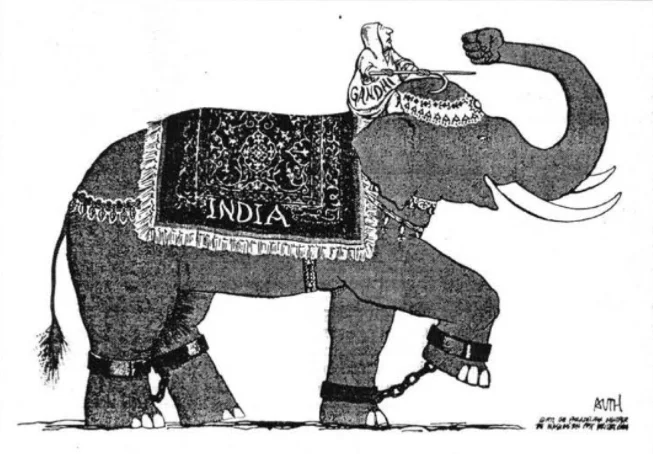
- Mocks Brezhnev’s praise of Congress’s ‘policy of industrialization… and a strong public sector’ as responsible for India’s current economic plight.
- Approves Spain’s lifting of the 37-year ban on political parties while keeping the Communist Party banned, contrasting it with Portugal’s near-disaster after an unconditional lifting.
With Many Voices
The closing page, ‘With Many Voices,’ is a compilation of short, wry quotations gathered from the international press on themes of liberty, hypocrisy, and current events — including a jab at Marxist sectarian splintering, M. R. Masani’s ideological eclecticism, British industrialists’ timidity, the nature of liberty versus power, and a closing quote from India’s Education Minister Nurul Hasan that ‘students should be socialist, secular.’
- Includes a quip that ‘the original name of the firm was Marx and Engels: Socialism, Wholesale, Retail and for Export,’ satirising Marxist sectarian fragmentation (A. J. P. Taylor, Observer).
- Quotes Jonathan Power describing M. R. Masani’s philosophy as ‘a melange of Senator Henry Jackson, Alexander Solzhenitsyn and Willy Brandt on international affairs and Mahatma Gandhi on village development.’
- Includes an old saying: ‘The love of liberty is the love of others, the love of power is the love of ourselves.’
- Closes with Education Minister Nurul Hasan’s remark, ‘Students should be socialist, secular,’ reported in the Times of India.
- Also includes the subscription form for Freedom First and the issue’s imprint/registration details (Registered No. MH By South/264).
Generated by the v1.5 extraction pipeline. Awaiting editorial review.
Metadata and summary are AI-extracted from the source PDF and reviewed for editorial accuracy. The original work is available via the Read PDF tab above (where present); paragraph-level citation inside the PDF is deferred to a future engagement.