periodical issue
Freedom First
A Journal of Liberal Ideas
By M. R. Masani, Bernard Levin, Geeta Doctor, S. P. Aiyar, V. B. Karnik
Published for the Democratic Research Service by J. R. Patel, Associate Editor, Freedom First at 127, M. Gandhi Road, Bombay 400 023 (Phone: 273914) and printed by him at Mohan Mudranalaya, Acme Estate, Sewri (East), Bombay 400 015. · Bombay · 1976
16 pages
Freedom First
Summary
This is issue No. 287 of Freedom First (October 1976), a monthly journal of liberal ideas edited by M. R. Masani and published in Bombay by the Democratic Research Service. The issue is dominated by the constitutional crisis of the Emergency: Masani’s lead editorial revisits his own 1975 lectures on federalism, presidential discretion, and fundamental rights, and then attacks the pending 44th Constitutional Amendment Bill as a device that strips the courts, the President, and the states of their power to check the Union executive. The editor’s column, ‘Between You and Me and the Lamp Post,’ extends this with sharp notes on Mao’s death, an Advocates Bill seen as an attack on the legal profession, and a Supreme Court judge’s remarks on judicial activism. A long reprinted piece by the British commentator Bernard Levin expounds Alexander Solzhenitsyn’s ‘Live Not by Lies’ credo of personal non-participation in falsehood, addressed to Soviet citizens but clearly offered to Indian readers as commentary-by-analogy on authoritarian rule. A ‘World News’ digest covers Pakistan’s fifth constitutional amendment, Kosygin’s uncertain health, press liberalisation in Brazil, and the economics of scarcity and queueing in the Soviet bloc, framed throughout by a preference for liberal-democratic over authoritarian arrangements. Geeta Doctor’s film column reflects on the death and mythology of Bruce Lee. Two book reviews close the issue: S. P. Aiyar on a sympathetic biography of Jayaprakash Narayan by Allen and Wendy Scrafe, and V. B. Karnik on the first volume of Sarvepalli Gopal’s official biography of Jawaharlal Nehru, which Karnik reads critically on the question of Nehru’s handling of the Partition-era communal crisis. The back cover assembles a page of aphoristic quotations (‘With Many Voices’) from world leaders and commentators of 1976.
Key points
-
M. R. Masani’s “The 44th — And the Last?” recalls his 1975 Bangalore lectures on presidential and gubernatorial discretion and attacks the pending 44th Constitutional Amendment Bill for denying the President a veto and insulating itself from Supreme Court review, arguing the ruling party’s 1971 mandate came from under a quarter of the total electorate.
-
The “Between You and Me and the Lamp Post” column contrasts Indian press adulation of Mao at his death with earlier condemnation of Stalin, citing estimates of 25-80 million killed under Mao’s rule, and criticises the Advocates (Amendment) Bill for abolishing the solicitor-barrister division in the Bombay and Calcutta High Courts.
-
Bernard Levin’s essay on Solzhenitsyn’s “Live Not by Lies” credo summarises the writer’s proposed “key” of personal non-participation in official falsehood as an alternative to active resistance, quoting his catalogue of everyday refusals such as not attending mandatory demonstrations.
-
A “World News” digest reports Pakistan’s fifth constitutional amendment curbing High Court bail powers, unconfirmed reports of Premier Kosygin’s declining health, and the pervasive burden of queueing for bread and apartments across the Soviet bloc.
-
Geeta Doctor’s film column “The Poetry of Violence” reflects on Bruce Lee’s death, describing how he transformed martial-arts combat into “a strangely compelling dance of death” through fanatical personal discipline.
-
S. P. Aiyar reviews a sympathetic Scrafe biography of Jayaprakash Narayan, criticising JP’s notion of partyless, small-community democracy as romantic but affirming his warnings against state power reducing citizens to “a cog in a vast human machine.”
-
V. B. Karnik reviews the first volume of Sarvepalli Gopal’s official Nehru biography, arguing Nehru and Congress leaders’ denial of the Muslim League’s representative character made Partition’s communal violence more likely, and rejecting the book jacket’s comparison of Nehru to Mao as “ludicrous.”
Essays
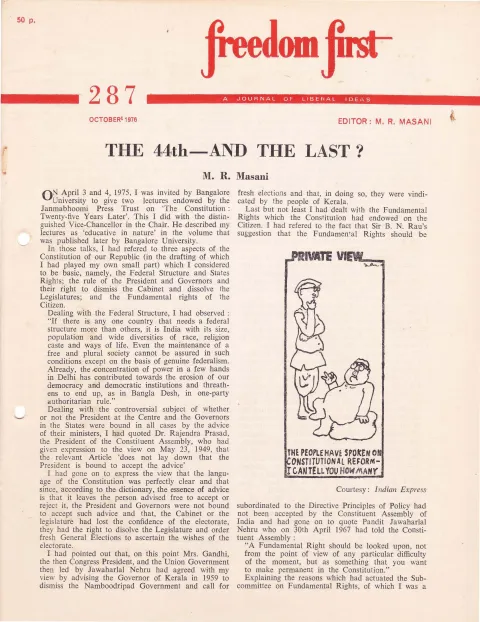
The 44th—And the Last?
By M. R. Masani
M. R. Masani’s lead editorial, ‘The 44th — And the Last?’, opens by recalling two lectures he gave at Bangalore University in April 1975 on ‘The Constitution: Twenty-five Years Later,’ in which he discussed the federal structure, the discretionary powers of the President and Governors to dismiss ministries and dissolve legislatures, and the Fundamental Rights chapter. He recounts having warned then that concentration of power in Delhi was eroding Indian democracy and could produce one-party authoritarian rule of the Bangladesh kind, and having argued (citing Dr. Rajendra Prasad and Jawaharlal Nehru’s own past positions) that a President or Governor is not bound to accept ministerial advice in all circumstances and that Fundamental Rights should not be subordinated to the Directive Principles. Masani then pivots to the news of the day: the 44th Constitutional Amendment Bill, introduced in the Lok Sabha on 1 September 1976, which he says would deny the President a veto, strip the Supreme Court of the power to strike the amendment down as an act ultra vires the Constitution (given the Kesavananda Bharati precedent), and effectively make the current, emergency-era concentration of power permanent by letting the Cabinet freely ‘remove difficulties’ in applying the amended Constitution for two years. He argues that Law Minister Gokhale’s claim that Parliament is sovereign and represents ‘the will of the people’ is undercut by the arithmetic of the 1971 election, in which the ruling party won its majority with under a quarter of the total electorate’s support. The essay closes by quoting Lord Hailsham and A. V. Dicey on the internal and external limits of parliamentary sovereignty, and Leslie Stephen’s dictum that even a legislature that could legally order the murder of blue-eyed babies would be resisted by disobedient subjects, to argue that removing constitutional checks and balances opens ‘the floodgates to the dangers of instability which accompany absolute sovereignty.’
- Recalls Masani’s 1975 Bangalore University lectures on federalism, presidential/gubernatorial discretion, and fundamental rights.
- Cites Dr. Rajendra Prasad’s 1949 view that the President is not bound in all cases to accept Cabinet advice.
- Notes that Nehru and Mrs. Gandhi both once acted on the premise that a Governor could dismiss a ministry and order fresh elections, citing the 1959 Kerala (Namboodiripad) precedent.
- Attacks the 44th Amendment Bill for removing the President’s veto, insulating the amendment from Supreme Court review, and permitting Cabinet-directed modification of the Constitution for two years.
- Disputes Law Minister Gokhale’s claim of unqualified parliamentary sovereignty by pointing out only about 43 percent of the 54 percent who voted in 1971 backed the ruling party.
- Invokes Dicey, Hailsham, and Leslie Stephen to argue that sovereignty is never truly absolute and that removing institutional checks threatens political stability, not just individual liberty.
And Now the 44th / Between You and Me and The Lamp Post
The unsigned editorial column ‘Between You and Me and The Lamp Post’ (customarily written by the editor) opens with a sardonic item on the Indian press’s reverential coverage of Mao Zedong’s death, contrasting it with the same papers’ earlier condemnation of Stalin, and citing rival estimates that Mao’s regime killed between 25 and 80 million people. A second item, ‘Under Attack Again,’ criticises the Advocates (Amendment) Bill for abolishing the solicitor/barrister division of legal labour in the Bombay and Calcutta High Courts, arguing this will lower the quality of litigation services, and juxtaposes this with a Supreme Court dictum by Justice P. N. Bhagwati that the law must serve ‘the weaker sections of the community.’ A third item, ‘Cockroaches in Park Lane,’ begins by describing a London hotel’s costly kitchen refit after a single cockroach was found, framing this fastidiousness as a model India, with its endemic cockroach and disease problem, might learn from.
- Contrasts Indian press adulation of Mao at his death with earlier condemnation of Stalin, citing estimates of 25-80 million killed under Mao’s rule.
- Criticises the Advocates (Amendment) Bill for abolishing the solicitor-barrister division in the Bombay and Calcutta High Courts.
- Quotes Justice P. N. Bhagwati’s Supreme Court remarks on law needing to serve the weaker and poorer sections of society.
- Uses a London cockroach-infestation story at the Park Lane Hotel as a springboard for a call for hygiene discipline in India.
Continuing the editor’s column on page 5, an item titled ‘Substitutes For a Free Press’ reports on the Soviet press campaign (via Pravda and Izvestia) against Radio Free Europe and Radio Liberty, estimating 35-40 million listeners in Russia and Eastern Europe, and notes that Jimmy Carter, then the Democratic presidential candidate, had praised these broadcasters as indispensable substitutes for a free press in Russia and Eastern Europe; it also notes West Germany’s refusal to accede to Soviet protests. A following item, ‘National Association for Freedom,’ profiles the newly formed British pressure group (led by Robert Moss, editor of The Economist’s Foreign Report) as a middle-class body defending individual liberty, supporting workers victimised by the closed shop, and opposing both Trade Union monopoly power and the racist National Front, which it labels ‘gutter fascism.’
- Reports Soviet propaganda attacks on Radio Free Europe/Radio Liberty and Jimmy Carter’s description of them as substitutes for a free press.
- Notes West Germany’s refusal to curb the broadcasters despite Soviet protest, citing Helsinki accord compliance.
- Profiles Britain’s National Association for Freedom (NAF), founded December 1975 under Robert Moss, as a civil-liberties body fighting closed-shop trade unionism and opposing the National Front.
To the Soviet Citizen: Solzhenitsyn’s Commandment
By Bernard Levin
Bernard Levin’s essay ‘To the Soviet Citizen: Solzhenitsyn’s Commandment,’ reprinted from The Times, discusses the continuing impact in Britain of Alexander Solzhenitsyn’s two 1976 addresses to the British people, and takes as its main text Solzhenitsyn’s February 1974 farewell statement ‘Live Not by Lies,’ issued the day the KGB forced him onto a plane to West Germany. Levin summarises Solzhenitsyn’s diagnosis that Soviet life rests on a ‘lock’ of universal, daily participation in official lies, and his proposed ‘key’: personal non-participation in falsehood — refusing to sign, write, print, utter, or applaud any lie, even while stopping short of demanding active resistance or a Gandhian civil disobedience campaign. Levin quotes at length Solzhenitsyn’s catalogue of specific refusals (not attending demonstrations whose slogans one doesn’t believe, not buying newspapers that distort facts, walking out of meetings that feature ideological cant) as a ‘roll-call of honour’ defining what it means to live in truth under totalitarianism.
- Frames Solzhenitsyn’s February 1974 ‘Live Not by Lies’ statement as his last public utterance before forced exile.
- Summarises Solzhenitsyn’s argument that the Soviet system depends on a ‘lock’ of universally internalised lies, sustained by fear and by the belief that ‘we cannot do anything about it.’
- Presents personal non-participation in lies as Solzhenitsyn’s proposed ‘key’ to liberation, distinct from active resistance or civil disobedience.
- Quotes the specific catalogue of everyday refusals Solzhenitsyn commends: not signing false statements, not attending mandatory demonstrations, walking out of propagandistic events, and not buying newspapers that distort the truth.
World News
The unsigned ‘World News’ digest, compiled from Western wire and newspaper sources, covers a run of stories from mid-to-late 1976: Pakistan’s National Assembly passing a fifth constitutional amendment curtailing High Court bail powers over Bhutto’s opposition; the Colombo non-aligned summit (‘First Tango in Colombo’), attended by figures such as Tito, Bhutan’s young King Jigme Singye Wangchuck, and Sri Lanka’s Mrs. Bandaranaike, including Bangladesh’s General Zia-ur Rahman’s resolutions and rivalries over the conference’s coordinating committee; reports that Kosygin’s retirement may be imminent after a swimming accident; Brazil’s O Estado newspaper exposing lavish official spending amid loosening press censorship; Pham Van Dong’s speech blaming the capitalist West for global economic crisis; and a piece on the pervasive, politically corrosive experience of queueing for goods and services (bread, apartments, medical care) across the Soviet bloc, including anecdotes from Poland, Romania, and other Eastern European states, closing with a wry note that only bribery in hard currency shortcuts the wait.
- Reports the Pakistani National Assembly’s fifth constitutional amendment curbing High Court bail powers, opposed by Bhutto’s government critics.
- Covers the Colombo non-aligned summit, noting friction between founder members (India, Yugoslavia) and newer radical members (Cuba, North Korea, Vietnam) over the coordinating committee.
- Notes unconfirmed reports of Premier Kosygin’s declining health and possible imminent retirement.
- Covers Brazilian press exposés of official extravagance amid an easing of censorship under President Geisel.
- Quotes Pham Van Dong’s speech blaming capitalist countries for the world economic crisis.
- Describes the everyday burden of queueing for bread, apartments, and medical care across the Communist bloc as a source of serious political unrest, especially in Poland.
The Poetry of Violence (Films)
By Geeta Doctor
Geeta Doctor’s film column ‘The Poetry of Violence’ reflects on the death of Bruce Lee and the instant, largely uncritical biographies that followed. She argues that Lee, though by most accounts an unremarkable actor off screen, transformed Karate and Kung-Fu combat into what she calls ‘a strangely compelling dance of death,’ turning violence in Enter the Dragon into something as emotionally pure as love, and made audiences leave the theatre wanting to find the nearest karate dojo. She discusses the esoteric, quasi-mystical roots of Kung-Fu (its claimed four-thousand-year lineage, its kinship with acupuncture’s map of the body’s weak points, and its demand for total mental concentration), tells illustrative parables of a Judo master’s reflexive strike and a Zen sword-master’s servant training a technique through unconscious readiness, and describes Lee’s own fanatical physical discipline. She closes by suggesting that Lee’s insistence that martial arts must genuinely disable an opponent rather than merely display virtuosity alienated the guardians of established schools, and that his fame ultimately betrayed his own Zen-inflected maxim that ‘the usefulness of a cup is in its emptiness,’ with his crack-up read by some as a retribution for ends that no longer respected proper means.
- Frames Bruce Lee’s on-screen violence in Enter the Dragon as an aestheticized, almost mystical spectacle rather than mere combat.
- Describes Kung-Fu’s claimed four-thousand-year lineage and its kinship with acupuncture’s mapping of the body’s weak points.
- Recounts parables illustrating reflexive, unconscious mastery in Judo and Zen swordsmanship.
- Details Lee’s personal discipline (practising with a wooden stool, nightly Kata practice) and his rejection of ritualistic, display-oriented martial arts schools.
- Suggests Lee’s death and legend were read by some as retribution for ends overtaking proper means, in tension with his own Zen-inflected maxim about emptiness.
J. P.: His Biography (review of Allen and Wendy Scrafe, Orient Longman, 1975)
By S. P. Aiyar
S. P. Aiyar reviews J.P.: His Biography by Allen and Wendy Scrafe (Orient Longman, 1975), a sympathetic account of Jayaprakash Narayan by an Australian couple who first met him in 1958 and later became Sarvodaya volunteers at his Sokhodeora ashram. Aiyar praises the biography’s intimate, humanising detail (including domestic anecdotes of JP’s married life with Prabhavati) while flagging factual errors (misdating the Permanent Settlement, mislabelling Rajaji a Soviet-oriented Marxist, wrongly crediting Gokhale as founder of Fergusson College). He engages substantively with JP’s political thought, expressing disagreement with the impracticality of JP’s ‘Plea for the Reconstruction of Indian Polity’ and its notion of partyless democracy, which Aiyar sees as ignoring the unlovely realities of village politics, but affirms the enduring value of JP’s warnings against the growing power of the state reducing citizens to ‘a cog in a vast human machine.’ He also discusses JP’s ideological journey from Marxism to Sarvodaya, his complicated but ultimately devoted relationship to Gandhi, and Masani’s own observation (quoted here) that JP’s slow conversion to Gandhism was a historical tragedy because it came too late for a fuller rapport with Gandhi to shape India’s destiny.
- Reviews Allen and Wendy Scrafe’s sympathetic 1975 biography of Jayaprakash Narayan, praising its intimacy and readability but noting several factual errors.
- Criticises JP’s notion of partyless, small-community democracy as romantic and inattentive to the realities of village politics.
- Affirms the lasting relevance of JP’s warnings against state power reducing the citizen to ‘a cog in a vast human machine.’
- Discusses JP’s evolution from Marxism to Sarvodaya and his complex, ultimately devoted relationship with Gandhi.
- Quotes Masani’s view that JP’s slow conversion to Gandhism was a tragedy that cost India a fuller Gandhi-JP rapport.
Jawaharlal Nehru: A Biography, Vol. I (review of Sarvepalli Gopal, Oxford University Press, Bombay)
By V. B. Karnik
V. B. Karnik reviews the first volume of Sarvepalli Gopal’s official biography Jawaharlal Nehru (Oxford University Press, Bombay, Rs. 100/-), covering 1889 to 1947, written with Indira Gandhi’s grant of ‘unlimited access’ to her father’s papers. Karnik credits Gopal with an interesting and authoritative, if hero-worshipping, account, but argues the biography is not flattering on Nehru’s handling of the central crisis of the transfer of power: he contends Nehru and other Congress leaders arrogantly denied the representative character of Jinnah’s Muslim League, making Partition’s communal catastrophe more likely, and that Nehru was slow to recognise the League’s growing strength as far back as 1937. He faults Nehru’s naive expectation that Indians would not resort to communal violence, and criticises Nehru’s ambivalence during the Second World War—wanting to end a century of hostility with Britain by joining the war effort even as the Congress opposed British imperialism. Karnik closes by dismissing as ‘ludicrous’ the biography’s jacket comparison of Nehru to Mao, arguing the two led fundamentally different kinds of transitions (a decades-long violent revolution versus a comparatively peaceful transfer of power), and looks forward to Gopal’s remaining two volumes.
- Reviews Vol. I of Sarvepalli Gopal’s official Nehru biography (1889-1947), written with Indira Gandhi’s unrestricted access to Nehru’s papers.
- Credits the biography as authoritative and interesting but marked by hero worship.
- Argues Nehru and Congress leaders’ denial of the Muslim League’s representative character made Partition’s communal violence more likely.
- Criticises Nehru’s ambivalence in World War II, torn between opposing British imperialism and wanting to join the war to end a century of Anglo-Indian hostility.
- Rejects the biography jacket’s comparison of Nehru to Mao Zedong as ludicrous, given their very different paths to power.
With Many Voices (quotations column)
The back cover, ‘With Many Voices’ (its title taken from Tennyson’s ‘Ulysses’), collects short aphoristic quotations from 1976 world affairs commentary, including Jimmy Carter on prayer and peace, B. K. Nehru on the limits of India’s affordable social welfare, The Economist on prime ministerial impatience and on politicians and sport, a Lebanese Christian soldier’s blunt statement of a preference for the Israelis over the Palestinians, Ronald Reagan on inflation as caused by government overspending, and closing notes on Third World rhetoric, Indo-Pakistani relations, and Burma as a cautionary tale that independence, socialism, and non-alignment alone do not guarantee peace and prosperity. The page also carries the journal’s subscription form and imprint details (published by J. R. Patel for Democratic Research Service, printed at Mohan Mudranalaya, Bombay).
- Compiles brief quotations from 1976 commentary by figures including Jimmy Carter, Ronald Reagan, B. K. Nehru, and The Economist.
- Includes a Lebanese Christian soldier’s quoted preference for the Israelis over the Palestinians.
- Closes with an editorial-style aphorism on Burma as proof that independence, socialism, and non-alignment do not by themselves bring peace and prosperity.
- Carries the subscription form and publication imprint for Freedom First.
Generated by the v1.5 extraction pipeline. Awaiting editorial review.
Metadata and summary are AI-extracted from the source PDF and reviewed for editorial accuracy. The original work is available via the Read PDF tab above (where present); paragraph-level citation inside the PDF is deferred to a future engagement.