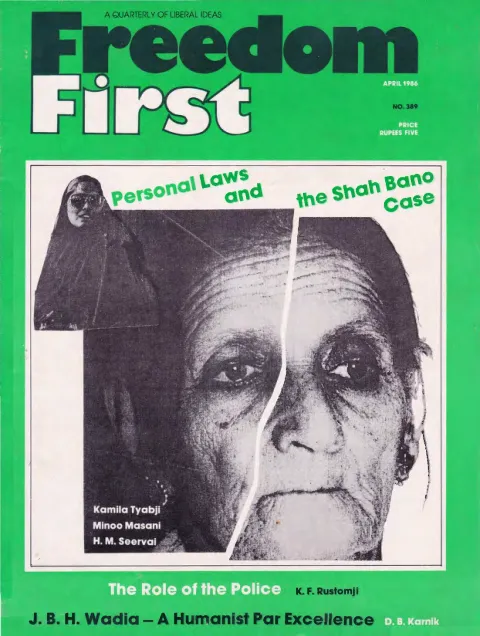
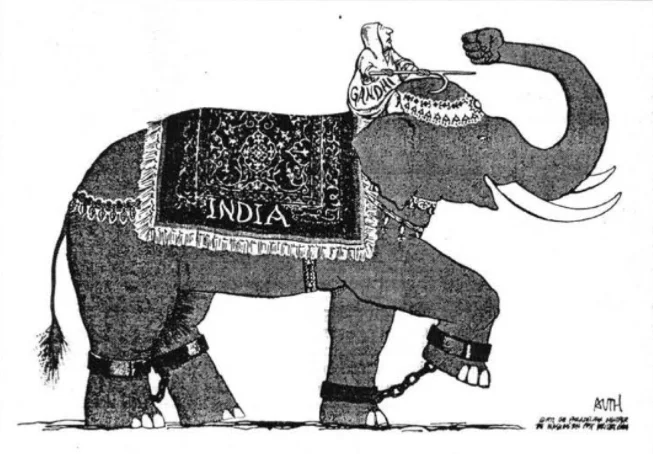
periodical issue
Freedom First
A Journal of Liberal Ideas
Published for the Democratic Research Service by J. R. Patel, Associate Editor, Freedom First at 127, M. Gandhi Rd., Bombay 400 023, and printed by him at States' People Press, Ghoga Street, Fort, Bombay-400 001. · Bombay · 1978
16 pages
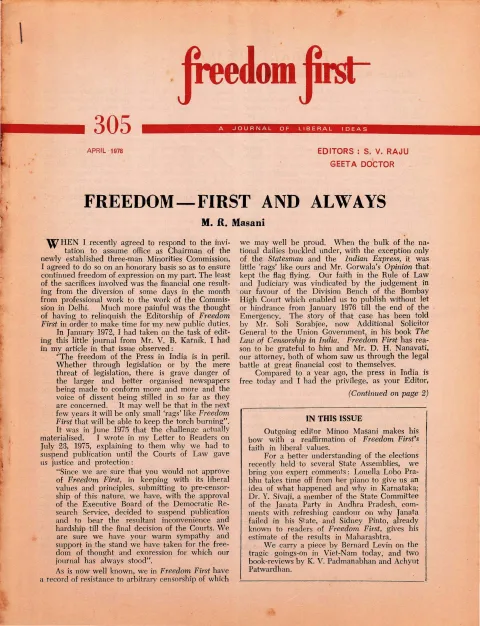
Freedom First
Summary
Freedom First No. 305 (April 1978) is a monthly issue of the Bombay-based liberal journal, marking a leadership transition: outgoing editor M. R. Masani hands over day-to-day editing to S. V. Raju and Geeta Doctor as he takes up the chairmanship of the newly-formed Minorities Commission, while reaffirming the journal’s record of resisting Emergency-era censorship. The issue’s centerpiece is a three-part analysis of the February 1978 State Assembly elections in Karnataka, Andhra Pradesh, and Maharashtra, written respectively by Louella Lobo Prabhu, Y. Sivaji, and S. A. A. Pinto, each dissecting why the Janata Party underperformed against a resurgent Indira Congress in the states’ first major polls since the Emergency. Other contents include an unsigned ‘Frankly Speaking’ editorial column touching on Maharashtra ministry-making, the Sikkim merger controversy, and the Union Budget; a syndicated Bernard Levin column (via The Times, London) on human-rights abuses under Vietnam’s post-1975 communist government; a ‘World News’ digest of foreign press clippings; two book reviews (K. V. Padmanabhan on R. K. Karanjia’s biography of the Shah of Iran, and Achyut Patwardhan on Madhu Dandavate’s comparative study of Marx and Gandhi); a reader’s letter on A. B. Vajpayee’s foreign-policy reversals; and the recurring ‘With Many Voices’ quotations column.
Key points
-
M. R. Masani’s valedictory editorial marks his departure from the Freedom First editorship to chair India’s new Minorities Commission, recalling the journal’s decision to suspend publication during the Emergency rather than submit to pre-censorship, vindicated by a Bombay High Court ruling.
-
Louella Lobo Prabhu’s analysis of the February 1978 Karnataka Assembly election finds the Indira Congress won 149 of 224 seats on 43% of the vote against Janata’s 59 seats, attributing the result to vote-splitting and Chief Minister Devaraj Urs’s patronage politics via the Havanur Backward Classes report.
-
Y. Sivaji’s analysis of the Andhra Pradesh election finds Janata’s vote share collapsed due to organisational disarray, poor candidate selection, and the co-option of discredited Congress defectors, of whom only 12 of 50 recontesting MLAs were re-elected.
-
S. A. A. Pinto’s analysis of the inconclusive Maharashtra election finds Janata the largest single party but far short of a majority, warning that seeking office via Congress(I) support could destroy its leadership’s credibility.
-
Bernard Levin opens a syndicated series on human-rights abuses under unified communist Vietnam, centred on testimony from Nguyen Cong Hoan, a National Assembly member disillusioned after visiting re-education camps holding detainees without trial since June 1975.
-
K. V. Padmanabhan reviews R. K. Karanjia’s admiring biography The Mind of a Monarch on the Shah of Iran, tracing his consolidation of power and “White Revolution” reform programme.
-
Achyut Patwardhan reviews Madhu Dandavate’s Marx & Gandhi, written during Dandavate’s Emergency imprisonment, praising its analysis of Gandhi’s warning that uncoordinated industrialisation and nationalisation both lead to a “servile society” under a leviathan state.
-
Sheila Sumant’s letter accuses Foreign Minister Atal Bihari Vajpayee of abandoning his own long-held positions on Kashmir, Pakistan, and the Indo-Soviet Treaty simply because he now serves in government.
Essays
Freedom—First and Always
By M. R. Masani
M. R. Masani’s valedictory editorial marks his departure from the Freedom First editorship as he takes up the chairmanship of India’s newly established three-man Minorities Commission. He recounts his tenure since January 1972, quotes his own 1972 warning about press freedom being in peril, and revisits the journal’s decision to suspend publication during the Emergency rather than submit to pre-censorship. He credits the Bombay High Court’s Division Bench judgement, and the legal efforts of Soli Sorabjee and D. H. Nanavati, with vindicating the journal’s stand and allowing publication to resume from January 1976. Masani closes by noting the continuing threat to press freedom under the post-Emergency Janata regime and thanking his successors and predecessor.
- Masani steps down as editor to chair the new Minorities Commission on an honorary basis to preserve his freedom of expression.
- He recalls his January 1972 editorial warning that press freedom was in peril and that only small ‘rags’ like Freedom First and Opinion kept dissenting voices alive.
- Freedom First suspended publication in mid-1975 rather than submit to Emergency pre-censorship, with the backing of the Democratic Research Service’s Executive Board.
- The Bombay High Court’s Division Bench ruled in the journal’s favour, permitting publication without hindrance from January 1976 to the end of the Emergency.
- Masani credits Soli Sorabjee and attorney D. H. Nanavati for seeing the journal through the legal battle at their own financial cost.
- He warns that the post-Emergency press climate, though freer, remains only a reprieve, citing disillusionment with the Janata government and a possible authoritarian backlash.
Frankly Speaking (Ministry-Making in Maharashtra; The Budget Hurts; Sikkim; Campaign Sidelights)
The unsigned ‘Frankly Speaking’ column surveys several current-affairs topics. It criticises the protracted and undignified process of ministry formation in Maharashtra following the 1978 state elections, comparing horse-trading over Independent MLAs to ‘counting heads of cattle,’ and endorses press commentary that a minority Janata government dependent on the CPI(M) and PWP would have been unworkable. It examines the Union Budget’s estimated deficit of Rs. 1,050 crores and rising excise duties, crediting the Finance Minister for prioritising rural infrastructure while cautioning against inflationary risk. A section on Sikkim discusses Morarji Desai’s controversial remarks to a New York Times correspondent questioning the manner of Sikkim’s merger with India, and a Janata MLA’s rebuttal alleging India suppressed the 1975 referendum result. The column closes with lighter items: satirical notes on gimmick-heavy Bombay election campaigning, and a nostalgic sketch of Charlie Chaplin’s life and his retirement home in Corsier-sur-Vevey.
- Criticises the drawn-out and manipulative process of ministry-making in Maharashtra, likening the recruitment of Independent MLAs to ‘rabbits out of white caps.’
- Endorses the view that a Janata minority government dependent on the CPI(M) and PWP would not have been durable, backing Governor Sadiq Ali’s decision not to call Janata to test its strength on the floor.
- Flags the Union Budget’s estimated uncovered deficit of Rs. 1,050 crores as alarmingly large, noting past budget deficit estimates have proved unreliable.
- Credits the Finance Minister for emphasising rural infrastructure development despite implementation risks resting with state governments.
- Recounts Morarji Desai’s remarks doubting the ‘desirability’ of Sikkim’s merger with India and a Janata MLA’s counter-allegation that the merger referendum result was suppressed by force.
- Offers a satirical account of gimmicky, poster-heavy Bombay election campaigning and profiles Charlie Chaplin’s biography and retirement in Corsier-sur-Vevey.
Karnataka—An Indira-Us Victory
By Louella Lobo Prabhu
Louella Lobo Prabhu analyses the February 1978 Karnataka Assembly election results, in which the Indira Congress won 149 of 224 seats on 43% of the vote against Janata’s 59 seats from 37.9% of the vote, a disparity she attributes to vote-splitting among the Reddy Congress, CPI, Maharashtra Ekikaran Samiti, RPI, and independents. She argues the outcome reflects an enduring ‘Indira-Urs charisma’ among rural voters largely indifferent to the Shah and Grover Commissions’ revelations, alongside Chief Minister Devaraj Urs’s patronage politics via the Havanur Backward Classes report, land-reform legislation, and hostel/education grants. She faults Janata for internal jockeying, an over-reliance on visiting central leaders who often proved counterproductive, insensitivity to prohibition and cow-slaughter concerns among toddy-tappers and Muslims, and divisive rhetoric from Central Congress leaders like Jagjivan Ram and Raj Narain. She closes by urging electoral reforms including proportional representation, mandatory voting, and curbs on defection.
- The Indira Congress won 149 of 224 Karnataka Assembly seats (43% of the vote) versus Janata’s 59 seats (37.9% of the vote), a gap attributed to vote-splitting among third parties.
- Turnout was 71.8% of the electorate (1,28,40,696 voters), one of the highest ever recorded in the state.
- Chief Minister Devaraj Urs’s Havanur Report classifying Backward Classes by caste, along with land-reform legislation and free hostel/education grants, cemented patronage-based rural support.
- Author argues the electorate showed cynical indifference to corruption allegations from the Shah and Grover Commissions.
- Janata’s campaign was hurt by internal delay in candidate selection, insensitivity on prohibition (toddy-tapping livelihoods) and cow-slaughter fears among Muslims, and divisive speeches by central leaders like Jagjivan Ram and Raj Narain.
- Calls for proportional representation (endorsing Masani’s repeated plea), mandatory voting, and curbs on defection as needed electoral reforms.
Andhra—Why Janata Failed
By Y. Sivaji
Y. Sivaji examines the Andhra Pradesh Assembly results, in which the Congress(I) won 175 of 290 contested seats (39% of votes) versus Janata’s 60 of 269 (29%), a sharp fall from the Janata-CPI(M) combine’s 38% Lok Sabha share in March 1977 to 31.5% in this poll. He attributes Janata’s collapse to organisational disarray (its state committee was not reorganised until September, its 9-member election committee ballooned to 27), poor candidate selection by out-of-touch central leaders, weak manifesto publicity, and the co-option of discredited defectors who tarnished the party’s image with voters, of whom only 12 of 50 sitting Janata MLAs who had crossed over from Congress were re-elected. He also argues Mrs. Gandhi successfully claimed credit for Chief Minister Vengalarao’s land and housing allotments to Scheduled Castes, and that Andhra’s middle class, unlike its northern counterpart, remained socially and economically closer to the poor and thus less receptive to Janata’s appeal.
- Congress(I) won 175 of 290 contested seats (39% of votes polled); Janata won 60 of 269 contested seats (29%); CPI(M) and CPI, allied respectively with Janata and Congress, won 2.74% and 2.32% of votes.
- The Janata-CPI(M) combine’s vote share fell from 38% in the March 1977 Lok Sabha poll to 31.5% in this Assembly election.
- Janata’s state committee was not reorganised until September 1977 and its 9-member election committee grew unmanageably to 27 members, contributing to poor candidate selection.
- Of 50 sitting Janata MLAs (mostly recent defectors from Congress) who recontested, only 12 were successful, reflecting voter rejection of turncoats.
- Mrs. Gandhi successfully claimed political credit for Chief Minister Vengalarao’s allotment of 5 lakh acres of agricultural land and thousands of house sites to Scheduled Caste families.
- Sivaji argues Andhra’s middle class, unlike the north Indian middle class, remains economically and socially close to the lower classes, blunting Janata’s appeal to it.
Maharashtra—A Non-Election
By S. A. A. Pinto
S. A. A. Pinto reviews the inconclusive February 1978 Maharashtra Assembly election, in which Janata emerged as the largest single party but far short of a majority, while the two Congress factions together also fell short. He shows the vote pattern was regionally split (Vidarbha for Congress(I), western Maharashtra for Congress, Bombay/Pune/urban areas for Janata) and argues that ideological distinctions between the parties had become blurred by opportunism, with 74 Congress defectors contesting on Janata tickets, most of whom lost. He highlights the notable Malabar Hill contest, where B. A. Desai (an Emergency loyalist) defeated independent Narayan Tawde, a Janata insider who had fought corruption within his own party. Pinto concludes that Maharashtra’s non-decisive result leaves the country’s fortunes hinging on whether Janata, as the largest party, can resist the temptation to enter unstable coalitions and instead accept opposition, since gaining office via Congress(I) support could destroy its central leadership’s credibility.
- Janata became the largest single party (98 seats, 27.22% of votes) but neither it nor the two Congress factions combined (69 + 62 seats) secured a majority.
- Voting was sharply regional: Vidarbha favoured Congress(I), western Maharashtra favoured Congress, and Bombay/Pune/urban areas favoured Janata.
- 74 Congress defectors contested on Janata tickets; most of them lost, undermining the strategy of ticket-shopping by turncoats.
- In the closely watched Malabar Hill contest, B. A. Desai — a self-described admirer of the Emergency and critic of JP — won with a large majority over independent Narayan Tawde, a Janata insider who had opposed the party’s induction of defectors.
- Pinto warns that if Janata, as the largest party, cannot benefit from being in opposition and instead seeks office via Congress(I) support, the distinction between it and either Congress faction will disappear.
Inside Vietnam Today
By Bernard Levin
Bernard Levin, writing in a column syndicated from The Times (London), opens a planned series on human-rights abuses under Vietnam’s unified communist government since 1975. He contrasts the silence of many prominent Western anti-war intellectuals with the honesty of war correspondent Jean Lacouture, and highlights a rare human-rights appeal signed by figures including Joan Baez, Roger Baldwin, Daniel Ellsberg, and Allen Ginsberg, noting the hostile ‘covert anti-communist’ response it drew from Vietnam’s defenders. Central to the piece is the testimony of Nguyen Cong Hoan, a former Thieu-regime opponent who was appointed to Vietnam’s National Assembly after reunification but became disillusioned after visiting re-education camps, where he found detainees — including former journalists, writers, scholars, and anti-communist officials — held without trial in starvation conditions since June 1975 for their political opinions alone.
- Levin announces the first in a series of columns on human-rights violations in unified communist Vietnam, criticising the silence of Western anti-war figures who had once denounced only American and South Vietnamese abuses.
- He praises war correspondent Jean Lacouture’s honesty in acknowledging both the Vietnam War’s victims and its victors’ subsequent crimes.
- He lists signatories of a human-rights appeal to Vietnam’s rulers — Joan Baez, Roger Baldwin, Daniel Ellsberg, Howard Fast, James Forest, Allen Ginsberg, Richard Neuhaus — and notes the appeal’s hostile reception, being smeared as CIA-linked and ‘covert anti-communist.’
- Central testimony comes from Nguyen Cong Hoan, a 34-year-old former Thieu-regime opponent turned National Assembly member under the new regime, who grew disillusioned after visiting re-education camps.
- Hoan reports detainees held since June 1975 — including former military and civilian officials, then later journalists, writers, and scholars — were kept in starvation conditions and hard labour without trial, purely for their political views.
World News
The unsigned ‘World News’ page compiles short items reprinted from the foreign press: a Guardian/Observer piece on the burdens of unpaid domestic labour on women; a review-derived item on the sociology of queuing in Britain versus other countries; a note on an early computer-based reading aid for the blind, the Optacon; a report from Vienna on Czechoslovak police intercepting mail sent to Alexander Dubcek on the anniversary of his 1968 appointment as Party secretary; and a profile of Simone de Beauvoir’s disillusionment, at 70, with the prospects for ‘real socialism’ delivering feminist goals, based on her remarks to Le Monde.
- An Observer Review item argues that assumptions about women’s unpaid domestic labour need to change, alongside working patterns like flexitime and part-time work.
- A Guardian item on a study of queuing culture argues queuing customs reflect a society’s class consciousness and egalitarian values, contrasting Britain, the U.S., Australia, and the Soviet Union.
- A brief report describes the Optacon, an early camera-based reading device that could vibrate printed letters onto a blind user’s finger at roughly 45-50 words per minute.
- A dispatch from Vienna reports that Czechoslovak police have intercepted messages sent to Alexander Dubcek marking the 10th anniversary of his appointment as Communist Party secretary, amid tightened surveillance during the ‘Prague Spring’ anniversary.
- Simone de Beauvoir, interviewed near her 70th birthday, tells Le Monde’s Pierre Viansson-Ponte that ‘socialism… exists nowhere’ and that no self-styled socialist country has delivered real gender equality.
Reviews: The Mind of a Monarch (by R. K. Karanjia)
By K. V. Padmanabhan
K. V. Padmanabhan reviews R. K. Karanjia’s book The Mind of a Monarch (Vikas Publishing), an admiring account of the Shah of Iran built around a question-and-answer format. The review summarises the Shah’s early consolidation of power after his father Reza Shah’s forced abdication in 1941, his gradual mastery over the Majlis, army, and clergy by the 1960s, and his ‘White Revolution’ program of reform. Padmanabhan notes the book’s uncritical tone toward the Shah but credits Karanjia for posing pointed questions on domestic and foreign policy, and closes by welcoming the Shah’s warmth toward India and his role in advancing Indo-Iranian development projects such as the Madras refinery, the Kudremukh project, and the Rajasthan Canal.
- The review covers R. K. Karanjia’s The Mind of a Monarch, an admiring biographical study of the Shah of Iran presented largely as a Q&A.
- It recounts Reza Shah’s 1925-1941 modernisation drive, his forced abdication after the Allied invasion, and Mohammed Reza Shah’s youth (22) when he inherited a weakened throne.
- It traces the Shah’s gradual consolidation of the Majlis, army, and clergy by 1963, culminating in the ‘White Revolution,’ expanded from a Six-Point to a Fifteen-Point national development programme.
- Padmanabhan concedes the book offers little critical analysis, being written by ‘an ardent admirer of the Shah,’ but credits Karanjia for at least posing some pointed questions.
- The review closes on warm remarks about the Shah’s friendliness toward India and ongoing Indo-Iranian projects, including the Madras refinery, the Kudremukh project in Karnataka, and the Rajasthan Canal.
Reviews: Marx & Gandhi (by Sri Madhu Dandavate)
By Achyut Patwardhan
Achyut Patwardhan reviews Madhu Dandavate’s Marx & Gandhi (Popular Prakashan), a comparative study written largely during Dandavate’s imprisonment in Bangalore Prison during the Emergency. Patwardhan credits Dandavate for a rigorous and even-handed reassessment of both thinkers’ enduring but declining influence on Indian thought, noting the book’s strongest achievement is its analysis of Gandhi’s views on the State and the town-village contradiction, and its warning against uncoordinated industrial growth and nationalisation as routes to a ‘servile society’ under a leviathan state. He faults Dandavate for underselling non-Marxist socially conscious critics of capitalism, and notes the book’s oversight of nonviolence’s new pragmatic relevance amid the nuclear arms race. Patwardhan closes by expressing hope that the book will spur renewed university research on Gandhi and Marx in a modern policy context.
- Dandavate wrote the comparative study during his imprisonment in Bangalore Prison throughout the Emergency, after being isolated from his career as a Member of Parliament and Socialist leader.
- Patwardhan credits Dandavate with conceding Marx’s due for objectively X-raying capitalism’s development from free enterprise to monopoly to imperialist domination, but faults him for neglecting non-Marxist critics of capitalism’s social costs.
- The book’s strongest contribution, per Patwardhan, is its analysis of Gandhi’s views on the State and the town-village contradiction, and Gandhi’s warning that uncoordinated industrial growth and nationalisation both lead to a ‘servile society’ under a leviathan state.
- Patwardhan notes Gandhian Sarvodaya theory as a refinement of Ruskin’s doctrine in Unto This Last, and praises Dandavate’s critical scrutiny of both classwar and Trusteeship as applied to a largely agrarian society.
- Patwardhan flags an omission: the book does not address nonviolence’s renewed pragmatic importance given the nuclear arms race between the superpowers.
- He hopes the book stimulates fresh university research on Gandhi and Marx in the context of concrete national policy planning.
On Safeguarding Freedom
By Jayaprakash Narayan
A short pull-quote box titled ‘On Safeguarding Freedom’ reproduces a statement by Jayaprakash Narayan issued on Martyrs’ Day (January 30), warning that freedom must be actively defended every day rather than taken for granted, and criticising public and governmental complacency in the face of encroachments on democratic rights.
- Jayaprakash Narayan’s statement, issued on Martyrs’ Day (January 30), argues freedom is ‘not a once over thing’ and must be won every day.
- He warns against waiting until a crisis (a house nearly collapsed) to act in defence of democratic rights.
- He criticises both the middle class and governments for apathy, urging citizens to take an active daily part in safeguarding freedom rather than leaving it to the state.
Letter: Mr. Vajpayee’s Volte Face
By Sheila Sumant
In a letter to the editor titled ‘Mr. Vajpayee’s Volte Face,’ Sheila Sumant of Gadag accuses External Affairs Minister Atal Bihari Vajpayee of abandoning his own long-held foreign-policy positions (on Kashmir, Pakistan, the Simla Pact, the Tashkent Agreement, Tibet, the Indo-Soviet Treaty, and nuclear policy) purely because he now serves in government rather than opposition. She illustrates the point with an anecdote about a medical representative who switched products and sales pitches overnight after changing employers, concluding that she has lost respect for politicians in general and will only vote for candidates of demonstrated integrity in future.
- Sumant argues that Vajpayee’s stock explanation for reversing his opposition-era foreign policy views — that he is no longer in the opposition — reveals he has no independent convictions of his own.
- She lists specific reversed positions: Kashmir, Pakistan, the Simla Pact, the Tashkent Agreement, Tibet (now called part of China), the Indo-Soviet Treaty, and nuclear policy.
- She draws an analogy to a medical representative who reversed his sales pitch entirely upon switching employers from one pharmaceutical company to a rival.
- She concludes she has developed ‘total contempt for all politicians’ and will only vote in future for a candidate of demonstrated integrity.
With Many Voices
The recurring ‘With Many Voices’ back page compiles short quotations from the world press under a Tennyson epigraph, including remarks by Peter Walker MP on the lack of vision in British politics, the Indian Express on J. R. D. Tata’s removal from Air India’s chairmanship, George Meany on protectionism, Margaret Thatcher, Aubrey Menen on the Nehru family, Bertrand Russell on democracy, George Fernandes, Shalil Ghosh criticising the cost of a Janata minister’s Hindi speech at the UN, Vasantrao Patil, and Sasthi Brata’s critical remarks on the New Statesman under its post-Kingsley Martin editors. The page closes with the journal’s subscription form and imprint details, listing Freedom First as published for the Democratic Research Service by J. R. Patel.
- Compiles pungent quotations from the international and Indian press on politics, economics, and public affairs, framed by a Tennyson epigraph.
- Includes the Indian Express’s line on ‘ingratitude’ regarding J. R. D. Tata’s removal as Air India chairman.
- Quotes Aubrey Menen in India Today declaring ‘The Nehrus have been found out,’ and Bertrand Russell on democracy and stupidity.
- Includes Shalil Ghosh’s Indian Express item criticising the Rs. 12 crore cost of a Janata minister’s Hindi speech at the UN as damaging to Janata’s standing in South India.
- Closes with the journal’s subscription form (annual subscription Rs. 5.00) and imprint: published for the Democratic Research Service by J. R. Patel, Associate Editor, and printed at States’ People Press, Bombay.
Generated by the v1.5 extraction pipeline. Awaiting editorial review.
Metadata and summary are AI-extracted from the source PDF and reviewed for editorial accuracy. The original work is available via the Read PDF tab above (where present); paragraph-level citation inside the PDF is deferred to a future engagement.