periodical issue
Freedom First
A Journal of Liberal Ideas
By V. V. John
Published for the Democratic Research Service by J. R. Patel, Associate Editor, Freedom First at 127, M. Gandhi Rd., Bombay 400 028 (Phone: 273914) and printed by him at States' People Press, Ghoga Street, Fort, Bombay-400 001. · Bombay · 1978
16 pages
Freedom First
Summary
Freedom First No. 309 (August 1978) opens with S. V. Raju’s lead editorial “Swept Under the Carpet,” which reads the Morarji Desai-Charan Singh standoff inside the Janata Party as a symptom of an unresolved ideological split between Nehruvian economic instincts and Gandhian minimum-government instincts within the ruling coalition. The ‘Frankly Speaking’ column comments on a violent Maharashtra Assembly brawl, the Hare Krishna temple crisis at Juhu, and Roy Guzzard’s proposal for plastic urban trees, alongside a piece on the Indian government’s handling of a foreign-funded village welfare project. Geeta Doctor contributes a long historical essay situating the April 1978 Afghan coup within two centuries of Russian, British, and now Chinese great-power manoeuvring around Afghanistan. Prafulla Mohanti’s reprinted Times of London piece, “A Great Hope Dashed,” narrates the disillusionment of an Orissa village that voted out the Congress government in 1977 only to find its poverty and unemployment unaddressed a year into Janata rule. The issue also carries the full unanswered correspondence between M. R. Masani (as Chairman of the Minorities Commission) and the Prime Minister documenting the Commission’s functional paralysis, plus reprinted world-affairs items (Soviet political humour, Thai birth-control politics, Cuban troops in Angola, and US arms exports) and two book reviews — of Chandra Shekhar’s Dynamics of Social Change and Charles Allen’s Plain Tales from the Raj — alongside the regular ‘With Many Voices’ quotations column.
Key points
-
S. V. Raju’s “Swept Under the Carpet” reads the Morarji Desai-Charan Singh standoff within the Janata Party as evidence of an unresolved ideological split between Nehruvian planning and Gandhian minimum-government instincts, since the coalition was formed only to oust Indira Gandhi rather than around shared economic policy.
-
Geeta Doctor’s “A Kick from the Horse” situates the April 1978 Marxist coup in Afghanistan within two centuries of great-power rivalry, from Peter the Great’s Persian ambitions through the 19th-century Great Game to current anxieties in China, Pakistan and Iran.
-
Prafulla Mohanti’s reprinted Times of London piece “A Great Hope Dashed” recounts an Orissa village’s disillusionment a year after voting out Congress in 1977, finding prices, unemployment and landlord retaliation against Harijan tenant farmers unaddressed under Janata rule.
-
The full correspondence between M. R. Masani, as Chairman of the Minorities Commission, and the Prime Minister documents the Commission’s paralysis from lack of staff and premises and its resignation, prompted by the Education Ministry drafting Aligarh Muslim University legislation without its input.
-
Israel Shenker’s reprinted piece describes a Kennan Institute gathering analysing Soviet political jokes, with scholar Stephen Cohen arguing they reveal genuine popular attitudes more honestly than official channels.
-
A World News digest covers Thai birth-control campaigner Mechai Viravaidya’s fight to keep contraceptive pills reaching 240,000 women, and Tom Gervasi’s study Arsenal of Democracy documenting the scale of US arms exports to Cold War client states.
-
K. S. Venkateswaran reviews Chandra Shekhar’s Dynamics of Social Change, criticising its Marxist-inflected attack on private enterprise and quoting economist Fredie Mehta’s view that low growth, not private enterprise, is the real threat to India’s poor.
-
K. V. Padmanabhan reviews Charles Allen’s oral-history anthology Plain Tales from the Raj, describing the insulated, hierarchical social world of British colonial administrators in India.
Essays
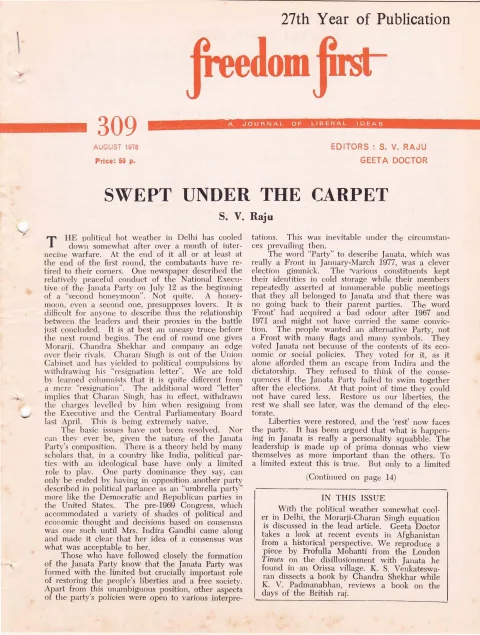
Swept Under the Carpet
By S. V. Raju
S. V. Raju’s lead editorial argues that the ceasefire within the Janata Party after a month of infighting over Charan Singh’s resignation and reinstatement is only a temporary truce, not a resolution. He traces the party’s fragility to its origin as an electoral ‘Front’ of convenience rather than a party built on shared ideology, formed to oust Indira Gandhi and restore civil liberties rather than to agree on economic policy. With that founding purpose achieved, Raju argues, the coalition’s internal contradictions — chiefly the unresolved choice between Nehruvian planning and a more Gandhian minimum-government approach — are now surfacing as personality clashes among Morarji Desai, Chandra Shekhar and Charan Singh.
- The Janata Party’s National Executive meeting of July 12 produced only a surface calm after Charan Singh’s withdrawal of his resignation letter.
- Raju argues Janata was formed as an electoral ‘Front’, not an ideologically unified party, uniting only around restoring liberties after the Emergency.
- The electorate voted Janata into power to escape the dictatorship of the Emergency, not because it endorsed any specific economic or social programme.
- With civil liberties restored, the party now must resolve internal disagreement over economic direction, framed as a personality dispute among top leaders.
- The piece continues on page 14, arguing the deeper contest is between ‘Nehruism’ and ‘Gandhism’ within Janata’s economic thinking.
Frankly Speaking… (Operation Topple / Hare Krishna Hots Up / The Plastic Revolution / How to Ruin a Good Thing)
By SVR / GD
The regular ‘Frankly Speaking’ column runs four short signed items. S.V.R. writes on ‘Operation Topple,’ condemning a violent brawl in the Maharashtra Legislative Assembly and the resignation and re-entry into government of Sharad Pawar, seeing it as further evidence that Maharashtra’s politicians have ‘learnt nothing and forgotten nothing.’ G.D. reports on the sudden turn against the Hare Krishna movement at its Juhu temple in Bombay following a fatal incident, describing how quickly popular goodwill toward the devotees evaporated. G.D. also writes on ‘The Plastic Revolution,’ mocking London architect Roy Guzzard’s proposal to landscape cities with artificial trees. S.V.R. closes with ‘How to Ruin a Good Thing,’ describing how a successful foreign-backed village welfare project in Maliwada, Maharashtra was thrown into bureaucratic jeopardy after the Indian President criticised the presence of foreign volunteers there.
- S.V.R. criticises the Maharashtra Assembly brawl of July 13, 1978 and Sharad Pawar’s resignation and the subsequent coalition manoeuvring in the state legislature.
- G.D. describes the rapid collapse of public sympathy for Hare Krishna devotees at the Juhu temple after a fatal altercation over stolen sandals.
- G.D. satirises architect Roy Guzzard’s call, quoted from the London Times, to landscape cities with plastic trees instead of real ones.
- S.V.R. recounts how the village of Maliwada near Daulatabad prospered under a foreign-linked welfare project until the President of India’s visit triggered bureaucratic suspicion of the foreign volunteers involved.
- The column overall highlights the authors’ recurring theme of official overreach and bureaucratic reflexes undermining otherwise successful private or voluntary initiatives.
A Kick from the Horse
By Geeta Doctor
Geeta Doctor’s ‘A Kick from the Horse’ places the April 1978 Marxist coup in Afghanistan within a two-century history of great-power rivalry over the country. She recounts Peter the Great’s Persian ambitions in 1722, the Great Game contest between the British and Russian empires through the 19th-century Afghan wars, Soviet absorption of Muslim Central Asia after the Basmachi Revolt, and the current regime’s professed loyalty to Islam under Nur Mohammad Taraki. She then surveys the coup’s likely consequences for India, Pakistan, Iran and China, arguing that China’s anxiety about Soviet encirclement, Pakistan’s fear of a renewed Baluchi/Pakhtoon insurgency, and the Shah of Iran’s domestic troubles are all entangled with the new instability in Kabul.
- The essay opens by comparing the unpredictability of the Chinese zodiac’s Year of the Horse to the surprise April 1978 Afghan coup.
- It reviews Peter the Great’s 18th-century Persian ambitions and Russia’s long-standing quest for warm-water access via the Persian Gulf.
- It surveys the 19th-century Great Game: two Anglo-Afghan wars, the Basmachi Revolt against Soviet rule, and Soviet absorption of Muslim Central Asian territories.
- The new Afghan regime under Nur Mohammad Taraki, though Marxist and Soviet-backed, publicly invokes Islam and denounces ‘traitors’ who plot against the April revolution.
- China’s fear of Soviet encirclement, Pakistan’s concern over renewed Baluchi and Pakhtoon agitation, and the Shah of Iran’s domestic unrest are all shown as entangled with instability following the coup.
A Great Hope Dashed
By Prafulla Mohanti
Prafulla Mohanti’s reprinted Times of London article recounts his return visits to an Orissa village before and after the March 1977 general election. In February-March 1977 he found villagers — Hindu, Muslim and Harijan — weighing their vote between Congress, Janata and Communist candidates, moved above all by anger at the Emergency’s curtailment of liberties and by economic hardship. The Janata candidate won by a large majority, but when Mohanti returned in March 1978 nothing had improved: prices were still rising, unemployment persisted, and the Harijan settlement’s tenant farmers had lost work as landlords retaliated after the vote. A state minister who had impressed villagers with his campaign rhetoric proved inaccessible once in office. The piece closes with villagers’ resigned verdict that Janata, while disappointing, is still preferable to ‘the mighty Congress.’
- Mohanti visited an Orissa village of 2,500 people, including Harijan and Muslim minorities, in the weeks before the March 1977 election.
- Villagers’ central concern was the restoration of individual liberties curtailed under the Emergency, alongside anger over prices and unemployment.
- The Janata candidate, a former Youth Congress member who opposed Mrs. Gandhi and went underground during the Emergency, won with a majority of 100,000 votes.
- On a return visit in March 1978, villagers reported no improvement: mustard oil scarcity, continued unemployment, and Harijan tenant farmers losing work to landlord retaliation.
- The Janata state minister who had won villagers’ admiration during the campaign proved unreachable for hours when Mohanti sought him out afterward.
- Villagers concluded they would give Janata two years before ‘throwing them out’ as they had Congress, having realised through the vote the power they held.
The Unanswered Indictment (letters to the Prime Minister re: Minorities Commission)
By M. R. Masani / V. V. John
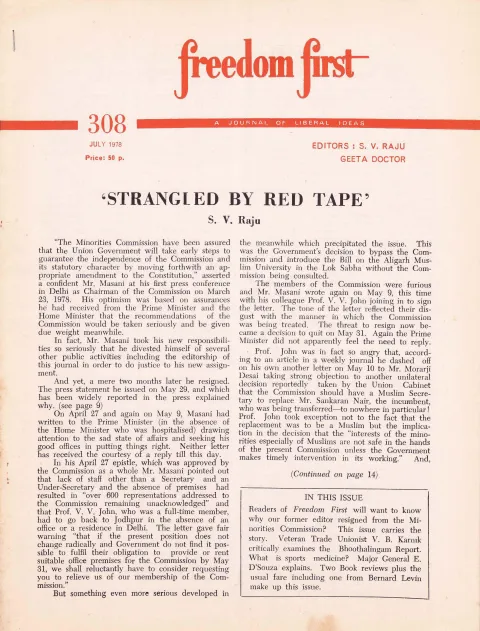
This piece reproduces in full two letters M. R. Masani wrote to the Prime Minister as Chairman of the Minorities Commission (dated April 27 and May 9, 1978), together with the answers given in Parliament on July 19-20 that provoked their release. The letters document the Commission’s inability to function: it had no premises, no staff beyond a Secretary and an Under Secretary, over 600 unacknowledged representations, and was ignored when the Education Ministry proceeded to draft Aligarh Muslim University legislation without waiting for the Commission’s promised input. The correspondence, continued on page 10, ends with Masani and V. V. John tendering their resignations effective May 31, 1978, citing the government’s failure to provide the working conditions it had promised when inviting them to serve.
- Masani’s April 27 letter protests that two months after its creation, the Minorities Commission has no office, no staff, and cannot function.
- The Commission was treated as an ‘attached office’ of the Home Ministry despite the Prime Minister’s own earlier assurance it should not be so treated.
- Over 600 representations addressed to the Commission had gone unacknowledged for lack of staff.
- The May 9 letter adds that the Education Ministry proceeded to draft Aligarh Muslim University legislation and announced its introduction in Parliament without waiting for the Commission’s promised recommendations, despite an explicit request to do so.
- The full text (continued on page 10) ends with Masani and V. V. John resigning from the Commission effective May 31, 1978, citing government’s failure to honour its assurances.
‘An Evening of Soviet Humour’
By Israel Shenker
Israel Shenker’s reprinted New York Times piece describes ‘An Evening of Soviet Humour,’ a Kennan Institute event in Washington where American Sovietologists shared and analysed Soviet political jokes. Scholars including Abraham Brumberg and Stephen Cohen discuss anecdotes about Soviet leaders, dissidents, and the absurdities of building socialism in one country, with Cohen arguing that the jokes reveal genuine popular attitudes — toward the permanence of the revolution, toward emigration, and toward the gap between propaganda and lived reality — more honestly than official channels do.
- The Kennan Institute for Advanced Russian Studies hosted ‘An Evening of Soviet Humour’ to explore Kremlinology through jokes rather than dry analysis.
- Frederick Starr organised the event and categorised jokes into three types: Russians joking about themselves, about the human condition, and (rarely) about Americans.
- Scholars recounted jokes about the fictional recurring figure ‘Rabinovich,’ about Brezhnev, and about whether socialism can be built in one country.
- Stephen Cohen argued that Soviet joke-telling functions as a form of political discussion under conditions where open dissent is prohibited.
- The piece closes on the observation that the common response to a good Soviet joke is not ‘how funny’ but ‘how true.‘
World News (Bangkok’s Pill Crisis / Aggression Against Angola? / Arsenal of Democracy)
The ‘World News’ section reprints several short foreign-press items. George McArthur’s Guardian piece describes Thai birth-control campaigner Mechai Viravaidya’s public battle with the Boonma Moving and Storage Company over missing shipments of contraceptive pills. An unsigned item from the Swiss Press Review examines Cuban military involvement in Angola, disputing Fidel Castro’s claims of troop withdrawals and pointing to the Shaba invasion of Zaire as evidence of continued Cuban-backed aggression, while noting the double standard by which Cuban action is called ‘liberation’ but comparable action by others is condemned. Peter Pringle’s piece, condensed from the Sunday Times, uses Tom Gervasi’s study ‘Arsenal of Democracy’ to detail the vast scale of US arms exports to developing nations, including Israel, Iran, Saudi Arabia, Chile and Taiwan.
- Mechai Viravaidya’s birth-control campaign in Thailand distributes subsidised pills to 240,000 women across 8,000 villages via a nationwide network.
- A dispute between Mechai and the Boonma Moving and Storage Company over missing pill shipments threatened to leave 240,000 women without contraceptives.
- The Swiss Press Review piece argues Cuban forces remain at full strength in Angola despite Castro’s claims of reduction, citing the Shaba Province invasion of Zaire as evidence.
- The piece highlights a double standard: Cuban intervention is termed ‘liberation’ while comparable French and Moroccan assistance to Zaire is called ‘raids.’
- Tom Gervasi’s ‘Arsenal of Democracy’ study documents US arms sales — 3,560 tanks, 5,240 armoured cars, 593 supersonic aircraft and more than 10,000 missiles between 1971-75 — concentrated in oil-producing states and Cold War client nations.
Reviews: Dynamics of Social Change by Chandra Shekhar
By K. S. Venkateswaran
K. S. Venkateswaran reviews Chandra Shekhar’s ‘Dynamics of Social Change,’ sharply criticising the book’s attack on private enterprise and ‘monopoly houses’ as relying on distorted language and Marxist jargon rather than serious economic analysis. The review argues that Chandra Shekhar’s advocacy of a fully state-controlled economy ignores that even Jawaharlal Nehru favoured a mixed economy with nationalisation only where genuinely necessary, and that economist Fredie Mehta’s critique of anti-growth ‘poverty economics’ better explains India’s continuing poverty than Chandra Shekhar’s redistributive framework.
- Venkateswaran accuses Chandra Shekhar of using distorted, Marxist-inflected language to tar private enterprise and ‘monopoly houses’ as the root of India’s economic ills.
- The review argues Chandra Shekhar sees a false dichotomy between private enterprise and a mixed economy, one the framers of India’s Constitution did not share.
- Jawaharlal Nehru is invoked as having explicitly favoured a competitive private sector alongside the public sector, contradicting Chandra Shekhar’s more absolutist redistributive stance.
- Economist Fredie Mehta is quoted arguing that ‘poverty economics’ wrongly treats growth and poverty reduction as opposed, holding back priority projects on the mistaken belief that pro-poverty policy must be anti-growth.
- Venkateswaran concludes that low growth, not private enterprise, is the real threat to India’s economic prospects.
Reviews: Plain Tales from the Raj, edited by Charles Allen
By K. V. Padmanabhan
K. V. Padmanabhan reviews Charles Allen’s ‘Plain Tales from the Raj,’ an oral-history anthology of over sixty British survivors of colonial India assembled from BBC radio interviews. The review describes the book’s portrait of the British administrative, military and mercantile classes in India — their self-contained social world, hierarchy (the Indian Civil Service, the Indian Political Service, the Army, and ‘box-wallah’ merchants), and their reliance on Indian domestic servants — and closes by noting the book’s value in illustrating candidly, with humour, how that world dissolved at independence and gave way to continuing Indo-British cooperation.
- Charles Allen’s anthology draws on BBC radio interviews with more than sixty survivors of British India, including Field Marshal Sir Claude Auchinleck and other senior figures.
- The review describes the insulated, hierarchical social world of British administrators, contrasted with the more mundane earlier generation of pioneers and settlers.
- A strict social order placed the Indian Civil Service (‘the Heaven-born’) above the Indian Political Service and Police, the Army, and merchant ‘box-wallahs’ at the bottom.
- The book documents British reliance on Indian domestic servants (‘wallahs’) for daily needs, down to named roles like the nappy-wallah and dudh-wallah.
- Padmanabhan concludes that despite the abrupt end of British rule, Indo-British relations have since flourished, and the book may help promote further understanding between the two countries.
With Many Voices (quotations compilation)
The closing ‘With Many Voices’ column collects short quotations from Indian and international newspapers and public figures on contemporary political topics, ranging from Devi Lal’s self-description as a kisan before a chief minister, to Acharya Kripalani’s comment that the Prime Minister must be living in a paradise of his own creation, to quotations from Sir Keith Joseph, Mario Puzo and Sidney Hook on democracy, reading and Solzhenitsyn.
- The column reprints a wide range of quotations from Indian newspapers (Times of India, Indian Express, Opinion) and international sources on current political controversies.
- Acharya J. B. Kripalani is quoted suggesting the Prime Minister (Morarji Desai) must be living in a paradise of his own creation if he believes India’s troubles are merely governmental.
- Sir Keith Joseph is quoted arguing that only a combination of democracy, rule of law and limited government can preserve a free society.
- The column closes with Prof. Sidney Hook’s remark on Solzhenitsyn’s fixed vision of Heaven despite having lived through ‘something very much like Hell.’
Generated by the v1.5 extraction pipeline. Awaiting editorial review.
Metadata and summary are AI-extracted from the source PDF and reviewed for editorial accuracy. The original work is available via the Read PDF tab above (where present); paragraph-level citation inside the PDF is deferred to a future engagement.