periodical issue
Freedom First
A Journal of Liberal Ideas
Edited by S. V. Raju
Published for the Democratic Research Service by J. R. Patel, Associate Editor, Freedom First at 127, Mahatma Gandhi Road, Bombay 400 023 (Phone: 273914) and printed by him at Commercial Printers & Stationers, 525 S. Bapat Marg, Dadar, Bombay-400028 · Bombay · 1979
16 pages
Freedom First
Summary
Freedom First No. 317 (April 1979), edited by S. V. Raju and Geeta Doctor, is dominated by reaction to Finance Minister Charan Singh’s first Union Budget. The editorial and two signed articles attack the Budget from complementary angles: the editorial (“The Pity of It All”) and Prof. B. P. Adarkar’s “Charan Singh’s Budgetary Bungle” fault its rural-versus-urban framing and its failure to curb public-sector waste and deficit spending, while K. H. Subramaniam’s “Mopeds Are For Others” and S. A. A. Pinto’s “Rustic Economics” attack specific measures — the steep petrol excise hike and the withdrawal of capital-gains and savings tax relief for the urban self-employed. Beyond the Budget, the issue carries Maj. Gen. E. D’Souza’s military-affairs survey of the Chinese People’s Liberation Army following the Sino-Vietnamese border war, Geeta Doctor’s “Of Cabbages & Kings” column on the veil and women’s status in revolutionary Iran, Nargish Hateria’s personal travel narrative about being stranded near Deolali during monsoon floods, a reader’s letter on the absurdity of domicile-certificate bureaucracy, S. P. Aiyar’s review of Arun Shourie’s book of essays on the Emergency (“Symptoms of Fascism”), and the regular “With Many Voices” page of quotations.
Key points
-
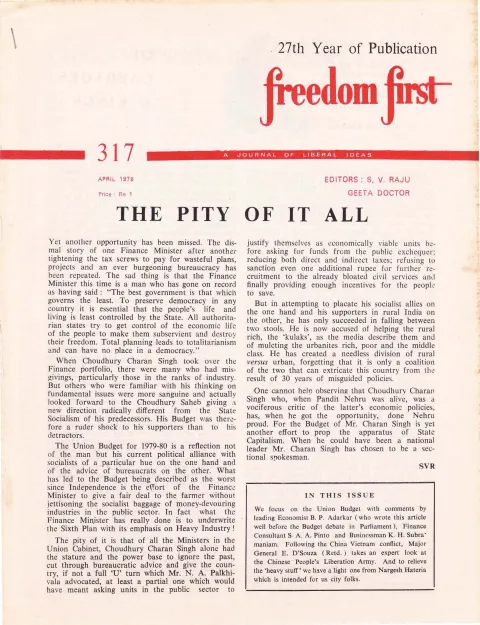
The lead editorial “The Pity of It All” argues Finance Minister Charan Singh’s first Budget squandered his political stature to break from state-socialist planning, instead propping up the public sector and heavy industry while raising taxes on the urban middle class and creating a false rural-versus-urban divide.
-
Prof. B. P. Adarkar’s “Charan Singh’s Budgetary Bungle” compares Charan Singh to Keynes’s “madmen in authority”, faulting the Budget for neglecting rural infrastructure and for a record Rs. 1,975 crore deficit without controlling public-sector waste.
-
K. H. Subramaniam’s “Mopeds Are For Others” attacks the Budget’s steep petrol excise hike, presenting a comparative table showing India’s roughly 400% petrol tax as the world’s highest and arguing the increase will raise transport costs for all classes, not just the “affluent”.
-
S. A. A. Pinto’s “Rustic Economics” criticises the Budget’s withdrawal of the long-term capital gains exemption and reduced savings tax relief for the urban self-employed, calculating the net revenue gain as tiny compared to non-development expenditure.
-
Maj. Gen. E. D’Souza surveys China’s People’s Liberation Army following the 1979 Sino-Vietnamese border war, drawing on his own 1965 experience facing PLA units in Sikkim, and concludes the war exposed the myth of PLA invincibility even as its manpower remains formidable in mountainous terrain.
-
Geeta Doctor’s column “Women in Veils” reflects on the paradox of Iranian women who wore the chador to protest the Shah only to have Ayatollah Khomeini make it compulsory after the revolution, praising the 50,000 women who then protested its reimposition.
-
Nargish Hateria recounts being stranded for three days near Deolali during monsoon flooding, an experience that dissolved her group’s condescension toward the villagers who sheltered them.
-
S. P. Aiyar reviews Arun Shourie’s Symptoms of Fascism, praising its documented indictment of the Emergency’s fascist character while faulting the book for one-sidedness toward Mrs. Gandhi.
Essays
The Pity of It All
By SVR
The unsigned lead editorial (signed “SVR”, i.e. S. V. Raju) argues that Charan Singh’s 1979-80 Union Budget squandered a real chance to break from the state-socialist pattern of previous finance ministers. It notes the irony that Charan Singh, who once championed minimal government, produced a budget that instead props up the public sector and heavy industry while raising taxes on the urban middle class and industry, creating a false rural-versus-urban divide rather than genuine fiscal reform.
- Argues Charan Singh had the political stature to break from wasteful Nehruvian state planning but did not use it.
- Criticizes the Budget for taxing urban sectors to fund an already bloated public sector and heavy industry under the Sixth Plan.
- Calls the 1979-80 Budget the worst since Independence for failing to give farmers a fair deal while retaining socialist economic baggage.
- Accuses Charan Singh of creating an artificial rural/urban divide instead of building a coalition between the two.
- Notes the irony that Charan Singh, once a vocal critic of Nehru’s economic policy, ended up extending Nehru’s model of state capitalism.
Of Cabbages & Kings (Women in Veils)
By GD
Geeta Doctor’s regular column “Of Cabbages & Kings” this issue focuses on “Women in Veils,” reflecting on the paradox of Iranian women who protested the Shah’s regime by donning the chador only to have the Ayatollah Khomeini make the veil compulsory after the revolution. The piece surveys the veil’s history as an instrument of controlling women across cultures, recalls Reza Shah’s 1936 decree unveiling Iranian women and opening universities to them, and closes praising the 50,000 Iranian women who publicly protested against the reimposition of the chador under the new theocratic regime.
- Opens with a cross-cultural survey of how different societies fixate on different parts of the female body, framing the veil as one of history’s most restrictive impositions on women.
- Notes the irony that Iranian women adopted the chador as an anti-Shah protest symbol only to have the post-revolutionary regime make it mandatory.
- Recounts Reza Shah’s 1936 decree ending compulsory veiling and opening Tehran University to women as a landmark of Iranian women’s emancipation.
- Reports that Ayatollah Khomeini’s government is rolling back these freedoms, including banning abortion.
- Praises the 50,000 Iranian women who demonstrated against the chador and calls the negotiated compromise (a lesser ‘veil of modesty’) a small but real victory.
Charan Singh’s Budgetary Bungle
By Prof. B. P. Adarkar
Prof. B. P. Adarkar’s article, written before the Budget debate in Parliament, dissects Charan Singh’s economic philosophy of rural development as expressed in his budget. Adarkar argues that while there is nothing wrong with favouring agriculture and cottage industries per se, Charan Singh’s approach is unrealistic in timeframe and neglects the infrastructure (roads, electricity, irrigation, banking) that must precede rural industrialization. He contends the government should focus on building this infrastructure rather than penalizing urban and large-scale industry, and separately criticizes the budget for failing to control runaway public expenditure, fiscal deficits, and corruption in the public sector.
- Compares Charan Singh to Keynes’s ‘madmen in authority’ who act on their own untested economic doctrines.
- Argues cottage industries cannot be grown overnight and that both small and large industry are needed for the economy.
- Quotes ‘Prof. Peter Drucker Clarke of Claremont’ warning that Indian planners misunderstand the correct policy mix of appropriate technology.
- Criticizes government for not building rural infrastructure (roads, electricity, irrigation, banking) before pushing rural industrialisation loans.
- Faults the budget for a record Rs. 1,975 crore deficit, uncontrolled Rs. 18,526 crore expenditure, and lack of financial/performance audit of Plan spending.
- Blames the sprawling, loss-making Public Sector — a legacy of Nehru’s Mixed Economy doctrine — for the country’s unemployment, stagflation, and corruption.
The People’s Liberation Army
By Maj. Gen. E. D’Souza, PVSM (Retd)
Maj. Gen. E. D’Souza (Retd.) surveys the organization, doctrine, equipment, and combat record of China’s People’s Liberation Army in light of its 1979 border war with Vietnam, drawing on his own experience facing PLA units at Himalayan passes during the 1965 Sikkim standoff. He details the PLA’s guerrilla-derived doctrine, its Confucian-inflected strategic maxims from Mao’s Red Book, its enormous manpower reserves versus its comparatively outdated weapons technology, and its political-commissar command structure. He concludes that while the PLA’s supposed invincibility was exposed by Vietnamese resistance, it should not be underestimated given its logistic and manpower advantages in mountainous terrain, though it lags badly in modern weapons and would need time to re-equip against a superpower adversary.
- Frames the article around the author’s own 1965 experience facing PLA units at Cho La, Yak La, Sebu La and Natu La in the Sikkim Watershed.
- Explains the PLA’s guerrilla-warfare doctrine derived from Mao’s Long March strategy and Confucian-style maxims (‘Enemy advances, we retreat…’).
- Details PLA organisation: roughly 4 million troops, 35-40 field armies, political commissars holding real command authority alongside military officers.
- Argues the PLA is comparatively outgunned and outdated in tanks, aircraft, and missile technology versus the USSR, USA, and even India’s own equipment sources.
- Recounts an anecdote of a ‘goat-parading’ standoff with Chinese troops at Natu La as an illustration of PLA concern with saving face.
- Concludes the Vietnamese conflict exposed the myth of PLA invincibility, but its vast manpower and guerrilla/infiltration tactics remain formidable in mountainous terrain.
A Sobering Experience
By Nargish Hateria
Nargish Hateria recounts a monsoon picnic to Wilson Dam near Deolali that turned into a three-day ordeal when floodwaters cut off her group’s taxi and stranded them in the village of Devla. The essay describes the group’s dependence on villagers’ hospitality (notably a woman named Manubai), their adaptation to rustic conditions without modern amenities, and their eventual rescue by wading through the floodwaters piggyback-style. The author reflects that the experience dissolved her and her friends’ condescension toward rural people, concluding that urbanites are no more ‘superior’ than the villagers who sheltered them.
- A picnic trip to Wilson Dam is cut off by monsoon flooding, stranding the narrator and two friends in the village of Devla for three days.
- The group takes shelter with a villager, Manubai, adapting to life without modern plumbing, toothpaste, or other urban comforts.
- The narrator describes local superstition (the inauspicious ‘Amvas day’) delaying their rescue attempt.
- The group is eventually carried piggyback across the flooded road back to their hotel by local swimmers.
- The essay closes on a reflective note about who is truly ‘superior’ — the humble rustic villagers or the soft-living city folk.
Letter: Must Our Laws be Asinine?
By S. S. Bankeshwar
A reader’s letter by S. S. Bankeshwar complains about the bureaucratic absurdity of obtaining a domicile certificate in Bombay, describing onerous documentation requirements even for decades-long residents, and recounts an anecdote of a pensioner denied his pension for a month due to a rigid, illogical identification requirement. The letter closes by asking whether India’s laws are designed to help citizens or merely to feed ‘briefless lawyers.’
- Describes the excessive documentation (rent receipts, LIC premium receipts) required to obtain a Bombay domicile certificate despite years of residency.
- Criticizes the requirement for court-affidavit identification by an advocate who has never met the applicant, for a fee of Rs. 20.
- Recounts an anecdote of a pensioner denied a month’s pension due to rigid procedural identification rules despite producing his identity certificate.
- Concludes by questioning whether Indian bureaucratic law serves citizens or merely sustains the legal profession.
Mopeds are for Others
By K. H. Subramaniam
K. H. Subramaniam’s “Mopeds Are For Others” attacks the Union Budget’s steep hike in petrol excise duty, arguing the government falsely claims Indian petrol prices are low by international standards while ignoring that India’s petrol tax rate (around 400%) is the highest in the world relative to cost. The essay describes a failed pre-Budget lobbying effort by consumer and transport bodies to forestall the price hike, and argues that the claim that only the ‘affluent’ are affected is a deliberate lie, since higher fuel costs will raise transport costs for essential goods used by all classes.
- Criticizes the government’s practice of using indirect ‘hidden’ taxes like excise duty to extract revenue from consumers of all income levels.
- Reports the Indian Liberal Group convened representatives of consumer and transport bodies in January 1979 to lobby against a feared petrol price hike, to no avail.
- Presents a comparative table showing India’s petrol tax (Rs. 14 out of Rs. 3.32 cost, i.e. roughly 400%) as the highest among surveyed countries (US, Japan, West Germany, Italy, Sweden).
- Rebuts the government’s claim that the 1979 OPEC price rise justified a 20% cost pass-through, noting the actual per-gallon cost increase was minimal.
- Argues that the price hike will raise costs for taxi fares and freight transport, hurting ordinary consumers, not just car owners as officially claimed.
Rustic Economics
By S. A. A. Pinto
S. A. A. Pinto’s “Rustic Economics” argues that while Charan Singh’s rural-uplift measures are not objectionable in themselves, his budget unfairly penalizes the urban self-employed and professional classes by removing the long-term capital gains exemption and reducing tax relief on long-term savings. Pinto contends these changes will destroy public confidence in government fair play, particularly harming self-employed professionals already exposed to volatile incomes, for a comparatively small net revenue gain.
- Argues nobody begrudges rural-sector tax favours, but objects to withdrawing equivalent relief from urban taxpayers.
- Criticizes removal of the long-term capital gains exemption and reduced tax relief on long-term savings as the two most objectionable levies on the urban sector.
- Notes capital gains are often merely inflationary and notional, with government itself the largest driver of inflation.
- Argues self-employed professionals face uniquely volatile incomes and rely on savings-related tax relief as insurance against bad years.
- Calculates the net revenue gain from these two measures (Rs. 23.6 crores) is tiny compared to the government’s Rs. 11,418 crore non-development expenditure.
Book Review: Symptoms of Fascism (by Arun Shourie, Vikas Publishing House, 1978)
By S. P. Aiyar
S. P. Aiyar reviews Arun Shourie’s Symptoms of Fascism (Vikas Publishing House, 1978), praising it as a scholarly and well-documented indictment of the Emergency’s fascist character, drawing on major Western historians of fascism such as Hannah Arendt, K. D. Bracher, Alan Bullock, Joachim Fest and William Shirer. The reviewer commends Shourie’s uncompromising prose and his critique of the Janata government’s mishandling of the Shah Commission reports, but faults the book for one-sidedness in its treatment of Mrs. Gandhi, some stylistic lapses, and notes a memorable printing error in the book (‘Mrs. Gaddhi’).
- Praises Shourie’s book for exposing the fascist character of the Emergency in India, countering claims that it lacked features of European fascism.
- Notes the book cites major scholars of fascism (Hannah Arendt, K. D. Bracher, Alan Bullock, Joachim Fest, William Shirer).
- Highlights Shourie’s account of how the Janata Cabinet dithered over prosecuting Mrs. Gandhi despite the Shah Commission’s damning findings.
- Criticizes the book for one-sidedness regarding Mrs. Gandhi’s character, some colloquial lapses in prose, and printing errors from the publisher.
- Notes the book is organized into five sections: Prelude, The Emergency, Mrs. Gandhi, The Sequel, and New Beginnings.
With Many Voices
“With Many Voices” is the issue’s regular closing feature collecting short quotations from contemporary press and public figures on politics, economics, and current events — including remarks by K. F. Rustamji on the state of Indian jails, commentary on Charan Singh’s Budget, and quotes from world figures such as Alexandr Solzhenitsyn, Henry Kissinger, Ayatollah Khomeini, and Joti Basu on communism, dictatorship, and dissent.
- K. F. Rustamji (Member, National Police Commission) is quoted saying most people in Indian jails ought not to be there.
- Two quotes comment sardonically on Charan Singh’s Budget, including H. R. Ranina calling it ‘a stupid budget presented by an intelligent man.’
- Alexandr Solzhenitsyn is quoted calling communism a ‘dead dog’ in Russia but ‘a living lion’ in the West.
- Henry Kissinger is quoted noting no communist country has solved the problem of succession.
- Ayatollah Khomeini is quoted rejecting the word ‘democratic’ as Western.
- S. K. Sinha (Calcutta Police Commissioner) is quoted lamenting the erosion of investigative and prosecutorial habits due to Preventive Detention Acts since 1971.
Generated by the v1.5 extraction pipeline. Awaiting editorial review.
Metadata and summary are AI-extracted from the source PDF and reviewed for editorial accuracy. The original work is available via the Read PDF tab above (where present); paragraph-level citation inside the PDF is deferred to a future engagement.