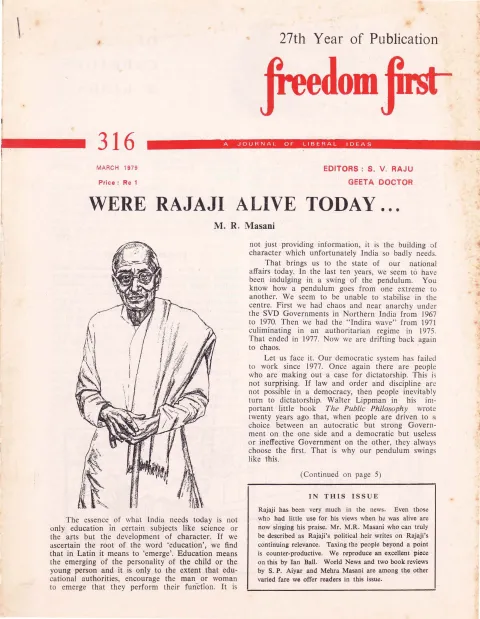
periodical issue
Freedom First
A Journal of Liberal Ideas
Edited by S. V. Raju
Published for the Democratic Research Service by J. R. Patel, Associate Editor, Freedom First at 127, Mahatma Gandhi Road, Bombay 400 023 (Phone: 273914) and printed by him at Commercial Printers & Stationers, 525 S. Bapat Marg, Dadar, Bombay-400028 · Bombay · 1979
16 pages
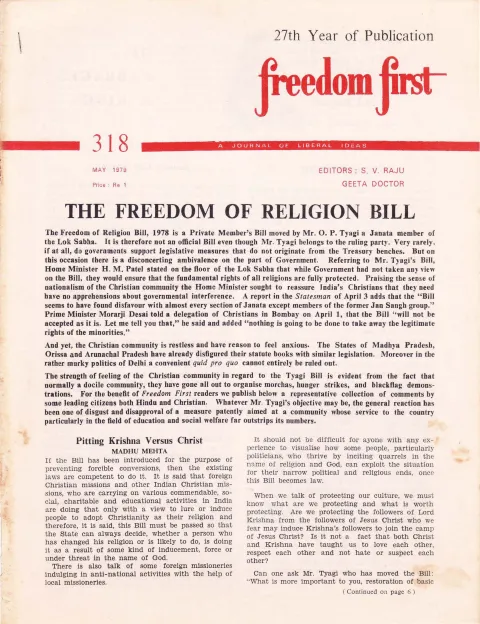
Freedom First
Summary
Freedom First issue 318 (May 1979) is a monthly issue of the Bombay-based liberal journal edited by S. V. Raju and Geeta Doctor. The issue opens with an editorial-led symposium on the Freedom of Religion Bill, 1978 (the Tyagi Bill), gathering objections from Hindu and Christian commentators alike who see the proposed anti-conversion law as a threat to civil and religious liberty. The regular column ‘Of Cabbages & Kings’ comments on the death-bed politicking around Jayaprakash Narayan’s illness, the economics and communal sensitivities of cow-slaughter bans, the assassination of Zulfiqar Ali Bhutto’s rival Bhutto himself having been hanged, and alleged American dollar-funding controversies involving Mrs Gandhi’s Congress. Feature pieces include a satirical travel account of chaotic rail and air journeys to Calcutta, an analysis of Bhutto’s execution as either the act of a murderer or a victim of judicial murder, a survey of California’s Proposition 13 tax revolt and its resonance with Indian fiscal debates (citing Milton Friedman, Arthur Laffer, and Nani Palkhivala), a ‘World News’ digest of Soviet dissidents, Chinese social controls, and other international items, and a page of quotations (‘With Many Voices’) drawn from the press. Three book reviews close the issue: Saroj Chakrabarty’s memoir on West Bengal chief ministers, Ved Mehta’s autobiography Face to Face, and Michael Herr’s Vietnam War reportage Dispatches.
Key points
-
A symposium on the Freedom of Religion Bill, 1978 (the Tyagi Bill) gathers objections from Hindu and Christian contributors, Madhu Mehta, Rajmohan Gandhi, George Menezes and A. Williams, S.J., arguing the anti-conversion measure threatens religious liberty and violates Articles 25/26 of the Constitution.
-
The “Of Cabbages & Kings” column reports Acharya Vinoba Bhave’s April 21 fast unto death over cow slaughter, notes Freedom First’s rare agreement with Communist leaders Jyoti Basu and E.M.S. Namboodiripad against a total ban, and covers the political fallout from Daniel Moynihan’s allegations of covert US dollar funding to the Congress.
-
K. B. Lam’s “Bhutto — Murderer or Murdered?” surveys the fairness of Zulfiqar Ali Bhutto’s trial, noting three of seven judges found him not guilty, and concludes General Zia’s execution of him looks less like justice than the elimination of a political threat.
-
K. S. Venkateswaran’s “The Great Tax Revolt” surveys California’s Proposition 13 tax revolt led by Howard Jarvis, citing Arthur Laffer’s tax-cut theory and Milton Friedman’s public backing, and connects it to Nani Palkhivala’s argument in The Highest Taxed Nation that low taxes are essential for enterprise and saving.
-
Geeta Doctor’s “Oh No, Calcutta!” comically recounts a friend’s disaster-strewn Bombay-to-Calcutta journey, including a rail blockade cleared by police with tear gas and a final leg completed by bullock cart after the taxi’s axle broke.
-
A World News digest reports Soviet dissident Yuri Orlov barred from sending scientific notes from his labour camp, engineer Joseph Zisels jailed for distributing Solzhenitsyn’s writings, and Chinese press campaigns against “bourgeois” bell-bottoms and foreign friendships.
-
V. B. Karnik reviews Saroj Chakrabarty’s memoir on West Bengal’s chief ministers, highlighting S. S. Ray’s January 1975 letter to Indira Gandhi recommending bans on the RSS and Ananda Marg months before the Emergency.
-
Vrunda Moghe Dev reviews Ved Mehta’s autobiography Face to Face, and Maj. Gen. E. D’Souza reviews Michael Herr’s Vietnam War reportage Dispatches, praising its unflinching depiction of the ordinary soldier’s experience.
Essays
The Freedom of Religion Bill
The lead editorial explains the background of the Freedom of Religion Bill, 1978, a Private Member’s Bill moved by Janata MP O. P. Tyagi, and notes the government’s ambivalent stance despite assurances from Prime Minister Morarji Desai and Home Minister H. M. Patel that minority rights would be protected. It reports that Christian communities in Madhya Pradesh, Orissa, and Arunachal Pradesh already live under similar state legislation, and that Bombay’s Christian community organised morchas and hunger strikes in protest. The editorial frames the piece as introducing a symposium of invited reactions from Hindu and Christian citizens, followed by pieces from Madhu Mehta (‘Pitting Krishna Versus Christ’), Rajmohan Gandhi (‘An Unwise Bill’), George Menezes (‘Violates A Fundamental Right’), and A. Williams, S.J. (‘Threat to Communal Harmony’), plus press clippings from Himmat, Sunday Standard, and Indian Express.
- The Freedom of Religion Bill, 1978 was a Private Member’s Bill by Janata MP O. P. Tyagi, not an official government measure
- Home Minister H. M. Patel said government had taken no view but would protect fundamental rights of all religions
- PM Morarji Desai told a Christian delegation in Bombay the Bill ‘will not be accepted as it is’
- Madhya Pradesh, Orissa, and Arunachal Pradesh already had similar anti-conversion legislation
- Christian community organised morchas, hunger strikes, and blackflag demonstrations against the Bill
- Madhu Mehta’s contribution argues existing law already covers forcible conversion and that the Bill risks politicising Hindu-Christian relations
- Rajmohan Gandhi’s piece frames freedom to change religion as a constitutional right and criticises giving officials power to judge conversions as insincere
- George Menezes and A. Williams, S.J. argue the Bill violates Articles 25/26 of the Constitution and Article 18 of the Universal Declaration of Human Rights, citing reports of Arunachal Christians pressured to renounce their faith for government jobs
Pitting Krishna Versus Christ
By MADHU MEHTA
No summary was extracted for this article. Listed for completeness.
An Unwise Bill
By RAJMOHAN GANDHI
No summary was extracted for this article. Listed for completeness.
Violates A Fundamental Right
By GEORGE MENEZES
No summary was extracted for this article. Listed for completeness.
Threat to Communal Harmony
By A. WILLIAMS, S. J.
No summary was extracted for this article. Listed for completeness.
Of Cabbages & Kings (Necrophilic Society; Banning Cow Slaughter; A Return to Tribalism; Those Alluring Dollars)
By GD / SVR
The recurring ‘Of Cabbages & Kings’ column (headed by a Lewis Carroll epigraph) runs four short items. ‘Necrophilic Society’ (initialled GD, likely Geeta Doctor) criticises the media and political frenzy around Jayaprakash Narayan’s declining health and J. B. Kripalani’s frailty, calling the morbid public fascination a ‘necrophilic tendency’ after Erich Fromm. ‘Banning Cow Slaughter’ (initialled SVR) surveys the debate over a total ban, quoting West Bengal Chief Minister Jyoti Basu’s economic objections and Mahatma Gandhi on religious versus State compulsion, and describes Acharya Vinoba Bhave’s fast unto death begun on April 21. ‘A Return to Tribalism’ reflects on the hangings of Bhutto and the killing of Hoveyda, and warns that the fall of strongman rule in Iran, Afghanistan, and Pakistan could unleash a reversion to tribal loyalties among Kurds, Baluchis, Turkomans, and Pakhtoons. ‘Those Alluring Dollars’ mocks the controversy stirred by Daniel Moynihan’s book alleging Dollar payments to the Indian National Congress, and Mrs Gandhi’s rebuttal via Sardar Buta Singh attacking Moynihan as a ‘rabid zionist.’
- GD criticises the ‘necrophilic’ public and press fixation on JP Narayan’s and J. B. Kripalani’s failing health
- SVR notes Freedom First’s rare agreement with Communist leaders Jyoti Basu and E.M.S. Namboodiripad in opposing a total cow-slaughter ban on economic grounds
- Quotes Mahatma Gandhi that Hindu religious prohibition on cow slaughter cannot be imposed on non-Hindus, just as Shariat cannot be imposed on non-Muslims
- Acharya Vinoba Bhave began a fast unto death on April 21 over cow slaughter, having previously called off an Emergency-era fast on government assurances
- ‘A Return to Tribalism’ links Bhutto’s and Hoveyda’s deaths to a broader risk of tribal fragmentation across Iran, Afghanistan, and Pakistan
- ‘Those Alluring Dollars’ reports on the political fallout in India from Daniel Moynihan’s book ‘A Dangerous Peace’ alleging covert US funding to the Congress
Bhutto — Murderer or Murdered?
By K. B. Lam
K. B. Lam’s essay weighs whether Zulfiqar Ali Bhutto was rightly convicted and hanged for conspiracy to murder, or whether the whole prosecution was a stage-managed act by General Zia to eliminate a political threat. The piece surveys the fairness of the trial (noting three of seven judges found Bhutto not guilty), international appeals for clemency, and Amnesty International’s doubts about the evidence, before concluding that the extremity of the sentence despite judicial dissent suggests Bhutto was less a murderer than the victim of a conspiracy against him. It closes praising Bhutto’s oratorical brilliance and lamenting the unstable political future facing Pakistan under continued martial law.
- Frames the central question as whether Bhutto was a murderer or himself murdered by a manipulated judicial process
- Notes three of seven judges pronounced Bhutto not guilty, casting doubt on proof beyond reasonable doubt
- Cites an impartial French lawyer’s view the case would have been dismissed in Western Europe and Amnesty International’s concerns about unfair conduct
- Argues Zia felt his own survival depended on eliminating Bhutto once electoral prospects favoured Bhutto’s return to power
- Credits Bhutto with major achievements in Pakistan’s foreign policy and skillful diplomacy after the 1971 war humiliation
- Rates Bhutto as an orator matched among contemporaries only by Harold Wilson
- Speculates on Pakistan’s uncertain political future, ranging from prolonged Zia rule to farcical elections or disintegration
Oh No, Calcutta!
By Geeta Doctor
Geeta Doctor’s humorous travel piece ‘Oh No, Calcutta!’ recounts a friend’s disaster-strewn journey to Calcutta, opening with Mark Twain’s 1896 observations on the city’s chaos before describing a modern odyssey: a delayed flight, a power cut at the guest house, a train delayed by a rail-blockade protest that brought police with rifles, lathis, and tear gas, and a taxi whose axle broke en route, forcing the traveller to complete the journey by bullock cart.
- Opens with Mark Twain’s 1896 remark that Calcutta’s streets seemed ‘full of grandmothers waiting for a chance to earn Rs. 10’ from traffic fines
- The friend’s Bombay-Calcutta flight was delayed for hours over two missing passengers
- A power cut at the guest house forced a candlelit climb up five flights of stairs
- Protesters lay on the tracks at Durgapur, prompting police intervention with rifles, lathis, and tear gas to clear the line
- An A/c compartment attendant recited the Bhagwad Gita aloud during the standoff and later served tea boiled with toilet-cistern water
- The train was halted again at Barakar by more protesters and the journey was finished by taxi, then bullock cart after the taxi’s axle broke
The Great Tax Revolt
By K. S. Venkateswaran
K. S. Venkateswaran’s essay surveys California’s 1978 Proposition 13 tax revolt led by Howard Jarvis, presenting it as a middle-class rebellion against overblown, self-indulgent government. It cites Prof. Arthur Laffer’s tax-cut theory (the Laffer Curve), Milton Friedman’s public backing of the initiative against establishment opposition, and Walter Heller’s Wall Street Journal commentary demanding government ‘deliver more per dollar of tax.’ The piece then pivots to India, invoking Nani Palkhivala’s book The Highest Taxed Nation and his argument that high taxation is inflationary because it discourages saving and investment, concluding that the Californian lesson has global, including Indian, relevance.
- Proposition 13 cut California property taxes by $7000 million in a June 1978 referendum after 1.5 million signatures were gathered
- Howard Jarvis is credited as the campaign’s driving figure after 15 years of tax-slashing advocacy
- Arthur Laffer’s ‘Laffer Curve’ thesis holds that lowering tax rates can increase total revenue by expanding business activity
- Milton Friedman publicly supported Proposition 13, prompting roughly 400 economists to issue a counter-statement predicting chaos
- Friedman calls the victory proof that ‘the wave of taxpayer protest’ will demand performance and not merely promises from politicians
- Nani Palkhivala’s The Highest Taxed Nation argues low tax rates are the sine qua non of an economy that fosters enterprise and savings
- The essay frames California’s revolt as holding lessons ‘worthy of greater attention’ for countries like India
Letter: Frisking St. George
By S. A. A. PINTO
A reader’s letter signed S. A. A. Pinto responds to a Freedom First item (‘Frisking St. George’) about a security check on former minister George Fernandes, arguing that Fernandes, unlike other ministers, forgoes VIP privileges and travels by ordinary means, and sarcastically asking the columnist GD to also list ‘all the better known history books’ in which the Emergency is supposedly being erased from memory.
- The letter responds to an earlier Freedom First piece questioning how a security check could arise for George Fernandes
- Argues Fernandes travels without VIP privileges unlike other ministers who use VIP lounges and limousines
- Accuses the columnist GD of implying the Emergency is being forgotten or ‘buried’
- Ends with a sarcastic request for a list of history books documenting the Emergency
World News (No Maths; No Solzhenitsyn; No Bell-Bottoms; No Foreign Boy-Friends; No Turning the Other Cheek; Skeletons from India)
By Nigel Wade / Richard Beeston / The Daily Telegraph
The ‘World News’ digest compiles short wire-service items from The Daily Telegraph on repression and social control abroad: Soviet dissident scientist Yuri Orlov forbidden to send scientific notes from labour camp; engineer Joseph Zisels sentenced for distributing Solzhenitsyn’s writings; Chinese press campaigns against Western fashions like bell-bottoms and against contact between Chinese citizens and foreigners; a British vicar’s call to meet home-invasion criminals with physical force; and India’s lifting of its ban on human skeleton exports for medical education.
- Soviet civil-rights campaigner Yuri Orlov, serving seven years in a labour camp, was barred from sending out scientific notes
- Engineer Joseph Zisels was sentenced to three years for distributing Solzhenitsyn’s writings and information on dissidents in psychiatric wards
- Chinese newspapers campaigned against bell-bottom trousers and foreign hairstyles as symbols of ‘bourgeois decadence’
- Chinese authorities banned informal friendships between Chinese citizens and foreigners in Peking
- A Yorkshire vicar urged parishioners to use physical force against home-invasion criminals rather than turn the other cheek
- India ended its ban on exporting human skeletons for medical education under new regulatory certification
Review: With West Bengal Chief Ministers (Saroj Chakrabarty)
By V. B. Karnik
V. B. Karnik reviews Saroj Chakrabarty’s ‘With West Bengal Chief Ministers,’ a memoir by a long-serving personal staff member covering West Bengal’s chief ministers from 1962 to 1977. The review highlights the book’s access to official correspondence, including exchanges between S. S. Ray and Indira Gandhi and Ray’s January 1975 letter recommending strong measures such as banning the RSS and Ananda Marg — measures Karnik notes anticipated the Emergency’s actual crackdown. The review judges the book informative but lacking analytical depth into the causes of Bengal’s political turbulence, including the rise of Naxalites and Marxist Communists.
- The book is a sequel to an earlier volume on Dr B. C. Roy and covers 1962-1977 under successive West Bengal chief ministers
- S. S. Ray’s January 1975 letter to Indira Gandhi recommended banning organisations like the RSS and Ananda Marg months before the Emergency
- Ray reportedly never paid court to Sanjay Gandhi despite the latter’s interference in Bengal Congress affairs
- The book documents the rise of Naxalites and Marxist Communists in Bengal but offers little causal analysis
- Karnik judges it ‘a useful publication’ for students of the 1962-1977 political era despite its lack of interpretive depth
Review: Face to Face (Ved Mehta)
By Vrunda Moghe Dev
Vrunda Moghe Dev reviews Ved Mehta’s autobiography ‘Face to Face,’ praising Mehta’s expressive prose style and describing the book’s account of the author’s childhood blindness from meningitis at age three, his family’s flight from Lahore during Partition violence, and his eventual education in America at the Arkansas School for the Blind and the University of California. The review calls the Partition section ‘most gripping’ and notes the book ends abruptly, just as the reader becomes fully engrossed.
- Ved Mehta was blinded by meningitis at age three and educated from age five at the Dadar Blind School
- His Lahore-based family fled Partition violence, boarding a train to safety while parents escaped separately to Bombay
- The review calls the Partition and refugee-camp section of the book ‘most gripping’
- Mehta was eventually accepted by an American school after early setbacks, attending the Arkansas School for the Blind and the University of California
- The reviewer notes the author shows no self-pity and that the book ‘ends quite abruptly… too abruptly for an engrossed reader’
Review: Dispatches (Michael Herr)
By Maj. Gen. E. D’Souza
Maj. Gen. E. D’Souza, PVSM (Retd.), reviews Michael Herr’s Vietnam War reportage ‘Dispatches,’ praising its unflinching depiction of the ordinary soldier’s (‘grunt’) experience over the era’s fixation on weapons and technology. The review, written by a retired career officer, discusses Herr’s vivid, profanity-laced prose style, his chapter on the sniper ‘Luke the Gook,’ and passages illustrating wartime atrocities and dehumanising language used by American troops toward Vietnamese civilians, alongside acknowledgment of Herr’s structural skill in weaving personal anecdote into broader argument.
- Michael Herr was Esquire’s special correspondent in Vietnam in 1967-68 during the Tet Offensive and siege of Khe Sanh
- The reviewer, a retired 36-year army officer, initially struggled to understand American slang terms like ‘grunt’ in the book
- Herr’s Dispatches is organised into six chapters including ‘Breathing In,’ ‘Hell Sucks,’ ‘Khe Sanh,’ and ‘Breathing Out’
- The review highlights Herr’s account of the sniper ‘Luke the Gook’ as emblematic of the war’s absurdity and cruelty
- The reviewer cites soldiers’ dehumanising remarks about Vietnamese civilians and incidents like the destruction of Ben Tre
- The review closes praising Herr’s ability to convey ‘the beast and the best’ in the Vietnam war
With Many Voices
The closing page ‘With Many Voices,’ introduced by a Tennyson epigraph, is a compilation of short newspaper quotations on contemporary politics: G. D. Birla on the Janata government’s mixed-economy contradictions, The Guardian on Islam versus Marxism, Arun Shourie on legislative contempt proceedings, Milton Friedman-adjacent commentary on socialism’s eventual recession, James Cameron on politicians being ‘off their crumpets,’ Vajpayee quoting Kabir in Peking, Alexei Kosygin threatening journalists, Morarji Desai on Sikkim’s accession and educating unwilling ministers, Idi Amin, General Zia-ul-Haq, and Iran’s Prime Minister Mehdi Bazargan on the aides around Ayatollah Khomeini.
- Compiles short press quotations from figures including G. D. Birla, Arun Shourie, James Cameron, Morarji Desai, Idi Amin, and General Zia-ul-Haq
- G. D. Birla comments twice: once on the contradiction of the PM backing mixed economy while a minister demands nationalisation, and once on Morarji Desai’s difficulty educating unwilling ministers
- Atal Bihari Vajpayee is quoted invoking Kabir while visiting Peking
- Soviet leader Alexei Kosygin threatens to exclude a journalist from the press corps for inaccurate reporting
- Iran’s Prime Minister Mehdi Bazargan is quoted describing conflict with the ‘Committee of aides’ around Ayatollah Khomeini
- The page functions as a satirical closing digest rather than a single-authored essay
Generated by the v1.5 extraction pipeline. Awaiting editorial review.
Metadata and summary are AI-extracted from the source PDF and reviewed for editorial accuracy. The original work is available via the Read PDF tab above (where present); paragraph-level citation inside the PDF is deferred to a future engagement.