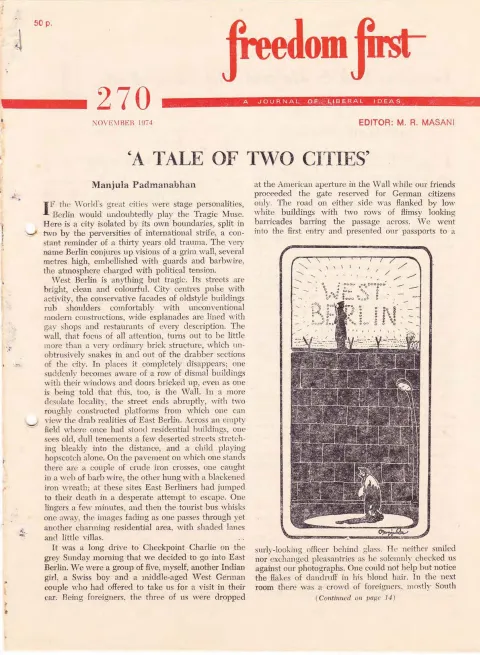
periodical issue
Freedom First
A Journal of Liberal Ideas
By S. V. Raju
Published for the Democratic Research Service by J. R. Patel, Associate Editor, Freedom First at 127, Mahatma Gandhi Road, Bombay 400 023 (Phone: 273914) and printed by him at Commercial Printers & Stationers, 525.S. Bapat Marg, Dadar, Bombay-400 028. · Bombay · 1979
16 pages
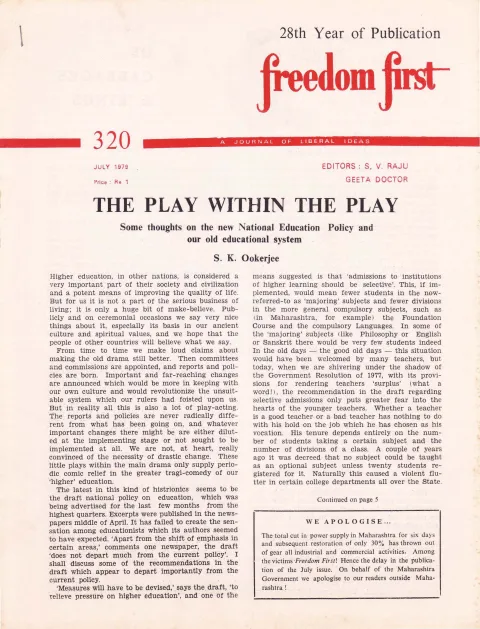
Freedom First
Summary
Freedom First No. 320 (July 1979), the 28th year of publication, edited by S. V. Raju and Geeta Doctor. The issue opens with S. K. Ookerjee’s critique of the draft National Education Policy and the entrenched dysfunctions of India’s higher-education system, and continues with the ‘Of Cabbages & Kings’ notes column skewering Western ‘ashram-hopping’ spiritual tourists and lamenting the government’s mishandling of the Silent Valley wildlife controversy in Kerala. S. V. Raju defends the legitimacy of Bishop Abel Muzorewa’s newly installed government in Zimbabwe-Rhodesia against Western and Indian scepticism, framing it as a gradualist, non-violent alternative to the Marxist-aligned Patriotic Front guerrillas. V. B. Karnik reviews a Stanford law study on racial job discrimination in the United States and draws parallels to caste-based reservation in India. Manjula Padmanabhan contributes a satirical piece imagining exaggerated global consequences of the Skylab re-entry. Two book reviews follow — Adi H. Doctor on W. H. Morris Jones’s essay collection on Indian politics, and K. V. Padmanabhan on A. R. H. Copley’s political biography of C. Rajagopalachari — and the issue closes with ‘With Many Voices,’ a page of topical press quotations.
Key points
-
S. K. Ookerjee’s critique of the draft National Education Policy of 1979 argues it will change little in practice, since colleges resist internal assessment and tutorial teaching is being cut back even as class sizes rise from 60 to 100 students.
-
Geeta Doctor’s “Of Cabbages & Kings” column satirises Western “ashram hoppers” seeking gurus at Himalayan and Poona ashrams, and separately criticises the Kerala Silent Valley hydroelectric project for threatening the endangered lion-tailed macaque despite existing wildlife sanctuaries.
-
S. V. Raju’s “Give the Bishop a Chance” argues Bishop Abel Muzorewa’s newly installed Zimbabwe-Rhodesia government deserves international recognition, contrasting his gradualist path to majority rule with the Marxist-aligned guerrilla campaigns of Robert Mugabe and Joshua Nkomo.
-
V. B. Karnik reviews William B. Gould’s Black Workers in White Unions on U.S. racial job discrimination, drawing an explicit parallel to India’s own caste-based reservation system for Scheduled Castes and Tribes.
-
Manjula Padmanabhan contributes a comic satirical piece imagining exaggerated global consequences of the 1979 Skylab re-entry, including a fictional “Space Debric Cult” in Java.
-
Adi H. Doctor reviews W. H. Morris Jones’s essay collection Politics Mainly Indian, highlighting his view that the Emergency built no institutions to replace democracy’s motive powers yet “matured the electorate”.
-
K. V. Padmanabhan reviews A. R. H. Copley’s political biography of C. Rajagopalachari, timed to his birth centenary, tracing his reform record as Madras Premier and his 1959 founding of the Swatantra Party after growing alienated from Nehru’s “totalitarian” tendencies.
Essays
The Play Within the Play: Some thoughts on the new National Education Policy and our old educational system
By S. K. Ookerjee
S. K. Ookerjee surveys the draft National Education Policy of 1979 and argues that it will change little in practice, echoing decades of reports and commissions that promise reform but leave the underlying system undisturbed. He focuses on two proposals — ‘selective admissions’ to higher education and ‘internal assessment’ replacing rote-memorization examinations — and walks through why neither is likely to be implemented seriously: colleges compete for enrolment to protect faculty jobs and ‘good college’ reputations, tutorial teaching has been curtailed rather than expanded even as class sizes rise from 60 to 100 students, and paper-setters, examiners, students and unions all resist a genuinely more demanding examination style. He concludes that without more money for smaller tutorial classes and higher teacher pay, and without political will to make education rather than economy the driving consideration, ‘the play will go on’ unchanged.
- The draft National Education Policy ‘does not depart much from the current policy’ despite advertised fanfare.
- A 1977 Government Resolution rendering teachers ‘surplus’ when enrolment in their subject falls has already made junior faculty insecure.
- Class-size caps have risen from 60 to 80 to 100 students, undermining tutorial-style teaching even as the draft calls for it.
- ‘Internal assessment’ replacing terminal university exams is described as workable only with major changes in student, teacher and management attitudes — changes the author doubts will happen.
- Colleges’ desire to protect their ‘good college’ reputation pressures them to push weak students through to the final exam rather than fail them at internal checkpoints.
- The tutorial method (breaking large classes into small groups) is called the single method most likely to improve higher education quality, but is being cut back, not expanded.
- The author concludes with resignation that financial and bureaucratic priorities will keep the reforms cosmetic.
Of Cabbages & Kings (column: Perils of Ashram Hopping; Silent Valley Silenced)
By GD
The ‘Of Cabbages & Kings’ notes column (signed GD, i.e. Geeta Doctor) runs two items. ‘Perils of Ashram Hopping’ satirizes a wave of Western spiritual tourists who arrive seeking gurus at Himalayan ashrams and around figures like Sai Baba, Ramana Maharshi, Shankaracharya and the Rajneesh ashram in Poona, portraying them as self-absorbed ‘seekers’ oblivious to the discomfort and disruption they cause their Indian hosts, and quoting a Rajneesh devotee’s dismissive letter to the Indian Express. ‘Silent Valley Silenced’ criticizes the Kerala hydroelectric project’s threat to the Silent Valley rainforest and its endangered wildlife, especially the lion-tailed macaque, and accuses the government of paying lip service to conservation while allowing wildlife habitat to be destroyed unchecked.
- Foreign ‘ashram hoppers’ are depicted as performative seekers of self-realization who romanticize Indian poverty while resisting genuine cultural adjustment.
- A Rajneesh devotee’s letter in the Indian Express is quoted defending Western dress and behaviour against Indian objections, which the column treats as emblematic of the friction between visitors and hosts.
- India’s tiger population’s decline from 40,000 to 2,500 in a century frames the piece on wildlife loss.
- The Silent Valley hydroelectric project in Kerala is criticized for threatening the lion-tailed macaque and other species despite the existence of 150 wildlife sanctuaries.
- The column argues government conservation policy amounts to short-term thinking dressed up as concern for the environment.
Give the Bishop a Chance
By S. V. Raju
S. V. Raju argues that Bishop Abel Muzorewa’s newly installed government in Zimbabwe-Rhodesia deserves international recognition and a chance to govern, rejecting Indian and Western scepticism about the fairness of the April 1979 elections. He recounts Rhodesia’s history from Cecil Rhodes’s founding in 1890 through Ian Smith’s 1965 Unilateral Declaration of Independence and the subsequent sanctions, and contrasts Muzorewa’s and Ndabaningi Sithole’s peaceful, gradualist path to majority rule with the guerrilla campaigns of Robert Mugabe and Joshua Nkomo, whom Raju characterizes as seeking one-party Marxist rule imposed by force rather than the ballot. He criticizes India’s foreign policy as reflexively hostile to the Internal Settlement and notes the U.N., Soviet Union, U.K. and U.S.A.’s mixed responses, closing by asking whether democratic nations will deny the Muzorewa government recognition purely because the transition is imperfect.
- India’s Prime Minister Morarji Desai told Lord Carrington that India considered the Salisbury government illegal, which Raju calls a continuation of a ‘spineless’ Nehru-era foreign policy.
- Muzorewa’s United National African Council won 51 of 72 seats in the April 1979 election, with 64% turnout despite guerrilla intimidation.
- Raju frames the guerrilla leaders Mugabe and Nkomo as seeking power via armed force and Soviet/Cuban backing rather than the democratic process.
- The Internal Settlement included a bill of rights, protection against nationalisation, an independent judiciary and public service, though whites retained 28 reserved parliamentary seats and guarantees for a decade.
- Raju compares Muzorewa’s incrementalist strategy to Gandhiji’s philosophy of ‘one step at a time’.
- The U.N. Security Council declared the elections ‘null and void’ while the U.K. and U.S. abstained and reserved judgment.
Job Discrimination in the U.S.A. (review of Black Workers in White Unions by William B. Gould)
By V. B. Karnik
V. B. Karnik reviews William B. Gould’s ‘Black Workers in White Unions’ (Cornell University Press, 1978), a legal-academic study of racial job discrimination in the United States drawing on Gould’s experience as an EEOC consultant. Karnik summarizes Gould’s account of how trade-union apprenticeship rules, seniority systems and exclusion from union leadership have perpetuated discrimination against Black, Puerto Rican, Chicano and Mexican workers even after the Civil Rights Act of 1964, and how courts — notably the Supreme Court in Griggs v. Duke Power Co. — have expanded remedies including affirmative action and quotas. He closes by drawing an explicit parallel to India’s own caste-based job reservation system for Scheduled Castes and Tribes, judging it inadequate but ‘better than doing nothing.’
- Gould’s book, based on legal proceedings and court decisions, documents discrimination in apprenticeship admission, journeyman certification, segregated union locals, and exclusion of Blacks from union policy-making bodies.
- As of 1973 the UAW’s international staff was only 14.3% minority despite Black membership of 25-30% of the union, illustrating persistent underrepresentation even in a ‘progressive’ union.
- The Supreme Court’s Griggs v. Duke Power Co. decision held that Title VII targets practices that perpetuate the effects of past discrimination even where neutral on their face.
- Karnik notes the book is written more for lawyers and race-relations specialists than general readers.
- He draws a direct comparison between U.S. racial job discrimination remedies and India’s reservation system for Scheduled Castes and Tribes, judging the latter ‘too inadequate’ but still worthwhile.
The Day the Sky fell on our Heads
By Manjula Padmanabhan
Manjula Padmanabhan contributes a comic, satirical piece imagining the aftermath of the 1979 Skylab space-station re-entry, mocking both American media hype over the debris and the exaggerated, farcical consequences she invents — from a ‘Space Debric Cult’ in Java to a supposed brisk trade in Skylab-fragment jewellery and collectibles. The piece is pure comic invective rather than reportage, riffing on the real uncertainty and contradictory reporting that surrounded Skylab’s actual re-entry.
- The piece opens from the narrator’s own house being hit by ‘a two-kilo weakling’ fragment of Skylab, immediately establishing the satirical register.
- It lampoons NASA’s shifting and contradictory public statements about where debris might land.
- It invents absurd consequences: a religious cult worshipping ‘the great god NASA’ in Java, and Tiffany’s reportedly considering ‘Skylab jewellery’.
- The piece closes by noting (satirically) that Soviet satellites pose a far greater uncontrolled risk than Skylab ever did.
Book Review: Politics Mainly Indian (by W. H. Morris Jones)
By Adi H. Doctor
Adi H. Doctor reviews W. H. Morris Jones’s ‘Politics Mainly Indian’ (Orient Longman, 1978), a collection of the veteran Indologist’s essays spanning the periods of Congress dominance and post-1967 ‘populist rhetoric’ in Indian politics, including his analysis of the Emergency. Doctor highlights Morris Jones’s view that the Emergency was largely an inevitable consequence of populist appeal combined with personalised administration, his defence of political apathy against claims that citizenship demands active participation, and his interest in press performance and election forecasting as an underexplored area of Indian political science.
- Morris Jones is praised as an outsider who has ‘earned the right’ to be treated as part of the Indian political scene after 35 years of study.
- He divides Indian politics into the earlier period of ‘politics of manipulation’ (Congress dominance) and the post-1967 ‘politics of populist rhetoric’.
- Morris Jones argues the Emergency did not represent a durable option because it built no institutions to replace the motive powers of democracy.
- He also argues the Emergency ‘matured the electorate’ and taught India a lesson it will not soon forget.
- Two essays from the 1960s reflect his early suspicion of Gandhi-JP style ‘decentralised democracy’ based on consensus rather than majority rule.
- Morris Jones defends political apathy, rejecting the idea that citizenship requires a baseline of political participation.
Book Review: The Political Career of C. Rajagopalachari: 1937-1954, A Moralist in Politics (by A. R. H. Copley)
By K. V. Padmanabhan
K. V. Padmanabhan reviews A. R. H. Copley’s ‘The Political Career of C. Rajagopalachari: 1937-1954, A Moralist in Politics’ (Macmillan, 1978), timed to Rajaji’s birth centenary. The review traces Copley’s account of Rajaji’s rise as Premier of Madras, his fraught relationships with Gandhiji, Nehru and Sardar Patel, his controversial wartime collaboration stance that alienated him from Congress, his subsequent return to high office (Governor of Bengal, Minister, and Governor-General of India), and his major reform record as Madras Premier — agrarian reforms, prohibition, and temple entry for Harijans — before his resignation as Chief Minister in 1954 and later founding of the Swatantra Party.
- Rajaji’s differences with Gandhiji intensified over the 1942 ‘Quit India’ resolution and his own earlier wartime-collaboration stance, which Gandhiji called ‘the greatest betrayal of the doctrine of non-violence’.
- Rajaji and Nehru shared little in temperament — Nehru’s agnosticism and socialism contrasted with Rajaji’s religiosity — but Nehru favoured Rajaji for the honoured position of India’s first President.
- Rajaji’s rivalry with Sardar Patel and his suspicion that Patel harboured a soft corner for Muslims are noted as sources of friction.
- As Premier of Madras (1937-39, and again 1952-54) Rajaji pushed through agrarian reform, prohibition and temple-entry for Harijans against vested-interest opposition.
- Governor Lord Erskine in 1939 called Rajaji ‘a really good administrator… a good Tory in internal politics… too much of a Tory for me’, wishing ‘to go back two thousand years and run India as in the time of King Asoka’.
- Rajaji founded the Swatantra Party in 1959 after growing alienated from Nehru’s ‘totalitarian’ tendencies in the 1950s.
- The book’s narrative effectively ends with Rajaji’s 1954 resignation as Chief Minister of Madras, with an epilogue and postscript covering his later years and a comparison to Morarji Desai.
With Many Voices (quotations column)
‘With Many Voices’ is the issue’s closing page of curated topical press quotations, drawn from sources including The Economist, The Daily Telegraph, Business India, The Observer, Time and The Statesman, spanning subjects from British and Indian politics to entrepreneurship and communal tension.
- The column collects short quotations attributed to figures including Margaret Thatcher, Indira Gandhi, Pope John Paul II, U.S. Senator S.I. Hayakawa and U.K. Chancellor Geoffrey Howe.
- Quotations touch on bureaucratic jargon, nationalisation of TISCO, communal rioting risk in India, and calls to reduce public-sector borrowing in Britain.
- The page is framed with an epigraph from Tennyson (‘The deep / Moans round with many voices…’).
Generated by the v1.5 extraction pipeline. Awaiting editorial review.
Metadata and summary are AI-extracted from the source PDF and reviewed for editorial accuracy. The original work is available via the Read PDF tab above (where present); paragraph-level citation inside the PDF is deferred to a future engagement.