periodical issue
Freedom First
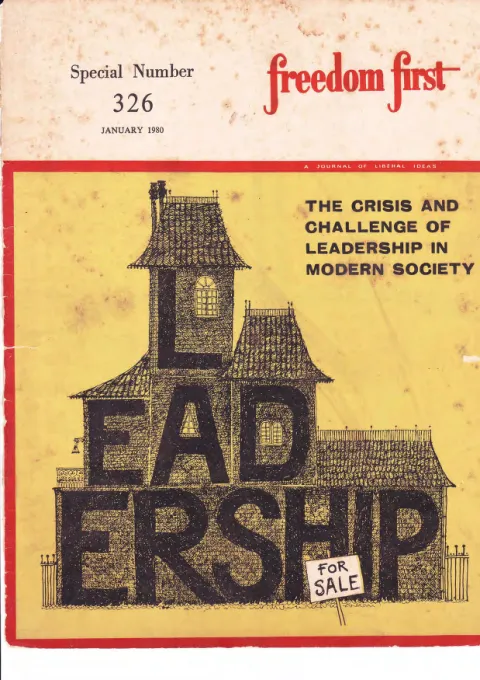
The Crisis and Challenge of Leadership in Modern Society
By S. V. Raju
freedom first · Bombay · 1980
72 pages
Freedom First
Summary
Freedom First No. 326 (January 1980) is a Special Number devoted entirely to “The Crisis and Challenge of Leadership in Modern Society,” marking the 28th year of the journal’s publication and, notably, the issue in which founding-era editors S. V. Raju and Geeta Doctor step down and hand over to the poet and critic Nissim Ezekiel as incoming Managing Editor. In the rendered pages the volume assembles a wide roster of contributors — academics, journalists, a retired major-general, a trade unionist, and Freedom First’s own editors — to examine leadership from many angles: as a political “riddle” resistant to typology (S. P. Aiyar), as a contrast of styles seen in Indian and Western politicians (M. R. Masani), as a problem sharpened by the accelerating pressures of the modern state (R. M. Lala), as a set of moral qualities that cannot be taught by formal instruction alone (S. K. Ookerjee), and as a test of efficiency, honesty, impartiality and accessibility in the civil service (Taya Zinkin, essay not yet concluded in the rendered pages). The volume’s argumentative center, set out in the unsigned editorial statement, is that India’s problems at the start of the 1980s amount fundamentally to a crisis of character in its leadership, and that the qualities embodied by Gandhi are receding into memory even as the nation’s need for them grows.
Key points
-
The Special Number, marking S. V. Raju and Geeta Doctor’s handover of the editorship to Nissim Ezekiel, is devoted entirely to “The Crisis and Challenge of Leadership in Modern Society,” with an unsigned editorial framing India’s problems as fundamentally a crisis of character in its leadership.
-
S. P. Aiyar’s “The Riddle of Leadership” argues no single typology survives historical variety and treats charismatic leadership as dangerous, citing Indira Gandhi’s Emergency-era isolation among sycophants as a cautionary example.
-
M. R. Masani’s “Two Styles of Leadership” blames India’s leadership shortage on a cultural deference to age and a “dialectical” reluctance to commit to clear positions, contrasting Churchill and De Gaulle’s conditional leadership with Morarji Desai and Charan Singh’s premierships.
-
R. M. Lala’s “Leadership Yesterday and Today” argues the burdens of jet travel, mass communication and unrelenting scrutiny have made modern leadership far harder than in Gladstone’s day, citing the Shah of Iran’s isolation from expert advice as a cautionary case.
-
S. K. Ookerjee’s “Recipe for Making Leaders” dismisses formal leadership training as impossible since leadership is a matter of character rather than technical skill, warning against both dictatorial figures like Hitler and Idi Amin and the surrender of followers’ own moral judgement.
-
Taya Zinkin’s “The Civil Servant as a Leader” argues efficiency must precede honesty and impartiality in public administration, illustrating “leading by example” with the story of Collector Captain Mohite of Sholapur, whose development gains collapsed once he was transferred.
Essays
The Riddle of Leadership
By S. P. Aiyar
S. P. Aiyar’s essay surveys the difficulty of generalising about leadership given the wide variation among historical leaders, and singles out “charismatic leadership” for extended, skeptical treatment. He argues charismatic authority rests on followers attributing superhuman qualities to a leader, is inherently transitory, and tends to make the leader impatient of established constraints — citing Indira Gandhi’s wartime and Emergency-era cult of personality as a cautionary Indian example. Aiyar then works through qualities he considers indispensable to effective leadership in any field: knowledge of the situation, imagination/foresight, and courage (physical and moral), illustrating each with examples ranging from Napoleon and Montgomery to Gandhi’s grasp of the post-WWI mood in India and Churchill’s 1940 Dunkirk speech. In the rendered pages the essay is cut off mid-argument on the theme of courage.
- Argues that no single typology of leadership survives contact with historical variety, and that ‘leaders are born and not made’ is too simple a formula.
- Treats charismatic leadership as dangerous: it is transitory, blindly followed, and encourages leaders to bypass established authority.
- Cites Indira Gandhi’s Emergency-era isolation (surrounded by ‘frightened intelligence officers and professional sycophants’) as an example of charismatic leadership’s failure mode.
- Identifies knowledge of the situation as a foundation of authority, invoking Gopal Krishna Gokhale’s Servants of India Society as an ideal now receding from Indian public life.
- Discusses imagination/foresight through Napoleon’s early military career and Gandhi’s reading of the post-WWI national mood.
- Begins a discussion of courage (physical and moral) using Churchill’s Dunkirk speech as illustration; essay continues past the rendered pages.
Two Styles of Leadership
By M. R. Masani
M. R. Masani argues that leadership is in especially short supply in India because of cultural traits — an exaggerated deference to age and authority alongside a ‘dialectical’ habit of never committing to a clear position — that discourage the courage and decisiveness leadership requires. He contrasts the conditional, principled leadership style of Winston Churchill and De Gaulle (who led only so long as their parties would follow them) with what he sees as the weaker, more compromised leadership of Morarji Desai and Charan Singh as Indian prime ministers since 1977, concluding that India has had ‘big government but not strong government.’
- Opens with a Guardian (London) quotation on the American presidential election to show that weak leadership is not uniquely Indian.
- Argues Indian culture combines exaggerated respect for age/authority with a ‘dialectical’ inability to commit to a clear position, both inimical to leadership.
- Cites Nehru’s rhetorical hedging (‘at the same time… on the other hand’) as an example of this dialectical habit, linking it to the origin of non-alignment.
- Praises Churchill and De Gaulle’s model of conditional leadership — willing to lead only on their own terms — contrasting it with Morarji Desai and Charan Singh’s premierships since April 1977.
- Diagnoses Indian governance as ‘big government but not strong government’: meddlesome but ineffective, with progressive labour laws unmatched by enforcement capacity.
Leadership Yesterday and Today
By R. M. Lala
R. M. Lala argues that the burdens on modern leaders — jet travel, instant communication, an exploded volume of legislation, terrorism, pollution, population growth, and unrelenting media scrutiny — have grown so much heavier than in Gladstone’s or Roosevelt’s day that the world now faces a shortage of first-rate leaders to match first-rate problems, India included. Drawing on figures from Roosevelt and Truman to Carter, Schmidt, De Gaulle, Adenauer, and the Shah of Iran, he contends that even naturally gifted leaders are more exposed and more easily eclipsed by circumstance than before, and that India’s leadership has ‘touched depths that few democracies can boast of.’
- Opens by contrasting Gladstone’s leisurely governance with the compressed, high-pressure demands on modern prime ministers.
- Notes the exponential growth of legislation in Britain (450 pages of law in 1911 vs. thirteen volumes 65 years later) as one marker of increased governing complexity.
- Surveys Roosevelt, Truman, and Carter’s differing burdens (depression/war, the nuclear age, and the energy crisis respectively).
- Discusses De Gaulle and Adenauer as leaders who ‘gave a turn to their times,’ and describes the Shah of Iran’s authoritarian drift and isolation from expert advice as a cautionary case, quoting Fereydoun Hoveyda’s forthcoming book on the Shah’s fall.
- Concludes that a decline in leadership quality is a global phenomenon, though Indian leaders have gone further than most democracies, contrasting the Independence-era ‘galaxy of stalwarts’ with ‘the puny characters that strut the stage today.‘
Recipe for Making Leaders
By S. K. Ookerjee
S. K. Ookerjee opens by dismissing formal ‘leadership training’ as impossible, arguing leadership qualities are moral qualities of character that cannot be produced by rules and instruction the way technical skills can. He works through three misconceptions — that leadership is morally neutral, that hero-worship or blind followership is healthy, and that leaders may dominate followers without check — warning against both dictatorial monsters (Hitler, Mussolini, Idi Amin) and against the opposite danger of surrendering one’s judgement entirely to a leader, quoting Plato’s Republic on the danger of guardians who abuse their auxiliaries. In the rendered pages the essay breaks off mid-argument on the complementary duties of leaders and followers; the TOC indicates it continues to page 31, beyond what was rendered here.
- Argues leadership qualities are ‘qualities of mind and character’ rather than teachable skills, unlike chemical technology or typing.
- Notes an earlier, now-defunct ‘Training for Leadership Centre’ in the Deccan as evidence formal courses cannot manufacture leaders.
- Identifies leadership as morally neutral in the sense that monstrous leaders (Hitler, Mussolini, Idi Amin) are still ‘leaders’ in the descriptive sense, while warning against conflating being led with hero-worship.
- Quotes Plato’s Republic on the danger of rulers (‘Auxiliaries’) treating citizens like sheep rather than partners.
- Argues followers must retain their own judgement and not surrender it even to legitimate authority when moral duty requires dissent.
The Civil Servant as a Leader
By Taya Zinkin
Taya Zinkin examines the civil servant as leader by first parsing the dictionary definitions of ‘civil,’ ‘servant,’ and ‘to lead,’ then arguing that a civil servant must first prove efficient, honest, impartial and accessible — in that order — before being capable of leadership at all. She illustrates efficiency and honesty with personal anecdotes, including her husband’s handling of a corrupt bearer (Sheikh Hussein) who extorted bribes, and James Walmsley’s disciplined desk-clearing habits during Partition. She then turns to ‘leading by example,’ comparing it to teaching, and tells the story of Captain Mohite, a Collector in Sholapur whose personal example transformed his sub-division’s development (college education for his wife, latrine-digging, road-building) — only for the gains to collapse once he was transferred, since his successor lacked his personal force of leadership. In the rendered pages the essay is not yet concluded (it continues past printed page 18, which is where the rendered set ends; the TOC lists the essay running through page 19).
- Defines civil service leadership through the dictionary meanings of ‘civil’ (polite, not rude), ‘servant’ (one who carries out orders), and ‘to lead’ (to conduct/guide by example).
- Argues efficiency must precede honesty and impartiality, since inefficiency itself breeds corruption by creating bottlenecks that tempt underlings to take bribes.
- Recounts how her husband cancelled a corrupt bearer’s target’s bail and paraded him in handcuffs rather than simply sacking the bearer, judging public exposure more effective than removal.
- Cites James Walmsley’s practice, during Partition, of keeping a daily list of tasks and holding subordinates answerable for anything left undone.
- Tells the story of Captain Mohite, Collector in Sholapur, whose personal example (educating his wife, digging latrines himself) transformed local development, but whose gains evaporated once he was transferred elsewhere.
- References the enduring reputation of ‘Gorwala Justice’ — named for civil servant A. D. Gorwala — as a byword in Sind for honest, accessible administration.
Generated by the v1.5 extraction pipeline. Awaiting editorial review.
Metadata and summary are AI-extracted from the source PDF and reviewed for editorial accuracy. The original work is available via the Read PDF tab above (where present); paragraph-level citation inside the PDF is deferred to a future engagement.