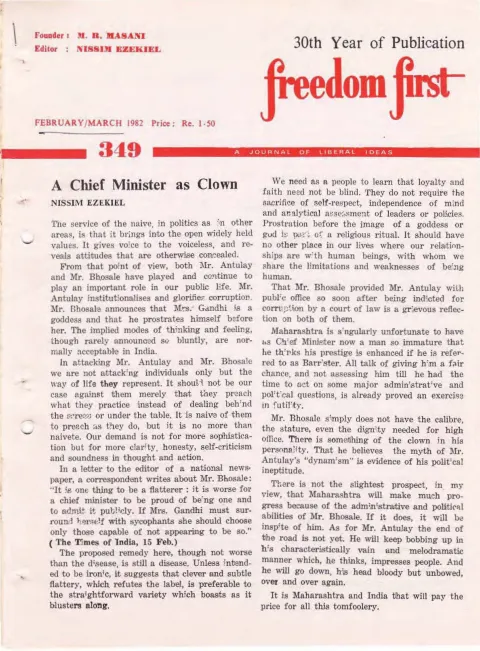
periodical issue
Freedom First
A Journal of Liberal Ideas
Published for the Democratic Research Service by J. R. Patel, Associate Editor, Freedom First at 127, Mahatma Gandhi Road, Bombay 400023 (Phone: 273914) and printed at Jam-e-Jamshed, Mangalore Street, Fort, Bombay 400038. · Bombay · 1981
16 pages
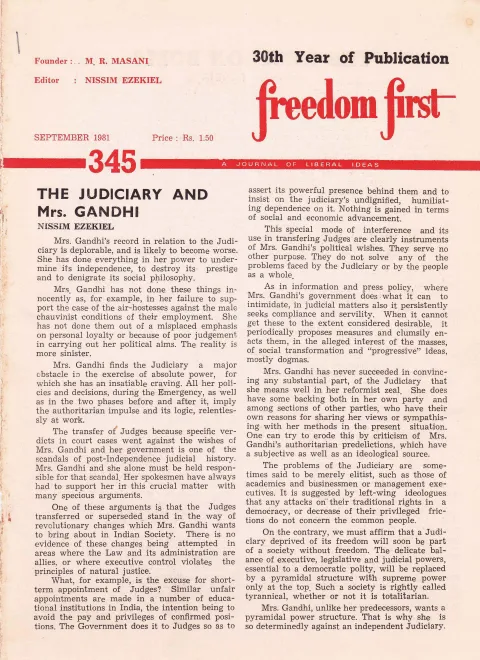
Freedom First
Summary
This September 1981 issue of Freedom First (No. 345, marking the journal’s 30th year of publication) opens with editor Nissim Ezekiel’s sharp attack on Indira Gandhi’s record of undermining judicial independence, particularly through the transfer of judges. Rashmi Taneja surveys the international controversy over President Reagan’s neutron bomb decision and its strain on NATO unity. K. V. Subrahmanyam offers a historical critique of how Congress dominance, Nehru’s authoritarian drift, and unresolved caste politics produced what he calls India’s ‘one party democracy.’ A two-part ‘Voices’ section carries a correspondent’s polemic against Janata Party defections and mergers, and Aloo Dalal’s report on the poor state of women’s health and development in India. ‘The World of Books’ reviews Bimal Prasad’s edited volume of Jayaprakash Narayan’s writings and Taya Zinkin’s guide to English communication. K. S. Venkateswaran’s ‘A Variety of Comment’ column takes up race riots in Britain, trade union conduct (including a defense of the American ‘right to work’ movement, quoting Hayek), and a skeptical look at calls to nationalise Indian healthcare, quoting Nirad Chaudhuri’s disillusionment with Britain’s NHS. The issue closes with notices from the Centre for the Independence of Judges and Lawyers and Common Cause (H. D. Shourie), reporting on their advocacy activities.
Key points
-
Nissim Ezekiel’s “The Judiciary and Mrs. Gandhi” indicts the government for deliberately transferring and superseding judges whose verdicts went against it, framing an independent judiciary as essential to a non-tyrannical polity.
-
Rashmi Taneja’s “The Neutron Bomb” examines the NATO backlash to Reagan’s decision to produce the radiation-heavy weapon, warning it could alienate European publics and hand the Soviet Union a propaganda advantage.
-
K. V. Subrahmanyam’s “India’s One Party Democracy” traces Congress’s post-Independence dominance to Nehru’s admiration for the Soviet model and adult franchise without literacy requirements, crediting Ambedkar alone among the framers with foreseeing the risks.
-
Two “Voices” pieces cover a polemic against Janata Party mergers and defections, and a report on India’s high maternal and infant mortality and worsening sex ratio, contrasting Kerala’s better outcomes with high female literacy.
-
Book reviews cover Bimal Prasad’s edited volume of JP’s writings tracing his evolution from Marxism to Sarvodaya and Total Revolution, and Taya Zinkin’s guide to English communication, Write Right.
-
K. S. Venkateswaran’s “A Variety of Comment” covers Indian media’s hypocritical reaction to Britain’s 1981 race riots, praise for the US “right to work” movement against forced unionism, and scepticism toward India’s “Health for All” nationalisation proposal.
-
Short notices announce the Centre for the Independence of Judges and Lawyers, formed in Geneva, and report on Common Cause’s advocacy for urban middle-class grievances including a Supreme Court writ petition on pensioner discrimination.
Essays
The Judiciary and Mrs. Gandhi
By NISSIM EZEKIEL
Nissim Ezekiel’s lead editorial indicts Indira Gandhi’s government for systematically undermining the independence of the judiciary, arguing that the transfer and supersession of judges whose verdicts went against her wishes was a deliberate campaign to intimidate the courts into compliance. He frames this as part of a broader authoritarian impulse evident throughout the Emergency and its surrounding periods, and warns that a judiciary stripped of freedom heralds a society without freedom, replaced by a pyramidal, tyrannical power structure.
- Mrs. Gandhi’s treatment of the judiciary is called deliberate, not accidental or well-intentioned.
- The transfer of judges over adverse verdicts is described as one of the scandals of post-Independence judicial history.
- Ezekiel links judicial interference to the same authoritarian logic seen in information and press policy.
- He rejects the argument that judicial elitism justifies executive interference.
- The piece frames an independent judiciary as essential to a democratic, non-tyrannical polity.
The Neutron Bomb
By RASHMI TANEJA
Rashmi Taneja examines the controversy surrounding President Reagan’s decision to produce the neutron bomb, describing the weapon’s radiation-heavy, low-blast design and its intended use against Soviet tank superiority in Europe. She details the backlash from NATO allies, especially West Germany, the Netherlands and Belgium, who were not consulted and fear the weapon lowers the nuclear threshold, and closes by warning that the decision could alienate European publics and hand the Soviet Union a propaganda advantage.
- The neutron bomb is designed to maximise radiation and minimise blast/property damage, aimed at Soviet tank forces.
- NATO allies were upset at not being consulted before the announcement.
- European anti-nuclear sentiment and scepticism about U.S. foreign policy consistency are rising.
- The Soviet Union is depicted as exploiting the controversy for propaganda purposes.
- Taneja criticises Reagan’s foreign policy as overly reliant on arms build-up over arms-limitation talks.
India’s One Party Democracy
By K. V. SUBRAHMANYAM
K. V. Subrahmanyam traces how the absence of a clear post-Independence policy vision, combined with Nehru’s admiration for the Soviet model and Congress’s decision to remain in power as a party rather than dissolve, entrenched one-party dominance in India. He argues Ambedkar was alone among the constitution’s framers in grasping the risks of directive principles overriding fundamental rights, and that adult franchise without literacy requirements enabled caste- and community-based vote-bank politics. The essay ends by describing Nehru’s drift toward authoritarian tendencies in power and the Congress syndicate’s miscalculated elevation of Indira Gandhi as a pliable figurehead.
- Congress chose to retain power as a party after Independence rather than following the American post-revolutionary precedent of dissolving.
- Nehru’s fascination with the Soviet Union’s handling of a multinational state shaped his political instincts.
- Ambedkar is credited as the only framer alert to the constitution’s structural risks, drawing a parallel to Weimar Germany’s collapse.
- Adult franchise without literacy/civics requirements is blamed for caste- and community-based electoral politics.
- Nehru’s increasing intolerance of criticism in his later years is illustrated via the cases of John Mathai and Chintaman Deshmukh.
- The essay closes on the Congress Syndicate misjudging Indira Gandhi as a controllable figurehead after Shastri’s death.
Voices - 1: Repeating Failures
By A CORRESPONDENT
Writing under ‘Voices — 1’, a correspondent excoriates the Congress(U), Lok Dal and Janata Party leaders for exploring a merger, accusing them of shamelessness and a cynical view of the electorate. The piece singles out Madhu Limaye’s role in engineering the Janata Party split over the ‘dual membership’ issue as a pretext to purge the Jan Sangh element, and mocks the proposed leadership carve-up among Chandra Shekhar, Charan Singh and Devaraj Urs, calling instead for senior politicians to retire and let younger people lead.
- Responds to an Indian Express report on a possible Congress(U)-Lok Dal-Janata merger.
- Accuses politicians of megalomania rather than sincere reform intent.
- Criticises the ‘dual membership’ pretext used to expel Jan Sangh elements from the Janata Party.
- Mocks a proposed division of leadership roles among Chandra Shekhar, Charan Singh and Urs as self-serving.
- Calls for senior politicians to retire and cede ground to younger leaders.
Voices - 2: Women Health and Development
By ALOO DALAL
In ‘Voices — 2’, Aloo Dalal reports on the deteriorating health status of Indian women, citing findings from the National Committee on the Status of Women and the report ‘Health for All: An Alternative Strategy.’ She documents high maternal and infant mortality, an adverse and worsening sex ratio, the decline in women medical graduates, and the disproportionate burden of malnutrition, early marriage and prolonged breastfeeding on women’s health, concluding that economic development has unfairly disadvantaged women, especially rural and construction labourers.
- India’s maternal mortality rate is cited at 393 per thousand live births, with high infant mortality at 120 per thousand.
- India’s sex ratio has worsened from 972 females per thousand males in 1901 to 935 in 1981, lowest in Punjab, most favourable in Kerala.
- Kerala’s high female literacy is linked to its comparatively better health outcomes and status for women.
- The proportion of women among medical graduates fell from 47.1% in 1965 to 19.2% in 1976.
- Female construction workers and rural female labour are highlighted as especially neglected and exploited groups.
The World of Books (reviews of ‘A Revolutionary’s Quest: Selected Writings of Jayaprakash Narayan’ ed. Bimal Prasad, and ‘Write Right’ by Taya Zinkin)
By B. P. ADARKAR; RAJALAKSHMI HEBSUR
In ‘The World of Books,’ B. P. Adarkar reviews Bimal Prasad’s edited volume ‘A Revolutionary’s Quest: Selected Writings of Jayaprakash Narayan,’ praising Prasad’s introduction and selection while tracing JP’s evolution from Marxism through Gandhism, Sarvodaya, Bhoodan, and finally to the concept of ‘Total Revolution.’ Rajalakshmi Hebsur separately reviews Taya Zinkin’s ‘Write Right,’ a guide to effective English communication aimed partly at social scientists, praising its compactness and practical exercises.
- Adarkar credits Bimal Prasad’s introduction and 33-chapter selection for tracing JP’s ideological evolution.
- JP’s thought moved from Marxism to a blend of Marxism, Gandhism and Western democratic values, and finally to Sarvodaya and Total Revolution.
- Adarkar notes JP’s reluctance to take administrative power despite his influence, including declining Nehru’s invitation to join government.
- Hebsur’s review of Zinkin’s ‘Write Right’ highlights its two-part structure: precepts on clear writing, followed by applied exercises.
- Zinkin’s book originated from her work training African and Asian doctoral students in the social sciences.
A Variety of Comment: 1. Race Riots in Britain; 2. Trade Union Conduct; 3. Health Service Problems
By K. S. VENKATESWARAN
K. S. Venkateswaran’s ‘A Variety of Comment’ column covers three subjects: the disproportionate and hypocritical Indian media reaction to Britain’s 1981 race riots, quoting Khushwant Singh’s blunt account of immigrant behaviour contributing to tensions; the wave of trade union militancy in India (citing the Datta Samant affair and a strike-banning ordinance) contrasted approvingly with the American National Right to Work Legal Defense Foundation’s fight against ‘forced unionism,’ quoting Hayek and Justice Thurgood Marshall; and a sceptical review of the ‘Health for All: An Alternative Strategy’ report, contrasting its utopian rhetoric against public-sector health corruption with Nirad Chaudhuri’s own disillusionment with Britain’s National Health Service.
- Venkateswaran criticises Indian media’s hysterical, one-sided coverage of the 1981 British race riots.
- He quotes Khushwant Singh’s frank commentary on the behaviour of South Asian immigrants in England as a contributing factor to tensions.
- He praises the U.S. National Right to Work Legal Defense Foundation’s legal battles against ‘forced unionism,’ quoting Hayek and Justice Thurgood Marshall.
- He links rising Indian trade union militancy (the Datta Samant arrest, a government strike-banning ordinance) to a broader crisis of union conduct.
- He criticises the ‘Health for All: An Alternative Strategy’ report as utopian statism, citing Nirad Chaudhuri’s own reversal on Britain’s NHS.
Centre for the Independence of Judges and Lawyers (notice)
A short notice describes the newly formed Centre for the Independence of Judges and Lawyers (CIJL), established by the International Commission of Jurists in Geneva, whose mission is to collect and disseminate information about threats to the independence of judges and advocates worldwide, especially those defending persons accused of political offences, and to invite cooperation from organisations and individuals.
- CIJL was formed at the International Commission of Jurists’ Geneva headquarters.
- Its remit covers collecting information on inroads into judicial and legal-profession independence worldwide.
- It documents harassment, arrest, exile and assassination of advocates, particularly those defending political offence cases.
- It invites organisations and individuals globally to supply information or request assistance.
Common Cause: Programmes and Activities
By H. D. SHOURIE
H. D. Shourie, Director of Common Cause, reports on the organisation’s programmes and activities as a voluntary, non-political platform for the urban middle class, covering its advocacy on direct tax anomalies, estate duty, property tax, pensioner discrimination (including a Supreme Court writ petition), and rent control, and closes with a membership and funding appeal.
- Common Cause presents itself as a non-political, non-sectarian, non-profit voice for urban middle-class grievances.
- It successfully influenced the 1980 and 1981 Union Budgets on direct tax anomalies.
- It pursued Estate Duty and Property Tax reform, including organising conferences and a resolution to the Government.
- It filed a Supreme Court writ petition on pensioner discrimination and anomalies after collecting thousands of petitions.
- It appeals for life membership (Rs. 100) noting donations are tax-exempt under section 80-G.
Generated by the v1.5 extraction pipeline. Awaiting editorial review.
Metadata and summary are AI-extracted from the source PDF and reviewed for editorial accuracy. The original work is available via the Read PDF tab above (where present); paragraph-level citation inside the PDF is deferred to a future engagement.