periodical issue
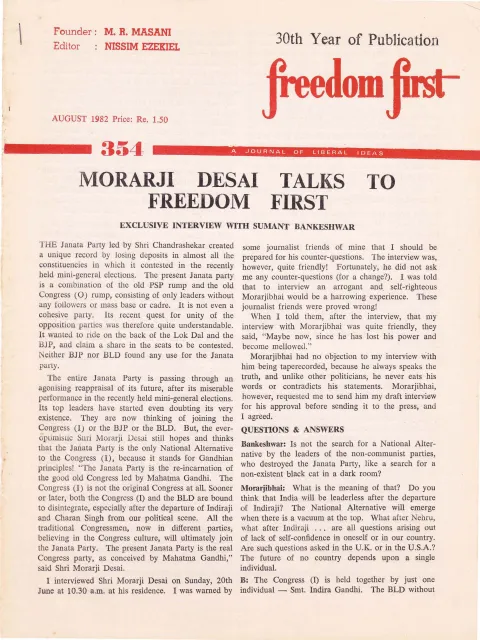
Freedom First
A Journal of Liberal Ideas
By NISSIM EZEKIEL, K. S. VENKATESWARAN, Y. SIVAJI, INDU SARAIYA, N. L. KHANOLKAR, P. S. SUNDARAM, K. V. PADMANABHAN, BUCHUNG K. TSERING
Published for the Democratic Research Service by J. R. Patel, Associate Editor, Freedom First at 127, Mahatma Gandhi Road, Bombay 400 023 (Phone: 273914) and printed at Jam-e-Jamshed, Mangalore Street, Fort, Bombay 400 038. · Bombay · 1981
16 pages
Freedom First
Summary
Freedom First No. 346 (October 1981), the classical-liberal Bombay monthly founded by M. R. Masani and edited by Nissim Ezekiel, opens with Ezekiel’s own editorial excoriating the non-aligned movement’s selective moral outrage — readily condemning Israel, South Africa, and the United States while staying silent on Soviet aggression in Afghanistan and Poland. K. S. Venkateswaran’s regular “A Variety of Comment” column takes up three current controversies: the Antulay scandal as an indictment of concentrated state power, the Bombay pavement-dwellers case and the claimed ‘fundamental right’ to squat on public land, and a data-driven defence of infant-milk-food manufacturers against the anti-formula campaign. Y. Sivaji contributes a wide-ranging essay on how post-colonial ‘socialist’ strongmen (Sukarno, Nkrumah, Indira Gandhi, Ne Win) erode liberal democracy through Soviet-style planning and concentrated economic power. The issue’s book-review section, “The World of Books,” covers A. B. Shah’s Religion and Society in India and B. R. Nanda’s Mahatma Gandhi: A Biography, and two “Voices” columns give personal takes on a Sam Shepard play (Buried Child) and on meritocracy in Indian and British education. Buchung K. Tsering’s essay recounts the political history of Tibet’s loss of independence to China, and a public-service feature from Beauty Without Cruelty details the animal-derived ingredients in cosmetics and consumer goods. The masthead notes this is the magazine’s 30th year of publication.
Key points
-
Nissim Ezekiel’s editorial accuses the non-aligned movement of a double standard, readily condemning Israel, South Africa and the US while staying silent on Soviet aggression in Afghanistan and Poland.
-
K. S. Venkateswaran’s “A Variety of Comment” reads the Antulay scandal as proof of concentrated state power’s corrupting potential, argues squatters lack a “fundamental right” to occupy Bombay’s pavements, and marshals statistics to defend infant-formula manufacturers against the anti-formula campaign.
-
Y. Sivaji’s “Threats to Liberal Democracy” surveys how post-colonial “socialist” strongmen like Sukarno and Nkrumah eroded democracy through Soviet-style planning, calling for decentralisation and a mixed economy instead.
-
Two “Voices” pieces review Sam Shepard’s Pulitzer-winning play Buried Child staged in Bombay and question whether India’s and Britain’s exam-driven education systems truly reward merit.
-
Book reviews cover A. B. Shah’s Religion and Society in India, which rejects Radhakrishnan’s model of secularism as equal state patronage of all religions, and B. R. Nanda’s biography Mahatma Gandhi.
-
Buchung K. Tsering’s “The Tragedy of the Tibetan People” surveys twenty-two years of Chinese rule over Tibet, criticising the UN’s ineffectiveness and affirming non-violence as the appropriate Tibetan strategy despite admiring the PLO’s ability to draw attention to its cause.
Essays
Evading the Truth: About African, Middle Eastern and Communist Regimes
By NISSIM EZEKIEL
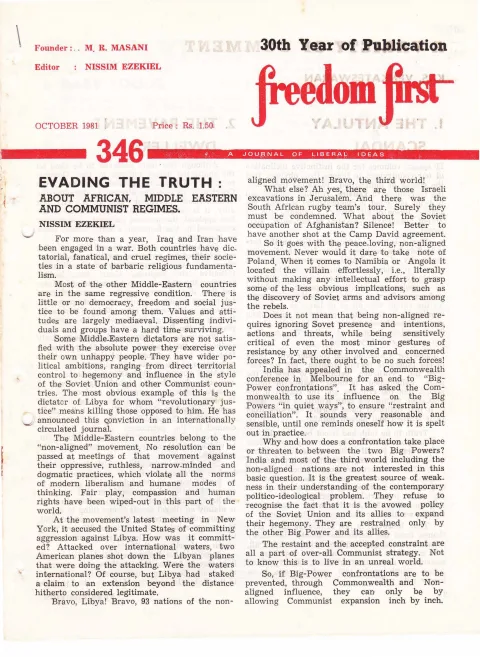
Editor Nissim Ezekiel argues that the non-aligned movement and much of world opinion apply a double standard: quick to condemn Israel, South Africa, and the United States (e.g., for shooting down attacking Libyan planes), but silent on Soviet actions in Afghanistan, Poland, and elsewhere. He contends that India’s Commonwealth appeal for an end to ‘Big-Power confrontations’ is naive, since in practice non-alignment functions to let Communist expansion proceed ‘inch by inch’ unchallenged.
- Non-aligned nations condemn the US, Israel, and South Africa but stay silent on Soviet occupation of Afghanistan and events in Poland.
- The dictator of Libya is cited as an example of a Middle Eastern regime pursuing territorial ambition under the guise of ‘revolutionary justice’.
- The US shoot-down of attacking Libyan planes over international waters is defended as justified self-defence.
- India’s Commonwealth appeal to end ‘Big-Power confrontations’ is criticized as vague and unworkable in practice.
- The author concludes that non-aligned rhetoric effectively enables gradual Communist expansion.
A Variety of Comment: 1. The Antulay Scandal, 2. The Pavement-Dwellers, 3. Baby Foods
By K. S. VENKATESWARAN
K. S. Venkateswaran’s ‘A Variety of Comment’ column addresses three topics. First, the Antulay scandal is read as proof of the corrupting potential of excessive state power, quoting Adam Smith on the ‘interested sophistry of merchants and manufacturers’ and Pogo’s line about having met the enemy. Second, on the Bombay pavement-dwellers case, he argues it is wrong in principle to accept that unauthorised squatters possess a ‘fundamental right’ to occupy public pavements, even while sympathising with their plight. Third, on baby foods, he marshals market-share and breastfeeding statistics to argue that the anti-formula campaign (inspired by The Baby Killers report) rests on exaggerated claims about multinational milk-food companies’ impact on Indian breastfeeding rates and rural consumption.
- The Antulay scandal illustrates the ‘inherent perversive potential of excessive state power’ concentrated in the hands of elected representatives.
- Business houses that ingratiated themselves with Antulay are blamed for succumbing to the licence-permit system’s coercive leverage.
- The Supreme Court’s order in the pavement-dwellers case is criticized for extending the Bombay High Court’s embargo on slum clearance indefinitely.
- Petitioners’ claim of a ‘fundamental right’ to occupy pavements is called legally and morally unsound, distinct from a humanitarian claim for reprieve.
- Only 4.7% of Indian babies use branded infant milk food, and of these only 1.9% use a foreign brand, per the column’s figures.
- Glaxo’s market share fell from over 29% (1971) to about 11% (1978) as milk co-operatives like Amul expanded.
- A 1978 survey found 93% of Indian mothers breastfeed for at least some time, undercutting claims that formula marketing undermines breastfeeding.
- The column argues a total ban on baby foods is not the right remedy; poor hygiene, not the products themselves, causes most bottle-feeding-related illness.
Threats to Liberal Democracy
By Y. SIVAJI
Y. Sivaji’s essay ‘Threats to Liberal Democracy’ surveys how newly independent Asian, African, and post-colonial states have drifted from democratic promise toward authoritarianism. Leaders such as Sukarno, Nkrumah, and (implicitly) Indira Gandhi’s contemporaries — Sirimavo of Ceylon, Ne Win of Burma — assumed paternalistic ‘father figure’ roles while pursuing Soviet-style economic planning that emphasizes heavy industry and public-sector expansion at the expense of private capital and consumer welfare. The author argues that genuine liberal democrats mistakenly equate ‘planning for democracy’ with Soviet-style ‘planning for totalitarianism,’ and that Communist united-front tactics exploit and eventually eliminate genuine socialists and liberals alike. He calls for decentralization of political power and a mixed economy that avoids both unchecked capitalism and stifling public-sector control.
- Post-independence leaders like Sukarno and Nkrumah styled themselves ‘father figures’ promising to dole out freedom and guide democracy paternalistically.
- Communist united-front strategy uses opportunistic ‘Socialist’ rulers as allies before eventually eliminating both them and genuine liberals.
- Soviet-style economic planning, emphasizing heavy industry and neglecting consumer industries, gradually leads newly liberated countries toward totalitarianism.
- Concentration of economic power inevitably leads to concentration of political power in the state.
- The essay calls for decentralisation of political power and a mixed economy balancing private capital with a non-wasteful public sector.
- China’s emergence as a third superpower has reshaped non-alignment’s original rationale, alongside Soviet actions in Hungary, Czechoslovakia, and support for authoritarian regimes.
Voices-1: Theatre Greatness (review of Buried Child by Sam Shepard)
By INDU SARAIYA
Indu Saraiya reviews ‘Buried Child,’ Sam Shepard’s Pulitzer Prize-winning play staged in Bombay by the Trinity Square Repertory Company (Rhode Island) at the Tata Theatre on 24 September 1981. The review reads the play’s surreal three-act structure as a study of family degeneration and regeneration, centred on Vince’s return to his dysfunctional farmhouse family, and praises the uniformly excellent cast including David Jones, Richard Kneeland, Tim Daly, and Amy Van Nostrand.
- The play concerns Vince’s return, after six years, to a decaying family farmhouse in Illinois, where no family member recognizes him.
- Central characters include Grandpa Dodge, Grandma Halie, and sons Tilden and Bradley, each caught in dysfunction and isolation.
- The mystery of a ‘buried child’ and its possible connection to Vince’s own birth structures the play’s suspense.
- Shepard is quoted (from 1974) reflecting on themes of dying and rebirth rooted in his own upbringing as an Episcopalian.
- The review praises the ensemble cast as uniformly excellent, highlighting David Jones, Richard Kneeland, Tim Daly, and Amy Van Nostrand.
Voices-2: Meritocracy?
By N. L. KHANOLKAR
N. L. Khanolkar’s ‘Voices’ column questions whether India’s (and Britain’s) exam-driven, ‘meritocratic’ education systems truly reward merit. Drawing on C. Northcote Parkinson’s satire and sociological studies by Anthony Heath and Miles Hewstone, he contrasts Britain’s class-inflected school hierarchy with the mechanical cut-off marks used for Indian professional-college admissions, and asks whether the well-rounded, curious student is being crowded out by rote learners, coaching classes, and exam malpractice.
- Parkinson’s satirical anecdote about a candidate rejected merely for being from ‘Wigglesworth’ opens the column’s skepticism about meritocratic selection.
- British sociologists Anthony Heath and Miles Hewstone are cited on the flawed workings of a ‘semi-meritocratic society’ and how public-school versus comprehensive-school students view each other.
- Anthony Sampson’s ‘Anatomy of Britain Today’ is invoked to argue that public-school old-boy networks still matter more than merit in the City.
- In India, admission to science, medical, and engineering courses is governed by rigid aggregate-mark cut-offs (e.g., 85% out of a 94% top score).
- The column criticizes exam copying, bribery for grade changes, and coaching-class culture as corrupting the meritocratic ideal.
- It closes by asking whether education’s purpose is only upward mobility, or also nurturing the ‘average learner’ and the well-rounded, curious student.
The World of Books: Religion and Society in India by A. B. Shah (review)
By P. S. SUNDARAM
P. S. Sundaram reviews A. B. Shah’s ‘Religion and Society in India’ (Somaiya Publications), a collection of essays by the self-described ‘conscientious atheist’ Shah. The review summarizes Shah’s argument that India’s founding vision of a shared national, not communal, identity has been undermined by religious separatism — more pronounced historically among Muslim elites than Hindu reformers — and by governmental policies (like the stalled uniform Civil Code and treatment of Aligarh Muslim University) that fail true secularism. Shah criticizes Radhakrishnan’s model of secularism as equal state patronage of all religions rather than genuine separation of religion and state.
- A. B. Shah is described as a ‘self-proclaimed atheist’ who nonetheless qualifies it with ‘conscientious’, retaining a strong moral sensibility.
- Shah argues India’s Constitution-framers sought a shared national identity rather than continued Hindu/Muslim/Sikh/Christian communal identification.
- The book contrasts the 19th-century Hindu renaissance’s willingness to self-critique with a Muslim elite that Shah says remained more circumspect toward Western/rationalist scrutiny of Islam.
- Shah highlights Gandhi’s practical secularism (treating Harijans as ‘blood brothers’, opening temples) versus Jinnah’s framing of Gandhi as merely a ‘Hindu politician’.
- Shah rejects Radhakrishnan’s notion of secularism as equal state funding of all religions, calling it inconsistent with genuine separation of religion and state.
- The review closes questioning why India has not enacted a uniform Civil Code and why Aligarh Muslim University escapes reform scrutiny.
The World of Books: Mahatma Gandhi - A Biography by B. R. Nanda (review)
By K. V. PADMANABHAN
K. V. Padmanabhan reviews B. R. Nanda’s ‘Mahatma Gandhi: A Biography’ (Oxford University Press), first published in 1958 and reissued for this printing. The review recounts an anecdote from Gandhi’s 1934 Harijan-fund tour to Mahe (the reviewer’s own mother was present and donated jewellery), praises Nanda — Curator of the Nehru Memorial Museum and Library — as eminently suited to write the ‘most readable biography on Gandhiji one can find in India,’ and traces Gandhi’s arc from Porbander and South Africa (where he developed Satyagraha) through the Independence and Partition negotiations, regretting only that the book was not updated to address criticisms of Gandhi raised in scholarship since 1958.
- The review opens with a personal anecdote: the reviewer’s own mother donated gold jewellery at Gandhi’s 1934 Harijan-fund collection in Mahe, French India.
- Nanda, Curator of the Nehru Memorial Museum and Library, is called eminently suited to the task, and the book is termed the most readable Gandhi biography available in India.
- The reviewer’s chief criticism is that the book (first published 1958) was not updated to incorporate newer scholarship or to counter ‘unfair and misguided criticisms’ of Gandhi.
- Gandhi’s political weapon, Satyagraha, is traced to his South Africa years, with early admirers like J. J. Doke (his first biographer) noting his ‘quiet, assured strength’.
- Gokhale is credited with inducing Gandhi’s return to India, hoping he would succeed him as President of the Servants of India Society.
- The book covers the tortuous WWII-era and post-war negotiations leading to Independence and Partition, crediting Attlee’s Britain and Gandhi’s acceptance of the ‘inevitable’ partition.
The Tragedy of the Tibetan People
By BUCHUNG K. TSERING
Buchung K. Tsering’s ‘The Tragedy of the Tibetan People’ surveys the twenty-two years since Tibet lost its independence to China, explaining Tibet’s historical isolation (as the ‘forbidden city’ of Lhasa) and religious institutions’ fear of foreign contamination as key reasons China could subjugate the country so easily. The essay describes the great-power rivalry among Russia, China, and British India over Tibet in the 1940s, the failure of the UN and international community to act on Tibetan appeals, and the current ‘sickening’ state of continued repression despite a nominal 1979-era liberalisation that has since been withdrawn. Tsering, while admiring the PLO’s use of violence to draw attention to its cause, argues Tibetans must continue pursuing non-violent means, and calls on the Tibetan government-in-exile to do more to publicise its cause internationally.
- China began arriving in Tibet around 1950 and had fully subjugated the country by the end of 1959.
- Tibet’s historic self-sufficiency, religious insularity, and restriction on foreign entry (except for Sherpas and Monpas) enabled China to isolate and control the country with little external scrutiny.
- In the 1940s, Tibet was caught between three power-hungry neighbours — Russia, China, and British India — competing for influence given Tibet’s strategic position and mineral wealth.
- Treaties like the Anglo-Russian, Anglo-Chinese, and Sino-Russian agreements led Russia and British India to wrongfully acknowledge Chinese ‘suzerainty’ over Tibet.
- The Dalai Lama and Panchen Lama’s 1956 visit to India, and Chou-en-Lai’s follow-up ‘friendly visit’, are cited as moments when China managed international perception of Tibet.
- The UN and international community are criticized for ineffectiveness despite Tibetan government delegations and memoranda.
- Even under a nominal 1979 ‘liberalisation’ policy, subsequent reports show renewed strict controls, and conditions are described as ‘sickening’.
- The author admires the PLO’s determination but ultimately affirms non-violence as the appropriate means for the Tibetan cause, while urging the Tibetan government to publicise the cause more aggressively.
Generated by the v1.5 extraction pipeline. Awaiting editorial review.
Metadata and summary are AI-extracted from the source PDF and reviewed for editorial accuracy. The original work is available via the Read PDF tab above (where present); paragraph-level citation inside the PDF is deferred to a future engagement.