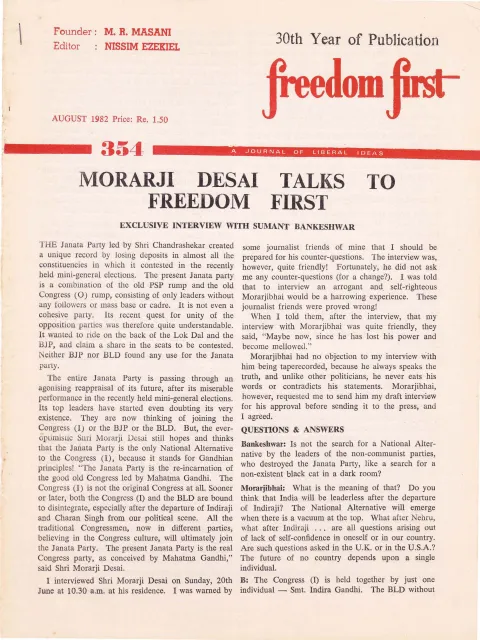
periodical issue
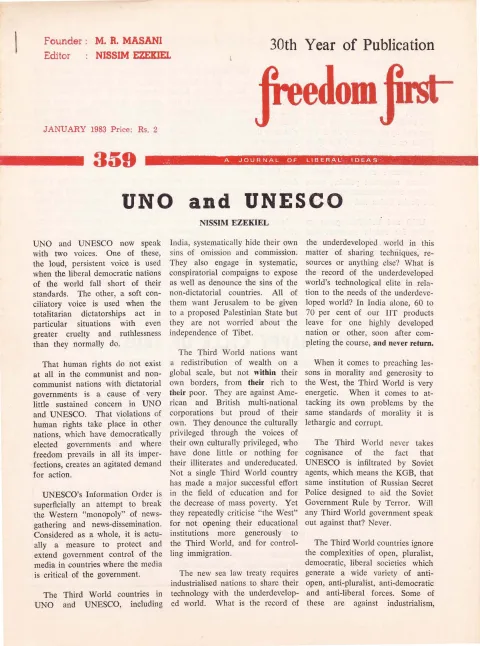
Freedom First
A Journal of Liberal Ideas
By Minoo Masani
Published for the Democratic Research Service by J. R. Patel, Associate Editor, Freedom First at 127, Mahatma Gandhi Road, Bombay 400 023 (Phone: 273914) and Printed by him at The Popular Press (Bom.) Pvt. Ltd, 35C Tardeo Road, Bombay 400 034 · Bombay · 1983
16 pages
Freedom First
Summary
Freedom First No. 359 (January 1983), edited by Nissim Ezekiel and founded by M. R. Masani, opens its 30th year of publication with a characteristically wide sweep of Cold War-era liberal commentary. The issue leads with Ezekiel’s own polemic against the double standards of UNO and UNESCO in policing human rights, followed by K. S. Venkateswaran’s regular ‘A Variety of Comment’ column covering judicial activism, a consumer-rights court victory on generic drug names, and the persecution of Soviet peace activists. A substantial interview conducted by Sumant S. Bankeshwar with veteran socialist leader S. M. Joshi ranges over non-alignment, Indo-Pak relations, the Akali agitation in Punjab, and the state of Indian political leadership. The remaining pages carry Rama Swarup’s obituary-style indictment of Brezhnev’s foreign-policy legacy, Minoo Masani’s tribute to Vinoba Bhave on his death and defence of voluntary euthanasia, Nitin G. Raut’s piece on the Sabra and Chatilla massacres in Lebanon, a critical book review by Shankar Raj of M. Chalapathi Rao’s ‘Indian Drama,’ and the magazine’s recurring ‘With Many Voices’ page of quoted aphorisms from the international press.
Key points
-
Nissim Ezekiel’s “UNO and UNESCO” argues both bodies apply a double standard, speaking harshly against rights violations by liberal democracies while staying largely silent on graver abuses by communist and dictatorial regimes, and describes UNESCO as infiltrated by Soviet influence.
-
K. S. Venkateswaran’s “A Variety of Comment” defends Justice Tulzapurkar’s criticism of judicial activism, hails a Delhi High Court ruling striking down a ban on brand-name drugs, and reports Soviet psychiatric persecution of peace activist Sergei Batovrin.
-
In an interview conducted by Sumant S. Bankeshwar, veteran socialist S. M. Joshi argues non-alignment has lost its original meaning, credits Dr. Lohia rather than Nehru as its architect, favours a South Asian federation with Ceylon, Burma and Nepal, and urges conceding the Akalis’ “just and reasonable” demands in Punjab while rejecting special status for Amritsar.
-
Rama Swarup’s “The Hard Truths Of The Brezhnev Legacy” rejects sympathetic Western obituaries of Brezhnev, citing the 1968 “Brezhnev Doctrine,” a decade-long Soviet military buildup, and destabilisation efforts across Asia, the Middle East and Africa.
-
Minoo Masani’s tribute to Vinoba Bhave praises his voluntary fast unto death as an assertion of the “Right to Die with Dignity” and condemns a Bombay High Court petition seeking to force medical intervention as illegal.
-
Nitin G. Raut’s “The Lebanon Massacre” argues that international condemnation of Israel over the Sabra and Chatilla massacres reflects a double standard given comparable atrocities, including Pakistan’s 1971 killings in Bangladesh and PLO massacres of Christians in Lebanon.
-
Shankar Raj reviews M. Chalapathi Rao’s “Indian Drama: Traditional Societies in Transition,” finding it derivative of Gunnar Myrdal’s “Asian Drama” and thin on research despite the author’s credentials.
-
The closing “With Many Voices” quotations page includes the Economist’s quip that India is “a functioning anarchy” where “the anarchy is getting the better of the functioning,” and Henry Kissinger’s remark on the Soviet Union being surrounded by hostile communist states.
Essays
UNO and UNESCO
By NISSIM EZEKIEL
Nissim Ezekiel’s opening piece argues that UNO and UNESCO apply a double standard: they speak loudly against rights violations by liberal democracies while staying largely silent on far graver abuses by communist and other dictatorial regimes. He accuses Third World nations of demanding wealth redistribution globally while resisting it domestically, of denouncing Western multinational corporations while ignoring Soviet infiltration of UNESCO, and of failing to develop their own education systems while blaming the West for not sharing technology. The piece closes by arguing that pluralist, liberal societies are held to standards that closed societies are never asked to meet.
- UNO and UNESCO speak with ‘two voices’: harsh toward liberal democracies, soft toward totalitarian dictatorships.
- Third World nations demand global wealth redistribution but resist it within their own borders.
- Not a single Third World country has made a major successful effort at mass education or poverty reduction, per the author.
- UNESCO’s ‘Information Order’ is characterized as a device to protect government control of media rather than to break a Western news monopoly.
- UNESCO is described as infiltrated by Soviet/KGB influence, a fact the author says the Third World never acknowledges.
- The article closes arguing that anti-open, anti-pluralist, anti-democratic forces are excused by the international community while liberal democracies are held to strict account.
A Variety of Comment
By K. S. VENKATESWARAN
K. S. Venkateswaran’s ‘A Variety of Comment’ column covers three items. First, he defends Justice Tulzapurkar’s controversial public criticism of judicial activism and of fellow Justice Bhagwati’s conduct, arguing the judge performed a public service by naming the decline in judicial standards. Second, he hails an under-reported Delhi High Court judgment striking down a government notification that would have banned brand names for five common drugs (analgin, aspirin, chlorpromazine, ferrous sulphate, piperazine), finding it unconstitutional and discriminatory. Third, he reports on Soviet persecution of an informal peace group (‘Group for the Establishment of Trust between the USSR and USA’), including the forcible psychiatric confinement of member Sergei Batovrin, drawing on an Amnesty International report.
- Justice Tulzapurkar’s Symbiosis Institute lecture criticizing judicial activism and fellow judges is defended as a service to judicial standards, not an embarrassment.
- References criticism of Justice Bhagwati, including his ‘fawning letter of congratulations to Mrs. Gandhi’ after her election win.
- Delhi High Court struck down a January 1981 government notification banning brand names for five drugs as unconstitutional interference with trade rights.
- The government’s argument that generic-only labelling would lower drug prices is dismissed as unlikely given tight price controls on all drugs.
- A Soviet informal peace group was subjected to interrogation, confiscation, and psychiatric confinement of a member (Sergei Batovrin) despite the group’s professed aim of easing US-USSR tensions.
S. M. Joshi Speaks to FREEDOM FIRST
By Sumant S Bankeshwar
A wide-ranging Q&A conducted by Sumant S. Bankeshwar with veteran Praja Socialist/Sarvodaya leader S. M. Joshi. Joshi argues non-alignment has lost its original meaning as nations have split into US- and USSR-aligned camps, credits Dr. Lohia (not Nehru) as the movement’s original architect, and criticizes both superpowers for exploiting Third World conflicts to test weapons and expand influence. He supports dialogue with Pakistan and China without abandoning the Soviet relationship, favors a South Asian federation including Ceylon, Burma and Nepal, and discusses the Akali agitation in Punjab, urging the government to concede ‘reasonable and just’ demands (such as the riparian water-sharing principle) while rejecting demands like a special status for Amritsar. He also reflects on the erosion of principled politics since independence and calls Gandhi the greatest man born after Christ.
- Joshi says non-alignment has lost meaning as nations split into pro-US and pro-USSR camps; credits Dr. Lohia, not Nehru, as its original architect.
- Argues superpowers have a vested interest in instigating wars among developing nations to test weapons and expand spheres of influence.
- Supports the Indira Gandhi-Zia dialogue and a Joint Commission with Pakistan, and favours an EEC/ASEAN-style South Asian federation including Ceylon, Burma, and Nepal.
- On Punjab: supports conceding the Akalis’ ‘just and reasonable’ demands (e.g., riparian water rights) but rejects demands like Vatican-style status for Amritsar or a separate Akali constitution.
- Criticizes the rise of ‘consensus’ leadership selection within Indian political parties as a fraud on democracy.
- Calls Mahatma Gandhi the greatest man born after Christ and laments that pre-independence politicians’ spirit of sacrifice has given way to post-independence politics driven by power and money.
The Hard Truths Of The Brezhnev Legacy
By RAMA SWARUP
Rama Swarup’s piece, written on the death of Leonid Brezhnev, rejects the sympathetic Western reminiscences (from figures like Jimmy Carter and Cyrus Vance) and instead catalogues what it calls the ‘hard truths’ of the Brezhnev era: the 1968 ‘Brezhnev Doctrine’ used to justify invasions of Czechoslovakia and Afghanistan and suppression in Poland; a massive Soviet buildup of nuclear and conventional forces despite detente; Soviet support for destabilizing movements and proxy conflicts across Asia, the Middle East, and Africa; and repeated violations of arms-control treaties. The essay concludes that the U.S. should not romanticize the Brezhnev legacy but should keep pressuring the Soviets.
- Rejects sympathetic Western reminiscences of Brezhnev (citing Jimmy Carter and Cyrus Vance) as a distortion of the actual Soviet record.
- Cites the 1968 ‘Brezhnev Doctrine’ as justification for invasions of Czechoslovakia (1968) and Afghanistan (1979) and suppression of Polish liberties (1981).
- Details a decade of Soviet nuclear and conventional buildup: 733 new nuclear-capable missiles, 4,000+ additional warheads, and continued SS-20 deployment despite the 1982 ‘Brezhnev freeze’ announcement.
- Details Soviet-backed destabilization efforts in Vietnam/Cambodia, the Middle East (Nasser’s 1967 blockade, Iran-Iraq arms transfers), Africa (ANC, SWAPO, Polisario, Angola), and Cuba.
- Argues Soviet military spending under Brezhnev was roughly 40% higher than U.S. outlay and 12-15% of GNP versus about 6% for the U.S.
- Concludes the U.S. should continue pressuring the USSR into difficult foreign-policy and resource-allocation choices rather than romanticizing Brezhnev’s legacy.
Vinoba Bhave
By MINOO MASANI
Minoo Masani’s tribute to Acharya Vinoba Bhave, written on his death, praises Vinoba’s voluntary fast unto death as a fitting end to a life devoted to ‘voluntaryism’ and opposition to centralized power. Masani defends Vinoba’s right to die voluntarily against a petition filed in the Nagpur Bench of the Bombay High Court seeking to force medical intervention, calling that petition illegal and an affront to the right of any citizen to refuse food, water, or medication. Masani places Vinoba in a lineage of Indian voluntary-death traditions (citing Dnyaneshwar, Tukaram, V. D. Savarkar, and Gopal Mandlik) and calls Vinoba and Jayaprakash Narayan the last apostles of the Gandhian faith, whose deaths mark the end of an era.
- Praises Vinoba Bhave’s voluntary death (November 15) as an assertion of the ‘Right to Die with Dignity’.
- Notes Gandhiji selected Vinoba as India’s first individual Satyagrahi in 1940 for his discipline.
- Criticizes a petition filed in the Nagpur Bench of the Bombay High Court seeking to force medical intervention to prolong Vinoba’s life, calling it illegal and a violation of a citizen’s right to refuse treatment.
- Situates voluntary euthanasia within an Indian tradition citing Dnyaneshwar, Tukaram, V. D. Savarkar and Gopal Mandlik.
- Declares that with Vinoba’s and Jayaprakash Narayan’s deaths, ‘the era of Mahatma Gandhi may be said to have come to an end.’
- Piece is credited as reprinted from Masani’s ‘As I See It’ column, courtesy The Statesman, Calcutta.
The Lebanon Massacre
By NITIN G. RAUT
Nitin G. Raut’s essay responds to the international outcry over the Sabra and Chatilla massacres in Lebanon, arguing that the condemnation of Israel reflects a double standard given the world’s relative silence on other mass atrocities (the My Lai massacre, Soviet actions in Afghanistan, Pakistan’s 1971 actions against Bangladeshis, King Hussein’s 1970 killing of Palestinians in Jordan, and PLO terrorism and massacres of Christians in Lebanon). He notes Israel itself appointed a Commission of Inquiry into the massacre and argues this response has more credibility than the international outcry against Israel, which he attributes partly to ‘petro-dollar politics.’
- Argues international condemnation of Israel over the Sabra and Chatilla massacres reflects double standards, given silence on comparable atrocities elsewhere.
- Cites the My Lai massacre, Soviet actions in Afghanistan, Pakistan’s 1971 killings of Bangladeshis, and King Hussein’s 1970 killing of Palestinians in Jordan (for which the PLO called him ‘The Butcher’) as comparators.
- Alleges Pakistani President Zia, then commander of Pakistan’s army contingent in Jordan, was in charge of the 1970 operation against Palestinians.
- Notes PLO massacres of Christians in Lebanon, particularly in Damour, and PLO chief Yasser Arafat’s reception by the Pope despite this.
- Praises Israel’s own Commission of Inquiry into the massacre as evidence of self-scrutiny lacking elsewhere.
- Attributes Western sympathy toward the PLO partly to ‘petro-dollar politics.‘
Book Review: Indian Drama: Traditional Societies in Transition (by M. Chalapathi Rao)
By SHANKAR RAJ
Shankar Raj reviews M. Chalapathi Rao’s ‘Indian Drama: Traditional Societies in Transition’ (Allied Publishers, Rs. 60) and finds it wanting: derivative of Gunnar Myrdal’s ‘Asian Drama’ despite the author’s denial, thinly researched, lacking bibliography or index, and composed of short essays that skim generalities on democracy, secularism, caste and population without real insight. The review singles out the essay on ‘Parliamentary Democracy’ as emblematic of the book’s superficiality.
- Reviews M. Chalapathi Rao’s ‘Indian Drama: Traditional Societies in Transition’ (Allied Publishers, 240pp, Rs. 60).
- Criticizes the book for lacking bibliography, index, and depth of research despite the author’s credentials (editor of National Herald, biographer, UN/Unesco service).
- Notes the author denies but effectively confirms the book’s debt to Gunnar Myrdal’s ‘Asian Drama.’
- Calls the book ‘an exercise in self-delusion’ covering democracy, secularism, caste, population, mass media and foreign policy without a single impressive insight.
- Singles out the essay on Parliamentary Democracy as illustrative of the book’s reliance on generalities and a Reader’s Digest-level account.
With Many Voices (quotations column)
The closing ‘With Many Voices’ page compiles short quoted aphorisms and observations from the international press (the Economist, the Times, the Observer, the Guardian, and the Herald Tribune), touching on Soviet life, Indian governance, political ambition, and journalism, credited to figures including Harold Macmillan, Gladstone, Henry Kissinger, Harold Wilson, Amos Oz, and James Cameron.
- A compilation of short quotations drawn from the Economist, Times, Observer, Guardian and Herald Tribune (October-November editions).
- Includes a quip on India as ‘a functioning anarchy’ where ‘the anarchy is getting the better of the functioning’ (the Economist, October 23).
- Includes Henry Kissinger’s remark that the Soviet Union is ‘the only country in the world entirely surrounded by hostile communist states.’
- Includes Harold Wilson’s comment on resigning after four premierships upon turning 60.
Generated by the v1.5 extraction pipeline. Awaiting editorial review.
Metadata and summary are AI-extracted from the source PDF and reviewed for editorial accuracy. The original work is available via the Read PDF tab above (where present); paragraph-level citation inside the PDF is deferred to a future engagement.