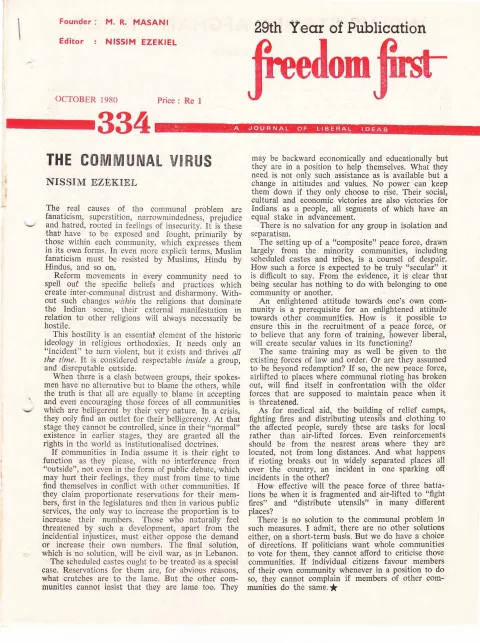
periodical issue
Freedom First
A Journal of Liberal Ideas
By Minoo Masani
Published for the Democratic Research Service by J. R. Patel, Associate Editor, Freedom First at 127, Mahatma Gandhi Road, Bombay 400 023 (Phone: 273914) and Printed by him at The Popular Press (Bom.) Pvt. Ltd, 35C Tardeo Road, Bombay 400 034 · Bombay · 1983
16 pages
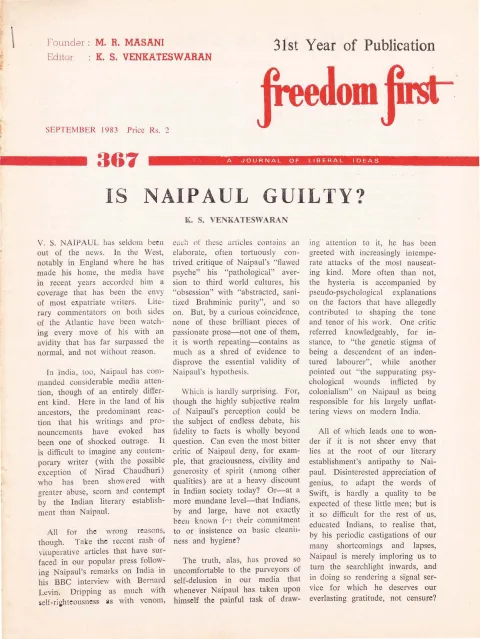
Freedom First
Summary
Issue No. 367 of Freedom First (September 1983, priced Rs. 2, its 31st year of publication) opens with editor K. S. Venkateswaran’s defence of V. S. Naipaul against Indian critics who accuse him of pathologising the country, arguing that the hostility toward Naipaul stems from envy rather than any factual error in his reporting. Founder M. R. Masani contributes ‘The Isle of Serendip,’ a topical piece on the 1983 Sinhalese-Tamil violence in Sri Lanka, drawing on press accounts (Mascarenhas, The Times, The Guardian, The Indian Express) to argue that Tamil Tiger aggression triggered the Sinhalese backlash, that President Jayewardene has been unfairly vilified in India, and that Indian politicians’ saber-rattling over intervention is itself hypocritical given India’s tolerance of Khalistani separatists. Brian Crozier’s ‘How Reagan could start rolling back the Russians’ surveys Soviet territorial gains since detente (Vietnam, Angola, Afghanistan, Grenada, etc.) and argues the West should exploit vulnerable client states like Cabinda, the Seychelles, Grenada and Surinam. A running debate on secularism continues from earlier issues: M. B. Shah’s ‘Secularism: A Dissenting View’ rebuts Masani’s claim (from the June 1983 issue) that secularism is Marxist-derived jargon that displaced ‘Sarva Dharma Samabhava,’ arguing instead that secularism counters obscurantism and is compatible with, even conducive to, genuine religiousness; Masani then responds, citing J. P. Narayan, M. V. Kamath, and Confucius to reaffirm his view that ‘secularism’ in Indian usage is anti-religious cant. Ashley J. Tellis reviews Nari Rustomji’s book Imperilled Frontiers: India’s North Eastern Borderland (Oxford University Press, 1983), praising its empirical account of tribal-state conflict in Nagaland, Meghalaya, Assam and Arunachal Pradesh while noting the book’s implicit rejection of a purely Marxist class-conflict explanation for regional unrest. The issue closes with the ‘With Many Voices’ page of quoted aphorisms (Hayek, Solzhenitsyn, Bernard Levin, George Shultz, and others) and a subscription order form.
Key points
-
Editor K. S. Venkateswaran’s “Is Naipaul Guilty?” defends V. S. Naipaul against Indian critics, arguing the hostility toward him stems from envy rather than any factual error in his reporting.
-
M. R. Masani’s “The Isle of Serendip” surveys the 1983 Sinhalese-Tamil violence in Sri Lanka, arguing Tamil Tiger aggression triggered the Sinhalese backlash and defending President Jayewardene against Indian vilification.
-
Brian Crozier’s “How Reagan could start rolling back the Russians” surveys continual Soviet territorial gains since detente and identifies Cabinda, the Seychelles, Grenada and Surinam as low-risk targets for Western-backed rollback.
-
M. B. Shah’s “Secularism: A Dissenting View” rebuts Minoo Masani’s claim that secularism is Marxist jargon, arguing it is older than Marxism and conducive to genuine religiousness rather than opposed to it.
-
Minoo Masani responds to Shah, citing J. P. Narayan, M. V. Kamath and Confucius to reaffirm that “secularism” in Indian usage is anti-religious cant that has bred political hypocrisy.
-
Ashley J. Tellis reviews Nari Rustomji’s “Imperilled Frontiers: India’s North Eastern Borderland,” crediting its account of tribal unrest as a clash between imposed modernisation and indigenous culture over a Marxist class-conflict explanation.
Essays
Is Naipaul Guilty?
By K. S. VENKATESWARAN
Editor K. S. Venkateswaran’s front-page piece defends V. S. Naipaul against what he characterises as an unjustified, envy-driven campaign of vilification in the Indian press, provoked most recently by Naipaul’s remarks on India in a BBC interview with Bernard Levin. The author argues that none of Naipaul’s Indian critics have produced evidence against the substance of his observations, and that Naipaul’s unflattering portraits are in fact a service to Indian self-understanding rather than an attack on it.
- Naipaul has faced disproportionate criticism in India compared to other expatriate writers, barring perhaps Nirad Chaudhuri.
- Recent press attacks followed Naipaul’s remarks on India in a BBC interview with Bernard Levin.
- Critics rely on pseudo-psychological explanations (Naipaul’s ‘flawed psyche’, ‘genetic stigma’) rather than factual rebuttal.
- The author contends Naipaul’s fidelity to facts is not seriously in question, only his subjective interpretations.
- The hostility to Naipaul is attributed to envy of a genius whose criticism forces Indians to confront their own shortcomings.
The Isle of Serendip
By MINOO MASANI
M. R. Masani’s ‘The Isle of Serendip’ surveys the 1983 anti-Tamil violence in Sri Lanka, drawing on reports by Anthony Mascarenhas and editorials from The Times, The Guardian and The Indian Express to argue that Tamil Tiger ambushes provoked the Sinhalese backlash that killed over 350 people. Masani defends President Jayewardene against Indian vilification, noting his efforts to accommodate Tamil grievances, and criticises Indian politicians (naming Karunanidhi) for chauvinistic war-mongering while India tolerates Khalistani separatists and shelters Tamil militants in Madras.
- Violence began with a Tamil Tiger ambush of a Lankan army convoy on 23 July, followed by a Sinhalese backlash killing over 350, mostly Tamils.
- Masani argues the original aggression came from the Tamil side, though this does not excuse the Sinhalese reprisals.
- President Jayewardene is portrayed sympathetically as a ‘humane and mature statesman’ subjected to a hysterical Indian vilification campaign.
- M. Karunanidhi is singled out for demanding Indian military intervention and partition of Sri Lanka along Cyprus lines.
- The Indian government is criticised for giving credence to a false canard that Lanka had requested military assistance from the UK, US, Pakistan and Bangladesh.
- Masani accuses India of a double standard: intolerant of foreign involvement in its own Assam troubles yet demanding a say in Sri Lanka, while sheltering Tamil secessionists in Madras.
How Reagan could start rolling back the Russians
By BRIAN CROZIER
Brian Crozier’s piece argues that despite Margaret Thatcher’s optimistic rhetoric about the ‘march of history’ favouring free democracies, the factual record since detente shows continual Soviet territorial gains (Vietnam, Laos, Cambodia, South Yemen, Ethiopia, Angola, Mozambique, Guinea-Bissau, Afghanistan, Nicaragua, Grenada, Surinam, Seychelles) with no reversals. He argues a cautious ‘rollback’ is now stirring in Washington under Reagan and Shultz, and identifies Cabinda (Angola), the Seychelles, Grenada and Surinam as low-risk targets for Western-backed change, citing historical precedents (Guatemala 1954, Iran 1953, Central African Republic 1979, Oman 1970) where determined Western action successfully removed or installed rulers.
- Since detente began in the 1970s, no country has ever left the Soviet orbit once captured, though China and Yugoslavia left Soviet control while remaining communist.
- Reagan called for a campaign to promote democratic institutions in communist countries; Secretary of State George Shultz convened a conference in October to implement this.
- The Pope’s visit to Poland demonstrated the fragility of Moscow’s hold on Eastern Europe, but Crozier argues systematic Western intervention there or in Cuba remains too dangerous for now.
- Cabinda, the Seychelles, Grenada, and Surinam are identified as low-risk or no-risk targets because their rulers lack legitimacy beyond force.
- Historical precedents cited: US action in Guatemala (1954) and Iran (1953), French removal of Bokassa in the Central African Republic (1979), and installation of Sultan Qaboos in Oman.
Secularism: A Dissenting View (with Mr. Masani’s rejoinder and ‘The Wisdom of Confucius’)
By M. B. SHAH
M. B. Shah’s ‘Secularism: A Dissenting View’ rebuts Minoo Masani’s earlier column (June 1983 issue) which had called secularism a piece of Marxist jargon introduced by Nehru at Krishna Menon’s behest, displacing the Indian concept of ‘Sarva Dharma Samabhava’. Shah argues secularism is far older than Marxism, is necessary in India to counteract obscurantism and commercialised religion, and is not opposed to but actually conducive to genuine religiousness, understood as rationalist, humanist values distinct from institutional religion.
- Shah disputes Masani’s claim that secularism is Marxist jargon imposed by Nehru; he says secularism is a concept as old as mankind.
- Institutionalised, commercialised religion in India is depicted as an ‘opiate’ that has fuelled partition, communal riots and sectarianism.
- Shah distinguishes ‘religion’ from ‘religiousness,’ arguing secularism only opposes the former’s abuses, not genuine spiritual values.
- Rationalism is presented as the intellectual foundation of secularism, challenging outdated religious presuppositions.
- Shah is sharply critical of Gandhi and Marx alike, quoting historian R. C. Majumdar’s description of Gandhi as a ‘magnificent failure.’
Minoo Masani responds to M. B. Shah’s dissent, reiterating that secularism as commonly used in India is basically anti-religious, and defending his earlier column. He cites Solzhenitsyn’s Templeton Address, J. P. Narayan’s 1962 Freedom First essay renouncing dialectical materialism, and M. V. Kamath’s Indian Express article ‘The Myth of Secularism’ to argue secularism has bred cynicism and hypocrisy among Indian politicians and fudged questions of religious identity. He closes by invoking Confucius’s dictum that ‘calling things by their proper names is the beginning of wisdom.’
- Masani had earlier distinguished a secular state from one equally benevolent to all religions, and denied that either the Indian people or Constitution are truly secular.
- He cites J. P. Narayan’s September 1962 Freedom First article recounting his disillusionment with dialectical materialism.
- He notes the Janata Government’s 45th Amendment attempt to redefine ‘secular’ in the Constitution’s preamble failed in the Rajya Sabha due to Congress (I) opposition.
- M. V. Kamath’s Indian Express article is quoted extensively, arguing ‘secular’ in Indian usage means anti-religious and that the concept is fudging political honesty.
- Masani closes with Confucius’s maxim on calling things by their proper names.
Book Review: Imperilled Frontiers: India’s North Eastern Borderland, by Nari Rustomji (Oxford University Press, 1983)
By Ashley J. Tellis Ashley J. Tellis reviews Nari Rustomji’s Imperilled Frontiers: India’s North Eastern Borderland (Oxford University Press, 1983, Rs. 80), the third book in a trilogy on India’s North East. The review credits Rustomji’s decades of administrative experience as Advisor to the Governor of the North Eastern Frontiers, and summarises his central thesis: that tribal unrest in Nagaland, Meghalaya, Assam and Arunachal Pradesh stems from a clash between imposed ‘modernisation’ and indigenous culture, not from Marxist class conflict as competing analyses claim. The reviewer finds the book’s readability and empirical grounding valuable against a Marxist paradigm he regards as insufficient, and calls the treatment of the Naga problem in particular masterful.
- The book is the third in a trilogy by Rustomji on India’s North Eastern region, following his career as Advisor to the Governor of the North Eastern Frontiers.
- Rustomji contrasts the ‘success story’ of Arunachal Pradesh (where he and Verrier Elwin were personally involved) with failures elsewhere in the region.
- The reviewer rejects the competing Marxist explanation that class conflict and exploitation of tribals by parasitic migrants drives unrest, though he calls the Marxist hypothesis ‘attractive’ though ‘insufficient.’
- Rustomji is critical of the Indian Army’s counter-insurgency tactics, arguing forced resettlement and disrespect for local mores fuelled insurgency rather than quelling it.
- The review quotes Nehru’s 1947 reflection on the danger of imposing an alien ‘image or likeness’ on tribal peoples.
- The reviewer notes the Naga problem occupies almost a third of the book and is its most masterfully handled section.
With Many Voices (quotations column)
No summary was extracted for this article. Listed for completeness.
Generated by the v1.5 extraction pipeline. Awaiting editorial review.
Metadata and summary are AI-extracted from the source PDF and reviewed for editorial accuracy. The original work is available via the Read PDF tab above (where present); paragraph-level citation inside the PDF is deferred to a future engagement.