periodical issue
Freedom First
A Quarterly of Liberal Ideas
By S. V. Raju, Minoo Masani, Bhanu Pratap Singh
Published by J.R. Patel for the Democratic Research Service and printed by him at Parsiana Publications Pvt. Ltd, 300 Perin Nariman Street, Bombay 400 001 · Bombay · 1988
56 pages
Freedom First
Summary
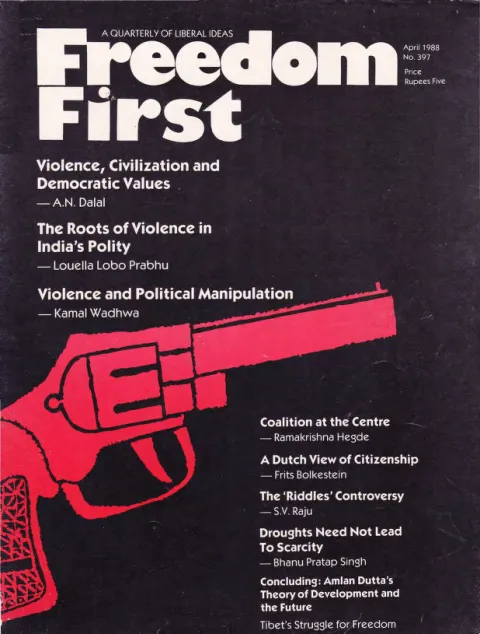
This is the April 1988 quarterly issue (No. 397) of Freedom First, Bombay’s long-running journal of liberal ideas, edited by S.V. Raju and R. Srinivasan under founder Minoo Masani. In the rendered pages the issue opens with its regular front-matter features — ‘With Many Voices’ (press clippings), ‘Of Cabbages and Kings’ (short editorial notes on Milovan Djilas, Bharat Bandhs, press censorship in Singapore, and South Korea’s state-directed ‘free enterprise’) — followed by a Bombay seminar statement and report on Chinese rule in Tibet (‘Tibet Struggles for Freedom’ and ‘Chinese Imperialism in Tibet — Some Facts’). The issue’s editorial center, signalled on the cover with a stylised pistol illustration, is a themed section ‘On Violence’ comprising four essays: A.N. Dalal on the psychology and sociology of mass and mediated violence and its incompatibility with democratic values (with a companion book-note on Elias Canetti’s Crowds and Power); Louella Lobo Prabhu tracing violence in Indian politics from mythic and historical precedent through Emergency-era state violence, reverse discrimination, and organised labour unrest; Kamal Wadhwa on violence as a tool of political manipulation; and S.V. Raju’s piece on the ‘Riddles’ controversy — the political storm over the posthumous publication of B.R. Ambedkar’s Riddles in Hinduism — accompanied by an extract from Ambedkar’s own book and a separate reprinted extract of an Ambedkar Constituent Assembly speech, ‘Safeguarding Our Democracy.’ In the rendered pages the volume also carries the constituent-assembly extract as a stand-alone item, several short items in the front matter (e.g. ‘Hooliganism in the House’ on a Rajya Sabha incident), and begins into further articles (Frits Bolkestein on Dutch citizenship, Ramakrishna Hegde on coalition government) that extend past the last page seen.
Key points
-
A.N. Dalal’s “Violence, Civilization and Democratic Values” argues mass violence is chiefly learned through social conditioning and media desensitisation, treating dowry deaths and child labour as forms of “passive” social violence, and invokes Gandhi, Martin Luther King and Khan Abdul Ghaffar Khan as models of non-violent response.
-
A companion book-note by Dalal reviews Elias Canetti’s Crowds and Power, summarising Canetti’s theory of the destructive “survivor” who feels empowered by mass death and calling the book’s neglect in India “one of the surprising scandals of our decade.”
-
Louella Lobo Prabhu traces the roots of violence in Indian politics from mythic and historical precedent through the abrogation of princely privy purses and the “reverse discrimination” effects of caste reservations, concluding India has strayed from the standards of Ashoka and Gandhi under its own elected governments.
-
The issue’s coverage of the ‘Riddles’ controversy reproduces a primary-source extract from B.R. Ambedkar’s Riddles in Hinduism, presenting his critique of Rama’s treatment of Sita after her rescue as incompatible with “ordinary human kindness.”
-
A reprinted extract of Ambedkar’s 25 November 1949 Constituent Assembly speech, “Safeguarding Our Democracy,” warns that India could lose its hard-won independence again through internal treachery and urges constitutional methods over the “Grammar of Anarchy.”
-
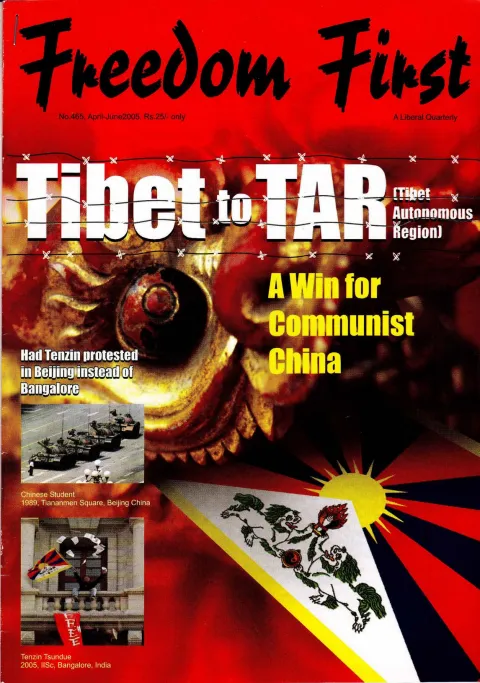
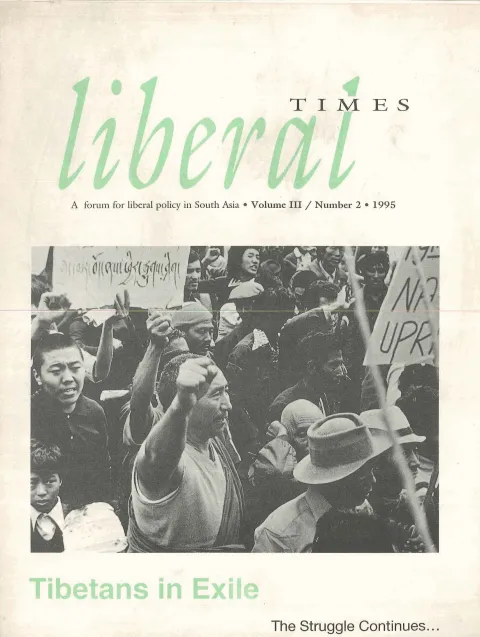
A Bombay seminar statement, “Tibet Struggles for Freedom,” condemns China’s occupation of Tibet, records over 87,000 Tibetans killed suppressing the national uprising, and endorses the Dalai Lama’s Five Point Peace Plan.
-
The “Of Cabbages & Kings” round-up covers Milovan Djilas’s rare 1987 interview on continuing crisis in communist systems, opposition-called Bharat Bandhs, Singapore’s press restrictions, and South Korea’s state-directed “Chaebol” economy.
Essays
Of Cabbages & Kings
An editorial round-up titled ‘Of Cabbages and Kings’ comprising four short unsigned/initialed notes: on Milovan Djilas’s rare 1987 interview describing continuing crisis in communist systems and his qualified praise for Gorbachev; on the mixed success and rising public fatigue with opposition-called Bharat Bandhs; on Singapore’s ‘gazetting’ (circulation-crippling) of critical foreign publications alongside anti-drug enforcement oddities in Sri Lanka, Israel and Germany; and on South Korea’s state-directed conglomerate (‘Chaebol’) economy presented as a cautionary case of ‘free enterprise’ that is neither free nor humane toward its industrial workforce.
- Djilas describes himself as a ‘virtual unperson’ in Yugoslavia despite The New Class being a major 20th-century political tract
- Djilas sees Gorbachev as bringing something positive but doubts reform will succeed without dismantling the whole Soviet system
- The March 15 Bharat Bandh killed seven and injured 250 but is judged to have achieved little beyond political theatre
- Singapore under Lee Kuan Yew ‘gazetted’ (restricted circulation of) Far Eastern Economic Review, Time and Asian Wall Street Journal for critical coverage
- South Korea’s Chaebols are described as capitalist in name but under total Ministry of Finance control, with harsh labour conditions for women workers
Tibet Struggles for Freedom
The text of a statement adopted at a February 1988 Bombay seminar convened by the Hindustani Andolan and the Indian Committee for Cultural Freedom, condemning China’s occupation of Tibet, backed by a companion fact-sheet (‘Chinese Imperialism in Tibet — Some Facts’) on troop levels, monastery destruction, and demographic transfer, and a report on the seminar proceedings featuring remarks from Minoo Masani, M.V. Kamath and Tibetan representative Thupten Samphel.
- The statement calls on the Government of India to permit a Tibetan government-in-exile and criticises India’s ‘pusillanimous’ historic acquiescence to China’s annexation
- It records that over 87,000 Tibetans were killed suppressing the national uprising and endorses the Dalai Lama’s Five Point Peace Plan
- The seminar proposes observing 1989, marking 30 years of the Dalai Lama’s exile, as the ‘Year of Tibet’
- The accompanying fact-sheet documents 6,254 destroyed monasteries, 1.2 million Tibetan deaths, and Chinese population transfer reducing Tibetans to a minority in Lhasa
- Minoo Masani recalled that Nehru prevented the United Nations from coming to Tibet’s assistance in 1959
Violence, Civilization and Democratic Values
By A.N. Dalal
A.N. Dalal, Professor of Political Science at Wilson College, Bombay, argues that mass violence — from football hooliganism to communal riots — is chiefly learned through social conditioning and mass-media desensitisation rather than innate, and that it is fundamentally incompatible with democratic values resting on rule of law and individual freedom. He surveys educational decline, group psychology and de-individuation, and violence against the powerless (dowry deaths, female infanticide, child labour) as ‘passive’ forms of social violence often ignored because they are not overtly political. The essay closes by invoking Gandhian non-violence, Martin Luther King and Khan Abdul Ghaffar Khan as models, arguing violence can only be overcome by non-violence, not eliminated outright.
- Violence is treated as largely learned/socially conditioned rather than a fixed genetic disposition
- Mass media (TV, cinema) desensitises viewers to violence and ‘glamourises barbarism’, especially for youth
- Group psychology de-individuates people, permitting acts of aggression individuals would not commit alone
- Passive/structural violence — dowry, female infanticide, child labour, exploitative wages — is as morally serious as overt political violence
- Gandhi, Martin Luther King and Khan Abdul Ghaffar Khan are cited as proof that non-violence is a learnable, effective response to provocation
- Violence by the state (e.g. extra-judicial ‘encounters’) is treated as equally corrosive of the rule of law as private violence
The Roots of Violence in India’s Polity
By Louella Lobo Prabhu
A companion book-note by A.N. Dalal reviewing Elias Canetti’s Crowds and Power (translated by Carol Stewart, Penguin 1973), summarising Canetti’s theory of the destructiveness of crowds, the psychology of the ‘survivor’ who feels empowered by mass death, and the Schreber case-history as a model of the paranoid pursuit of absolute power, comparing this dynamic to Hitler’s regime.
- Canetti identifies four traits of crowds: the drive to grow, internal equality, love of density, and the need for a common direction
- The ‘survivor’ — the commander or ruler who outlives others in mass death — is presented as the essence of political power-seeking
- The Schreber case (a paranoid lawyer) is used by Canetti as a precise model of political power that feeds on the crowd
- Dalal calls the book’s neglect in India ‘one of the surprising scandals of our decade’
Violence and Political Manipulation
By Kamal Wadhwa
Louella Lobo Prabhu, Associate Editor of Insight, traces the roots of violence in Indian politics from mythic/historic precedent (the Mahabharata-era and medieval betrayals cited as recurring patterns of internal treachery enabling foreign conquest) through to post-independence India, arguing that communal, linguistic and caste prejudice explain mass violence far more than poverty or unemployment. In the rendered portion she covers Constitutional amendments unilaterally overriding contracts with princes and the ICS, the unintended consequences and ‘reverse discrimination’ effects of caste-based reservations, and violence embedded in organised labour’s adversarial relationship with government, concluding that India has strayed from the standards of Ashoka and Gandhi under its own elected governments rather than under foreign rule.
- Communal, linguistic and caste prejudices are argued to matter more for India’s mass violence than economic deprivation
- The abrogation of privy purses and contractual pensions to princes and ICS officers is characterised as a form of ‘violence by the State’
- Reservation policy, intended to uplift Scheduled Castes, is argued to have calcified into a ‘travesty’ inviting reverse discrimination and resentment
- Industrial labour relations are described as violence-prone because government ‘only responds to violence’ in industrial disputes
- The essay closes by contrasting India’s current trajectory unfavourably with the eras of Ashoka and Gandhi
Coalition at the Centre
By Ramakrishna Hegde
S.V. Raju’s article on the ‘Riddles’ controversy is not directly rendered in this chunk, but the issue carries an associated primary-source extract from B.R. Ambedkar’s Riddles in Hinduism, reproducing Ambedkar’s critique of Rama’s treatment of Sita after her rescue from Ravana in the Ramayana, alongside the Sanskrit verses (Kalyana-Kalpataru edition of Valmiki’s Ramayana) and their English translation.
- The extract reproduces Ambedkar’s argument that Rama’s cold, suspicious treatment of Sita after her rescue is incompatible with ‘ordinary human kindness’
- Sanskrit verses from the Valmiki Ramayana (Kalyana-Kalpataru edition) are quoted with facing English translation
- Rama is quoted telling Sita he reclaimed her only to avenge his own honour, not for her sake, and that her ‘very sight is revolting’ to him
The ‘Riddles’ Controversy
By B. R. Ambedkar
A reprinted extract, ‘Safeguarding Our Democracy’, from B.R. Ambedkar’s speech in the Constituent Assembly during the third reading of the Constitution of India (25 November 1949), warning that India, having lost its independence once before through internal treachery, could lose its hard-won democracy again if political parties place party creed above country, and urging that constitutional methods — not the ‘Grammar of Anarchy’ (civil disobedience, satyagraha, non-cooperation) — must now be the sole legitimate means of pursuing social and economic change.
- Ambedkar warns that India previously lost independence through the ‘infidelity and treachery’ of figures like Jaichand and the commanders who took bribes during Mahommed-Bin-Kasim’s invasion of Sind
- He fears that placing political creed above country could again put India’s independence in jeopardy
- He argues India was never ignorant of democratic or parliamentary procedure, citing the rules of the Buddhist Sanghas as proof
- He calls for abandoning ‘unconstitutional methods’ (civil disobedience, non-cooperation, satyagraha) now that constitutional avenues are open, terming them ‘the Grammar of Anarchy’
Generated by the v1.5 extraction pipeline. Awaiting editorial review.
Metadata and summary are AI-extracted from the source PDF and reviewed for editorial accuracy. The original work is available via the Read PDF tab above (where present); paragraph-level citation inside the PDF is deferred to a future engagement.