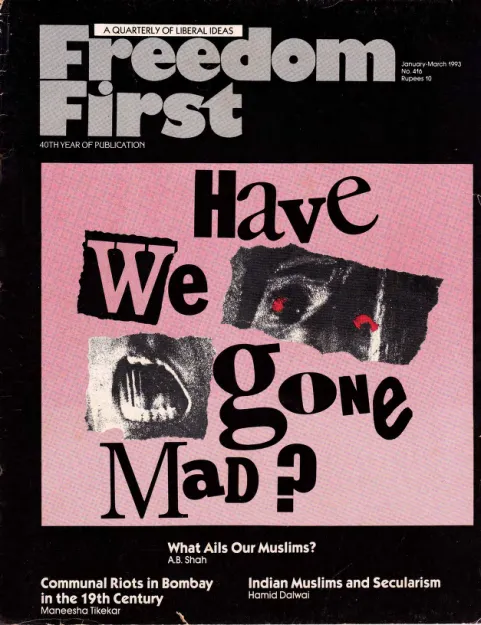
periodical issue
Freedom First
A Quarterly of Liberal Ideas
By C. Rajagopalachari, Minoo Masani, Bhanu Pratap Singh, S. V. Raju
Published by J.R. Patel for the Democratic Research Service and printed by him at Parsiana Publications Pvt. Ltd. 300 Perin Nariman Street, Bombay 400 001 · Bombay · 1989
60 pages
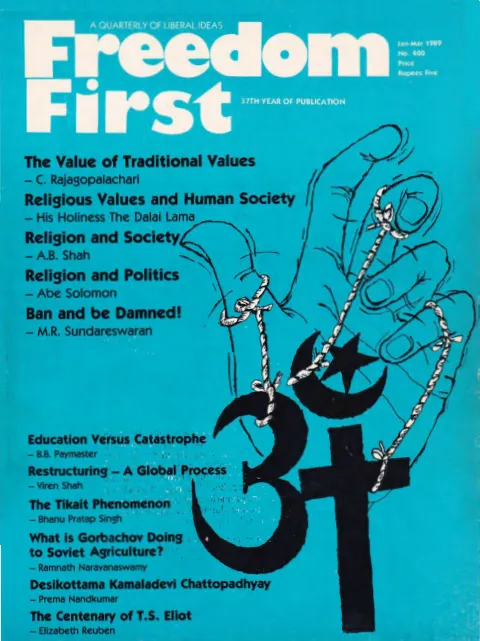
Freedom First
Summary
Freedom First No. 400 (Jan-Mar 1989), marking the journal’s 37th year of publication, is a themed issue on religion and public life, assembled against the backdrop of the government’s October 1988 ban on Salman Rushdie’s The Satanic Verses. The editorial and the lead section reprint reflections on religion and values from C. Rajagopalachari, the Dalai Lama, and the late A. B. Shah, framing religion as, in the editors’ words, neither for nor against liberalism but a source of values whose institutional capture by ‘priests, preachers and politicians’ produces communal mischief. The issue’s polemical center is the Rushdie ban: Abe Solomon takes issue with Minoo Masani’s plea for ‘Dharma in politics,’ arguing for a strictly secular, rights-based public life, while M. R. Sundareswaran’s ‘Ban and be Damned!’ supplies a detailed chronology of the ban and indicts it as political appeasement of Muslim vote-bank politics and a betrayal of constitutional free-expression guarantees, reinforced by sidebar reprints from Nehru (on the folly of banning books) and a note on the earlier proscription of Premchand.
Key points
-
C. Rajagopalachari’s 1964 reprint “The Value of Traditional Values” argues traditional values such as honesty and compassion are evolutionary products essential to human survival that secular law cannot substitute for.
-
The Dalai Lama’s “Religious Values and Human Society” presents compassion, not doctrine, as religion’s essential core, arguing good motivation rather than religious affiliation determines whether politics and other fields serve or harm humanity.
-
A. B. Shah’s posthumously reprinted “Religion and Society” contrasts Gandhi’s and Maulana Azad’s differing approaches to reforming Hinduism and Islam, arguing Gandhi succeeded partly because prior Hindu reformers since Rammohan Roy had already done the “spadework.”
-
Abe Solomon’s “Religion and Politics” rejects Minoo Masani’s call for more “Dharma in politics,” arguing India’s sarva-dharma-samabhava conception of secularism corrupts true secularism by tacitly endorsing discriminatory religious practices.
-
M. R. Sundareswaran’s “Ban and be Damned!” chronicles the October 1988 banning of Salman Rushdie’s The Satanic Verses under pressure from MP Syed Shahabuddin, casting it as electorally motivated appeasement and a betrayal of constitutional free-speech guarantees.
-
Sidebar reprints accompanying the Rushdie coverage include Soli Sorabjee’s op-ed against the ban, an account of Premchand’s own colonial-era censorship, Minoo Masani’s recollection of Indira Gandhi’s Emergency-era ban on his son Zareer’s biography of her, and Nehru’s essay “On the Banning of Books.”
Essays
The Value of Traditional Values
By C. Rajagopalachari
A 1964 Swarajya reprint in which Rajagopalachari, describing himself as ‘superstitious’ in the etymological sense, argues that traditional values such as honesty, compassion, and respect for contracts are evolutionary products essential to human survival, and that secularly enforced laws cannot substitute for them. He rejects a purely materialist account of evolution, holding that some ‘inscrutable design’ underlies these values, and warns that discarding traditional values under the pressure of destructive scepticism would return mankind to a feeble, beast-like condition.
- Rajagopalachari self-identifies as a ‘superstitious’ believer in things beyond reason and rationality.
- Quotes the Isa Upanishad on those who deny the soul wandering in darkness.
- Argues traditional values (honesty, compassion, cooperation) arose through natural selection and have survival value.
- Credits Herbert Spencer (unread but presumed) with a similar argument about man’s original evolutionary bestiality.
- Rejects blind evolutionary materialism; believes values reflect a divinely designed order.
- Warns that intellectual critique of tradition is easy from the safety of settled civilization, but civilization itself depends on the ‘knitted fabric’ of inherited values.
Religious Values and Human Society
By His Holiness The Dalai Lama
A reprint (courtesy Awareness, Clarity and Insight, Snow Lion Publications) of an address by the Dalai Lama arguing that compassion is the essential core of all religion and that a rightly-motivated life matters more than doctrinal belief. He develops a reasoning for extending compassion even to enemies by contrasting the ‘single I’ against the ‘limitless’ others, and argues that good motivation, not religious affiliation, is what makes politics, science, and other fields serve rather than harm humankind.
- Compassion, not doctrine, is presented as the real essence of religion, common across Buddhism, Christianity, and other faiths.
- A reasoning exercise: since ‘others’ are limitless and the self is one, others’ happiness should take priority — the basis for developing universal compassion.
- One’s enemy is described as ‘the best teacher’ because it tests and develops tolerance and inner strength.
- Politics itself is not inherently ‘dirty’; it becomes bad only when practised with cunning and selfish motivation.
- Warns that a society preoccupied with money and power at the expense of compassion and honesty will face greater suffering in future generations.
Religion and Society
By A.B. Shah
A reprint of the late A. B. Shah’s essay ‘Religion and Society in India’ (from his book Religion and Politics, Somaiya Publications), examining how religion and social change have historically interacted in India. Shah lays out a general theory of religion’s three functions (explaining man’s experiences, providing criteria for choosing between alternatives, and undergirding social institutions), traces how religions arise as harbingers of change but become entrenched and resistant to further reform, and then applies this to a comparison of Gandhi’s and Maulana Azad’s differing approaches to reforming Hinduism and Islam. Shah argues Gandhi succeeded partly because generations of prior Hindu reformers (since Raja Rammohan Roy) had already done the intellectual ‘spadework,’ whereas Islam in India has not yet had its equivalent reform movement, and that even the Gandhian approach — reliant on religious idiom — proved a weak vehicle for lasting change, as shown by continued untouchability among Gandhi’s own followers.
- Religion has three core functions: intellectual explanation of existence, ethical criteria for choice, and legitimation of social institutions.
- Religions begin as reformist/revolutionary movements but become entrenched establishments resistant to further change.
- Christianity accommodated modern change over roughly 400 years; Hinduism underwent comparable change in the 19th century; Islam, per Shah, has only just begun this process.
- Gandhi and Maulana Azad are contrasted as the leading modern reinterpreters of Hinduism and Islam respectively, but Azad’s approach was cautious/apologetic compared to Gandhi’s revolutionary willingness to override scripture.
- Gandhi’s reliance on religious idiom (Rama-Rajya, Sanatana Dharma) is identified as a structural weakness: after his death the traditional meanings of these terms reasserted themselves, eroding his reformist message.
- Muslim society in India lacks the countervailing secular/reformist infrastructure that cushioned Hindu society, making a ‘Gandhi’ figure alone insufficient for Muslim reform.
- Shah calls for a new generation of radical, liberal, modernist Muslim reformers willing to subject Islamic tradition to rigorous scrutiny.
Religion and Politics
By Abe Solomon
Abe Solomon (President, Indian Secular Society, and trustee of the Freedom First Foundation) responds to Minoo Masani’s July 1988 Freedom First essay ‘India — Time for a Renaissance,’ rejecting Masani’s call for more ‘Dharma in politics.’ Solomon argues that the European Renaissance’s essence was a shift from a God-centered to a Man-centered worldview and the assertion of reason against religious authority, and that religion in India has become an obstacle to social and cultural progress rather than a resource for it. He criticizes the Indian conception of secularism as sarva-dharma-samabhava (‘respect for all religions’) as a corruption of true secularism, which he defines as tolerance combined with opposition to any belief or practice that violates human rights.
- Solomon takes issue with Masani’s essay for lapsing into ‘confused’ apologetics for religion in politics.
- Defines the historical Renaissance as a shift from God-centered to Man-centered worldview and a revolt against dogmatic religious authority.
- Argues moral and ethical values are products of human reason and social development, not religion, which he calls an ‘obstacle to social and cultural progress’ in modern society.
- Critiques the Indian usage of ‘secularism’ as sarva-dharma-samabhava (equal respect for all religions) as effectively endorsing all religions’ dogmas and discriminatory practices (e.g., suttee, untouchability).
- Insists secularism is not anti-religious but requires opposition to beliefs/practices violating human rights, and agrees with Masani only insofar as ‘Dharma’ is read as moral/ethical behaviour rather than religion as such.
- Concludes with a call for India to build its future on reason, truth, freedom and compassion rather than religiously-inflected politics.
- Includes a sidebar reprint of a telegram from ‘Friends of Tibet, Bombay’ urging Rajiv Gandhi to raise Tibetan autonomy with China, quoting Nehru’s 1950 parliamentary statement on Chinese suzerainty over Tibet.
Ban and be Damned!
By M.R. Sundareswaran
M. R. Sundareswaran’s ‘Ban and be Damned!’ recounts the October 5, 1988 banning of Salman Rushdie’s The Satanic Verses by the Government of India under Section 11 of the Indian Customs Act, following pressure from MP Syed Shahabuddin and other Muslim politicians who admitted not having read the book. The essay surveys press and political reaction — including Rajiv Gandhi’s refusal to revoke the ban, divided Muslim intelligentsia opinion, and near-total silence from opposition parties — and argues the ban was an act of political expediency ahead of general elections rather than a principled response to genuine offense, casting it as surrender to fundamentalism and a betrayal of India’s constitutional free-speech guarantees. The piece incorporates substantial sidebar material: Soli Sorabjee’s Times of India op-ed ‘A Betrayal of India’s Tradition of Tolerance,’ an extract from Premchand’s autobiography on the colonial-era proscription of his story collection Soz-e-Watan, Minoo Masani’s ‘Let the Courts Decide’ (recalling Indira Gandhi’s Emergency-era ban on a biography written by his son Zareer Masani), and a closing Jawaharlal Nehru extract ‘On the Banning of Books’ plus a note on the historical banning of Tamil and Hindu texts (‘Swadeshi Hindu Satanic Verses’).
- The Satanic Verses was banned on October 5, 1988 under Section 11 of the Indian Customs Act after protests led by Syed Shahabuddin, who admitted not having read the book.
- Rajiv Gandhi publicly refused to revoke the ban despite acknowledging Home Ministry officials had not read the book themselves.
- Sundareswaran frames the ban as electorally motivated appeasement of the Muslim vote ahead of general elections, not a principled or consistent policy.
- Muslim intelligentsia opinion was divided: most published reactions supported the ban, with the Indian Muslim Youth Conference president Mukhtar Abbas Naqri a notable exception opposing it.
- Opposition parties are criticized for near-total silence on the ban, seen as complicity via a shared fear of alienating Muslim votes.
- Soli Sorabjee’s reprinted op-ed argues no law permits banning creative work merely for hurting religious sentiment absent malicious intent, quoting Justice Chinnappa Reddy on India’s constitutional culture of tolerance.
- The Premchand sidebar recounts his own book being suppressed by a British colonial district collector in 1909-10 for ‘sedition,’ offered as a historical parallel to contemporary censorship.
- Minoo Masani’s sidebar recalls Indira Gandhi’s Emergency-era ban on a biography of her written by his son, Zareer Masani, later found to contain nothing objectionable and released by the Janata government.
- Nehru’s reprinted 1937-38-era essay ‘On the Banning of Books’ (from his Selected Works, Vol. 3) argues book bans are self-defeating, driven by human fascination with the forbidden, and dangerous as precedent regardless of who wields the power.
- A closing sidebar, ‘Swadeshi Hindu Satanic Verses,’ notes earlier Indian bans on the Tamil poem Ravana Kaviyam and briefly references controversy over a Tamil folk-song collection reprinted by the Saraswathi Mahal Library in Tanjore.
Generated by the v1.5 extraction pipeline. Awaiting editorial review.
Metadata and summary are AI-extracted from the source PDF and reviewed for editorial accuracy. The original work is available via the Read PDF tab above (where present); paragraph-level citation inside the PDF is deferred to a future engagement.