periodical issue
Freedom First
A Quarterly of Liberal Ideas
By A. Solomon, Sharad Joshi, K. B. Dadiseth, S. V. Raju
Indian Committee for Cultural Freedom, 3rd Floor, Army & Navy Building, 148, Mahatma Gandhi Road, Mumbai 400 001. Published by J. R. Patel for the Indian Committee for Cultural Freedom and printed by him at Kaiser-E-Hind Private Ltd., 300, Perin Nariman Street, Mumbai 400 001. · Mumbai · 1997
52 pages
Freedom First
Summary
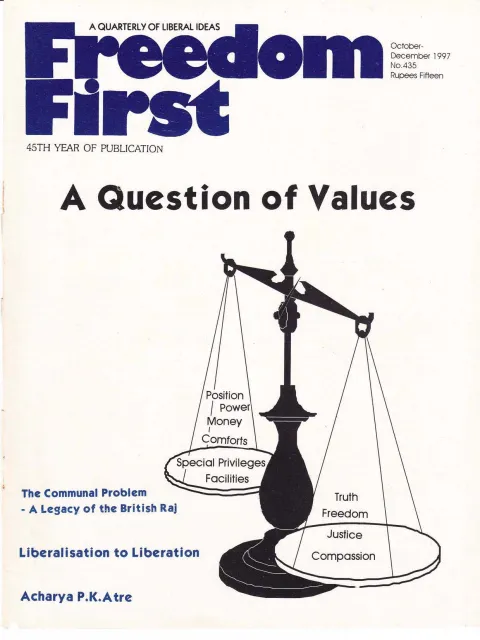
Freedom First No. 435 (October-December 1997), marking the magazine’s 45th year of publication, leads with a themed cover feature, “A Question of Values,” prompted by editor S. V. Raju’s sense that public character and basic decencies had sharply declined. The issue opens with a tribute extract from the Dalai Lama on the 38th anniversary of the Tibetan resistance, followed by the regular satirical/quotation columns “With Many Voices” and “Of Cabbages and Kings,” and a short piece on Dadabhai Naoroji’s vision by Nani Palkhivala. The centerpiece, produced in association with the Project for Economic Education, reproduces Abe Solomon’s draft “Universal Declaration of Human Values” (eleven articles grounding human rights in freedom, truth, reason, and compassion) and a transcript of a half-day Mumbai seminar discussing it, with participants debating the philosophical basis of rights, the Maharashtra government’s values-education GR, the Diana/Mother Teresa moment, science and insecurity, and the gap between Indian rhetoric and practice on values. The rendered pages close with V. C. Viswanathan’s “Ethics as Business Strategy,” profiling Alacrity Foundations and Body Shop as businesses built on ethical codes. Further contents listed in the table of contents - on the communal problem’s colonial roots (Sharad Joshi), liberalisation (K. B. Dadiseth), a tribute to Acharya P. K. Atre (Y. C. Phadke), a US travel account (Arvind A. Deshpande), a UN tribute (Adi Doctor), a Pakistan visit account (S. V. Raju), and book reviews - lie beyond the rendered page range and are not summarized here.
Key points
-
The cover feature “A Question of Values” reproduces Abe Solomon’s draft “Universal Declaration of Human Values”, eleven articles grounding rights in freedom, truth, reason and compassion, produced in association with the Project for Economic Education, arguing the 1948 UN Declaration of Human Rights rests on unstated values that need their own explicit codification.
-
A transcript of the accompanying Mumbai seminar records eighteen named participants debating whether values or rights are logically prior, the Maharashtra government’s new compulsory school values-education policy, and the public’s emotional response to the deaths of Princess Diana and Mother Teresa.
-
Nani Palkhivala’s acceptance speech for the Dadabhai Naoroji Memorial Prize sketches Naoroji’s vision of a free India built on universal education and secular equality among religions, closing on a pessimistic note about India’s corruption fifty years after independence.
-
V. C. Viswanathan’s “Ethics as Business Strategy” profiles Alacrity Foundations and Body Shop as businesses built on ethical codes.
-
The “Of Cabbages and Kings” column criticises politicians occupying AIIMS guest-house rooms meant for visiting scientists, a Karnataka legislators’ rest-house built with jacuzzis and imported tiles, and Uttar Pradesh Chief Minister Kalyan Singh’s defector-heavy cabinet, sixteen of whose ministers face criminal charges including murder and dacoity.
-
The issue opens with a tribute extract from the Dalai Lama marking the 38th anniversary of Tibetan resistance, alongside the regular “With Many Voices” column of press quotations.
Essays
A Question of Values / A Draft Universal Declaration of Human Values / The Discussion
By A. Solomon
“With Many Voices” is Freedom First’s recurring column of pointed quotations culled from the Indian and international press. In this issue it strings together barbed or ironic remarks on VIP guest-house abuse, Mahathir Mohamad’s clash with George Soros over ASEAN currency speculation, cricket diplomacy between India and Pakistan, the popularity of I. K. Gujral compared to Gorbachev, and Subramanian Swamy’s plan to reform politics via the Janata Party, among other topics.
- Compiles ironic or critical quotations from October 1997 Indian and international press.
- Includes Malaysian PM Mahathir Mohamad calling George Soros a ‘moron’ over ASEAN currency speculation, and Soros calling Mahathir ‘a menace to his own country’.
- Quotes comparing Prime Minister I. K. Gujral’s domestic unpopularity to Mikhail Gorbachev’s.
- Includes Subramanian Swamy stating he can ‘guide’ educated people into politics through the Janata Party.
- Uses Tennyson’s ‘many voices’ epigraph to frame the column as a chorus of contemporary commentary.
Ethics as Business Strategy
By V. C. Viswanathan
“Of Cabbages and Kings” is the issue’s editorial-commentary column, titled after the Lewis Carroll verse. This installment covers the “VIP Nuisance” of politicians overstaying in AIIMS guest houses meant for visiting scientists, a Karnataka legislators’ rest-house built with luxury amenities (jacuzzis, imported tiles, prospective masseuses) funded on a supposed no-profit basis, and a satirical aside (“Prophetic ‘Cho’”) comparing UP Chief Minister Kalyan Singh’s defector-heavy BJP cabinet to a scene from Cho Ramaswamy’s play about a minister-making prime minister, noting many of Singh’s ministers are history-sheeters facing criminal charges.
- Criticizes politicians occupying AIIMS guest-house rooms meant for visiting scientists, naming Sanjay Singh’s relatives and Tariq Anwar as long-term occupants.
- Describes a Public Interest Litigation, filed by the Hind Mazdoor Sabha, that forced ITDC chairman Anil Bhandari to give up a subsidized luxury hotel suite.
- Reports on a Karnataka ‘Legislators’ Home’ in Bangalore built with imported tiles and jacuzzis, ostensibly run on a ‘no-profit-no-loss’ basis.
- Uses Cho Ramaswamy’s play Mohammed Bin Tuglak to satirize UP CM Kalyan Singh’s cabinet of 22 Congress defectors and 12 BSP defectors.
- Notes that 16 of Kalyan Singh’s ministers are ‘history sheeters’ facing charges including murder, dacoity, kidnapping, rioting and robbery.
The Communal Problem - A Legacy of the British Raj
By Sharad Joshi
Nani Palkhivala’s acceptance speech at the Dadabhai Naoroji Memorial Prize Award Function (Bombay, August 12, 1997) sketches Naoroji’s vision of a free India built on free and universal education, arguing that Naoroji’s own words - ‘I realize that I had been educated at the expense of the poor… I must devote myself to the service of the people’ - reveal a man who believed India’s salvation lay in equality of religions and would, had he lived to frame the Constitution, have entrenched the same secular and fundamental rights India adopted. Palkhivala contrasts the English ‘sense of justice and fairness’ that elected Naoroji to the House of Commons with what he sees as India’s own failure to embody those virtues, and closes lamenting that India’s current ‘degradation and corruption’ fifty years after independence make the country undeserving of leaders like Naoroji or Mahatma Gandhi.
- Delivered as Palkhivala’s acceptance speech for the Dadabhai Naoroji Memorial Prize, Bombay, August 12, 1997.
- Frames Naoroji’s political vision as rooted in free, universal education and a duty to return to the poor what education gave him.
- Argues Naoroji, had he helped frame India’s Constitution, would have entrenched secular equality among religions and fundamental rights for minorities.
- Cites Naoroji’s biographer R. P. Masani on the difficulty of persuading families to send daughters to school in his era.
- Closes on a pessimistic note about India’s degradation and corruption fifty years after independence.
Liberalisation to Liberation
By A. Solomon
Abe Solomon’s cover-feature introduction explains that Freedom First, together with the Project for Economic Education, convened a half-day Mumbai discussion on October 18, 1997, around his draft “Universal Declaration of Human Values,” proposed to the International Humanist and Ethical Union. Solomon argues that the 1948 Universal Declaration of Human Rights presupposes values - human dignity, reason, and a common morality - that were never separately codified or internalised, and that in many societies traditional values conflict with the Declaration’s premises. His eleven-article draft grounds all rights in the dignity of the human person as a rational, autonomous agent, naming reason, critical intelligence, truth, tolerance, creativity, freedom, equality, justice, harmony with nature, and a universal culture as the constitutive values. The seminar transcript that follows records eighteen named participants (identified by initials) debating whether values or rights are logically prior, whether the Declaration is one of “faith not fact,” the Maharashtra government’s new compulsory school values-education period (criticized as ad hoc and potentially exclusionary of minorities), the public’s emotional response to Princess Diana’s and Mother Teresa’s deaths, and whether science and technology have outpaced society’s ethical assimilation of them.
- Draft “Universal Declaration of Human Values” proposed by Abe Solomon (President, Indian Secular Society) to the International Humanist and Ethical Union.
- Argues the 1948 UN Declaration of Human Rights rests on unstated values - human dignity, reason, truth, tolerance, compassion - that need their own explicit declaration.
- Eleven articles cover Source of Values, Reason, Critical Intelligence, Truth, Tolerance, Creativity, Freedom, Equality, Justice, Humankind and Nature, and Universal Culture.
- Half-day seminar held October 18, 1997 in Mumbai with 18 named participants (e.g. Dr. B. N. Colabawalla, Arvind A. Deshpande, Nissim Ezekiel, Prof. M. P. Rege, Dr. Indumati Parikh, Mr. L. R. Sampat).
- Discussion covers the history of rights instruments (Magna Carta, 1688 Bill of Rights, US and French constitutions, 1948 UDHR), the Maharashtra government’s compulsory school values-education GR and its risk of privileging Hindu content over minority institutions, the emotional public response to the deaths of Princess Diana and Mother Teresa, and anxieties about science/technology outpacing ethical assimilation.
- One participant (Prof. M. P. Rege) frames the Declaration as ‘a declaration of faith and not a statement of fact or of reality anywhere in the world, particularly in India,’ citing Philip Spratt’s characterization of Indians as ‘narcissistic.’
- Discussion links the theme of values to economic liberalisation, questioning why liberalisation of the economy isn’t matched by liberalisation of social, political, and cultural life.
Generated by the v1.5 extraction pipeline. Awaiting editorial review.
Metadata and summary are AI-extracted from the source PDF and reviewed for editorial accuracy. The original work is available via the Read PDF tab above (where present); paragraph-level citation inside the PDF is deferred to a future engagement.