periodical issue
Freedom First
A Quarterly of Liberal Ideas
Published by J. R. Patel for the Indian Committee for Cultural Freedom and printed by him at Kaiser-E-Hind Private Ltd., 300, Perin Nariman Street, Mumbai 400 001. · Mumbai · 1998
52 pages
Freedom First
Summary
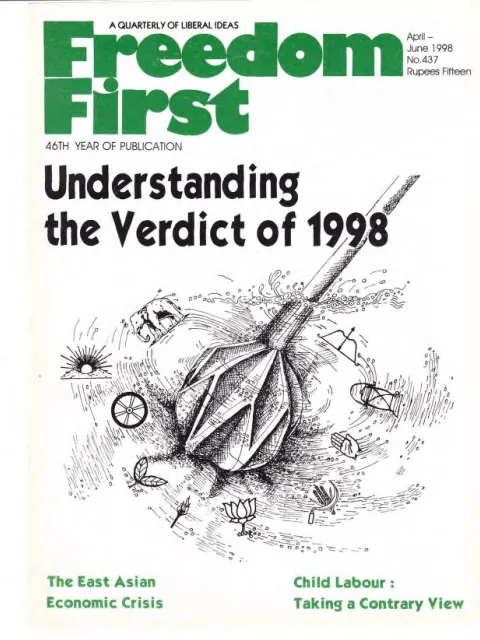
This is issue No. 437 of Freedom First (April-June 1998), the 46th year of publication, edited by S. V. Raju and published in Bombay for the Indian Committee for Cultural Freedom. The cover feature, “Understanding the Verdict of 1998,” anchors the issue: it reproduces a summary of a seminar held on 14 March 1998 in Mumbai (organised with the Project for Economic Education and the Friedrich-Naumann-Stiftung) in which some thirty participants debated why the 12th Lok Sabha elections again produced a hung parliament, touching on voter confusion, criminalisation of politics, proportional representation, federalism, and the rise of backward-caste political power. Two signed follow-on essays extend the theme in the rendered pages: Amit Dholakia’s “A Turning Point,” which reads the 1998 result as evidence of party fragmentation, the “end of ideology” in mainstream manifestos, and the growing role of television in campaigning; and V. Krishnamachari’s “She Came, She Waved, but Failed to Conquer,” which opens a critical post-mortem of Sonia Gandhi’s 1998 campaign debut, contrasting it with Indira Gandhi’s 1977 defeat and disputing claims of a ‘Sonia magic’ with constituency-level results. The issue’s regular front sections - “Between Ourselves” (editor’s note), “With Many Voices” (a column of quoted press soundbites on Indian politics), and “Of Cabbages and Kings” (miscellany: the closure of the Harold Laski Institute of Political Science, an obituary for Advisory Board member Aziz Madni, notes on a Hiroshima-Nagasaki photo exhibition, and a critical item on novelist Gabriel Garcia Marquez’s politics) - are covered in full in the rendered pages.
Key points
-
The cover feature “Understanding the Verdict of 1998” summarises a thirty-participant Mumbai seminar debating why the 12th Lok Sabha elections again produced a hung parliament, covering proposals such as proportional representation, a fixed election calendar, and postal ballots for soldiers, plus a boxed argument that political power is shifting from caste Hindus toward Scheduled Castes, Scheduled Tribes and Other Backward Classes.
-
Amit Dholakia’s “A Turning Point” reads the hung parliament as evidence of party fragmentation and the “end of ideology”, describing Congress’s fall to just one actor among many and predicting satellite television will become a decisive, potentially trivialising, factor in future elections.
-
V. Krishnamachari’s “She Came, She Waved, but Failed to Conquer” offers a critical post-mortem of Sonia Gandhi’s 1998 campaign debut, arguing the “Sonia magic” was overstated since Congress’s 142-seat tally barely exceeded Narasimha Rao’s uncharismatic 1996 result, and documenting losses in symbolically important seats including Rae Bareilly.
-
The “Of Cabbages and Kings” column reports the 1997 closure of the Harold Laski Institute of Political Science, an obituary for Freedom First Advisory Board member Aziz Madni, and a polemical item accusing Nobel laureate Gabriel Garcia Marquez of being an apologist for Castro, Stalin and Pablo Escobar.
-
The regular “With Many Voices” column compiles press soundbites on the corruption and criminalisation surrounding the 1998 elections, including Chief Election Commissioner M. S. Gill’s remark that booth capturing is “the reality of India”.
Essays
Many Voices
A one-page column of short quotations from the Indian press (BusinessWorld, The Washington Monthly, The Economist, India Today, The Times of India, Asian Age, and vox-pop comments from students, shopkeepers and a farmer gathered by Outlook) on the corruption, criminalisation and cynicism surrounding Indian electoral politics in early 1998, framed by an epigraph from Tennyson.
- Compiles press soundbites on political corruption ahead of/around the 1998 elections
- Includes commentary on the UCPI’s support for Congress, citing a 1920 Lenin instruction to support Gandhi
- Includes vox-pop quotes from young people (a BA student, a paan-shop owner, college students) expressing disillusionment with politicians
- Quotes Chief Election Commissioner M. S. Gill on booth capturing as ‘the reality of India’
- Quotes M. J. Akhar’s line that Jayalalitha is ‘the throne behind the power’
Of Cabbages & Kings
A miscellany column covering four items: the closure on 27 November 1997 of the Harold Laski Institute of Political Science, Ahmedabad (founded 1954 by Purshottambhai Mavalankar), quoting his farewell letter at length; an obituary for Aziz Madni, a long-time Advisory Board member and former editor of Freedom First, written by S. V. Raju; a report on a Hiroshima-Nagasaki photography exhibition marking Gandhi’s 50th death anniversary, with a translated Sadako Kurihara poem, and a separate note on a golden-jubilee photography exhibition curated with the Alfred Stieglitz Center and USIS; and a sharply critical item on Nobel laureate Gabriel Garcia Marquez’s sympathetic writings about Fidel Castro, Pablo Escobar, and other authoritarian or violent figures, including a fabricated news report about the Falklands war.
- Harold Laski Institute of Political Science (Ahmedabad), founded 1954, closed 27 Nov 1997; founder-director Purshottambhai Mavalankar’s farewell letter is quoted at length
- Obituary for Aziz Madni (d. 7 February), Freedom First Advisory Board member and former editor when the journal was a monthly, written by S. V. Raju
- A Hiroshima/Nagasaki ‘Never Again’ exhibition marking Gandhi’s 50th death anniversary is described, including nuclear-arsenal statistics and a poem by A-bomb survivor Sadako Kurihara
- A photography exhibition on India’s golden jubilee (with the Alfred Stieglitz Center and USIS) is critiqued for over-representing BJP imagery and omitting photos of the Emergency and the JP movement
- A polemical item accuses Gabriel Garcia Marquez of being an apologist for Castro, Stalin, Janos Kadar, Mao, and Colombian drug trafficker Pablo Escobar, and recounts a fabricated Falklands-war dispatch he filed
Understanding the Verdict of 1998
The cover-feature seminar summary on ‘Understanding the Verdict of 1998,’ held 14 March 1998 in Mumbai with about thirty participants (freelance journalists, academics, businesspeople, retired officials, and NGO figures), records a wide-ranging, non-consensus discussion of why the 12th Lok Sabha election again produced a hung parliament. Contributors debate whether voters were ‘confused’ or simply voting rationally along caste, regional, and personality lines; whether criminalisation of candidates reflects a failing judiciary; whether India is drifting toward a genuinely federal, multi-party polity that a first-past-the-post system cannot register; and whether reforms such as proportional representation, a fixed election calendar, postal ballots for soldiers and the disabled, and constitutionally mandated stability provisions (as in Germany) might reduce electoral volatility. A separate boxed contribution argues that political power is passing from caste Hindus toward Scheduled Castes, Scheduled Tribes and Other Backward Classes, and predicts further polarisation into two or three major groupings led by these communities.
- Voter turnout was 62% in 1998 versus 57.94% two years earlier, undercutting the idea of ‘voter fatigue’
- Participants disagree on whether the electorate is ‘confused’ or discriminating; some argue rural, feudal-minded voters back candidates like Jayalalitha or Sukh Ram despite corruption charges
- K. F. Rustomji and others discuss whether India needs proportional representation, a fixed election calendar (citing the US and German models), or constitutional safeguards against no-confidence votes without an alternative government in place
- Nagindas Sanghavi’s boxed note ‘One Night Stands’ argues 1998 was a rerun of 1996, with alliances behaving like short-term unions rather than lasting coalitions
- Jehangir Patel’s boxed note frames Congress as now chosen only as ‘the lesser evil’ rather than a default ruling party
- Dr. Amitabh’s boxed contribution, ‘The Emergence of the Backward Castes,’ argues power is shifting from caste Hindus to Shudras and Ati-Shudras, quoting Swami Vivekananda, and predicts continued polarisation into two or three major political groupings
- Granville Austin is quoted (via The Hindu, 16 March 1998) noting the Constitution’s framers never anticipated a hung Parliament scenario
- Discussion covers disfranchisement of servicemen and disabled voters lacking postal-ballot access, and proposals to make MPs/MLAs more directly accountable to constituents
A Turning Point
By Amit Dholakia
Amit Dholakia’s essay ‘A Turning Point,’ part of the ‘Understanding the Verdict of 1998’ package, argues that the fourth consecutive hung Lok Sabha signals accelerating fragmentation of India’s party system and the ‘representational crisis’ of national parties, which have been forced to regionalise. He traces the Congress’s decline into just one actor among many, the transformation of Indian politics from ‘Congress versus the rest’ to ‘BJP versus the rest,’ and the erosion of ideology as a mobilising force, arguing that most major parties now converge on liberalisation, globalisation and social development (excepting ‘a bunch of anachronistic and incorrigible marxist ideologues’). He closes (within the rendered pages) by discussing the growing role of satellite television in political communication, predicting TV will become a decisive determinant in future elections, and worrying that this could trivialise political discourse.
- Frames the fourth consecutive hung parliament as a ‘turning point’ reflecting fragmentation and regionalisation of India’s party system
- Describes the Congress’s fall to ‘just one of the actors in a competitive, multi-party system’ for the first time in its history
- Argues the contest has shifted from ‘Congress versus the rest’ to ‘BJP versus the rest’
- Claims ‘the age of ideology is finally over in Indian politics,’ with major parties converging on liberalisation and globalisation
- Analyses the BJP’s expansion into Dalit, tribal, OBC and even Muslim votes despite its Hindutva base, alongside secular allies like Ramakrishna Hegde and Mamata Banerjee
- Discusses the rise of satellite television as a political communication tool, projected to reach 378 million viewers by 2000, warning of a shift toward ‘cheap theatrics’
- Notes seats determined by regional/caste/tribal voting patterns rather than uniform ‘vote bank’ behaviour
She Came, She Waved, but Failed to Conquer
By V. Krishnamachari
V. Krishnamachari’s essay, opening in the rendered pages, offers a sharply critical account of Sonia Gandhi’s 1998 campaign debut, comparing it to Indira Gandhi’s overconfident call for elections after the Emergency in 1977. It argues that Congress leaders and the press overstated a ‘Sonia magic,’ noting the party’s Lok Sabha tally (142) barely differed from Narasimha Rao’s non-charismatic 1996 result (also around 142), despite Sonia Gandhi’s high-profile 60,000 km campaign across 141 constituencies. The rendered portion (through page 20) documents specific constituency losses, including Rajiv Gandhi’s own former seat and Rae Bareilly, and describes friction between Sonia loyalists and other Congress leaders such as Sharad Pawar in Maharashtra, where the essay is cut off before its conclusion.
- Opens by recalling Indira Gandhi’s 1977 miscalculation in calling elections after the Emergency, drawing a parallel to Sonia Gandhi’s 1998 debut
- Argues ‘Sonia loyalists’ like Arjun Singh miscalculated the political moment, banking on the Jain Commission report and memories of Rajiv Gandhi’s assassination
- States Sonia Gandhi campaigned in 141 constituencies (60,000 km travelled) but the Congress tally (142 seats) barely exceeded Narasimha Rao’s 1996 result, undercutting claims of a ‘Sonia magic’
- Documents Congress losses in symbolically important seats: Sriperumbudur (Rajiv Gandhi’s site of martyrdom), Rae Bareilly (Indira Gandhi’s constituency), New Delhi, Amethi, Phulpur, and Nainital
- Notes Congress won only 48 of 48 Maharashtra seats it contested versus 52 in 1996, attributing the state’s opposition success in Mumbai-area seats to Sharad Pawar’s alliance-building with the RPI and Samajwadi Party rather than to any ‘Sonia factor’
- Describes friction between Sonia Gandhi loyalists and Sharad Pawar, calling the Congress’s spurning of Pawar a negative consequence of overconfidence
- Essay is cut off mid-argument on p.20 discussing the ‘Queen Can Do No Wrong’ framing of Sonia Gandhi’s role as Congress President and CPP Chairperson
Generated by the v1.5 extraction pipeline. Awaiting editorial review.
Metadata and summary are AI-extracted from the source PDF and reviewed for editorial accuracy. The original work is available via the Read PDF tab above (where present); paragraph-level citation inside the PDF is deferred to a future engagement.