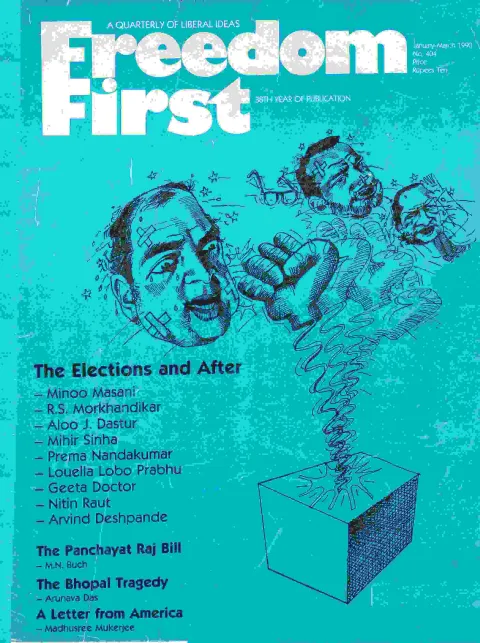
periodical issue
Freedom First
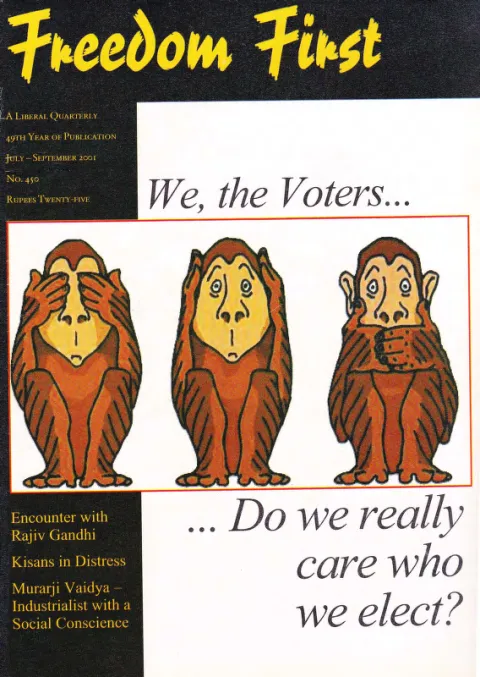
We, the Voters... Do we really care who we elect?
By Arvind Deshpande, Bhanu Pratap Singh, M. R. Pai
Published by J. R. Patel for the Indian Committee for Cultural Freedom and printed by him at Kaiser-E-Hind Private Ltd., 300, Perin Nariman Street, Mumbai 400 001. Publishers: Indian Committee for Cultural Freedom, 3rd Floor, Army & Navy Building, 148, Mahatma Gandhi Road, Mumbai 400 001. · Mumbai · 2001
52 pages
Freedom First
Summary
Freedom First No. 450 (July–September 2001), the 49th year of publication of this Bombay-based liberal quarterly edited by S. V. Raju, leads with a cover feature on voter apathy and indifference, prompted by the 2001 Tamil Nadu and West Bengal election results. Several contributors — R. Srinivasan, Arvind Deshpande, Anjali Patil-Gaikwad, C. Narendra, S. S. Bankeshwar, and Seetha — examine, from different angles, whether Indian voters actually care who they elect, and whether the electorate’s tolerance of corrupt and criminal politicians (notably J. Jayalalitha’s re-ascension to the Tamil Nadu chief ministership despite corruption charges) reflects a deeper civic and moral decline. The issue’s centerpiece, in the rendered pages, is Subroto Roy’s first-person memoir ‘Encounter with Rajiv Gandhi,’ an account of his personal dealings with Rajiv Gandhi between September 1990 and Gandhi’s assassination in May 1991, in which Roy claims his ‘perestroika’ manuscript for India and its circulation among Congress economic advisors were instrumental in shaping the economic-reform thinking that culminated in the 1991 liberalisation. Other departments in this issue (per the table of contents, not all seen in these rendered pages) include reader letters (‘With Many Voices’), editorial notes (‘Of Cabbages and Kings’), a rural/agrarian piece by Bhanu Pratap Singh (‘Kisans in Distress’), a profile of industrialist Murarji Vaidya by M. R. Pai, a debate section, and book reviews. The issue also reproduces a statement by the Dalai Lama on the 42nd commemoration of the 1959 Tibetan uprising and his clarification on Kashmir.
Key points
-
The cover feature on voter apathy, prompted by the 2001 Tamil Nadu and West Bengal elections, opens with R. Srinivasan’s “Do We Really Care Who We Elect?”, which frames Indian elections as a “gladiatorial sport” driven by caste loyalty and patronage, and argues political corruption is a “global phenomenon” citing scandals touching Western leaders’ families too.
-
C. Narendra’s “Democracy on the Decline in Tamilnadu” condemns the newly elected government’s night-time arrest of former chief minister M. Karunanidhi as an act that “would do fascism proud”.
-
Seetha’s “Rewarding the Corrupt” argues Indian voters share the blame with corrupt politicians, citing the repeated re-election of Jayalalitha, Neelalokahitadasan Nader, and Rabri Devi despite serious charges, contrasting this with the 1989 anti-Bofors backlash.
-
S. S. Bankeshwar’s “A Great Leap Backwards” warns India’s legal framework lets convicted candidates become chief ministers through gaps between the Representation of the People Act and gubernatorial discretion, and proposes minimum educational qualifications for candidates and voters.
-
The issue’s centrepiece, Subroto Roy’s memoir “Encounter with Rajiv Gandhi”, claims his “perestroika” manuscript and an unpublished 1955 Milton Friedman memorandum shaped the Congress economic-reform group that drafted the March 1991 manifesto he says was the true template for the 1991 liberalisation.
-
The issue reproduces the Dalai Lama’s March 2001 statement on the 42nd anniversary of the Tibetan uprising and his August 2001 clarification affirming Jammu and Kashmir as an integral part of India.
Essays
With Many Voices,
A short reader-letters department, ‘With Many Voices,’ opens the issue with a set of quoted remarks culled from the Indian press (Times of India, Common Cause, The Week, Outlook, and others) on globalisation, corruption, hypocrisy about ‘foreign’ standards, and the routine nature of bribery — offered without extended commentary, as a mosaic of contemporary Indian public discourse.
- Compiles brief quoted remarks from named public figures and unnamed citizens, sourced to specific newspapers and dates in mid-2001
- N. R. Narayana Murthy of Infosys is quoted defining globalisation as sourcing capital, production, and sale wherever most profitable
- A Bombay police constable and a Delhi police sub-inspector are quoted on the ordinariness of bribery
- The selection has no unifying editorial voice beyond the Tennyson epigraph framing the section as many ‘voices’
Of Cabbages and Kings
The editorial department ‘Of Cabbages and Kings’ offers wry observations on everyday civic dysfunction in Bombay and elsewhere: badly designed bus-stop advertising hoardings that obscure route information, unenforced laws (from spitting and urinating in public to VIP traffic violations), and a photograph of women being made to publicly atone for entering a Mumbai railway ladies’ compartment. It closes with reproduction of the Dalai Lama’s statements on Tibet and on Kashmir.
- Criticises Mumbai’s BEST bus-stop shelters for prioritising advertising over passenger information
- Laments the non-enforcement of public-nuisance and traffic laws despite over 300 outdated laws finally being scrapped
- Suggests Singapore-style on-the-spot penalties as a deterrent, including for ‘VIP’ offenders
- Reproduces the Dalai Lama’s March 10, 2001 statement on the 42nd anniversary of the Tibetan uprising, addressing China’s Tibet policy and his ‘Middle-Way Approach’
- Reproduces the Dalai Lama’s August 2001 clarification of his remarks on Kashmir, affirming Jammu and Kashmir’s status as an integral part of India
Do We Really Care Who We Vote?
By R. Srinivasan
R. Srinivasan’s cover essay ‘Do We Really Care Who We Elect?’ argues that Indian elections have degenerated into a ‘gladiatorial sport’ in which voting is only a minute part of a spectacle driven by caste loyalty, patronage, and eroded public morality. He traces a broader global collapse of political integrity — from Tamil Nadu’s re-election of Jayalalitha despite corruption charges to financial scandals touching the families of Western leaders (the Bushes, the Thatchers, the Clintons) and Asian leaders — arguing India should not be uniquely harsh on its own tainted politicians given this is a ‘global phenomenon.’
- Frames elections as a ‘gladiatorial sport’ where the casting of a vote is a minor part of a month-long spectacle
- Argues public and political morality has collapsed since independence, as religious and Gandhian ethical restraint eroded
- Cites Tamil Nadu’s Chief Minister and DMK/AIADMK dynamics, and the conviction-but-not-disqualification of Neelalokahitadasan Nader, as evidence of voter tolerance for corruption
- Frames political corruption as a ‘global phenomenon,’ citing financial scandals around Jacques Chirac, the Mitterrand family, Margaret Thatcher’s relatives, and the Clintons
- Author identified as Dr. R. Srinivasan, retired professor of political science at Bombay University and associate editor of Freedom First
What do the Election Results Indicate?
By Arvind Deshpande
Arvind Deshpande’s short piece ‘What Do the Election Results Indicate?’ argues the 2001 Tamil Nadu result was not the ‘sweeping mandate’ for Jayalalitha it was portrayed as, since only 59% of voters actually voted and the AIADMK’s seat count would have looked similar to the DMK’s under proportional representation.
- Argues 41% of voters abstained, so Jayalalitha’s mandate is overstated
- Notes AIADMK and DMK would have won near-equal seats under proportional representation
- Concludes the election outcome shows practically nothing except local, not national, voter concerns
- Author identified as Honorary Secretary of the Leslie Sawhny Programme for Training in Democracy and a member of the Indian Liberal Group
Don’t Our People Care Any Longer?
By Anjali Patil-Gaikwad
Anjali Patil-Gaikwad’s essay ‘Don’t Our People Care Any Longer?’ explores the paradox of a stable Indian democracy run by leaders of doubtful credibility. She argues ordinary people do care but feel powerless, while an educated elite that could drive reform is cynical and disengaged; she calls for active citizenship, local pressure groups, and civic education, citing the Netagiri school for future politicians in Jharkhand as a hopeful model.
- Describes the 2001 Tamil Nadu and West Bengal elections as showing Indian democracy ‘at its worst’
- Argues voters do care because bad governance affects their daily lives, but feel helpless to effect change
- Identifies an educated elite that is disengaged and resigned to its inability to change anything alone
- Calls for ‘active citizenship,’ networking among like-minded people, and local pressure groups for accountability
- Cites the Netagiri school for future politicians (launched in Jharkhand by former politician Raj Ranjan) as a hopeful initiative
- Author identified as a member of the Indian Liberal Group, a lecturer in communication skills, and an All India Radio commentator
Democracy on the Decline in Tamilnadu
By C. Narendra
C. Narendra’s ‘Democracy on the Decline in Tamilnadu’ criticises the newly elected Tamil Nadu government’s arrest of former chief minister M. Karunanidhi in the middle of the night as an act that ‘would do fascism proud,’ comparing the servility of the IAS in this episode with past instances of political interference with police and legislators in Andhra Pradesh and Uttar Pradesh, and lamenting Tamil Nadu’s decline from a front-ranking state at independence to one now lagging on literacy, health, and governance.
- Condemns the arrest of Karunanidhi as unconstitutional and reminiscent of fascist tactics
- Contrasts the servile behaviour of the IAS in this episode with the IPS’s earlier resistance to political pressure in Andhra Pradesh under N. T. Rama Rao
- Recounts the 1994 episode of Chandrababu Naidu sequestering over 150 MLAs in a hotel to prevent defections
- Notes both major Tamil Nadu parties are widely seen by voters as corrupt, leaving little real choice
- Author identified as a journalist and member of the Indian Liberal Group
Great Leap Backwards
By S. S. Bankeshwar
S. S. Bankeshwar’s ‘A Great Leap Backwards’ warns that India’s constitutional and legal framework permits convicted criminals to become chief ministers or even prime minister because of gaps between the Representation of the People Act, Election Commission guidelines, and gubernatorial discretion, using Jayalalitha’s swearing-in despite disqualification as the trigger, and calls for constitutional amendments including minimum educational qualifications for candidates and voters.
- Argues the Constitution’s founders never anticipated ‘dacoit kings,’ gangsters, and underworld dons becoming lawmakers
- Notes a convicted person disqualified by the Election Commission from contesting can still be appointed Chief Minister by the Governor for six months
- Cites former Election Commissioner G. V. G. Krishnamurthy’s condemnation of Jayalalitha’s swearing-in as ‘a slap on the face of all our courts’
- Proposes a Constitutional Review Committee address whether law-breakers should be law-makers, and mandate minimum (4th-standard) education for candidates and voters
- Author identified as a freelance writer and member of the Advisory Board of Freedom First
Rewarding the Corrupt
By Seetha
Seetha’s ‘Rewarding the Corrupt’ argues that Indian voters share the blame with corrupt politicians, since electorates in Tamil Nadu, Bihar, and elsewhere have repeatedly returned candidates facing serious corruption or criminal charges (Jayalalitha, Neelalokahitadasan Nader, Rabri Devi/Laloo Yadav) to power, showing an ‘indulgent attitude’ that has made corruption a non-issue in Indian elections, unlike the Bofors-driven backlash of 1989.
- Argues the public’s outrage over Jayalalitha’s treatment of Karunanidhi obscures a deeper indulgence of corruption by voters themselves
- Cites the re-election of Jayalalitha, Neelalokahitadasan Nader (despite sexual molestation charges), and Rabri Devi/Laloo Yadav (despite the fodder scam) as evidence voters have accepted corruption as normal
- Contrasts this with the 1989 anti-Bofors wave that unseated the Congress, arguing corruption has since ceased to be a decisive election issue
- Cites an India Today opinion poll in which 43% named Indira Gandhi the best PM India ever had, and Priyanka Gandhi was favoured over Manmohan Singh to lead the Congress, as evidence against ‘dynastic rule’ being disliked by the public
- Author identified as Associate Editor of Business Today and a member of the Indian Liberal Group
Encounter with Rajiv Gandhi
By Subroto Roy
Subroto Roy’s ‘On the Origins of the 1991 Economic Reform: Encounter with Rajiv Gandhi’ is a first-person memoir of the author’s meetings with Rajiv Gandhi from September 1990 until Gandhi’s assassination in May 1991. Roy recounts giving Gandhi his ‘perestroika’ manuscript for India (later published by Sage) along with an unpublished 1955 Milton Friedman memorandum prepared for the Government of India, and describes being drawn into a small group (including K. V. Krishan Rao, V. Krishnamurthy, M. K. Rasgotra, and later A. M. Khusro) tasked with drafting economic-policy sections of the Congress election manifesto. He reproduces extracts from the March 22, 1991 manifesto draft on inflation control, panchayati raj, rural development, education, industrial efficiency, and investment/trade, and argues this draft — not Manmohan Singh or P. V. Narasimha Rao as often credited — was the true origin of India’s 1991 economic liberalisation, a claim he says was corroborated by his conversations with Manmohan Singh in 1993 and by Jairam Ramesh’s later account.
- Roy met Rajiv Gandhi about half a dozen times between September 1990 and Gandhi’s assassination in May 1991
- He gave Gandhi his ‘perestroika for India’ manuscript, which included an unpublished 1955 Milton Friedman memorandum written for the Government of India
- Gandhi convened a group (K. V. Krishan Rao, V. Krishnamurthy, M. K. Rasgotra, Sam Pitroda, later A. M. Khusro) to draft economic proposals and the Congress manifesto
- Roy describes discussions with Gandhi on panchayati raj, privatisation, public goods, Pakistan relations, and the Gulf War
- The March 22, 1991 manifesto draft (excerpted at length) covered inflation control, fiscal discipline, deregulation, panchayati raj, rural development, education, industrial efficiency, and foreign investment
- Roy claims this draft, delivered via Rajiv Gandhi to N. Krishna Rao and Narasimha Rao, was the true template for the reforms launched in July 1991, disputing sole credit to Manmohan Singh or Narasimha Rao
- Article dedicated to Mihir and Purnima Roy and the memory of Suchandra Bhattarcharjee; author bio identifies Dr. Subroto Roy as an LSE/Cambridge-trained economist, professor at IIT Kharagpur’s Vinod Gupta School of Management, and member of the Indian Liberal Group
Generated by the v1.5 extraction pipeline. Awaiting editorial review.
Kisans in Distress
By Bhanu Pratap Singh
No summary was extracted for this article. Listed for completeness.
Reflections Serious and Facetious
By Louella Lobo Prabhu
No summary was extracted for this article. Listed for completeness.
Metadata and summary are AI-extracted from the source PDF and reviewed for editorial accuracy. The original work is available via the Read PDF tab above (where present); paragraph-level citation inside the PDF is deferred to a future engagement.