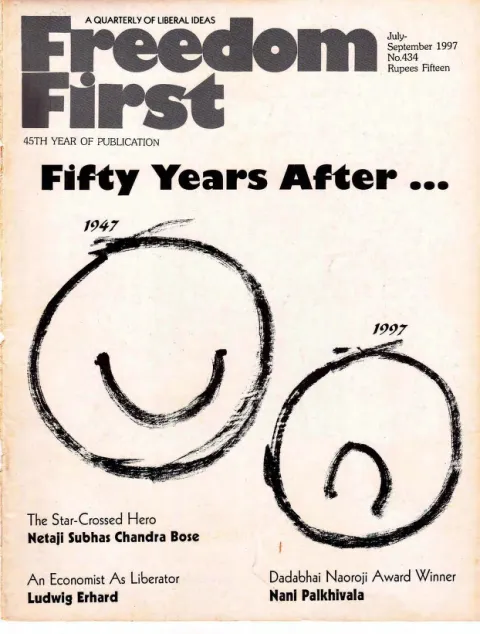
periodical issue
Freedom First
A Liberal Quarterly
By Jiban Mukhopadhyay, Sadanand Varde
Indian Committee for Cultural Freedom, 3rd Floor, Army & Navy Building, 148, Mahatma Gandhi Road, Mumbai 400 001. Published by J. R. Patel for the Indian Committee for Cultural Freedom and printed by him at Kaiser-E-Hind Private Ltd., 300, Perin Nariman Street, Mumbai 400 001. · Mumbai · 2003
56 pages
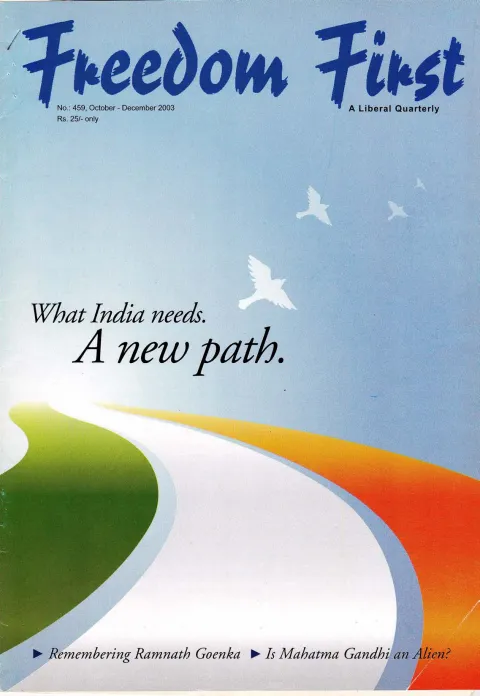
Freedom First
Summary
This issue of Freedom First (No. 459, October–December 2003) is dedicated to the memory of Satyendra Kumar Dubey, the IIT-trained National Highways Authority of India engineer murdered in Gaya, Bihar in November 2003 after exposing corruption on the Golden Quadrilateral highway project. In the rendered pages, the issue opens with an Indian Liberal Group election appeal calling for clean candidates, transparency, and continued economic liberalization tempered by equity, followed by the masthead, table of contents, and the editor’s tribute to Dubey. The bulk of the rendered material is the concluding installment of a year-long cover series titled ‘What India Needs,’ built from a seminar held at St. Xavier’s College, Mumbai on September 27, 2003. Four contributors address governance, economics, politics, and social justice: A. D. Moddie argues that India must discard its colonial administrative architecture and build countervailing power against an unaccountable political class; Jiban K. Mukhopadhyay makes the economic case for agriculture-led growth and engagement with the WTO; Nagindas Sanghavi diagnoses corruption, criminalization, and communalism as intertwined political diseases requiring a stronger judiciary; and Sadanand Varde surveys caste-based rural violence and argues for citizen-driven accountability mechanisms such as a right to recall elected representatives. A short unsigned piece opens the symposium describing Dubey’s killing and the public reaction to it, and the chunk ends as a brief item on India-Israel cooperation in the United States begins.
Key points
-
Freedom First No. 459 (Oct-Dec 2003) is dedicated to Satyendra Kumar Dubey, the NHAI engineer murdered in Gaya, Bihar after exposing corruption on the Golden Quadrilateral project; an unsigned piece details the bureaucratic mishandling of his complaint and calls for “hundreds of Satyendra Dubeys.”
-
The issue concludes the year-long “What India Needs” cover series, drawn from a September 2003 seminar at St. Xavier’s College, Mumbai.
-
A. D. Moddie’s keynote argues India inherited and perpetuated a colonial administrative architecture, citing a Fraser Institute/Centre for Civil Society study ranking India 86th of 123 countries on economic freedom, and calls for a coalition to build countervailing power against an unaccountable political class.
-
Jiban K. Mukhopadhyay makes the economic case for a feasible 7% growth rate led by agriculture, citing China’s post-1978 reform sequencing, and argues full engagement with WTO negotiations gives India more leverage than the IMF or World Bank.
-
Nagindas Sanghavi diagnoses corruption, criminalisation and communalism as intertwined diseases, citing India’s shortage of judges relative to Western democracies, and admits he has no solution to offer for communalism.
-
Sadanand Varde argues social justice requires equalising real opportunity, not just formal legal equality, recounting caste-based violence in rural Maharashtra and proposing a constitutional “right to recall” non-performing elected representatives.
-
The Indian Liberal Group’s election appeal opening the issue calls for clean candidates, transparency, and continued economic liberalisation tempered by equity.
Essays
Many Voices
This unsigned piece recounts the November 27, 2003 murder of Satyendra Kumar Dubey, a National Highways Authority of India engineer working on the Golden Quadrilateral project, after he wrote a confidential letter to the Prime Minister exposing corruption and shoddy contracting. It details the bureaucratic mishandling of his complaint, tributes from IIT Kanpur faculty and alumni, the muted response from Bihar Chief Minister Laloo Prasad Yadav and Prime Minister Vajpayee, and closes by praising The Indian Express’s investigative reporting and calling for ‘hundreds of Satyendra Dubeys’ and a people’s movement against corruption.
- Dubey, a 1994 IIT Kanpur civil engineering graduate, was Deputy General Manager at NHAI working on the Golden Quadrilateral road project
- He anonymously wrote to the Prime Minister in November 2002 detailing ‘poor implementation’ and ‘loot of public money’, but attached his biodata, which led to his identification
- His letter was forwarded down the bureaucratic chain to the very NHAI officials it implicated, with a note recommending ‘action as deemed fit’
- He was shot dead by unidentified assailants in Gaya, Bihar on November 27, 2003
- IIT Kanpur’s director and alumni associations mobilized in response; Bihar CM Laloo Prasad Yadav and PM Vajpayee were criticized for their slow, muted reactions
- A sidebar cites that 57 Bihar engineers were killed, 25 kidnapped, and 37 assaulted over the preceding decade
- The piece calls for the Indian Express to be awarded the Pulitzer Prize for its investigative journalism on the case
- It closes invoking Jayaprakash Narayan’s Total Revolution Movement as a model for a needed anti-corruption people’s movement
Hundreds of Satyendra Dubeys
A. D. Moddie’s keynote address argues that the quality of life rests on freedom and good governance, and that independent India inherited and perpetuated a colonial administrative architecture rather than replacing it. He cites Ambedkar’s 1950 warning about India’s ‘life of contradictions,’ compares India unfavorably with freer, better-governed states like Singapore and Hong Kong using a Fraser Institute/Centre for Civil Society economic freedom study, and calls for a coalition of the best political, administrative, and business minds to build countervailing power against the government and to design a post-licence-raj governance architecture for the 21st century.
- Moddie frames freedom and good governance as the twin keys to quality of life, citing a comparison of Singapore/Jamaica and Japan/Nigeria
- He cites a global economic freedom study (Fraser Institute’s Economic Freedom of the World 2000 Annual Report, in which the Centre for Civil Society participated) ranking India 86th of 123 countries
- Freer economies in the study had longer life expectancy, higher per capita income ($18,000 vs $2,000), lower inequality, and lower illiteracy and corruption
- He argues India’s post-1947 elite merely transferred colonial administrative power from ‘white’ to ‘brown’ hands without discarding colonial-era laws (Official Secrets Act, Criminal Procedure Code, Indian Penal Code, IPC)
- He blames India’s top 5% elite for failing to build countervailing institutions, citing business leaders’ capitulation to Gujarat CM Narendra Modi as an example
- He calls for a national consensus to discard the 19th-century colonial administrative legacy and design a ‘post-licence, post-permit raj’ governance architecture
The Good Governance Perspective
By A. D. Moddie
Jiban K. Mukhopadhyay, Economic Adviser at Tata Services Limited, presents the economic case for what India needs: acceptance of a feasible (rather than an ideal) growth rate of around 7% per annum, agriculture-led growth given its high correlation with industrial and overall GDP growth (citing China’s post-1978 reforms), a restructuring of industry for competitiveness even at some short-term employment cost, and full engagement with WTO negotiations as a multilateral, one-country-one-vote forum that gives developing countries leverage the IMF or World Bank do not offer.
- Mukhopadhyay argues a ‘feasible’ 7%+ GDP growth rate (versus an ‘ideal’ 9-10%) would double India’s per capita income in about 15 years
- About 44% of Indians live on less than a dollar a day (PPP) and 43% are illiterate; income distribution is highly skewed (46% of income to top 10%, 8% to bottom 10%)
- India shifted from a Nehruvian mixed economy to a public-sector-dominated economy until 1991 reforms; post-reform GDP growth rose to 6.1% while population growth fell to 1.9%
- Agriculture’s share of GDP fell from ~56% in the 1950s to ~25% today even though 67% of population and 54% of the workforce depend on it; agricultural growth is volatile, with 2002-03 a drought year
- He argues incremental agricultural income (he estimates Rs. 7,500 crores of incremental disposable income per 1% agricultural growth) flows into consumer demand that drives industrial growth, citing China’s agriculture-first reform sequencing from 1978
- The 148-member WTO represents over 98% of world exports; unlike the IMF/World Bank, WTO decision-making is one-country-one-vote, giving developing countries leverage
- He criticizes the Indian government for both resisting globalisation domestically and threatening to walk out of WTO negotiations at Cancun/Doha
The Economic Perspective
By Jiban K. Mukhopadhyay
Political scientist and columnist Nagindas Sanghavi argues that corruption, criminalization, and communalism are three intertwined diseases corroding Indian public life. He contends that India’s judiciary is too numerically weak (13 judges per million population versus 135 in western democracies) to check corruption and crime, that politics has become a route to power and privilege for those with few other avenues of advancement, and that communalism, though a centuries-old malady predating and contributing to Partition, is a problem for which he says he has ‘nothing to offer as a solution.’
- Sanghavi treats corruption and criminalization as inseparable, mutually reinforcing phenomena in India’s political structure
- He cites a claim that India has only 13 judges per million population versus 135 in Western democracies as evidence of judicial weakness
- He argues judicial immunity from public scrutiny, and lawyers who exploit technicalities, have made the judiciary lethargic and inefficient
- He describes politics as a path to ‘total obscurity and poverty to a visibility that is unheard of’ via perks like free housing, cars, and patronage, attracting those with few other routes to advancement
- He calls communalism a ‘loathsome disease’ at the root of Partition, now spread across every party and political leader competing to exploit communal passion
- He concludes with a stark admission that he has no solution to offer for communalism
The Political Perspective
By Nagindas Sanghavi
Educationist and former Maharashtra education minister Sadanand Varde argues that social justice requires equalizing real opportunity in education, health, housing and other domains for historically deprived groups, not just formal legal equality. He recounts two cases of caste-based violence in rural Maharashtra, notes the state’s very high rate of one-teacher primary schools and dropout rates, discusses the pros and cons of caste-based reservations after the Mandal Commission, and calls for citizen-driven accountability mechanisms, including a constitutional ‘right to recall’ non-performing elected representatives, as a remedy for what he sees as widespread political and civic apathy.
- Varde argues India’s Constitution promises social justice on paper, but societal structure keeps people unequal despite formal political equality
- He recounts a case where Pardhees (a formerly criminal-tribe-labelled community) were beaten to death by a mob in Usmanabad district, and another where a Dalit-Maratha inter-caste elopement led to a village being pillaged by upper-caste Hindus
- He cites that of Maharashtra’s 65,000 primary schools, about 12,000 (18%) are one-teacher schools, with very high dropout rates before matriculation
- On reservations, he says he is ‘not persuaded that reservations are totally wrong’ since they address opportunities denied by birth into a backward caste, while noting some states have breached the Supreme Court’s 50% cap
- He proposes a constitutional amendment creating a ‘right to recall’ non-performing elected representatives, citing precedents in Switzerland and California
- He criticizes Rajiv Gandhi’s admission that only 10-15 paise of every welfare rupee reached its target group as ‘a travesty of justice’
- He closes with a documentary-inspired anecdote about a grandson teaching his illiterate grandfather to write his own name, calling the grandson ‘my role model’
Generated by the v1.5 extraction pipeline. Awaiting editorial review.
Metadata and summary are AI-extracted from the source PDF and reviewed for editorial accuracy. The original work is available via the Read PDF tab above (where present); paragraph-level citation inside the PDF is deferred to a future engagement.