periodical issue
Freedom First
A Journal of Liberal Values
Published by J. R. Patel for the Indian Committee for Cultural Freedom (ICCF) and printed by him at Kaiser-E-Hind Private Ltd., Plot No.A-191, Road No.16A, MIDC, Wagle Industrial Estate, Thane (W) - 400 604. · Mumbai · 2006
12 pages
Freedom First
Summary
This August 2006 issue of Freedom First (No. 471, 53rd year of publication) is dominated by the aftermath of the July 11, 2006 Mumbai train bombings. Ashok Karnik’s lead essay traces the transnational ideology of ‘Islamic Jehad’ from Hassan al-Turabi’s doctrine through a chronology of attacks from 9/11 to the Mumbai blasts, arguing that India faces both Pakistan’s territorial grievances and a broader jehadi network, and proposes intelligence, legal, and anti-terror-financing reforms. Sharad Bailur’s companion piece argues India’s ‘soft state’ status invites terrorism and calls for tougher anti-terror laws modelled partly on Israeli practice. A ‘Point-Counterpoint’ column by Karnik stages opposing views on the blasts, BMC monsoon failures, and the Jaswant Singh PMO-mole controversy. The issue also carries a historical piece on the 1806 Vellore Mutiny bicentenary, a continued symposium on caste reservations (three reader contributions), a profile of Cold War diplomat George Kennan, a book review of ‘National Resurgence in India’, Firoze Hirjikaka’s satirical ‘Cornucopia’ column, an editorial marking the journal’s return to monthly publication after 21 years, and the ‘Many Voices’ page of press quotations.
Key points
-
Freedom First No. 471 (August 2006), marking the journal’s return to monthly publication after 21 years, is dominated by the aftermath of the July 11, 2006 Mumbai train bombings.
-
Ashok Karnik’s lead essay traces the transnational ideology of “Islamic Jehad” from Hassan al-Turabi’s doctrine through a chronology of attacks culminating in the Mumbai blasts, recommending better intelligence and anti-terror-financing reforms.
-
Sharad Bailur argues India’s constitutional commitment to liberty has produced a “soft state” vulnerable to terrorism, proposing Israeli-style measures including mandatory unappealable death sentences and a dedicated anti-terrorist finance department.
-
R. Srinivasan marks the bicentenary of the 1806 Vellore Mutiny, questioning whether it and 1857 constitute genuine proto-nationalist uprisings or a retrospectively constructed myth.
-
Three contributors continue the reservations symposium: Bapu Satyanarayana criticises Arjun Singh’s 27% OBC quota as political self-preservation, Saratchandra Panda argues rural employment creation matters more than reservation, and Santosh Nedungadi argues reservation has served its purpose and should be phased out over a decade.
-
V. Balachandran profiles Cold War diplomat George Kennan, correcting an Indian newspaper’s misdated obituary and describing Kennan’s regret over the militarised distortion of his “containment” doctrine.
-
Firoze Hirjikaka’s “Cornucopia” column addresses the rape and murder of a child domestic servant by an upper-middle-class Mumbai family, arguing Indian employers treat domestic help with dehumanising entitlement.
Essays
Terrorism - The Global Dimension
By Ashok Karnik
Ashok Karnik’s lead essay argues that the trans-continental spread of terrorism since the 1990s is linked by the ideology of ‘Islamic Jehad’, tracing this to Hassan al-Turabi’s Islamic Charter Front and his 1996-97 doctrinal guidance for jehadi action. Karnik lists major attacks from 9/11 through the July 11, 2006 Mumbai train blasts, argues India faces both Pakistan’s territorial claims and a broader Islamist agenda aimed at destabilising the Indian state, and describes the modus operandi of local terror modules. He closes with policy remedies: rebuilding quality intelligence, ruling out precipitate ‘hot pursuit’, strengthening anti-terror laws with safeguards, encouraging Muslim opposition to jehadi violence, and coordinated, sustained remedial action.
- Terrorism has historically been localized, but since the 1990s has become transnationally linked through ‘Islamic Jehad’ ideology
- Hassan al-Turabi is credited with formulating the doctrine driving international jehadi coordination via the International Muslim Brotherhood
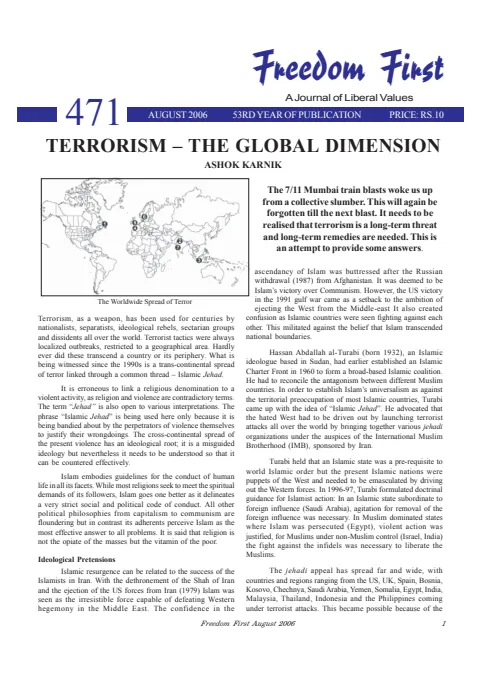
- A chronology of major attacks (9/11, Delhi Parliament attack, Bali, Madrid, London, Mumbai) is presented to show the spread of terror
- India faces terrorism rooted in both Kashmir and a broader Pakistani strategy to ‘bleed India through a thousand cuts’
- Local terror modules are recruited from fanatics, aggrieved youth, and mercenaries, with SIMI cited as a source of recruits
- Karnik recommends intelligence quality over quantity, stronger but checked anti-terror laws, and encouraging Muslims to oppose jehadi violence
Mumbai, Terror and the Soft State
By Sharad Bailur
Sharad Bailur argues that India’s constitutional commitment to individual liberty has been taken to an extreme that produces a ‘soft state’, citing the July 11, 2006 Mumbai blasts as the occasion for hard lessons from Israel’s counter-terrorism approach. He proposes a mandatory ‘no prisoners taken’ and ‘no negotiations’ policy, ending the practice of jailing (and later releasing/exchanging) terrorists, mandatory death sentences without appeal for convicted terrorists, fast-tracked special anti-terror courts, and a dedicated Anti-terrorist Finance Department. He also flags Mumbai’s coastal vulnerability, citing Bhatkal-area smuggling routes and unguarded landing points near Thane Creek.
- India’s extreme commitment to individual liberty has produced a ‘soft state’ vulnerable to terrorism
- Bailur cites Israel’s approach, despite disagreeing with Israel’s lack of secularism, as a model for firmness
- Proposes a mandatory ‘no prisoners taken’ and ‘no negotiations’ policy, citing the Kandahar hijacking and Syed Salahuddin
- Calls for mandatory, unappealable death sentences for convicted terrorists and special fast-tracked anti-terror courts
- Proposes an Anti-terrorist Finance Department and closer coordination with Israel’s Shin Bet
- Identifies Mumbai’s unguarded coastline (Bhatkal to Harnai/Alibag to Thane Creek) as a major security gap
Remembering July 10, 1806: The Vellore Mutiny
By R. Srinivasan
R. Srinivasan’s historical essay marks the bicentenary of the July 10, 1806 Vellore Mutiny, situating it among other regional revolts against East India Company rule (Kattabomman’s Poligar wars, Kittur and Dharwad under Rani Chennave, the Rani of Jhansi). He recounts the mutiny’s causes — new uniform regulations seen as forced Christianisation (banning turbans, caste marks, beards; a leather-touched cap) — and its course: soldiers killed about a hundred English soldiers and 15 officers before reinforcements from Arcot crushed the revolt, killing an estimated 800 or more rebels. The piece closes by questioning whether Vellore and 1857 were truly proto-nationalist uprisings or whether that framing is a retrospective myth (comparing it to Savarkar’s characterisation of 1857 and to the mythologising of the Magna Carta).
- Marks the 200th anniversary of the July 10, 1806 Vellore Mutiny against East India Company rule
- Situates Vellore among other regional revolts: Kattabomman’s Poligar wars, Kittur/Dharwad under Rani Chennave, the Rani of Jhansi
- New uniform rules banning turbans, caste marks, and beards, plus a leather-touched cap, sparked the mutiny as perceived forced Christianisation
- The mutiny killed about 100 English soldiers and 15 officers before being crushed, with roughly 800 or more rebels killed
- The presence of Tipu Sultan’s family (1400 people) in the fort was a contributing factor
- Questions whether Vellore and 1857 constitute genuine ‘nationalism’ or a retrospectively constructed myth, comparing this to the mythologising of the Magna Carta
Point <-> Counter-Point
By Ashok Karnik
Ashok Karnik’s recurring ‘Point-Counter-Point’ column presents paired opposing viewpoints on current controversies: the 7/11 Mumbai blasts as an intelligence/administration/disaster-management failure versus a view centred on Pakistani proxy war and national resolve; monsoon flooding exposing BMC failures versus a defence of the BMC against media exaggeration; Muslim MPs protesting harassment during blast investigations versus the counter-argument about proportional suspicion; and the Jaswant Singh PMO ‘mole’ letter controversy about India’s 1995 nuclear test plans, laid out as a numbered list of unresolved questions.
- Format pairs opposing viewpoints on the 7/11 blasts, BMC monsoon failures, minority harassment complaints, and the Jaswant Singh PMO-mole controversy
- One side blames intelligence, administrative, and disaster-management failure for the blasts; the other frames it as a Pakistani proxy war requiring national resolve
- Defends the BMC against media hype over monsoon flooding while acknowledging real infrastructure decay
- Lays out five unresolved questions about Jaswant Singh’s claimed PMO-mole letter regarding India’s 1995 nuclear test planning
Cornucopia (Get Milk / Amoral Power)
By Firoze Hirjikaka
Firoze Hirjikaka’s satirical ‘Cornucopia’ column runs two pieces. ‘Get Milk’ mocks Western Viagra manufacturers’ anxiety over an elderly Barmer farmer’s claim that camel’s milk boosted his virility, imagining a cynical marketing pivot. ‘Amoral Power’ is a sharper commentary on the rape and murder of a ten-year-old domestic servant by an upper-middle-class Mumbai family (the Gajaria case), arguing that Indian employers routinely treat domestic help, especially girls from remote villages, with dehumanising entitlement, compounded by victims’ fear of stigma and police reluctance to act.
- ‘Get Milk’ satirizes Western pharmaceutical anxiety over camel-milk virility claims from an elderly Rajasthani farmer
- ‘Amoral Power’ addresses the rape and murder of a child domestic servant by the Gajaria family in Mumbai
- Argues employers of domestic help, especially illiterate girls from remote villages, exhibit a sense of ownership rather than employment
- Notes police reluctance to register complaints from underprivileged victims and social stigma that silences victims rather than perpetrators
Essay 6
By Bapu Satyanarayana
Bapu Satyanarayana’s contribution to the continued reservations symposium argues reservation has become a divisive, emotive issue and criticises HRD Minister Arjun Singh’s 27% OBC quota (Mandal II) as a political manoeuvre to shore up his standing rather than genuine upliftment, noting his role in prior ‘de-safronization’ and the Aligarh Muslim University reservation controversy. He cites the National Knowledge Commission’s 6-2 vote against reservation and Homi Vyarawalla’s ‘Camera Chronicles’ account of the 1947 Partition-planning meeting to argue that divisive, expedient politics has long characterised the Congress party.
- Reservation is described as an emotive, divisive issue with the potential to snowball along caste and class lines
- Criticises HRD Minister Arjun Singh’s 27% OBC reservation (Mandal II) as motivated by personal political survival rather than upliftment
- Notes the National Knowledge Commission voted 6-2 against reservation, which Arjun Singh publicly attacked
- Cites NSS data suggesting OBC employment share already equals their population share, with ‘creamy layer’ capturing most benefits
- Invokes Homi Vyarawalla’s ‘Camera Chronicles’ account of a June 14, 1947 meeting to argue the Congress party has historically treated India ‘as their jagir’
- Notes three Congress stalwarts (Nehru, Indira Gandhi, Rajiv Gandhi) were each personally sceptical of reservation despite the party’s current stance
s short reservations-symposium contribution argues the real
By Saratchandra Panda
Saratchandra Panda’s short reservations-symposium contribution argues the real ‘need of the hour’ is rural employment creation for SC/ST communities rather than reservation, since without food, shelter, and income, education and reserved jobs remain out of reach for the poorest. He argues most reservation benefits accrue to relatives of officials and ministers who are already SC/ST, and recommends need-based assistance (free boarding, tuition waivers) rather than reserved seats, so that competition remains on the basis of equality.
- Argues rural employment creation, not reservation, is the real priority for SC/ST upliftment
- Migrant labourers who leave impoverished villages are described as the worst-affected and most exploited segment
- Claims government welfare spending for SCs/STs mostly fails to reach the target group, quoting Rajiv Gandhi’s ‘ten to fifteen paise per rupee’ remark
- Argues reserved-job benefits mainly go to relatives of officials/ministers who are already SC/ST
- Recommends free boarding, lodging, and tuition waivers rather than reservation, so competition remains merit-based
- States the non-government sector will never accept job reservation since it must compete domestically and internationally
The Reservation Conundrum (symposium: Without Reservations / The Need of the Hour / Doing Away with Reservations - Gradually)
By Bapu Satyanarayana; Saratchandra Panda; Santosh Nedungadi
Santosh Nedungadi’s reservations-symposium contribution argues that reservation has served its purpose — untouchability has vanished and affected communities have been reasonably uplifted — and that it now matters little to younger generations, while political parties keep it alive for narrow interests. He opposes extending reservation to the private sector, calls for merit alone to matter within a decade, and questions whether any political party will have the courage to actually roll reservation back.
- Argues reservation has served its purpose and communities affected have been ‘reasonably uplifted’
- Claims untouchability has vanished and temple-entry restrictions have been abolished
- Argues younger generations barely understand what reservation debates are about
- Opposes extending reservation to the private sector, praising industry associations for opposing it
- Calls for a roadmap to reduce reservation over ten years so ‘only merit matters’
- Questions whether any political party will have the political will to adopt such a rollback
George Kennan
By V. Balachandran
V. Balachandran’s profile of George F. Kennan opens by correcting an Indian newspaper’s erroneous report of Kennan’s death (misdated to March 2006 instead of March 2005), using this as an indictment of sloppy Indian journalism. He then surveys Kennan’s career as author of the Cold War ‘containment’ doctrine via his 1946 ‘Long Telegram’ and 1947 ‘X’ article, arguing this was later distorted by Cold War hardliners (Nitze, the Dulles brothers, Acheson) into a more militarist policy than Kennan intended. The piece covers Kennan’s advocacy of ‘passive containment’, his later regret over Korean War escalation into North Korea, his role fathering the CIA’s Covert Operations Directorate (which he called his ‘greatest mistake’), and his skepticism, late in life, about the value of secret intelligence.
- Opens by debunking an Indian newspaper’s erroneous claim that Kennan died in March 2006 (he died in March 2005)
- Kennan authored the Cold War ‘containment’ doctrine via his 1946 ‘Long Telegram’ and the 1947 anonymous ‘X’ article in Foreign Affairs
- Argues Kennan’s own doctrine of ‘passive containment’ was more restrained than the militarised version pursued by Cold War hardliners
- Describes friction with Paul Nitze, John Foster and Allen Dulles, and Dean Acheson over Kennan’s opposition to military escalation and the hydrogen bomb
- Kennan later called fathering the CIA’s Covert Operations Directorate ‘the greatest mistake I ever made’
- Kennan’s 1994 and 1999 remarks expressed regret over Cold War military spending and skepticism about the value of secret intelligence
Book Review: National Resurgence in India
By Professor R. V. Chari
Professor R. V. Chari reviews ‘National Resurgence in India’ (Bharatheeya Vichara Kendram, Thiruvananthapuram, 2005), a 296-page volume of 33 contributions from an orientation course on India’s civilisational progress. Chari highlights Dr. M. D. Srinivas’s essay on Panini’s Ashtadhyayi grammar and its relationship to Vedic Sanskrit, and Michel Danino’s essay surveying India’s contributions across fields, including a quoted passage from Will Durant calling India ‘the motherland of our race’ and ‘mother of us all’ via Sanskrit, Buddhism, and self-government. Chari recommends the book to the ‘younger generation’ as an introduction to India’s civilisational achievements.
- Reviews ‘National Resurgence in India’, a 296-page, 33-contributor volume from a Bharatheeya Vichara Kendram orientation course
- Highlights Dr. M. D. Srinivas’s essay on Panini’s Ashtadhyayi and its account of Sanskrit grammar versus Vedic language
- Highlights Michel Danino’s essay surveying Indian contributions to global civilisation
- Quotes Will Durant’s characterisation of India as ‘the motherland of our race’ and ‘mother of us all’
- Recommends the book, priced at Rs. 400, for younger readers to learn about India’s historical achievements
Between Ourselves …
By S. V. Raju
Editor S. V. Raju’s ‘Between Ourselves’ column explains the issue’s retro layout as a callback to the journal’s pre-1985 monthly format, quoting founder-editor M. R. Masani’s 1985 announcement converting Freedom First to a quarterly. Raju notes the journal survived financially, that public discourse has shifted (profit and private enterprise are no longer dirty words even for PSUs), and announces the journal’s return to monthly publication to keep pace with India’s continuing need for economic and social ‘U-turns’, name-checking Minoo Masani and Nani Palkhivala’s earlier advocacy for reform.
- Explains this issue’s layout deliberately recalls the pre-1985 format, the journal’s format for 21 years before quarterly conversion
- Quotes founder M. R. Masani’s 1985 announcement converting Freedom First from monthly to quarterly for financial viability
- Notes the journal survived and its content has been appreciated, though finances remain tight
- Observes that public discourse has shifted since 1985 — profit and private enterprise are no longer stigmatised, even by PSUs
- Announces Freedom First’s return to monthly publication to keep pace with India’s need for continued economic and social reform
Many Voices
The ‘Many Voices’ page compiles short press quotations on current events: West Bengal Chief Minister Buddhadeb Bhattacharjee defending economic pragmatism; Karnataka Chief Minister H. D. Kumaraswamy on ministerial attire; the Dalai Lama on Tibetan exile life in India; an Indian Express editorial on the pervasiveness of moles/spies; and further quotations on Mumbai’s status as a migrant haven, VVIP security exemptions, and the city’s neglected infrastructure.
- Compiles quotations from Buddhadeb Bhattacharjee, H. D. Kumaraswamy, the Dalai Lama, and various editorials/columnists
- Bhattacharjee defends pragmatic economic realism over ideological rigidity in West Bengal
- The Dalai Lama reflects on why Tibetan exiles regard India as home
- Editorials comment wryly on security-exemption privileges and the government’s tardy acknowledgment of security threats
- Closing quotations from Siddharth Dhanvant Shanghvi and Vir Sanghvi address Mumbai’s status as a migrant magnet and its neglected infrastructure
Generated by the v1.5 extraction pipeline. Awaiting editorial review.
Essay 11
No summary was extracted for this article. Listed for completeness.
Essay 12
No summary was extracted for this article. Listed for completeness.
Metadata and summary are AI-extracted from the source PDF and reviewed for editorial accuracy. The original work is available via the Read PDF tab above (where present); paragraph-level citation inside the PDF is deferred to a future engagement.