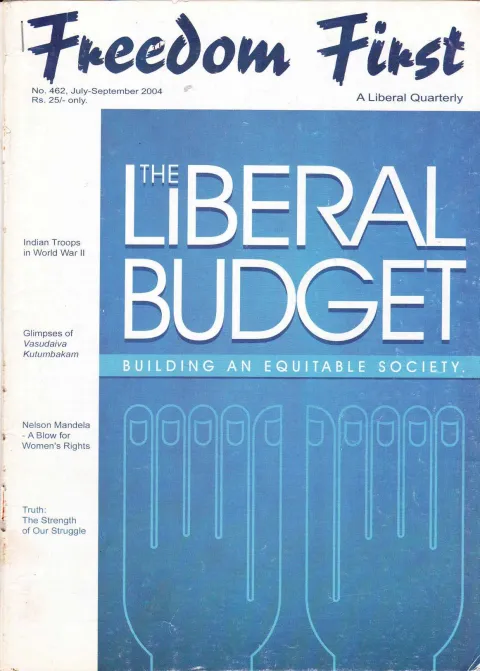
periodical issue
Freedom First
The Liberal Position
By Sharad Joshi
Indian Committee for Cultural Freedom (ICCF), 3rd Floor, Army & Navy Building, 148, Mahatma Gandhi Road, Mumbai 400 001. Published by J. R. Patel for the Indian Committee for Cultural Freedom (ICCF) and printed by him at Kaiser-E-Hind Private Ltd. · Mumbai · 2007
48 pages
Freedom First
Summary
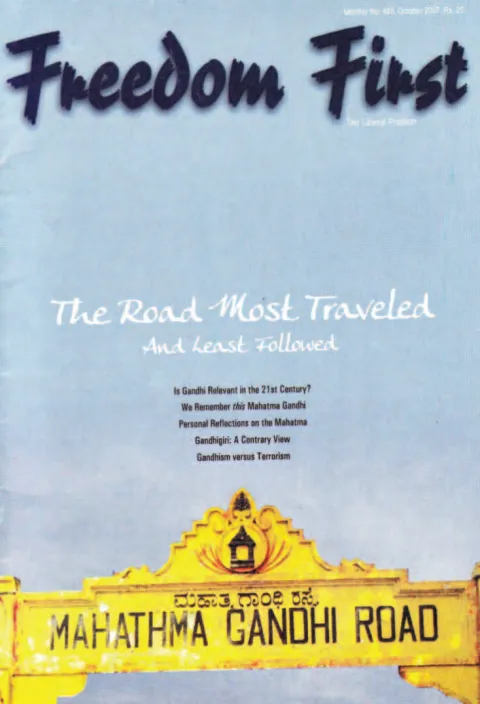
This is issue No. 485 (October 2007) of Freedom First, the liberal monthly founded by Minoo Masani and edited by S. V. Raju, published by the Indian Committee for Cultural Freedom (ICCF), Bombay, in its 54th year of publication. The issue’s cover feature, “The Road Most Traveled And Least Followed,” is built around the Gandhi birth-centenary moment and the Bollywood-driven “Gandhigiri” vogue (Lage Raho Munnabhai), assembling contributor essays that range from reverent to sharply revisionist. Aloo Dastur defends Gandhi’s continuing relevance through Truth and Non-Violence; Amitabh, writing from an Ambedkarite standpoint, indicts the “Harijan” framing and Gandhi’s record on caste as a form of shrewd political opportunism; Firoze Hirjikaka gives a personal, warts-and-all reflection contrasting Gandhi’s stature with contemporary Indian leaders; Kusum Choppra takes a contrarian, skeptical view of the commercialized “Gandhigiri” fad and Nelson Mandela’s parallel reconciliation; and V. Balachandran examines whether Gandhian non-violence has any purchase against modern terrorism, closing with a schoolboy’s naive essay on the same theme. Beyond the cover package, the rendered pages also include the magazine’s regular front-matter departments (“Many Voices” press-quote digest, “Of Cabbages and Kings” editor’s notebook, and the editor’s “Between Ourselves” column framing the issue around Frost’s and Jayaprakash Narayan’s poems on the road not taken) and the opening of Bharat Verma’s “The Danger is Real,” a security-affairs piece on threats to India’s territorial integrity from Naxalism, Kashmir militancy, and Northeast insurgencies backed by China, Pakistan, and Bangladesh.
Key points
-
Freedom First No. 485 (October 2007) devotes its cover feature, “The Road Most Traveled And Least Followed,” to the Gandhi birth-centenary moment and the Bollywood “Gandhigiri” vogue, assembling essays ranging from reverent to sharply revisionist.
-
Aloo Dastur defends Gandhi’s continuing relevance through Truth and Non-Violence, tracing his introduction of passive resistance from South Africa through the Salt Satyagraha and his standoff with Ambedkar over separate electorates.
-
Writing as “a humble follower of Babasaheb Dr. Ambedkar,” Dr. Amitabh indicts Gandhi’s record on caste, recalling his exclusion from touching Tilak’s body over caste hierarchy and his 1932 fast that forced Ambedkar to give up separate electorates for the Depressed Classes.
-
Firoze Hirjikaka gives a warts-and-all reflection calling Gandhi “certainly no saint” yet crediting him with defeating the British Empire without conventional weapons, contrasting his stature with contemporary politicians’ venality.
-
Kusum Choppra takes a skeptical view of the commercialised “Gandhigiri” fad, contrasting it with Nelson Mandela’s post-prison reconciliation with apartheid’s perpetrators.
-
V. Balachandran examines whether Gandhian non-violence has any purchase against modern terrorism, tracing Gandhi’s 1909 rejection of violence after Madanlal Dhingra’s assassination of a British official through the Irish Troubles and the 2006 Ayodhya bombing’s peaceful aftermath.
-
Bharat Verma’s “The Danger is Real” opens a security-affairs piece warning of threats to India’s territorial integrity from a Naxalite corridor linking Nepal to Andhra Pradesh and Kashmir Valley militancy.
Essays
s Buddhadeb Bhattacharjee, and Amit Varma
A digest of press quotations from Indian newspapers (Hindustan Times, Mint, The Statesman, The Indian Express, Outlook) spanning July-September 2007, on subjects including agriculture and food security, farmer pricing, the BJP’s prospects, economic growth and poverty, the Mumbai riots commission, capitalism versus socialism as articulated by West Bengal’s Buddhadeb Bhattacharjee, and Amit Varma’s call for renewed civil-liberty consciousness.
- Compiles topical quotations from named commentators and officials rather than original argument.
- S. Narayan (former Union Finance Secretary) flags India’s growing dependence on imported wheat and pulses as a food-security risk.
- Pratap Bhanu Mehta distinguishes fixable ‘broken states’ from harder-to-cure ‘sick societies’.
- West Bengal CM Buddhadeb Bhattacharjee is quoted defending market-oriented policy as pragmatic necessity (‘I just cannot build socialism in one state of India’).
- Amit Varma argues India stopped caring about freedom after 1947 and needs to fight anew for the right to say and do as one pleases.
s notebook column, covering: a defense of former Finance Secretary S. Narayan
By The editor
The editor’s notebook column, covering: a defense of former Finance Secretary S. Narayan’s warning about India’s rising food-security exposure via wheat imports; a sympathetic take on Shinzo Abe’s abrupt resignation as Japanese PM, contrasted with Indian politicians’ clinging to office; a wry item on cellphone addiction and ‘cell phone therapy’; a satirical item on the high cost of a Left Front protest caravan to Vizag; and a note on temple and Ganesh-mandal philanthropy funding education and healthcare.
- Approves S. Narayan’s argument to refocus policy on agriculture rather than stock markets or M&A.
- Praises Shinzo Abe’s quiet resignation as ‘refreshing’ next to Indian politicians who cling to power (citing Kumaraswamy in Karnataka and the UPA’s nuclear-deal maneuvering).
- Uses a Times of India report on a teenager’s self-harm over cellphone denial to illustrate compulsive gadget dependence.
- Details the budget (Rs. 4 lakh) of a CPI(M)-led ‘Left Front’ bus protest to Vizag against the US-India nuclear deal and naval exercises, noting the irony of an air-conditioned Volvo protest against ‘Yankee imperialism’.
- Cites a Hindustan Times feature showing Ganesh Mandal festival collections in Mumbai funding scholarships and study centres.
Is Gandhi Relevant in the 21st Century?
By Aloo Dastur
Aloo Dastur (formerly Head of the Department of Civics and Politics, University of Mumbai), in remarks excerpted from a May 2007 Leslie Sawhny Endowment address, argues Gandhi remains relevant because Truth and Non-Violence remain relevant. She traces Gandhi’s introduction of non-violence from the South African experience through his 1917 return to India, the Salt Satyagraha, the Round Table Conference and his confrontations with Ambedkar over separate electorates for the Scheduled Castes, and the Lancashire mill workers he met after the Conference. She concludes that Gandhi’s relevance lies less in what he said than in what he did, and that he never wavered from Truth or from his self-identification as a Hindu.
- Frames Gandhi’s relevance as contingent on whether Truth and Non-Violence remain relevant principles.
- Recounts the South African train incident and Gandhi’s turn toward passive resistance.
- Describes the 1931 Round Table Conference, Gandhi’s refusal of first-class travel, and his famous quip about the King wearing ‘enough clothes for the two of us’.
- Covers the standoff with Ambedkar over separate electorates for Scheduled Castes and Gandhi’s fast unto death.
- Notes Gandhi’s visit to Lancashire mill workers hurt by the khadi boycott, and his defense that Indian poverty forced the choice.
- Closes by quoting Einstein’s remark that future generations would scarcely believe such a man walked the earth.
We Remember this Mahatma Gandhi
By Amitabh
Dr. Amitabh, Trustee of The People’s Foundation and editor of Vision India, offers a pointedly Ambedkarite counter-memory of Gandhi under the heading ‘We Remember this Mahatma Gandhi.’ Writing as ‘a humble follower of Babasaheb Dr. Ambedkar,’ he recalls episodes largely excluded from the sanitized centenary narrative: Gandhi’s exclusion from touching Tilak’s body because of caste; Ambedkar’s 1927 Mahad Satyagraha; Gandhi’s 1932 fast that forced Ambedkar to give up separate electorates for the Depressed Classes; Gandhi’s use of a Brahmin agent to fracture the non-Brahmin movement in Maharashtra in the 1930s; and Gandhi’s own writings defending the varna system and hereditary occupation (quoting Young India and Harijan). He argues Gandhi was ‘perhaps the most shrewd and opportunist politician India has produced.’
- Opens by disclaiming discipleship of Gandhi in favor of Ambedkar.
- Recounts Gandhi being barred from touching Tilak’s body in 1920 due to caste hierarchy (Bania Vaishya vs. Konkanstha Brahmin).
- Details Ambedkar’s 1927 Mahad Chawadar tank satyagraha and its influence on Gandhi’s own 1930 Dandi Salt March.
- Describes Gandhi’s fast unto death forcing Ambedkar to relinquish separate electorates for the Scheduled Castes, won earlier at the Round Table Conference.
- Quotes Gandhi’s own writings (Young India, Harijan, 1920-1937) endorsing the chaturvarnya system and hereditary occupational duty, including ‘A scavenger has the same status as a Brahmin.’
- Closes with a long Ambedkar quotation on the fragility of political unity without social union.
Personal Reflection on The Mahatma
By Firoze Hirjikaka
Firoze Hirjikaka, a member of the Freedom First Advisory Board, gives a personal, unsentimental reflection on Gandhi timed to his October 2 birthday. He admits limited direct engagement with Gandhi’s own writings, dismisses the sanitized ‘Munnabhai’ image of Gandhi, and argues Gandhi ‘was certainly no saint’ — a shrewd, calculating operator whose self-imposed poverty was a political tool rather than pure sacrifice. He nonetheless calls Gandhi one of the towering personalities of the twentieth century for defeating the British Empire without conventional weapons, contrasts Gandhi-era leaders’ ‘presence’ and ‘stature’ with the venality of contemporary politicians, addresses the Sonia Gandhi surname coincidence, and closes pessimistically that Gandhi’s relevance to today’s India is ‘not much,’ while wistfully wishing for a ‘second coming’ of the Mahatma.
- Confesses to not having read Gandhi’s own writings, only seen Attenborough’s film — and not even Munnabhai.
- Argues the popular ‘Gandhigiri’ image is a mythologized, idealized Mahatma unlike the real, calculating political operator.
- Credits civil disobedience and the boycott of British goods, not moral appeals, with making continued British rule unprofitable.
- Contrasts the ‘stature’ of Gandhi-era leaders (including Nehru and Sardar Patel, despite their flaws) with today’s populist, self-interested politicians surrounded by security details.
- Clarifies that Sonia Gandhi has no blood relation to Mahatma Gandhi — the surname came via Indira’s marriage to Feroze Gandhi, a distant Parsi cousin of the author’s.
- Concludes Gandhi’s relevance to contemporary India is limited, while wishing for a ‘second coming’ of the Mahatma as India awaits one for Christ or Mohammed.
Gandhigiri – A Contrary View
By Kusum Choppra
Freelance writer Kusum Choppra takes a skeptical, contrarian view of the ‘Gandhigiri’ phenomenon popularized by the films Munnabhai MBBS and Lage Raho Munnabhai. She questions whether the Jadoo ki Jhappi (‘magic hug’) and rose-giving tactics can scale from feel-good anecdotes to structural change, doubting that industrial power, government, or George Bush’s war-making would ever yield to non-violent moral pressure the way ordinary citizens’ stories suggest. She contrasts this with Nelson Mandela’s ‘Gandhigiri’ — his reconciliation with apartheid’s perpetrators after prison — and closes arguing that for Gandhigiri to succeed anywhere, leaders must be shown a concrete economic benefit to taking the peaceful path, or campaigns will hit a dead end.
- Recalls her own youthful contrarian stance during an earlier Gandhi centenary as a frame for skepticism about repeat ‘Gandhi mania’.
- Describes the Jadoo ki Jhappi trend of citizens using roses/hugs on landlords, teachers and officials, doubting its effect against entrenched power.
- Cites the West Bengal SEZ violence and the Iraq war as counterexamples where ‘Gandhigiri’-style peace rallies failed to move power.
- Criticizes Nehru’s post-independence embrace of ‘Big Industry’ and Fabian socialism as a departure from Gandhian values once Gandhi was gone.
- Frames Nelson Mandela’s post-prison reconciliation with apartheid figures, aided by Winnie Mandela’s earlier violent resistance, as its own version of Gandhigiri.
- Concludes that Gandhigiri will remain an ‘optimist’s fad’ unless leaders are shown the economic benefit of choosing peace over conflict.
Gandhism versus Terrorism
By V. Balachandran
V. Balachandran, formerly Special Secretary of the Cabinet Secretariat, Government of India, examines whether Gandhian non-violence offers any answer to contemporary terrorism, drawing on Andre Malraux’s account of Nehru, Mark Juergensmeyer’s scholarship, and Rajmohan Gandhi’s writing. He notes Gandhi rejected violence as a matter of principle after Madanlal Dhingra’s 1909 assassination of an India Office official, believing that ends never justify violent means, but that Gandhi nonetheless sanctioned violence against a ‘mad dog’ or ‘brutal rapist’ and speculated he might have physically subdued a suicide bomber. Balachandran extends the analysis through the Irish Troubles, the Israeli-Palestinian conflict, and the 2006 Ayodhya bombing response, concluding that dialogue and ‘looking beyond the clash’ — not overwhelming force — vindicate Gandhi’s century-old principles.
- Opens with Andre Malraux’s Anti-Memoirs anecdote (via Nehru) about Chandrasekhar Azad crying ‘Gandhiji-Zindabad’ before becoming what the British called a terrorist.
- Cites Mark Juergensmeyer (Orfalea Center, UC) on Gandhi’s 1909 exposure to Madanlal Dhingra’s assassination of Curzon Wyllie and his consequent rejection of violence as self-perpetuating.
- Notes Gandhi’s carve-outs for violence against a ‘mad dog’ or rapist, and his speculative willingness to physically subdue a suicide bomber.
- Traces the Irish conflict from Cromwell’s 1649-50 repression through the 1998 Good Friday Agreement as an example of dialogue succeeding over force.
- Cites the 2006 Ayodhya bombing aftermath, where Hindu and Muslim religious leaders in Varanasi jointly worked for peace, as a modern Gandhian success.
- Closes citing the 2005 volume After Terror (ed. Akbar Ahmed) and its thesis that tolerance and dialogue, not overwhelming force, defeat terrorism.
- Essay is followed by a schoolboy’s ‘Gandhiji and Terrorism’ speech treating terrorists as misguided children needing patient correction rather than punishment.
The Danger is Real
By Bharat Verma
Bharat Verma, Editor of Indian Defence Review, opens (courtesy reprint) ‘The Danger is Real,’ arguing that India’s policymakers avoid acknowledging serious threats to territorial integrity because security has become hostage to vote-bank politics. Within the rendered pages he lays out ‘Danger-I’ (a Naxalite-controlled corridor from Nepal to Andhra Pradesh, allegedly linked to crime mafias, opium cultivation, and cross-border coordination with Nepali Maoists) and begins ‘Danger-II’ (the Kashmir Valley, held physically by the Indian Army since Independence, with LeT-linked infiltration and a Pakistani psywar campaign to demonize the Army and push demilitarization).
- Argues India’s 8%+ growth and democratic stability are no guarantee against territorial fragmentation if internal security is neglected.
- Identifies three named ‘dangers’ to India’s territorial integrity, of which the essay begins covering the first two within the rendered pages.
- Danger-I: a Naxalite corridor from Nepal through Chhattisgarh to Andhra Pradesh, linked to crime mafias, opium financing, and cross-border Nepali Maoist coordination.
- Danger-II: Kashmir, framed as facing a ‘ghost force’ campaign of psywar against the Indian Army, LeT-aligned rallies, and pressure for demilitarization and repeal of the Armed Forces Special Powers Act.
- Essay’s page range extends past the rendered chunk (ends mid-Danger-III, Northeast); full argument not captured here.
Generated by the v1.5 extraction pipeline. Awaiting editorial review.
Point Counter Point
By Ashok Karnik
No summary was extracted for this article. Listed for completeness.
The Left’s Opposition to the CND
By P. M. Kamath
No summary was extracted for this article. Listed for completeness.
Metadata and summary are AI-extracted from the source PDF and reviewed for editorial accuracy. The original work is available via the Read PDF tab above (where present); paragraph-level citation inside the PDF is deferred to a future engagement.