periodical issue
Freedom First
The Liberal Position
By N. Vittal
Published by J. R. Patel for the Indian Committee for Cultural Freedom (ICCF), 3rd Floor, Army & Navy Building, 148, Mahatma Gandhi Road, Mumbai 400 001; printed by him at Kaiser-E-Hind Private Ltd., Plot No.A-191, Road No.16A, MIDC, Wagle Industrial Estate, Thane (W) · Mumbai · 2007
16 pages
Freedom First
Summary
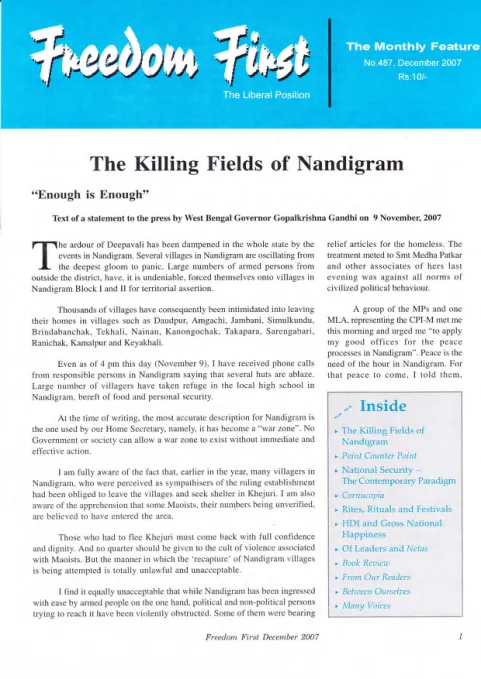
This December 2007 issue of Freedom First (No. 487) is dominated by the Nandigram violence in West Bengal, opening with West Bengal Governor Gopalkrishna Gandhi’s 9 November 2007 press statement condemning the armed ‘recapture’ of Nandigram villages, followed by an exchange of open letters between Justice V. R. Krishna Iyer and the Governor, a report on CPI(M) leaders’ furious reaction to the Calcutta High Court’s ruling against the March 14 police firing, and T. H. Chowdary’s essay likening Nandigram to the Kronstadt rebellion and Tiananmen Square as instances of communist regimes turning on their own supporters. Beyond Nandigram, the issue carries Ashok Karnik’s recurring ‘Point Counter Point’ debate feature (on Musharraf’s emergency, the Nandigram violence, and Karnataka’s political defections), V. Balachandran’s opening instalment on a four-part series on national security in the era of globalization, Firoze Hirjikaka’s ‘Cornucopia’ column on Indian diplomatic timidity and religious commercialism, Suman Oak’s new series on Hindu rites and festivals (beginning with Makarsankranti), Sadanand Kumta’s explainer on the Human Development Index and Gross National Happiness, Kusum Choppra’s commentary on political leadership and a political cartoon strip, N. Vittal’s review of Feroza Seervai’s anti-corruption memoir ‘Winning Without Corruption’, reader letters, and the regular ‘Between Ourselves’ editorial note and ‘Many Voices’ quotations column.
Key points
-
Freedom First No. 487 (December 2007) is dominated by the Nandigram violence, opening with West Bengal Governor Gopalkrishna Gandhi’s November 2007 statement condemning the armed “recapture” of Nandigram villages as a “war zone.”
-
An exchange of open letters between Justice V. R. Krishna Iyer and the Governor, and a report on CPI(M) leaders’ furious reaction after the Calcutta High Court ruled the March 14 police firing that killed 14 residents unconstitutional.
-
T. H. Chowdary likens Nandigram to the 1921 Kronstadt uprising and the 1989 Tiananmen Square crackdown as instances of communist regimes turning violently on their own supporters.
-
V. Balachandran opens a planned four-part series on national security, arguing globalisation has eroded state control and citing the 2001 Group of Ministers report’s broadened definition encompassing non-traditional threats like epidemics and migration.
-
Firoze Hirjikaka’s “Cornucopia” argues India habitually capitulates to diplomatic pressure, citing its failure to extradite Ajmer blast suspects from Bangladesh and its pressuring of Taslima Nasreen to withdraw passages from her autobiography.
-
Suman Oak launches a new series on Hindu rites and festivals, opening with Makarsankranti and calling for discarding rituals harmful to human dignity while retaining those that foster goodwill.
-
N. Vittal reviews Feroza H. Seervai’s memoir “Winning Without Corruption,” highlighting her practical advice for citizens resisting corrupt officialdom through persistence and the right to information.
Essays
s cover feature reproduces West Bengal Governor Gopalkrishna Gandhi
By The issue
The issue’s cover feature reproduces West Bengal Governor Gopalkrishna Gandhi’s 9 November 2007 press statement on the Nandigram violence, in which he describes villages being forcibly repopulated by armed outsiders, thousands displaced and sheltering in schools, and calls the situation a ‘war zone’ demanding immediate government action, while also criticizing the unlawful manner of the CPI(M)‘s ‘recapture’ of the area. This is followed by an exchange of open letters: former Supreme Court Justice V. R. Krishna Iyer’s published letter urging the Governor to ensure security, liberty and property rights for Nandigram’s people and to establish a high-level commission, and Gandhi’s careful reply describing his continuing distress over the violence. A subsequent section, ‘Why the Commies Bared their Fangs,’ reports CPI(M) leaders’ (Biman Bose, Shyamal Chakraborty, Benoy Konar) furious public reaction after the Calcutta High Court ruled the March 14 police firing (which killed 14 Nandigram residents) unconstitutional, accusing the judiciary, Governor and intellectuals of bias. The section closes with a Bertrand Russell epigraph on communism.
- Governor Gopalkrishna Gandhi’s 9 November 2007 statement describes Nandigram as a ‘war zone’ with villages burned and thousands displaced
- Gandhi asked Chief Minister Buddhadeb Bhattacharjee for immediate return of ‘ingressers,’ relief for displaced persons, and facilitation of villagers’ return home
- Gandhi calls the manner of the CPI(M)‘s ‘recapture’ of Nandigram ‘totally unlawful and unacceptable’
- Justice V. R. Krishna Iyer’s open letter to the Governor argued for a high-level commission and invoked the ‘tryst with destiny’ language addressed to the ‘innovative Marxian Chief Minister’
- The Calcutta High Court ruled the 14 March police firing that killed 14 Nandigram residents unconstitutional and ordered a CBI probe
- CPI(M) leaders Biman Bose, Shyamal Chakraborty and Benoy Konar publicly attacked the judiciary, the Governor, intellectuals and the media over the ruling and over sympathy shown to displaced CPI(M) supporters
The Killing Fields of Nandigram (incl. “Enough is Enough” statement, “An Exchange of Open Letters”, “Why the Commies Bared their Fangs!”, “Nandigram - India’s Kronstadt”)
By West Bengal Governor Gopalkrishna Gandhi / T. H. Chowdary
T. H. Chowdary’s essay draws an extended analogy between the 1921 Kronstadt sailors’ uprising against Bolshevik rule, the 1989 Tiananmen Square crackdown, and the Nandigram violence, arguing that in each case a communist regime brutally suppressed people (former revolutionary supporters, students, or peasant supporters) who turned against its authoritarian excesses. He argues Nandigram farmers, though long CPI(M) voters, resisted land acquisition for industrialization and were met with terror, killings and alleged rapes by CPI(M) cadres backed by the state government, and predicts CPI(M) leaders including Prakash Karat, Brinda Karat, Biman Bose and Buddhadeb Bhattacharjee will dismiss criticism as they believe their ‘dialectical’ arguments will silence dissent.
- Kronstadt (1921) was a naval uprising against Bolshevik dictatorship that was brutally crushed by Lenin’s Red Army, later organized under Leon Trotsky
- The essay compares Nandigram to Kronstadt and to the 1989 Tiananmen Square crackdown on student protesters
- Nandigram farmers, many historically CPI(M) voters, resisted land acquisition for industrialization and faced terror and killings from CPI(M) cadres with alleged state government connivance
- The author predicts CPI(M) leaders will not be moved by international or domestic intellectual condemnation
- The essay quotes the historical demands of the Kronstadt sailors, including free elections to the Soviets and freedom of speech and press
Point Counter Point: The General’s Experiments With Truth / Nandigram Nightmare / The New Lows of Karnataka
By Ashok Karnik
Ashok Karnik’s recurring ‘Point Counter Point’ feature presents paired, opposing viewpoints on three topical issues: General Pervez Musharraf’s imposition of emergency rule and its implications for Pakistan and the world; the Nandigram violence and the CPI(M)‘s use of force against its opponents; and the political defections and realignments in Karnataka involving the BJP, Congress and JD(S) following Deve Gowda’s shifting alliances.
- On Musharraf: one view calls him a habitual dissembler who imposed emergency rule to protect his own position; the counter-view argues he may be a ‘known devil’ preferable to unstable alternatives given Pakistan’s fragile political landscape
- On Nandigram: one side blames CPI(M) cadre violence and government connivance for the November 2007 killings; the counter-view stresses that the state ceding its monopoly on legitimate force to party cadres is a serious constitutional impropriety
- On Karnataka: the feature criticizes Deve Gowda’s repeated switching of alliances between Congress, the BJP and back, calling it ‘a political farce’, while the counter-view notes BJP’s own complicity in trusting an unreliable ally twice
- The column includes an epigraph from The Week describing ‘the issue of land’ at Nandigram as ‘yielding a bitter crop’
National Security - The Contemporary Paradigm
By V. Balachandran
V. Balachandran’s essay, the first of a planned four-part series adapted from a paper he delivered on 12 October 2007 to the Indian Institute of Public Administration, argues that national security can no longer be understood as simply a matter of military strength or internal policing, citing the 9/11 attacks on the heavily-armed USA and repeated Chechen attacks on Russia despite large militaries. He describes how globalization has eroded state control, drawing corporations, NGOs and even criminal and terrorist networks into a ‘transnational society,’ and surveys the 2001 Group of Ministers report’s definition of national security as encompassing territorial integrity, political and economic sovereignty, and social cohesion, alongside newer ‘non-traditional security’ concerns like epidemics, migration and environmental security.
- The US, Russia and India all suffered major security failures (9/11, Chechen attacks, the 2001 Parliament attack) despite having large, well-equipped armed forces
- Globalization has eroded state control over security, per Stanley Hoffman’s concept of ‘erosion’ via a ‘transnational society’ including MNCs, NGOs, criminals and terrorists
- The US Department of Homeland Security was created to draw in over 100 non-traditional sectors, including the corporate sector, into national security planning, a step India has not taken
- The February 2001 Group of Ministers report (post-Kargil) defined national security as encompassing territorial integrity, political/economic subversion, national leadership, vital installations, and societal character
- Non-traditional security issues (NTS) — migration, epidemics like SARS, human trafficking, environmental security — are increasingly prioritized, prompting some to argue for redefining state sovereignty itself
- This is the first of four planned instalments, with the next covering ‘Challenges to National Security’
Cornucopia: India - A Craven Superpower / The Small God of All Things
By Firoze Hirjikaka
Firoze Hirjikaka’s ‘Cornucopia’ column features two pieces. ‘India — A Craven Superpower’ argues that despite India’s economic and military heft, its government habitually capitulates to pressure — citing its failure to secure extradition of Ajmer blast suspects from Bangladesh, its silence after Malaysia publicly rebuked an Indian chief minister, and the government’s pressuring of writer Taslima Nasreen to withdraw passages from her autobiography — and contrasts this with Britain’s principled defense of Salman Rushdie. ‘The Small God of All Things’ criticizes the commercialization of Hindu religious practice, from online darshan of temple deities to bhajan CDs marketed as bringing prosperity, arguing that this trivializes faith into a purchasable commodity.
- India failed to secure extradition of the suspected Ajmer blasts mastermind from Bangladesh despite its regional clout
- A Malaysian minister publicly criticized a senior Indian chief minister over treatment of ethnic Indians, without consequence
- Taslima Nasreen was reportedly pressured by the Indian government to withdraw passages from her autobiography to placate Muslim fundamentalists
- The column contrasts this with Britain’s 1989 decision to protect Salman Rushdie despite the fatwa against him
- The second piece criticizes commercial exploitation of Hindu religious sentiment, including online darshan services and prosperity-themed bhajan CDs, and questions the mixing of religion with ‘rank commercialism’
Rites, Rituals and Festivals: Makarsankranti
By Suman Oak
Suman Oak introduces a planned new monthly series examining Hindu rites, rituals and festivals critically, prompted by news events like the melting of the Amarnath Shivalinga and the proposed demolition of Ram Setu. The introductory essay traces how ancient Indian religious philosophy (the intellectual stream of the sages) diverged from the socially-enforced ritual conduct imposed via the Varnashrama system and the Brahmanas, arguing this produced uncritical mass acceptance of ritual and resistance to reform, especially rules that confine women. The first instalment covers Makarsankranti, describing its solar (not lunar) basis, its mythological elaborations (the goddess Sankranti and demon Sankarasur), regional customs across Maharashtra, Bengal, the Himalayas and south India (Pongal), and questions the utility of some customs like distributing sesame paste in sacred rivers, while praising others like Tilgul distribution for promoting goodwill.
- The series is prompted by contemporary controversies: the melting of the Amarnath Shivalinga and the proposed demolition of Ram Setu
- The essay distinguishes the intellectually enlightening stream of Indian religious philosophy (the sages’ Aranyakas) from the socially enforced ritual conduct codified in the Brahmanas and Smritis
- The author calls for discarding rituals harmful to human dignity, especially those confining women, while retaining practices beneficial to emotional development
- Makarsankranti is a solar festival marking the sun’s entry into Capricorn, unusual among Hindu festivals for following the solar rather than lunar calendar
- The festival is elaborated in Hindu almanacs through the shifting mythological figure of goddess Sankranti, whose attributes each year are used to predict the coming year’s fortunes
- Regional customs vary: Maharashtra’s Tilgul and Haladi-Kumkum ceremonies, Konkan’s rice-sharing custom, Himalayan bird-shaped fried flour offerings, Bengal’s Tluva/Pishtak sweets, and south India’s three-day Pongal festival
- The author criticizes some customs (sesame-paste bathing in sacred rivers) as wasteful while praising others (Tilgul exchange, Haladi-Kumkum) for fostering goodwill, and notes widows are excluded from these ceremonies
Human Development Index and Gross National Happiness
By Sadanand B. Kumta
Sadanand B. Kumta’s short explainer introduces readers to the Human Development Index (HDI) and Gross National Happiness (GNH), noting both terms originated in Asia — HDI developed by Pakistani economist Mahbub ul Haq and adopted by the UNDP, and GNH coined by Bhutan’s King Jigme Wangchuck in 1972. The piece gives India’s 2006 HDI ranking (126th of 177, medium category) alongside comparators (Norway, Australia, Canada, Sweden at the top; Sri Lanka, China, Iran, South Africa above India; Pakistan below at 134th), and cites happiness rankings where Vanuatu tops the list and India ranks 61st, concluding that the Happy Planet Index shows no correlation with HDI.
- HDI was developed by Pakistani economist Mahbub ul Haq and is published annually by the UNDP, measuring health, education/literacy, and standard of living
- India ranked 126th of 177 countries in the HDI report released 9 November 2006, in the ‘medium’ category with a score of 0.611
- Norway, Australia, Canada and Sweden have the highest HDI scores (above 0.95); Sri Lanka, China, Iran and South Africa rank above India; Pakistan ranks below India at 134th
- Gross National Happiness was coined by Bhutan’s King Jigme Wangchuck in 1972
- In a happiness ranking, Vanuatu tops the list at No.1 and India ranks 61st, with Bhutan at 13 and Sri Lanka at 15
- The author concludes the Happy Planet Index shows no correlation with the Human Development Index
Of Leaders and Netas
By Kusum Choppra
Kusum Choppra’s column laments that India’s ‘Lead India’ campaign seeks only a single national leader rather than nurturing many young leaders across the country’s diverse regions, invoking the Maoist-era slogan ‘let a hundred roses bloom.’ In its second half, she criticizes the political maneuvering around L. K. Advani’s prime ministerial ambitions, including Atal Bihari Vajpayee’s belated and dubiously-sourced endorsement of Narendra Modi, and questions whether Advani’s ambitions are driven by genuine desire for the office or anxiety over the Hindutva forces he himself once unleashed. The column is accompanied by a political cartoon strip satirizing selective Chinese claims of political liberalization.
- The author argues India should nurture multiple young regional leaders rather than seeking one national leader through campaigns like ‘Lead India’
- She recalls Vajpayee’s regret over the 2002 Godhra violence (‘What face will I take abroad?’) followed by his later refusal to acknowledge wrongdoing in Gujarat
- The column questions the authenticity and timing of Vajpayee’s reported election-eve endorsement of Narendra Modi
- The piece speculates that Advani’s renewed prime ministerial bid may stem from anxiety about the Hindutva forces he originally mobilized
- An accompanying cartoon strip (credited to Asian Age, 27 October 2007) satirizes Chinese Communist Party claims of political liberalization and transparency
Book Review: Winning Without Corruption by Feroza H. Seervai
By N. Vittal
N. Vittal, formerly Chief Vigilance Commissioner of the Government of India, reviews Feroza H. Seervai’s 84-page booklet ‘Winning Without Corruption,’ describing it as a distilled, anecdote-rich account of her decades as a voluntary social worker who succeeded in resisting corruption without capitulating to it. The review highlights her practical advice for citizens dealing with corrupt officialdom (persistence, transparency, exercising the right to information, escalating to the top official) and recounts several anecdotes involving her late husband H. M. Seervai and Maharashtra’s former Chief Minister Morarji Desai, concluding that the book offers a timely, optimistic counter to prevailing cynicism about corruption in India.
- Feroza H. Seervai’s book, published in 2006 by Public Concern for Governance Trust, distills 60 years of her experience as a voluntary social worker resisting corruption
- Her practical advice includes persistence, thorough homework, seeking transparency and exercising the right to information, and escalating to the senior-most responsible official
- The review recounts anecdotes involving her late husband H. M. Seervai (former Advocate General of Maharashtra) and former Chief Minister Morarji Desai
- Vittal frames the Zoroastrian community’s historical spirit of adding value to their adopted society as an apt parallel to Seervai’s own persistent, principled civic engagement
- The reviewer highlights her successful defence of Princess Victoria Mary Gymkhana’s land against extortionate demands as an example of her method’s effectiveness
From Our Readers: The Nuke Deal / Dream Sellers
By K. Vedamurthy / Eknaath Nagarkar
The ‘From Our Readers’ section carries two letters: K. Vedamurthy of Chennai reproduces his unpublished letter to The Hindu praising national security chief M. K. Narayanan for his measured handling of the India-US nuclear deal and comparing him to earlier seasoned Indian diplomats. Eknaath Nagarkar of Bangalore recounts, with wry humor, his experience receiving and testing an elaborate email lottery scam falsely claiming Microsoft Corporation sponsorship and featuring a photograph of Bill Gates, concluding that some ‘sadist’ is ‘engaged full-time in selling dreams.’
- K. Vedamurthy’s letter praises M. K. Narayanan’s handling of the India-US nuclear deal and the seriousness of senior US officials involved
- Vedamurthy compares Narayanan to earlier seasoned Indian diplomats including K.P.S. Menon, B.K. Nehru, and Governor Gopalkrishna Gandhi
- Eknaath Nagarkar recounts a phishing/lottery scam email falsely invoking Microsoft Corporation and Bill Gates, promising him Stg. Pounds 800,000
- Nagarkar’s playful reply to the scammers drew a follow-up inviting him to London with fabricated official documentation requirements
Between Ourselves …
By Editor
The editor’s ‘Between Ourselves’ note explains the issue’s focus on Nandigram and praises Governor Gopalkrishna Gandhi’s constitutional restraint, introduces the new ‘Rites, Rituals and Festivals’ series, previews upcoming April 2008 and January 2008 issue themes (parliamentary democracy’s future, and a review of economic reforms across four Liberal budgets), and appeals to subscribers for renewals. The accompanying ‘Many Voices’ column collects short topical quotations from various public figures and publications, including S. Prasannarajan on Deve Gowda, Antara Dev Sen on Nandigram, Hasan Suroor on British hypocrisy over corruption, Aidan Hartley on selective Olympics boycotts, Mikhail Gorbachev on Russian democracy, Sonia Gandhi on political engagement, Soli Sorabjee on global inequality, and Narendra Modi on illiteracy responsibility in Gujarat.
- The editor praises Governor Gopalkrishna Gandhi’s constitutionally restrained handling of the Nandigram crisis
- The April 2008 issue is previewed as covering the future of parliamentary democracy and party politics in India
- The January 2008 issue’s cover story is previewed as a review of India’s economic reforms across four Liberal budgets
- The ‘Many Voices’ column includes quotations from S. Prasannarajan, Antara Dev Sen, Hasan Suroor, Aidan Hartley, Mikhail Gorbachev, Sonia Gandhi, Soli Sorabjee and Narendra Modi on topics ranging from Nandigram to global corruption and illiteracy
- Masthead information confirms Minoo Masani as founder, S. V. Raju as editor, and R. Srinivasan as associate editor, published by the Indian Committee for Cultural Freedom (ICCF)
Generated by the v1.5 extraction pipeline. Awaiting editorial review.
Many Voices
No summary was extracted for this article. Listed for completeness.
Metadata and summary are AI-extracted from the source PDF and reviewed for editorial accuracy. The original work is available via the Read PDF tab above (where present); paragraph-level citation inside the PDF is deferred to a future engagement.