periodical issue
Freedom First
The Liberal Monthly
By Ajit Karnik
Published by J. R. Patel for the Indian Committee for Cultural Freedom (ICCF) and printed by him at Kaiser-E-Hind Private Ltd., Plot No.A-191, Road No.16A, MIDC, Wagle Industrial Estate, Thane (W) - 400 604. Publishers: Indian Committee for Cultural Freedom (ICCF), 3rd Floor, Army & Navy Building, 148, Mahatma Gandhi Road, Mumbai 400 001. · Bombay · 2008
20 pages
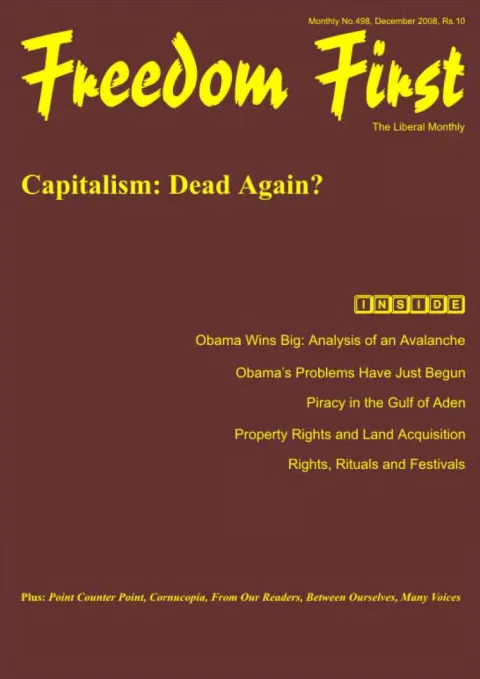
Freedom First
Summary
This December 2008 issue of Freedom First (No. 498) is dominated by two world events from the preceding weeks: the global financial crisis and Barack Obama’s election as U.S. President. Ajit Karnik opens with a defence of the liberal ‘State and markets’ position against both market fundamentalism and the Left’s opportunistic revival of anti-capitalist rhetoric in the wake of the 2008 meltdown. Two pieces then dissect the Obama victory from different angles: B. Ramesh Babu reads it as a historic, values-affirming landslide, while Nitin Raut warns that Obama’s foreign-policy room for manoeuvre, especially toward India, Pakistan and China, is more constrained than the euphoria suggests. Ashok Karnik’s recurring ‘Point Counter Point’ feature stages both sides of debates on ‘Hindu terrorism’ after the Malegaon blasts and on regional/linguistic vigilantism (the MNS agitation in Mumbai), plus shorter takes on the Obama result. I. C. Rao, a retired Vice Admiral, reports on Somali piracy in the Gulf of Aden and the Indian Navy’s operations there, including the rescue of the Jag Arnav and the prolonged hijacking of the Stolt Valor. Sanjeev Sabhlok continues his ‘Come On, Liberals’ column with a case against India’s post-1971/1978 erosion of constitutional property rights and a framework for compensating land acquisition. Suman Oak continues her ‘Rites, Rituals and Festivals’ series with an instalment on Tulsi Vivah, arguing the ritual mythology functions to keep women docile. Firoze Hirjikaka’s ‘Cornucopia’ column covers the Jet Airways sacking-and-reinstatement episode as a free-market parable and closes with a wry meditation on the meaning of the ‘American Dream’. The issue also carries reader letters (‘From Our Readers’), an editorial note (‘Between Ourselves’) previewing the magazine’s upcoming 500th issue (February 2009) and its own founding history (est. 1952 by Minoo Masani), a ‘Many Voices’ page of quoted commentary, and short fillers (a reprinted Mint editorial on steel-price policy, a cartoon, an anecdote from L. K. Advani’s autobiography, and a cricket tribute to Anil Kumble).
Key points
-
Ajit Karnik defends the liberal ‘State and markets’ position against both market fundamentalism and the Left’s opportunistic revival of anti-capitalist rhetoric after the 2008 financial crisis, invoking Hayek’s ‘Fatal Conceit’ against the assumption that government is omniscient.
-
B. Ramesh Babu reads Barack Obama’s election as a historic, values-affirming landslide reflecting demographic change and a repudiation of the Bush era, while Nitin Raut counters that Obama’s foreign-policy room for manoeuvre toward India, Pakistan and China is more constrained than the euphoria suggests.
-
Ashok Karnik’s “Point Counter Point” debates ‘Hindu terrorism’ after the Malegaon blasts arrests, the Maharashtra Navnirman Sena’s attacks on non-Maharashtrians, and whether Obama’s win holds lessons for Indian politics.
-
Vice Admiral (retd.) I. C. Rao reports on the surge of Somali piracy in the Gulf of Aden, describing the Indian Navy’s rescue of the Jag Arnav and the prolonged hijacking of the Stolt Valor, and calls for an international naval task force under the IMO.
-
Sanjeev Sabhlok argues Indian property rights have been progressively eroded since independence through Nehru’s land ceiling laws and the 1971 and 1978 constitutional amendments, and proposes a framework for legitimate compulsory land acquisition based on local referenda and expert compensation panels.
-
Suman Oak’s “Rites, Rituals and Festivals” instalment on Tulsi Vivah recounts competing Puranic origin myths and criticises the ritual as ideologically designed to confine women to domestic servitude.
-
Firoze Hirjikaka’s “Cornucopia” uses the Jet Airways mass-sacking-and-reinstatement episode to argue Indians want free-market rewards without accepting free-market risk, and praises Ratan Tata’s withdrawal from the Singur Nano project as pushback against political interference.
-
Reader letters address Naxalism and religious conversion, the razing of a Sardar Patel statue in Uttar Pradesh, and the 123 Agreement/Hyde Act debate, while the editor’s note previews the magazine’s landmark 500th issue.
Essays
Capitalism: Dead Again?
By Ajit Karnik
Ajit Karnik argues that reports of capitalism’s 2008 ‘death’ echo 1929 and are overstated: the system will again reinvent itself, this time perhaps chastened by better financial regulation. He criticises the Left (naming Jayati Ghosh and Prabhat Patnaik) for opportunistically claiming vindication while ignoring the historical failures of socialism, and lays out the ‘Liberal position’ as one of ‘State and markets’ rather than a false ‘State versus markets’ binary, invoking Hayek’s ‘Fatal Conceit’ against the assumption that government is omniscient and omnipotent. He surveys the regulation/deregulation debate (Glass-Steagall repeal, the Gramm-Leach-Bliley Act) and concludes that the right regulatory touch must be decided on grounds of efficacy, not ideology.
- Frames the piece as an explicitly Liberal rebuttal to Left claims that the 2008 crisis proves capitalism’s collapse.
- Recaps the 1929 precedent and Keynesian/New Deal revival of capitalism as a template for the current crisis.
- Surveys competing economist views (Rodrik, Krugman, Stiglitz, Sachs, Eichengreen, Block, Strahan, Tabarrok) on deregulation’s role in the crisis.
- States the Liberal position as belief in ‘State and markets’, rejecting both market fundamentalism and the Left’s push for expanded state control.
- Invokes Hayek’s ‘Fatal Conceit’ and the assumptions of government omniscience/omnipotence as the core critique of interventionist ideology.
- Concludes regulation should be decided by efficacy and administrative capability, not dogma, in a ‘second best world’ of imperfect alternatives.
Obama Wins Big: Analysis of an Avalanche
By B. Ramesh Babu
B. Ramesh Babu (formerly Sir Pherozeshah Mehta Professor of Civics & Politics, University of Bombay) reads Barack Obama’s November 2008 election as a historic culmination of long-gathering demographic and political change in the United States. He details the scale of Obama’s win (popular vote margin, electoral college count, demographic breakdown of support) and frames it as both a repudiation of the Bush-era economic and foreign policy record and a vindication of American democratic maturity, given McCain’s gracious concession. He closes hoping Obama will govern with ‘moderation and stark realism’.
- Frames Obama’s victory as a culmination of both gradual social change and the sudden shock of the financial crisis.
- Cites detailed vote totals and demographic breakdowns (68% first-time voters, 96% African-Americans, 55% women).
- Argues Obama’s win signals the eclipse of ‘Middle America’ rightwing populism epitomised by Sarah Palin.
- Frames the financial meltdown as effectively delegitimising the free-market, small-government rhetoric of the Republican right.
- Closes on a hope that Obama will bring ‘moderation and stark realism’ to governance.
Obama’s Problems Have Just Begun
By Nitin Raut
Nitin Raut, a lawyer and Freedom First advisory board member, pushes back against the ‘overzealous’ romanticism around Obama’s win, arguing his real foreign-policy challenges are only beginning. He contends that, contrary to popular belief, Indo-U.S. relations have historically been more stable under Republican administrations than Democratic ones, reviewing the record from Reagan through Bush’s nuclear deal. He flags concerns about Obama’s past positions on Kashmir, outsourcing, and the India-U.S. nuclear deal, and urges India not to let its own domestic vote-bank politics obscure long-term strategic interests.
- Cautions against ‘overzealous’ and ‘romanticized’ readings of Obama’s victory as an unambiguous good for India.
- Argues Indo-U.S. relations have been historically more stable and mature under Republican administrations, citing Reagan, Bush Sr., and Bush Jr.
- Notes Obama’s prior comments on Kashmir and outsourcing, and his initial opposition to the India-U.S. Nuclear Deal, as causes for concern.
- Frames Obama’s constraints (Iraq, Afghanistan, Iran, NATO) as limiting his freedom to reshape foreign policy quickly.
- Praises the McCain-Obama post-election civility as a model India’s politicians should emulate.
Point Counter Point
By Ashok Karnik
Ashok Karnik’s recurring ‘Point Counter Point’ feature presents paired opposing viewpoints on topical issues without adjudicating between them. This instalment covers ‘Hindu Terrorism’ (reactions to the Malegaon blasts arrests), ‘Regional Terrorism’ (the Maharashtra Navnirman Sena’s attacks on non-Maharashtrians), and briefer paired takes on the ‘Triumph of Values’ represented by Obama’s election, framed as a debate on whether it holds any lesson for India.
- Presents two opposing viewpoints each on ‘Hindu Terrorism’ and ‘Regional Terrorism’ without editorial resolution.
- The Hindu Terrorism debate centres on the Malegaon blasts arrests and whether the Sangh Parivar has been consistent in condemning all terrorism regardless of religion.
- The Regional Terrorism debate addresses MNS attacks on non-Maharashtrians and railway job/exam agitation.
- A shorter ‘Triumph of Values’ section debates whether Obama’s win holds lessons for India’s own politics of caste, religion and language.
- Includes a boxed Shobha De quote on the Mumbai-Bombay divide.
Piracy in the Gulf of Aden
By I. C. Rao
Vice Admiral (retd.) I. C. Rao reports on the surge of piracy in the Gulf of Aden in 2008, describing the Indian Navy’s successful rescue of the bulk carrier Jag Arnav on 11 November and the prolonged, still-unresolved hijacking of the Stolt Valor (with 18 Indian crew) since 15 September. He details pirates’ tactics, the scale of ransom payments (about US$20 million paid to Somali pirates in 2008), and argues for an international naval task force under the IMO, based at Djibouti, as the long-term solution, citing the successful precedent of eliminating piracy in the Malacca Straits in the 1990s.
- Describes the Indian Navy’s rescue of the Jag Arnav on 11 November 2008 via INS Tabar’s helicopter-borne commandos.
- Details the ongoing Stolt Valor hijacking (since 15 September 2008) and its complex multinational ownership/crewing arrangements.
- Cites approximately US$20 million paid in ransoms to Somali pirates during 2008 and roughly 65 ships hijacked in the first 10 months of the year.
- Describes pirate tactics: twin-boat operations at night, hostage-taking, and steering captured vessels into Somali territorial waters.
- Calls for an international naval task force under the IMO based at Djibouti, citing the 1990s elimination of Malacca Strait piracy as the model to emulate.
Property Rights and Land Acquisition (Come On, Liberals: Let’s Change India!)
By Sanjeev Sabhlok
A short filler piece attributed to a Freedom First subscriber (Dan Driscoll, Goa) reproduces ‘The Fable of the Centipede’, an anecdote quoted from L. K. Advani’s autobiography ‘My Country, My Life’ (Rupa, 2008), in which the late ICS officer Aditya Nath Jha uses the fable to illustrate the proper division of labour between ministers (policy) and bureaucrats (execution).
- Reproduces an anecdote from L. K. Advani’s autobiography ‘My Country, My Life’ (Rupa, 2008), p. 131.
- The fable of a centipede seeking a cure from a ‘Wise Owl’ is used to illustrate minister-bureaucrat relations.
- The moral: a minister’s function is to lay down policy; execution is the bureaucrat’s job.
- Attributed to Aditya Nath Jha, described as the last surviving ICS officer, who told the story to Advani in 1967.
Rites, Rituals and Festivals (7): Tulsi Vivah
By Suman Oak
In his ‘Come On, Liberals: Let’s Change India!’ column, Sanjeev Sabhlok continues a discussion begun the previous month, responding to a reader’s skepticism about a proposed local-governance reform model. He then argues that Indian property rights have been progressively eroded since independence, through Nehru’s land ceiling legislation, Indira Gandhi’s 25th Amendment (1971) removing the compensation requirement, and the Janata Party’s 44th Amendment (1978) abolishing the constitutional right to property altogether. He proposes a framework for legitimate compulsory land acquisition (public-interest validation via local referenda, expert compensation panels, value-sharing formulas) while rejecting acquisition for purely private purposes, citing the Tata Nano/Singur controversy, and closes with a plug for the ‘Freedom Team of India’ political initiative.
- Responds to a reader’s doubts about a local-governance reform model proposed in the November 2008 issue.
- Traces the erosion of Indian property rights: Nehru’s land ceiling laws, Indira Gandhi’s 25th Amendment (1971), and the Janata Party’s 44th Amendment (1978) which repealed Article 19(1)(f).
- Argues property is now merely a legal right ‘revocable by simple majority in Parliament’ rather than a constitutional guarantee.
- Proposes a framework for legitimate compulsory acquisition: public-interest validation through local referenda, expert compensation panels headed by a retired High Court judge, and value-sharing formulas.
- Rejects state coercion for purely private acquisition, citing the Tata Nano project’s retreat from Singur as an example of where state power should not be used.
- Closes by inviting readers to join the ‘Freedom Team of India’ (freedomteam.in).
India Needs Men Like Anil Kumble Not only in Cricket But Everywhere
A short filler tribute, ‘India Needs Men Like Anil Kumble Not only in Cricket But Everywhere’, reproduces two extracts from cricket commentator Harsha Bhogle’s tribute to Anil Kumble on his retirement, praising Kumble’s dignity, integrity, and competitive character.
- Reproduces two extracts from Harsha Bhogle’s tribute to Anil Kumble on his retirement, originally published in The Indian Express, November 3, 2008.
- Praises Kumble’s dignity, integrity, and the respect he commanded in the cricketing world.
- Frames Kumble as a model of character ‘not only in Cricket But Everywhere’.
Cornucopia (Free Market or No Market / I Dream of America)
By Firoze Hirjikaka
Firoze Hirjikaka’s ‘Cornucopia’ column runs two items. ‘Free Market or No Market’ uses the sacking (and subsequent reinstatement) of 1900 Jet Airways employees to argue that Indians want the upside of a free-market economy without accepting its risk of job loss, contrasting this with the American acceptance of layoffs as a calculated market risk; it also praises Ratan Tata’s withdrawal from the Singur project as a rare instance of corporate pushback against political interference. ‘I Dream of America’ is a lighter, first-person meditation on the ambiguous meaning of the ‘American Dream’ as invoked repeatedly during the 2008 presidential debates.
- Uses the Jet Airways mass-sacking-and-reinstatement episode to argue Indians want free-market rewards without accepting free-market risk.
- Contrasts Indian reactions to layoffs with the American acceptance of job losses as a ‘calculated risk of living in a free market economy’.
- Praises Ratan Tata’s withdrawal from the Singur Nano project as a rare pushback against political interference in business.
- The second item, ‘I Dream of America’, is a humorous personal essay questioning what the ‘American Dream’ invoked by both 2008 presidential candidates actually means.
- Continues on page 19 with reflections on Mexican workers’ disillusionment with the American Dream and a riff on the term ‘earmarks’.
modern filmy
By Suman Oak
Suman Oak’s series ‘Rites, Rituals and Festivals’ continues with instalment 7 on Tulsi Vivah, the family ritual marrying the Tulasi plant to an infant Krishna idol. Oak recounts the ritual’s practice and several competing Puranic myth-origins (from the Skandapuran and Brahmavaivarta Puran, plus a ‘modern filmy’ variant), then critiques the ritual as botanically counterproductive (denuding live trees rather than protecting them) and ideologically designed to keep women confined, illiterate, docile and obedient to their husbands.
- Describes the Tulsi Vivah ritual: the Tulasi plant is ceremonially married to an infant Krishna idol during Kartik month.
- Notes the ritual is sometimes performed with ‘daughterless’ families marrying Tulasi to a toddler Krishna idol to accumulate merit, drawing an implicit contrast with female foeticide.
- Recounts multiple competing Puranic origin myths for the ritual (Skandapuran, Brahmavaivarta Puran) involving Tulasi, Shankhachud, and Vishnu.
- Criticises the practice of buying market-bought branches rather than protecting living sacred trees as ‘What an empty claim!’
- Argues the aim of the Puranic stories is to confine women to domestic servitude and unquestioning obedience to husbands, ‘be they men or demons’.
From Our Readers
The ‘From Our Readers’ section carries four letters responding to prior issues and current events: S. C. Panda (Bhubaneshwar) responds to a November article on Naxalism and communal harmony, defending VHP/Bajrang Dal vigilance against aggressive religious conversion; Farrokh Mehta (Mumbai) is shocked by the razing of a Sardar Patel statue in UP and the muted response from Congress, BJP, and the press; H. R. Bapu Satyanarayana (Mysore) weighs in on the 123 Agreement versus the Hyde Act debate from the October issue; and N. S. Venkataraman (Chennai) argues that small, violent minorities (MNS, Singur agitators, and others) are able to hold India’s ‘chaotic democracy’ hostage while the majority stays silent.
- S. C. Panda’s letter responds to a November 2008 article on Naxalism, arguing conversions by Christian missionaries provoke communal conflict that VHP/Bajrang Dal activity merely reacts to.
- Farrokh Mehta’s letter condemns the razing of a Sardar Patel statue in UP under Mayawati’s government and criticises Congress, BJP and the press for inadequate response.
- H. R. Bapu Satyanarayana’s letter engages with an October 2008 article (FF No.496) on the 123 Agreement/Hyde Act and international law around the India-U.S. nuclear deal.
- N. S. Venkataraman’s letter argues that small violent groups (MNS, Singur agitators, a Tamil Nadu actor-politician’s rally) are able to paralyse public life while large majorities remain uninvolved, terming this a failure of governance.
Between Ourselves …
By Editor
The unsigned editorial column ‘Between Ourselves’ contextualises the issue’s Obama/financial-crisis coverage, notes Dr. Ajit Karnik’s rebuttal of the Left’s claims about the crisis, previews the January 2009 issue on the forthcoming Indian parliamentary elections (featuring Professor Jagdeep Chhokar of ADR), and announces that the February 2009 issue will be the magazine’s landmark 500th, to be composed of a curated selection from the preceding 499 issues.
- Frames the issue’s Obama and financial-crisis coverage as thematically connected (both driven by the 2008 economic meltdown).
- Notes Dr. Ajit Karnik’s article as a rebuttal to Left claims that the crisis vindicates anti-market ideology.
- Previews the January 2009 issue on the forthcoming Parliamentary elections, featuring Professor Jagdeep Chhokar of the Association for Democratic Reforms (ADR).
- Announces the February 2009 issue will be Freedom First’s 500th, curated from articles across the preceding 499 issues.
- Describes the 500th issue as intended to be a ‘collector’s item’ commemorating 56+ years of the magazine.
Many Voices
‘Many Voices’ is a recurring compilation of short quoted commentary from external sources on current affairs, including French President Nicolas Sarkozy on pragmatism over ideology, Dr. Asghar Ali Engineer on vigilance against terrorism of all religions, K. K. Khullar on national confidence and humour, Vir Sanghvi on the significance of Obama’s victory for American democracy compared to India, and Dr. Pritam Singh on the shortcomings of India’s examination system.
- Compiles brief quotes from external commentators on current events, without original Freedom First commentary.
- Includes French President Nicolas Sarkozy (The Economist, Nov 13) on pragmatism over ideology in the face of human misery.
- Includes Dr. Ashgar Ali Engineer (Secular Perspective, Nov 1-15) calling for vigilance against terrorism regardless of religion.
- Includes Vir Sanghvi (Hindustan Times, Nov 9) contrasting Obama’s victory with India’s continued distance from post-caste, post-religion politics.
- Includes Dr. Pritam Singh, former IIM Lucknow Director (Outlook, Sept 29), arguing the CAT-based examination system fails to identify leadership qualities, noting even Gandhi would have failed it.
Generated by the v1.5 extraction pipeline. Awaiting editorial review.
Essay 12
No summary was extracted for this article. Listed for completeness.
Essay 13
No summary was extracted for this article. Listed for completeness.
Metadata and summary are AI-extracted from the source PDF and reviewed for editorial accuracy. The original work is available via the Read PDF tab above (where present); paragraph-level citation inside the PDF is deferred to a future engagement.