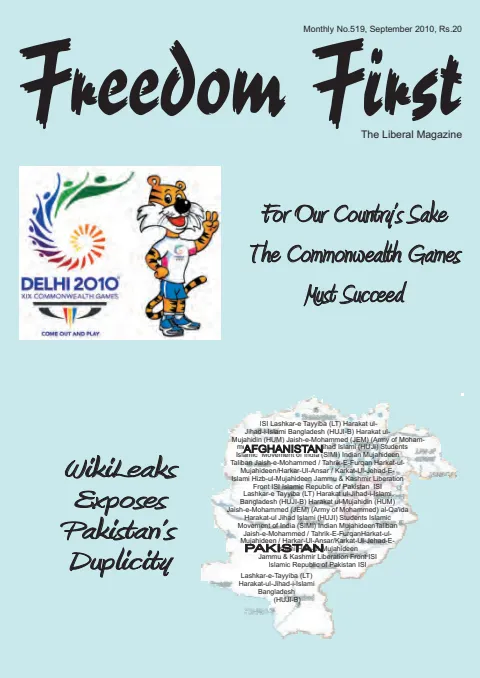
periodical issue
Freedom First
The Liberal Magazine
Edited by S. V. Raju
Publishers: Indian Committee for Cultural Freedom (ICCF), 3rd Floor, Army & Navy Building, 148, Mahatma Gandhi Road, Mumbai 400 001. · Mumbai · 2010
36 pages

Freedom First
Summary
The rendered pages show the August 2010 issue of Freedom First, opening with a cover, an obituary tribute to sociologist Dr. Dhiren Narain, the contents page, and an editor’s note that asks readers to renew debate about liberalism, secularism, social justice, and the proper role of the state. The visible issue then moves through reader letters, India-Pakistan diplomacy, terrorism, Bhopal accountability, constitutional government, civic participation, and a seminar report on recovering the civic patriotism associated with 1885 and the early Indian National Congress.
Key points
-
Nitin Raut argues the July 2010 India-Pakistan foreign-ministerial talks were damaging for India because Pakistan had not acted against terrorism and could exploit dialogue to deflect attention, urging stronger internal security instead.
-
P. M. Kamath, via a reprinted K. P. Sreenivasan column and his own piece, argues Pakistan has leveraged its strategic usefulness to the US into rewards while continuing to shelter militant groups, framing its demand for a civil nuclear deal as an insistence on parity with India.
-
Ashok Karnik’s “Point Counter Point” weighs Bhopal justice against the limits of criminal punishment, contrasts India’s desire for access to David Headley with US plea-bargaining realities, and questions whether the government can distinguish between the Afzal Guru and Kasab mercy petitions.
-
Meera Sanyal compares Indian and American democracy after the Times Square bomb case, arguing India can learn from clearer governmental accountability and citizen ownership under ‘We the people.’
-
Jyoti Marwah reports on a national seminar, “My Country India: Reviving Patriotism of 1885,” aiming to reconnect civic memory with India’s anti-colonial and diverse past rather than empty nationalist symbolism.
-
Keshav Rau critiques the Group of Ministers’ recommendations on Bhopal as politically useful but substantively thin, arguing proposed compensation is undercut by disputed casualty classifications and doubting the belated push to extradite Warren Anderson.
-
Salil Tripathi compares the BP oil spill response with Bhopal to argue that home governments and corporations owe victims accountability beyond borders, contrasting Obama’s aggressive BP response with US closure-seeking over Bhopal.
-
R. Srinivasan’s tribute to sociologist Dr. Dhirendra Narain remembers him as a beloved Mumbai University teacher known for courtesy and scholarly generosity.
Essays
Essay 0
R. Srinivasan’s front-matter tribute remembers Dr. Dhirendra Narain as a beloved teacher in Mumbai University’s sociology circles. It stresses his courtesy, intellectual generosity, commitment to teaching in Bombay despite offers elsewhere, and the scholarly value of his work on Hindu character, modernization, and the institutional history of sociology.
- Narain is presented as a teacher whose authority came from mastery, courtesy, and personal warmth.
- The tribute emphasizes his long connection with Mumbai University and the older School of Economics milieu.
- It notes his role in organizing a major symposium on modernization and his continuing scholarly influence.
- It closes by acknowledging the role of his wife, Vatsala Narain, in sustaining a hospitable intellectual home.
Between Ourselves
The editor’s note reports that reader response to the magazine’s financial appeal has been encouraging and that subscription renewals have crossed one lakh rupees. It frames Freedom First as a liberal magazine committed to reason while still acknowledging faith, and it calls for renewed discussion of liberalism, secularism, capitalism, social justice, and the state’s role in a changing context.
- Reader donations and fraternity subscriptions are presented as evidence of renewed confidence in the magazine.
- The editor says liberalism in India needs re-examination rather than rote inheritance.
- The note distinguishes liberalism from a narrow identification with capitalism.
- It argues that debates over secularism, social justice, and the state are necessary to attract younger citizens.
From Our Readers
The reader letters praise Freedom First, debate the Commonwealth Games, criticize the BJP-RSS relationship, ask harder questions about Maoist leadership and state strategy, and revisit Swatantra Party integrity versus socialism. Several letters use the magazine as a forum for liberal anxieties about nationalism, socialism, Hindutva, state coercion, and the public meaning of secular democracy.
- Readers respond to the magazine’s financial position with donations, subscriptions, and praise.
- One letter defends Commonwealth Games spending as potentially useful for urban infrastructure and national morale.
- A former RSS swayamsevak argues that the BJP cannot become a real democratic alternative unless the RSS moves beyond Hindutva.
- Another letter praises Swatantra leaders for refusing to label the party socialist and the editor corrects the constitutional history of socialist language.
India-Pakistan Talks - An Exercise in Futility
By Nitin Raut
Nitin G. Raut argues that the July 2010 India-Pakistan foreign-ministerial talks were damaging for India because Pakistan had not acted against terrorism and could exploit dialogue to minimize terror as an issue. He presents Pakistan’s behaviour as a strategic diversion tied to Afghanistan, U.S. policy, and Kashmir, and urges India to strengthen internal security and pursue harder diplomatic options rather than resume talks without leverage.
- Raut claims the talks exposed India’s diplomatic weakness after 26/11 and the Pune blast.
- He argues Pakistan used the composite dialogue to shift attention away from terrorism.
- The article links Pakistan’s Afghan strategy and U.S. military dependence on Pakistan to India’s diplomatic predicament.
- Raut recommends stronger internal security and strategic engagement with the U.S. and Afghanistan rather than talks on Pakistan’s terms.
Essay 5
By K. P. Sreenivasan
K. P. Sreenivasan’s reprinted column makes a narrower argument about India-Pakistan talks: given the circumstances of Partition, India and Pakistan can manage their relationship but cannot quickly transform it into trust. He suggests the practical objective should be to accept deep disagreements, especially over Kashmir and terrorism, and seek limited progress elsewhere.
- The prefatory note by Ram Narayanan endorses the column’s distinction between managing and transforming the relationship.
- Sreenivasan argues that Pakistan was born from distrust of undivided India and that this inheritance cannot be wished away.
- He says Krishna and Qureshi may be better off agreeing to disagree on the conceptual obstacles to trust.
- The column ends by rejecting the illusion that trust can be created out of nothing.
Pakistan Deserves to be placed on the Terror List, Not on Civil Nuclear Deal
By P. M. Kamath
P. M. Kamath contends that Pakistan has leveraged its strategic usefulness to the United States into rewards while continuing to shelter or distinguish between ‘bad’ and ‘good’ Taliban forces. In the rendered page, he argues that Pakistan’s demand for a civil nuclear deal rests on parity with India rather than a comparable non-proliferation record; the article is incomplete and continues on printed page 36, outside this chunk.
- Kamath depicts Pakistan as simultaneously a U.S. ally, a recipient of aid, and a protector or sponsor of militant groups.
- He argues U.S. electoral and Afghan-war priorities incentivize concessions to Pakistan.
- The piece quotes Musharraf’s memoir on bounty payments for captured terrorists.
- The visible section frames Pakistan’s nuclear-deal demand as an insistence on parity with India.
Point Counter Point
By Ashok Karnik
Ashok Karnik’s Point Counter Point column presents paired arguments on Bhopal justice, David Headley, and the Afzal Guru-Kasab mercy-petition issue. The column is structured as opposing numbered positions, weighing punishment, legal process, administrative failure, and political responsibility while repeatedly returning to whether justice delayed has undermined public confidence.
- The Bhopal section contrasts anger over Union Carbide’s conduct with limits of criminal punishment under existing law.
- The Headley section contrasts India’s desire for access with U.S. plea-bargaining realities and intelligence tradeoffs.
- The Afzal Guru-Kasab section asks whether the government can distinguish between mercy petitions while maintaining a credible administrative process.
- The page also includes a quoted N. Vittal note on agricultural infrastructure and a political joke.
We the People
By Meera Sanyal
Meera Sanyal compares Indian democracy with the United States after observing the Times Square bomb case and visiting U.S. civic institutions. She argues that India can learn from clearer governmental purpose, accountability, access to representatives, public service as a temporary vocation rather than a hereditary profession, and citizen ownership of government.
- Sanyal uses the swift U.S. handling of the Faisal Shahzad case to contrast security and institutional responsiveness.
- She invokes the Declaration of Independence to argue that governments exist to secure rights rather than multiply roles.
- She compares U.S. accountability after the BP oil spill with Indian failures after Bhopal.
- She calls for citizens to take more ownership of Indian democracy under the constitutional phrase ‘We the people’.
My Country India
By Jyoti Marwah
Jyoti Marwah reports on a national seminar titled ‘My Country India: Reviving Patriotism of 1885 in Contemporary Times.’ The article presents the seminar as an effort to reawaken historical memory, national integration, good governance, youth civic responsibility, and a form of patriotism rooted in knowledge of India’s diversity and anti-colonial past rather than empty symbolism.
- The seminar aimed to reconnect younger participants with the civic and historical meaning of Indian unity.
- Speakers addressed governance, rural realities, divisiveness, partition, nationalism, oral history, women’s suffering, and regional movements.
- The article highlights Tagore’s caution about aggressive nationalism and Gandhi’s warnings in Hind Swaraj.
- Student presentations and awards are treated as signs that younger researchers can carry forward the discussion.
The Bhopal Tragedy: Saving the Government from Further Flak
By Keshav Rau
Keshav Rau critiques the Group of Ministers’ recommendations on Bhopal as politically useful but substantively thin. He argues that compensation, extradition, curative litigation, and Dow Chemical liability measures are framed in ways that may deflect criticism of the UPA government while doing little to resolve the deeper failures surrounding victims, cleanup, and accountability.
- Rau says the recommendations were welcomed mainly because the previous 26 years had produced so little.
- He argues the proposed additional compensation is undercut by reliance on disputed casualty classifications and deductions from earlier payouts.
- He doubts the belated extradition push for Warren Anderson and the curative petition route will produce meaningful justice.
- He criticizes the lack of concrete action on Dow Chemical liability and site remediation.
Responsibilities Beyond Borders
By Salil Tripathi
Salil Tripathi’s article, reprinted from the Institute for Human Rights and Business, compares the BP oil spill response with Bhopal to ask what home governments and corporations owe victims beyond borders. He argues that Indian authorities failed their duties in 1984, but that the United States and companies should not hide behind jurisdictional limits when corporate misconduct abroad harms human rights and lives.
- Tripathi contrasts Obama’s aggressive response to BP with U.S. closure-seeking over Bhopal.
- He presents Bhopal as a layered failure involving regulation, inspection, compensation, cleanup, extradition, and criminal classification.
- The article argues that companies cannot rely only on legal minimums without losing their social licence to operate.
- Tripathi points to extraterritorial legal approaches and the Red Flags initiative as ways to frame corporate responsibility abroad.
Guns Across America
By Firoze Hirjikaka
No summary was extracted for this article. Listed for completeness.
Generated by the v1.5 extraction pipeline. Awaiting editorial review.
Metadata and summary are AI-extracted from the source PDF and reviewed for editorial accuracy. The original work is available via the Read PDF tab above (where present); paragraph-level citation inside the PDF is deferred to a future engagement.