
periodical issue
Freedom First
By R. M. Mohan Rao, Ajit Karnik
PUBLISHERS: Indian Committee for Cultural Freedom (ICCF) 3rd floor, Army & Navy Building, 148, Mahatma Gandhi Road, Mumbai 400001. PUBLISHED BY J. R. Patel for the ICCF and printed by him at Union Press, 13, Homji Street, Fort, Mumbai 400001. · Mumbai · 2014
40 pages
Freedom First
Summary
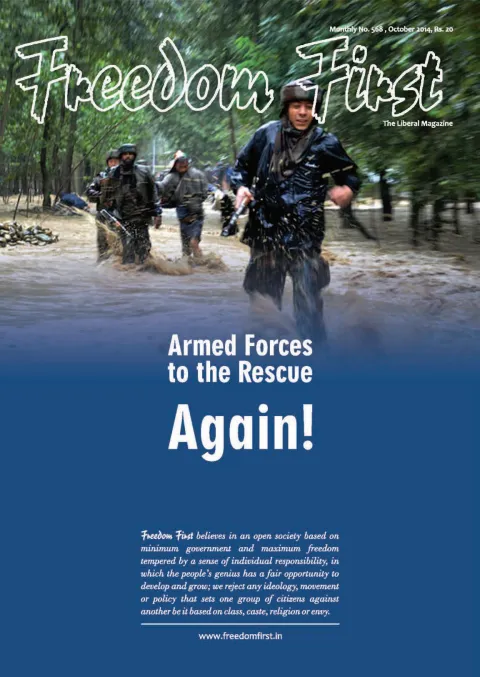
This is the October 2014 issue (No. 568, 63rd year of publication) of Freedom First, the Bombay-based classical-liberal monthly published by the Indian Committee for Cultural Freedom under editor S. V. Raju. The cover story and opening pages are dominated by the Jammu & Kashmir floods of September 2014: a Bombay Natural History Society press release frames the disaster as ecologically man-made (decades of wetland loss around Dal and Wular lakes), while an editorial and a companion piece praise the Army, IAF and NDRF’s rescue of roughly 200,000 people and contrast this with a paralysed state government and absent separatist leaders. The rest of the issue is characteristic Freedom First fare: tributes to liberal and nationalist figures (an obituary of Kannada novelist U. R. Ananthamurthy by Nandana Reddy, a birth-anniversary piece on Andhra freedom fighter T. Prakasam Panthulu by T. H. Chowdary, notes on Sardar Patel and on Sir M. Visvesvaraya as a model for Narendra Modi’s governance, and a reprint of Rajaji’s 1966 address on Gopal Krishna Gokhale); running assessments of the 100-day-old Modi government’s economic and political performance (Ranga Kota and Firoze Hirjikaka); foreign-policy commentary on Modi’s Japan visit and India’s BRICS/China positioning; Ashok Karnik’s point-counterpoint column on Zawahiri’s new jihad unit, stalled India-Pakistan talks, and state election arithmetic; a continuing series on agricultural indebtedness by R. M. Mohan Rao; shorter pieces on Kerala’s strike culture, the Anglo-Indian community’s legacy, an Air Force bird-strike memoir, book reviews of studies on Muslim backward classes and Hindu spirituality, an ‘Educating Adults’ section (population policy, a fictionalised account of the Campa Cola Compound demolitions, and a student essay on the UPSC English-language controversy), and a page of archival one-liners under ‘Many Voices from the Past’. Readers’ letters and a press release on the arrest of Tibetan activist Tenzin Tsundue at Sabarmati Ashram during Xi Jinping’s visit round out the issue. Editorially the magazine’s classical-liberal, anti-dynastic and pro-Armed-Forces orientation is consistent throughout, alongside a cautiously optimistic but watchful stance toward the new NDA government.
Essays
Between Ourselves
By SVR
The editor’s note explains a reversion to the magazine’s older, plainer page format after criticism that the redesigned version imitated better-funded journals, then turns to the Kashmir floods, crediting the Armed Forces’ rescue effort and urging that Article 370 and separatist responsibility not be politicised, while praising the Bombay Natural History Society for a non-political assessment of the disaster’s causes.
- Editor S. V. Raju reverts to an older, simpler magazine layout after reader criticism of a more elaborate redesign
- Frames the Kashmir floods as a reminder of poor governance in the state since 1947
- Credits India’s Armed Forces (as in the 2013 Uttarakhand floods) for rescue efforts despite being targets of terrorism and separatist suspicion
- Argues the disaster should not be politicised around Article 370 but does fault the National Conference government and separatists
- Cites the Bombay Natural History Society (BNHS) for a non-political ecological assessment
From Our Readers
A letters column in which readers debate decriminalising Indian politics via the Supreme Court’s obiter dicta on tainted candidates, where Andhra Pradesh’s new capital should be sited, whether retired judges should become governors, TTD’s claimed exemption from the RTI Act, Tagore’s concept of the ‘Hindu Christian’ and religious pluralism, and the Congress party’s post-2014 decline; one letter also praises the magazine’s ‘Many Voices from the Past’ feature.
- Major Mathew Oommen urges disqualification of candidates once criminal charges are framed against them
- Suresh Sharma questions the opacity and land-speculation risk around siting Andhra Pradesh’s new capital
- A reader raises whether retired judges should be barred from becoming governors, citing Rajaji’s objection to Justice Chagla’s appointment
- Dr. T. H. Chowdary reports TTD’s refusal to comply with RTI requests despite a minister’s public assurance
- Dr. Ramesh Babu and Dr. Ali Khwaja reflect on Tagore’s ‘Hindu Christian’ formulation and India’s religious pluralism
- Phiroze Javeri likens the Congress party’s post-defeat plight to Churchill’s wounded cavalry-charge metaphor
- K. Vaithinathasamy praises the new ‘Many Voices from the Past’ column, especially a Rajagopalachari item on English
The Kashmir Floods: An Ecological Disaster Waiting to Happen
A Bombay Natural History Society press release, quoting Director Dr. Asad Rahmani, argues the Jammu & Kashmir floods are a man-made ecological disaster caused by decades of wetland loss (Dal Lake nearly halved, Wular Lake reduced from 20,200 to 2,400 hectares), and calls for a Wetland (Conservation) Act modelled on the Forest (Conservation) Act, 1980, noting the existing Central Wetlands Regulatory Authority has proven ineffective.
- BNHS field studies document severe, decades-long wetland loss in the Kashmir Valley
- Dal Lake has shrunk to about 1,200 hectares, roughly half its earlier extent
- Wular Lake and associated marshes fell from 20,200 to 2,400 hectares, partly due to forest-department willow plantations
- The Valley’s single natural drainage outlet via the Jhelum River makes wetland loss especially consequential for flooding
- BNHS recommends a national Wetland (Conservation) Act and warns against classifying wetlands as wastelands
U. R. Ananthamurthy - the Controversial Bard
By Nandana Reddy
An unsigned piece details the Indian Army, IAF, Navy and NDRF’s massive rescue operation in the flooded Kashmir Valley (86 aircraft, 30,000 troops, nearly 200,000 people rescued), contrasting the military’s response with a ‘paralysed’ state government and the conspicuous absence of separatist Hurriyat leaders, and noting international commentary including Al Jazeera America’s characterisation of the episode as a ‘PR stunt.’
- The state secretariat itself was submerged, leaving the state government unable to communicate with its own officials
- The Armed Forces, NDRF, BSF, CRPF, ITBP and CISF arrived first and led relief and rescue efforts
- Nearly 200,000 people were rescued and 50 tonnes of relief material distributed via 68 relief camps in Jammu
- Chief Minister Omar Abdullah stated the disaster required central government air and helicopter resources
- Hurriyat Conference separatist leaders were reported missing during the crisis despite claiming to represent Kashmiris
- The Army’s conduct won unusually broad praise from ordinary Kashmiris after decades of insurgency-related distrust
Jayanti of Andhra Kesari T. Prakasam Panthulu
By T. H. Chowdary
A reprint from the Swatantra Newsletter (No. 58, May 1966) recounts a Madras address by C. Rajagopalachari on the occasion of Gopal Krishna Gokhale’s birth centenary, contrasting Gokhale’s gradualist school (educate Britain and the people before self-rule) with Tilak’s belief that people were always ready for freedom, and recalling that both Gandhi and Gokhale respected each other despite disagreeing over passive resistance; Rajaji closes by suggesting Gokhale would have been heartbroken by the tax burdens imposed by post-independence governments he had trusted.
- Rajaji contrasts Gokhale’s gradualist liberalism with Tilak’s belief that Indians were already ready for self-government
- Gandhi chose Gokhale as his political guru on returning from South Africa
- Gokhale asked Gandhi not to preach passive resistance, fearing premature political mobilisation and violence
- Rajaji argues both Gokhale and Tilak were right in different respects, since passive resistance both won freedom and provoked violence
- Rajaji contends Gokhale, who opposed the colonial salt tax, would be heartbroken by the tax burden imposed by independent India’s own government
Point Counter Point
By Ashok Karnik
Nandana Reddy’s personal tribute to Kannada novelist and public intellectual U. R. Ananthamurthy (1932-2014) traces his rise as a pioneer of the ‘Navya’ movement through his novel Samskara, his Lohia-socialist politics, his friendship with the writer’s filmmaker parents who adapted the novel (which was banned before winning the National Award and international prizes), his role during the Emergency and the Chickmagalur by-election campaign against Indira Gandhi, and closes with a personal account of his death and his wife Ester’s devotion.
- Ananthamurthy’s novel Samskara critiqued decadent Brahminical Hinduism and was inspired partly by Ingmar Bergman’s ‘The Seventh Seal’
- The film adaptation of Samskara was initially banned by the Censor Board before winning the National Award for Best Film and international honours
- Ananthamurthy was a follower of Ram Manohar Lohia’s socialism and grew closer to the author’s family through shared political circles
- He supported the author when she was beaten by police during the anti-Indira Gandhi Chickmagalur election campaign after the Emergency
- Despite a lifelong rejection of organised religion, his last rites followed religious convention, reflecting an inner spiritual searching
- He and his father-figure (the author’s father) both married Christian women as a quiet political statement
Transforming India - Building Values in the System of Governance
By H. R. Bapu Satyanarayana
T. H. Chowdary marks the 142nd birth anniversary of Andhra freedom fighter Tanguturi Prakasam Panthulu (‘Andhra Kesari’), recounting his defiance of British police during the Simon Commission protest, his penurious life despite serving as Premier of undivided Madras Presidency, his split from Congress to found the Kisan Mazdoor Praja Party, his brief tenure as first Chief Minister of Andhra State, and President Sanjeeva Reddy’s pointed contrast between Prakasam’s self-sacrifice and the wealth and dynastic power of the Nehru-Gandhi family.
- Prakasam bared his chest before armed police during the anti-Simon Commission protest, earning the title ‘Andhra Kesari’ (Lion of Andhra)
- He spent his considerable legal earnings entirely on the freedom movement and lived on public offerings, unlike wealthier contemporaries
- He defied Gandhi and the Congress High Command to become Premier of the undivided Madras Presidency after the 1946 election, but was later removed by a no-confidence motion
- After the Congress denied him leadership in 1952 despite his party’s electoral strength, he became Andhra’s first Chief Minister but was soon toppled by rivals
- President Sanjeeva Reddy, in a 1980 letter to Indira Gandhi about Maharashtra corruption, contrasted Prakasam’s penury with the Nehru-Gandhi family’s continuous hold on high office
The Promise of Good Times
By Ranga Kota
Suresh C. Sharma’s short tribute, timed to Sardar Vallabhbhai Patel’s 139th birth anniversary, recounts his 1927 Gujarat flood-relief work (favouring loans and seed distribution over free gifts) and his leadership of the 1928 Bardoli Satyagraha against a land-revenue increase, which ended with the government reducing the hike from 22% to 5.7% and returning confiscated land.
- Over 4,000 Gujarat villages were flooded in 1927; Patel organised 200 volunteers for relief while opposing free charity in favour of loans and seeds
- In the 1925 Bardoli land-revenue dispute, Patel organised complete non-cooperation among 17,000 landholders against the district collector
- Farmers locked themselves in their homes with their families and cattle to resist land confiscation
- The government ultimately relented, capping the revenue increase at 5.7% against its proposed 22% and returning confiscated land
- The episode earned Patel nationwide acclaim as ‘Bardoli ka Sardar’
Raindrops on Roses
By Firoze Hirjikaka
Ashok Karnik’s point-counterpoint column presents opposing views on Al-Qaeda chief Zawahiri’s announcement of a new jihad unit for the Indian subcontinent (read against ISIS’s rival Caliphate declaration), on India’s cancellation of foreign-secretary talks with Pakistan after its High Commissioner met Kashmiri separatists, and on the electoral arithmetic facing BJP-Shiv Sena and Congress-NCP alliances ahead of Maharashtra and Haryana polls.
- Zawahiri’s new Al-Qaeda unit for the subcontinent, headed by Asim Umar, is read as partly a response to the rival Islamic State’s declared Caliphate
- The counterpoint warns fidayeen from the US, UK, Nigeria and Somalia could now target India via the ‘Global Jihad’, not just Pakistan-based infiltration
- India called off talks with Pakistan after its High Commissioner met Hurriyat separatist leaders ahead of scheduled Foreign Secretary talks
- One side argues India’s tougher stance changes a longstanding pattern of futile talks; the counterpoint questions whether it merely reflects domestic Kashmir-election politics
- On Maharashtra, the column debates whether the BJP-Shiv Sena alliance would fracture over seat-sharing, ultimately noting central BJP leadership averted a break-up
Foreign Relations in the 21st Century - Triumph In Tokyo: Modi and Abe Upgrade India-Japan Relations
By B. Ramesh Babu
H. R. Bapu Satyanarayana urges Prime Minister Narendra Modi to emulate Sir M. Visvesvaraya (‘Sir MV’), the reformist Dewan of Mysore State under Maharaja Nalwadi Krishnaraja Wodeyar, recounting anecdotes of Sir MV’s incorruptibility (refusing job recommendations even from his own mother, declining extended VIP hospitality beyond his entitled days as a state guest, criticising government policy even after receiving the Bharat Ratna) and his catalytic role in projects such as the Mokameh Bridge in Bihar, alongside his respectful but substantive disagreement with Gandhi over industrialisation versus village industry.
- Modi is compared to Maharaja Wodeyar and urged to find his own ‘Sir MV’ among his cabinet colleagues
- Sir MV’s clarion call was ‘industrialise or perish’, a theme the author links to Modi’s development agenda
- Sir MV insisted on strict rules for VIP hospitality, moving to a hotel in Patna once he learned his stay exceeded the permitted days
- On receiving the Bharat Ratna in 1955, Sir MV told Nehru the honour would not deter him from criticising government policy he disagreed with
- Gandhi and Sir MV maintained mutual respect despite disagreeing over big machinery versus village and cottage industry
- Sir MV’s advice, sought by Nehru, led to the construction of the Mokameh Bridge across the Ganga in Bihar
Tenzin Tsundue Arrested
Ranga Kota assesses the new NDA government’s first months, arguing that the BJP/RSS’s pursuit of an intangible pan-Indian Hindu identity matters less to voters than tangible delivery on jobs and prices, and surveys obstacles including rigid labour laws, skill-development shortfalls, competition for Japanese and Chinese infrastructure investment, and food-inflation drivers such as Minimum Support Price hikes and import/export restrictions, concluding that state-level governance quality will ultimately determine whether ‘good times’ materialise.
- The government has quickly ‘buried’ the intangible pillars of the Nehruvian legacy, socialism and secularism, more easily than it can deliver tangible economic promises
- UP and Bihar are described as key ‘testing grounds’ for BJP’s strategy of building a pan-Hindu identity across caste lines
- A dramatic change to central labour laws is seen as unlikely until the NDA gains a majority in the Rajya Sabha
- Foreign (particularly Japanese) investment is seen as important for infrastructure, but past mega-projects like the Delhi-Mumbai Freight Corridor show execution risk from land acquisition and clearances
- Food inflation is attributed to domestic policy (MSP hikes, procurement, import/export restrictions) rather than global price trends, per an unnamed business-press analysis
- The article concludes governance quality varies by state, so which citizens benefit from ‘good times’ will differ by region
Narendra Modi in the BRICS Lane: What the World Thinks of India
By B. N. Mehrish
Firoze Hirjikaka offers a cautiously optimistic review of the Modi government’s first 100 days, covering tightened bureaucratic discipline, the new bank-account and insurance scheme for the poor, the sidelining of BJP seniors (Advani, Joshi, Rajnath Singh) in favour of Amit Shah, the controversial cancellation of India-Pakistan talks over Hurriyat contacts, the wave of Congress-appointed state governors being replaced, and criticism of HRD Minister Smriti Irani’s directive making Modi’s Teachers’ Day speech compulsory viewing in schools.
- The author credits Modi with a genuine shift in public mood but questions whether concrete achievements match the hype
- New administrative discipline (punctuality, longer hours) is popular even as onion and tomato prices rise
- BJP seniors L. K. Advani and Murli Manohar Joshi were ‘kicked upstairs’; Amit Shah’s elevation as BJP president consolidates Modi’s control of both party and government
- The cancellation of India-Pakistan Foreign Secretary talks is read as pre-election positioning for Jammu & Kashmir rather than principled policy
- Massive Japanese investment pledges (including a bullet train) are welcomed but the author cautions against expecting Japan to counter a Chinese incursion
- The HRD ministry’s directive on compulsory viewing of Modi’s Teachers’ Day address is criticised as authoritarian overreach and ‘sycophancy‘
“Gokhale’s India”
A Friends of Tibet press release reports the arrest of Tibetan poet-activist Tenzin Tsundue on 17 September 2014 at Sabarmati Ashram, Ahmedabad, during Chinese President Xi Jinping’s visit, recounts his history of high-profile protests against visiting Chinese leaders, and condemns the Ashram authorities for hosting Xi Jinping, comparing Chinese actions in Tibet to Nazism.
- Tsundue was arrested while protesting Xi Jinping’s visit to Sabarmati Ashram, the site of Gandhi’s 1930 Salt March
- He previously staged rooftop ‘Free Tibet’ protests against Chinese Premiers Zhu Rongji (2002) and Wen Jiabao (2005)
- Friends of Tibet calls the Ashram’s hosting of Xi Jinping a betrayal of Gandhian non-violence, comparing it to a precedent set when George W. Bush visited Rajghat in 2006
- The organisation likens Chinese rule over Tibet, East Turkestan and Mongolia to Nazism and calls for an apology from Ashram authorities
The Rural Perspective - Agriculture and Rural Indebtedness - III
By R. M. Mohan Rao
B. Ramesh Babu analyses Prime Minister Modi’s four-day state visit to Japan, covering Japan’s pledge of $35.5 billion investment over five years, the upgrade of the bilateral relationship to a ‘Special’ Strategic and Global Partnership, exploration of an upgraded US-Japan-India trilateral dialogue, Modi’s ‘red carpet, not red tape’ pitch and ‘demand, democracy, demography’ framing to Japanese business, and his oblique warning against ‘expansionism’ widely read as directed at China.
- Japan pledged 2.1 lakh crore rupees ($35.5 billion) in Indian infrastructure, clean energy and skills projects over five years, including one defence-sector agreement
- A civilian nuclear deal did not materialise, constrained by India’s non-signature of the NPT and Japan’s sensitivities post-Fukushima
- Modi and Abe agreed to upgrade their Strategic and Global Partnership to a ‘Special’ partnership and explore a Foreign Minister-level US-Japan-India trilateral dialogue
- Modi contrasted ‘vistarvaad’ (expansionism) with ‘vikasvaad’ (developmentalism) in a speech read as an oblique criticism of China
- Modi pitched India’s ‘three Ds’ — demand, democracy, demography — to Japanese investors and flagged off a TCS training programme for Japanese trainees
- The visit is assessed as a strong start, but the author stresses that translating promises into performance remains the harder task
God’s Own NGOs!
By P. Koshy
B. N. Mehrish surveys India’s rising global profile under Modi, covering the contest with China over the BRICS Development Bank’s headquarters, unresolved India-China border tensions including incursions in the Demchok sector, India’s aspirations for APEC and Shanghai Cooperation Organisation membership, Modi’s forthcoming US visit and meeting with President Obama, and comparative international favourability polling toward India.
- China is likely to secure the BRICS Development Bank headquarters in Shanghai over India’s bid for New Delhi
- Chinese PLA troops reportedly crossed the Line of Actual Control in Ladakh’s Demchok sector even as India and China had signed a 2013 border pact
- China invited Modi to the November 2014 APEC summit and signalled possible support for India’s Shanghai Cooperation Organisation membership
- Modi is expected to receive a strong reception in the United States, having earlier been denied a US visa in 2005
- International favourability polling shows the US, Japan, Vietnam, Indonesia and Bangladesh viewing India favourably, while China and Pakistan rate India least favourably
- The author identifies India’s politically unstable and economically deprived immediate neighbourhood as Modi’s biggest foreign-policy challenge
Anglo Indians : ‘Rose Petals Strewn on the Ganga’
By Nitin G. Raut
An announcement for a day-long Mumbai symposium on 15 November 2014, jointly organised by the Indian Committee for Cultural Freedom, the Project for Economic Education, and the Indian Secular Society, marking the death centenary year of Gopal Krishna Gokhale and inviting discussion of contemporary economic, political and social issues arising from the 2014 general election.
- February 2014-15 marks the death centenary year of Gopal Krishna Gokhale, who died in February 1915 aged 49
- The centenary year was flagged off in Pune by the Deccan Education Society, Servants of India Society and Gokhale Institute of Politics and Economics
- ICCF, the Project for Economic Education, and the Indian Secular Society will jointly host a symposium in Mumbai on 15 November 2014
- The symposium will discuss the current economic, political and social situation following the May 2014 general election results
A Soldier’s Tale - Avian Risk Management
By Cecil Parker
The third instalment of R. M. Mohan Rao’s series on agricultural indebtedness argues that Indian agriculture — despite generating about 21% of GDP and supporting 69% of the population — remains chronically under-prioritised in Plan allocations, cites M. S. Swaminathan’s analysis of the 2004 farmers’-distress election verdict, presents a Punjab cotton-belt study showing high non-institutional debt burdens, and calls for a new comprehensive rural credit survey and targeted debt-relief measures.
- Agriculture contributes about 21% of GDP and provides direct employment to 56.7% of the workforce, yet receives disproportionately low Plan outlays
- M. S. Swaminathan’s 2004 Hindu article traced the agrarian crisis behind that year’s general election verdict
- A Punjab cotton-belt study found average farm debt of Rs. 96,632, with 60.5% owed to non-institutional sources, chiefly commission agents
- Debt burdens were far higher on marginal and small farms than on larger holdings
- The author calls for a new All India Rural Credit Survey-style assessment and debt-relief measures modelled on the 1990 Agriculture and Rural Debt Relief Scheme
- The article lists eleven critical policy issues (role of the state, indebtedness, institutional credit, risk, viability, cost of production, technology, extension, marketing, social infrastructure, farmer participation) to be addressed across the series
Book Reviews
Suresh C. Sharma’s short explainer describes the Yazidi community of northern Iraq — their syncretic religion, their persecution history under Ottoman Turkish rule, and the August 2014 Islamic State assault on Sinjar that forced conversions, killings and the enslavement of women.
- Most of the roughly 70,000 Yazidis live around Sinjar in North Iraq and practise a religion blending Judaism, Christianity and Islam
- Their veneration of the ‘Peacock Angel’ has been mischaracterised by Muslims as devil worship
- Yazidis sheltered Armenians and Christians persecuted by Ottoman Turkish forces a century earlier, drawing Turkish retaliation
- Iraq deported about 20,000 Yazidis from Sinjar in 1975
- Islamic State forces took Sinjar in August 2014, killing many Yazidis and enslaving women who refused conversion
Educating Adults
P. Koshy’s satirical piece describes Kerala’s entrenched culture of strikes, hartals and bandhs orchestrated by unions of non-gazetted officers (‘NGOs’) and gazetted officers (‘GOs’), the rent-seeking practices of the state bureaucracy, and asks whether the Modi government’s early push for stricter office discipline in Delhi might eventually reach Kerala’s civil service.
- Kerala’s ‘socio-political entrepreneurial’ strike culture often lacks a clear or convincing rationale for the specific day chosen
- Unions of non-gazetted officers (NGOs) hold effective veto power over whether government policies are implemented
- Thiruvananthapuram’s relative prosperity is attributed to its concentration of government offices and NGOs/GOs rather than productive activity
- The BJP’s rising vote share in Kerala, especially in Thiruvananthapuram, is noted as a sign of business-community and middle-class dissatisfaction with governance
- The author draws a parallel between Modi’s tightening of Delhi bureaucrats’ discipline and the need for similar reform of Kerala’s babudom
Many Voices - From the Past
Nitin G. Raut’s tribute to the Anglo-Indian community highlights its disproportionate contributions to independent India in the first decades after 1947 — military gallantry in the 1965 and 1971 wars, dominance in Indian hockey, literary figures like Ruskin Bond, and broadcaster Melville D’Mello — while noting the community’s shrinking numbers and its failure to fully use constitutional protections available to it.
- In the 1964 and 1971 wars, 20% of decorated Group Captains and 30% of decorated Wing Commanders in the IAF were Anglo Indian
- Anglo Indians constituted a significant share of India’s 1964 Olympic gold-medal-winning hockey team, including Leslie Claudius
- The Pearce family, Anglo Indian railway-colony emigrants, helped found Australian hockey before Independence
- Ruskin Bond, the celebrated Mussoorie-based author, is cited as an example of Anglo Indian achievement earning the Padma Bhushan
- The community holds constitutional protections (Articles 332, 333, 337) but has largely failed to leverage them as its numbers and institutions have shrunk
Essay 21
Retired Air Vice Marshal Cecil Parker recounts a 1970 bird-strike incident during a live rocket-firing trial in a Hunter jet trainer, in which a bird shattered the windscreen and injured his co-pilot mid-flight, using the episode to reflect on the principles of aviation risk management and the pilot’s responsibility for constant lookout in the ‘avian domain.’
- As a squadron commander in 1970, Parker combined a live Sneb rocket-pod firing trial with a dual instrument check for an experienced pilot returning from leave
- A large bird struck the aircraft’s windscreen during the dive, injuring the co-pilot’s face and disabling intercom and radio contact
- Parker managed an emergency landing using visual signals, with medical help arranged in advance of touchdown
- He faults himself in retrospect for not noticing the co-pilot had raised his helmet visor before the strike
- The rockets fired during the trial were confirmed a direct hit despite the mid-air incident
Essay 22
Dr. Ali Khwaja reviews Azra Khanam’s ‘Muslim Backward Classes — A Sociological Perspective’ (Sage, 2013), which documents the occupational (rather than caste-based) hierarchy among Muslim backward classes in India, their low uptake of OBC reservation benefits, religious objections to interest-based loans, the post-Partition emigration of the Muslim professional class, and stark gender gaps in education and marriage age, praising the book’s case studies while criticising internal statistical inconsistencies.
- Backwardness among Indian Muslims is attributed to hereditary low-status occupations rather than a rigid caste hierarchy, since caste runs counter to Islamic religious ethos
- Post-Partition emigration of the educated Muslim professional class to Pakistan weakened the community’s remaining economic position
- 80% of Muslim OBCs are in petty business yet earn low incomes, partly because conservative Muslims avoid interest-based (riba) institutional loans
- Surveys show 71% of Muslim women in North India do not participate in economic activity, and 80% of Muslim girls receive only madrasa education versus 20% in regular schools
- The reviewer notes internal contradictions in the book’s OBC population statistics but highlights an encouraging finding that 77% of Muslim OBC families have progressed socio-economically in recent years
Essay 23
Prema Nandakumar reviews Vasanthi Srinivasan’s ‘Hindu Spirituality and Virtue Politics’ (Sage, 2014), which examines four twentieth-century figures — Radhakrishnan, Vinobha Bhave, Rajaji, and Ananda Coomaraswamy — as exemplars of spiritually grounded public life, closing with a reflection on dharma-linked ‘moderate political discourse’ as an antidote to political cynicism.
- Radhakrishnan’s Advaita Vedanta-inflected humanism traced spiritual evolution through facilitators such as Buddha, Shankara, Gandhi and Sri Aurobindo
- Vinobha Bhave’s Bhoodan (land-gift) movement is presented as an example of ‘spiritual politics’ rooted in sharing as a physical representation of spirituality
- Rajaji drew on the Ramayana and Mahabharata’s moral dilemmas, with bhakti seen as key to resolving their apparent ethical contradictions
- Ananda Coomaraswamy’s linguistic, mineralogical and philosophical breadth led him toward an intellectual, less emotional mysticism
- The review closes by invoking Vinobha and Rajaji as models of ‘virtue politics’ amid contemporary cynicism about Indian political life
Essay 24
N. S. Venkataraman argues that Prime Minister Modi has avoided addressing India’s population growth, warning that continued growth of about 2.5 crore people a year will keep poverty intractable even at 7% GDP growth, and proposes renewed public campaigning alongside incentive- or punitive-based family-size measures.
- India adds roughly 70,000 births a day versus about 43,000 in China, contributing around 18% of daily global population growth
- States like Kerala and Tamil Nadu have checked population growth while Uttar Pradesh, Bihar and Rajasthan show alarming growth
- Political parties have avoided the population issue since the backlash against Sanjay Gandhi’s coercive 1960s-70s family-planning drives
- About 30% of Indians (over 300 million people) remain below the poverty line despite decades of growth in food production and the economy
- The author proposes incentive schemes, and potentially punitive measures, for families that limit themselves to two children, after building public consensus
Essay 25
Ajit Karnik’s short fictional narrative, framed by a news headline about the Campa Cola Compound demolitions, follows a child, Jhanvi, whose Mumbai home is destroyed as an ‘illegal’ structure despite promises of protection from neighbours and a sympathetic ‘lady in white sari,’ contrasting the intense media and political spectacle beforehand with the family’s complete abandonment during the actual demolition.
- The story is framed by a real headline: ‘Mumbai: Campa Cola Compound residents face homeless future’ (IBN Live)
- Before the demolition, TV cameras, officials and a sympathetic ‘lady in white sari’ promised to protect the residents’ homes
- On the day of demolition, none of those figures were present; only the family and the demolition trucks remained amid despair and wailing
- The child does not understand why a home where her family was happy and had lived for years must be destroyed
- After the family relocates by open tempo, the narrative closes with the same media and political spectacle now surrounding a different building, exposing the performative nature of the earlier promises
Essay 26
College student Shruti Shetty argues against the government’s August 2014 decision to exclude English-language marks from UPSC Civil Services grading, contending that candidate ability rather than language of examination should determine selection, and urging that examinations be offered consistently and fairly in both Hindi and English.
- India recognises 22 languages under the Eighth Schedule though over 1,600 languages are spoken across the country
- On 4 August 2014, the government announced English marks would no longer count toward UPSC candidate gradation, a move opposed by many former bureaucrats
- The author argues candidates who take exams in English gain an unfair international-level advantage over those examined in Hindi
- She proposes that examinations be made mandatorily available in both Hindi and English so that a candidate’s underlying capability, not language choice, determines selection
Essay 27
A compiled page of short archival quotations from 1954-1956, drawn from periodicals including Encounter, the New Leader, The Times of India, Mysindia and Freedom First’s own back issues, touching on Vinoba Bhave’s asceticism, satirical takes on British and Indian political culture, the Krishna Menon/jeep-scandal controversy, Ambedkar’s remark on the Constitution, Jayaprakash Narayan on the Second Five Year Plan’s authors, and M. A. Sreenivasan’s aphorisms on tolerance, language and insurance nationalisation.
- Vinoba Bhave, told his ideas amounted to ‘communism minus violence,’ offered a cryptic rejoinder about the difference between two otherwise identical people
- Dr. B. R. Ambedkar, quoted from a 1955 Times of India piece, compared India’s Constitution to a temple already possessed by devils before the intended gods could be installed
- Jayaprakash Narayan is cited noting that the authors of Nehru’s Second Five Year Plan were ‘all men from behind the Iron Curtain’
- M. A. Sreenivasan is quoted in several 1956 Freedom First speeches on tolerance, loose language, and opposing insurance nationalisation
- Pandit Govind Ballabh Pant reportedly urged that the Public Accounts Committee review the ‘jeep scandal’ before V. K. Krishna Menon’s induction into the Cabinet
Generated by the v1.5 extraction pipeline. Awaiting editorial review.
Metadata and summary are AI-extracted from the source PDF and reviewed for editorial accuracy. The original work is available via the Read PDF tab above (where present); paragraph-level citation inside the PDF is deferred to a future engagement.