
periodical issue
Freedom First
The Liberal Magazine
PUBLISHERS: Indian Committee for Cultural Freedom (ICCF) 3rd floor, Army & Navy Building, 148, Mahatma Gandhi Road, Mumbai 400001. PUBLISHED BY J. R. Patel for the ICCF and printed by him at Union Press, 13, Homji Street, Fort, Mumbai 400001. · Mumbai · 2014
36 pages
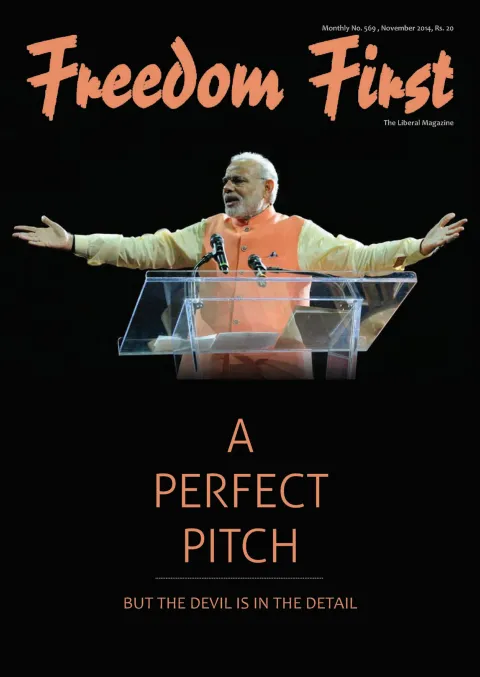
Freedom First
Summary
Freedom First No. 569 (November 2014), the Bombay-based liberal monthly of the Indian Committee for Cultural Freedom in its 63rd year, is dominated by two threads: Narendra Modi’s first six months as Prime Minister (his August 15 address, the September 2014 US trip including the UN speech, Madison Square Garden rally and Obama meetings, and the ‘Make in India’ and anti-Planning-Commission reform agenda) and the state of India-Pakistan relations following border firing and Modi’s UN remarks. The issue opens with a tribute package on Gopal Krishna Gokhale ahead of his 100th death-anniversary symposium (a reproduced M. V. Kamath column plus an ICCF programme notice), runs Ashok Karnik’s recurring ‘Point Counter Point’ feature weighing opposed views on Pakistan’s border provocations, Modi’s China/US diplomacy, the ‘Love Jihad’ controversy and the Burdwan blast, and carries several single-author op-eds on foreign policy, the Congress party’s post-defeat strategy, ease-of-doing-business rankings, and an alternative design for the Planning Commission proposed by the Swatantra Forum. A three-part India-Pakistan Relations section covers the 1965 war’s internal Pakistani politics, the long-run futility of the conflict, and the case for people-to-people diplomacy. Shorter items include a report on a citizen-led ‘100 Laws to Repeal’ project, a note on tax-planning versus tax-avoidance law, a soldier’s flying memoir, two book reviews (on international-relations theory and on Indian civil-military relations), an ‘Educating Adults’ feature trio (on Asian development models, mandatory teaching by CSIR scientists, and Sir M. Visvesvaraya’s legacy), a page of historical magazine quotations (‘Many Voices — From the Past’), reader letters, and several short excerpted news items (Israel’s Iron Dome, wildlife-monitoring drones, Middle East heritage destruction, air pollution, and a coal-block ruling). The issue closes with a memorial page for founder Minoo Masani on his 109th birth anniversary.
Essays
Gopal Krishna Gokhale - Servant of India, Despite the Raj
By M. V. Kamath
M. V. Kamath’s reproduced Free Press Journal column, published to mark the ICCF’s November 15, 2014 symposium on the 100th anniversary of Gopal Krishna Gokhale’s death, argues Gokhale deserves wider modern recognition (including possibly a Bharat Ratna and a ‘Gokhale Day’) despite being obscure to ‘GenNext’. It sketches his biography — Elphinstone-educated mathematics professor, founder of the Servants of India Society, Congress president in 1905 — and his commitment to nonviolence and social reform, including support for the Age of Consent Bill. The piece contrasts Gokhale with his contemporary Bal Gangadhar Tilak (both Chitpavan Brahmins and Elphinstone/Deccan Education Society colleagues who diverged on strategy toward the British) and credits Gokhale as mentor to both Mahatma Gandhi and Mohammad Ali Jinnah, as well as the architect, via his rapport with Secretary of State Lord Morley, of the 1909 Morley-Minto Reforms.
- Written by veteran journalist M. V. Kamath, reproduced from his ‘Odd Man In’ column (Free Press Journal, Aug 29, 2014), timed to the ICCF’s Nov 15, 2014 Gokhale symposium.
- Argues for greater recognition of Gokhale (Bharat Ratna debate, possible ‘Gokhale Day’ on his death anniversary, Feb 19).
- Traces Gokhale’s life (1866-1915): Elphinstone College, professor of mathematics, founder of the Servants of India Society, Congress president in 1905.
- Highlights his advocacy of the Age of Consent Bill (raising the age from 10 to 12) despite opposition from figures like Tilak.
- Contrasts Gokhale’s constitutionalist, pro-British-cooperation approach with Tilak’s opposition to British interference in Indian life.
- Describes Gokhale as mentor to both Gandhi (‘pure as crystal… the most perfect man in the political field’) and Jinnah, who aspired in 1912 to become the ‘Muslim Gokhale’.
- Credits Gokhale’s rapport with Secretary of State Lord Morley for shaping the 1909 Morley-Minto Reforms.
From Our Readers
Ashok Karnik’s recurring ‘Point Counter Point’ feature stages opposed viewpoints on four topical issues: Pakistan’s border firing ahead of J&K elections; Modi’s China and US diplomacy; the ‘Love Jihad’ controversy sparked in the UP by-elections; and the Burdwan (WB) bomb-blast case. Each pairing sets a hawkish or skeptical ‘Point’ against a more measured or contrarian ‘Counter Point’, without resolving which view is correct, closing with an epigraph in which Gokhale is quoted praising Dadabhai Naoroji.
- On Pakistan’s border firing: contrasts a reading tied to J&K election timing and Pakistani domestic rhetoric (Bilawal Bhutto, Musharraf) against a counter-view stressing Pakistan’s internal conspiracy culture and its habitual blaming of India, Israel, the US and UK.
- On Modi’s China/US diplomacy: weighs optimism about US and Chinese investment pledges against skepticism given continuing Chinese incursions in Ladakh during and after Xi Jinping’s visit.
- On ‘Love Jihad’: one side frames it as a genuine (if newly named) conversion conspiracy; the counter-point notes no statistics support it and warns against manufacturing communal suspicion.
- On the Burdwan blast: contrasts West Bengal’s initial framing as a local TMC-CPM dispute against evidence implicating the Jamaat-ul-Mujahideen Bangladesh in a cross-border terror plot.
- Closes with a quoted tribute in which Gokhale praises Dadabhai Naoroji as a once-improbable ‘trusted spokesman of a united India.‘
Point Counter Point
By Ashok Karnik
B. Ramesh Babu’s analysis of PM Modi’s September 2014 five-day US visit frames it as combining ‘style, symbolism and substance’: the UN address in Hindi, the Madison Square Garden rally before 18,000-plus Indian-Americans, and White House meetings with President Obama. The article situates the trip within a longer arc of India-US relations moving from ‘estranged’ to ‘engaged democracies’, peaking at the 2008 civil nuclear deal and drifting under UPA-II and Obama’s first term, and stresses the unique depth of people-to-people ties between the two countries. It concludes that despite an unprecedented joint Washington Post editorial and joint statement, no breakthrough occurred on hard issues (Nuclear Liability Law, IP rights, trade-vs-food-security), and that India and the US remain ‘friends, not allies’ given divergent worldviews, such as India’s rejection of US unilateral military interventionism.
- Frames the September 2014 US visit as a ‘winning PR campaign’ combining cultural pride and diplomatic substance.
- Traces India-US relations from ‘estranged’ to ‘engaged democracies’, peaking with the 2008 Civilian Nuclear Agreement and stalling under UPA-II/Obama’s first term.
- Highlights the unique depth of people-to-people ties (diaspora, NRIs) as distinguishing the India-US relationship from India’s ties with Russia, China or Japan.
- Covers the UN address (Hindi, ‘vasudhaiva kutumbakam’, call for UN reform), the Madison Square Garden rally, and meetings with US CEOs including GE and Westinghouse on nuclear reactors.
- Notes the unprecedented joint Washington Post op-ed and joint statement, but argues these were ‘long on generalities’ with no breakthrough on Nuclear Liability Law, IP rights or trade-versus-food-security.
- Concludes that ‘consensus at the conceptual level and contention at the concrete level’ will remain the defining feature of India-US ties, and that India and the US are ‘friends, not allies.‘
Foreign Relations in the 21st Century - Modi Goes to the US - Style, Symbolism and Substance
By B. Ramesh Babu
Nitin G. Raut argues that Modi’s ‘Oath Diplomacy’ (inviting SAARC heads to his May 2014 inauguration) and subsequent tougher posture toward Pakistan mark a ‘new dimension’ in Indian foreign policy, complemented by a deepening India-Japan axis (Shinzo Abe’s proposed $35 billion investment) intended to balance China. The piece reviews Xi Jinping’s September 2014 visit as undercut by simultaneous Chinese incursions in Chumar and Depsang, and recommends a ‘tactical multilateral alliance’ with the US, Japan, Australia, Vietnam and the Philippines rather than military confrontation, while flagging the security risk posed by the US withdrawal from Afghanistan by end-2014.
- Frames Modi’s May 2014 ‘Oath Diplomacy’ (SAARC heads at his inauguration) as a soft diplomatic coup toward regional stability.
- Argues cancelling Foreign Secretary-level talks with Pakistan after Hurriyat meetings was a necessary assertive signal.
- Presents Japan’s Shinzo Abe and a proposed $35 billion investment as central to a new India-Japan strategic axis against China.
- Reviews Xi Jinping’s September 2014 visit as undercut by simultaneous incursions in Chumar and Depsang (Ladakh).
- Recommends a ‘tactical multilateral alliance’ (US, Japan, Australia, Vietnam, Philippines) rather than military confrontation with China.
- Notes Australia’s agreement to export uranium to India as a further diplomatic gain.
- Flags the US withdrawal from Afghanistan by end-2014 as a looming security threat from ISIS and the Taliban.
Foreign Policy: Modi’s New Dimension
By Nitin G. Raut
H. R. Bapu Satyanarayana praises Modi’s August 15, 2014 Independence Day address for its unscripted, security-light delivery and its focus on micro-level governance issues (Jan Dhan, toilets, cleanliness, model villages) over macro politics, defending Modi against critics like Mani Shankar Aiyar for not addressing price rise, corruption and communalism given time constraints. The piece then surveys concrete follow-through in the two months since — Jan Dhan account openings, a proposed minimum pension for central government pensioners, black-money recovery steps, corporate-funded school toilets, skill-development targets, and the Swachh Bharat campaign — before closing with an account of Modi’s US visit as further evidence of his rising international stature.
- Praises Modi’s Aug 15, 2014 address for breaking tradition (no bulletproof glass, mixing with students) and calling himself ‘Pradhan Sevak’ rather than ‘Pradhan Mantri’.
- Defends Modi against critics who faulted the speech for omitting price rise, corruption, black money and communal issues, arguing these had already been addressed during the campaign.
- Reports Jan Dhan scheme progress (four crore families, Rs. 1,500 crore deposited) and a proposed Rs. 1,000 minimum pension for central pensioners currently receiving Rs. 50-200.
- Covers steps to repatriate black money via a new SIT, corporate toilet-building commitments, and National Skill Development Corporation targets (150 million of 500 million people to be skilled by 2022).
- Describes the Swachh Bharat clean-India campaign launched on Gandhi’s birth anniversary and the Congress’s criticism of it as appropriating Gandhi’s legacy.
- Covers Modi’s US trip (UN address, Madison Square Garden, Lincoln and Martin Luther King memorials, meeting Obama) as further evidence of enhanced international standing, including the effective reversal of America’s 2005 visa denial.
Modi’s Independence Day Talk - Walking the Talk
By H. R. Bapu Satyanarayana
Feroze Hirjikaka argues that the Congress party’s continued attacks on Modi after its 2014 election defeat are strategically self-defeating, citing Rahul Gandhi’s gaffes (such as his remark about Modi’s Taiko drum in Japan) as reinforcing perceptions of pettiness, and advises the party to adopt silence rather than criticism. The piece predicts that the BJP’s own excesses — inflammatory remarks by Yogi Adityanath, Sakshi Maharaj and a state president, plus the RSS’s undiminished influence evidenced by Mohan Bhagwat’s Doordarshan-broadcast Dussehra speech — will eventually erode Modi’s carefully maintained statesman image, pointing to BJP losses in the Uttar Pradesh and Rajasthan by-polls as early evidence.
- Argues Congress’s continued Modi-bashing after its 2014 defeat is ‘positively asinine’ and recommends strategic silence instead.
- Cites Rahul Gandhi’s gaffes, including his remark about Modi’s Taiko drum in Japan during a power outage in India, as reinforcing a perception of pettiness.
- Contrasts this with Modi’s own tactic of refraining from attacking the split Shiv Sena out of respect for Bal Thackeray during the Maharashtra campaign.
- Predicts the BJP’s own fringe figures (Yogi Adityanath, Sakshi Maharaj, Shivraj Singh Chauhan, a state president’s remark equating cow slaughter with murder) will eventually damage the party.
- Notes Mohan Bhagwat’s Dussehra day speech being broadcast live on Doordarshan for the first time, and Information Minister Prakash Javdekar defending this use of state television.
- Cites the BJP’s Uttar Pradesh and Rajasthan by-poll losses as early evidence the ‘Modi wave’ is weakening.
Congress Scores An Own Goal
By Feroze Hirjikaka
Sunil S. Bhandare examines Modi’s ‘Make in India’ vision and its ‘Advantage 3D’ (Democracy, Demography, Demand) framing against the backdrop of China’s declining manufacturing dominance, then reviews the World Bank’s Doing Business 2014 report ranking India 134th of 189 economies, weakest on getting credit, protecting investors and registering property. The piece surveys the UPA-II’s stalled 2012 National Manufacturing Policy as a cautionary precedent and catalogues early NDA reform steps (labour law changes, reduced export paperwork, environmental-clearance carve-outs), concluding that ease-of-doing-business reform requires coordination well beyond central ministries and that ranking alone does not determine investment flows.
- Frames Modi’s ‘Make in India’ as targeting both domestic industry and foreign investors, building on ‘Advantage 3D’ (Democracy, Demography, Demand).
- Cites the World Bank’s Doing Business 2014 report ranking India 134th of 189 economies (down three places from 2013), weakest on getting credit (28), protecting investors (34) and registering property (92).
- Notes Commerce Secretary Rajeev Kher’s public dispute with the World Bank’s ranking methodology.
- Reviews the UPA-II’s ambitious but stalled 2012 National Manufacturing Policy (25% of GDP, 100 million jobs) as an example of ‘policy paralysis’.
- Catalogues early NDA reforms: labour law amendments (Apprenticeship Act, Factories Act, Labour Laws Act), reduced export documentation, and an environmental-clearance carve-out for factory construction.
- Argues ease-of-doing-business reform requires coordination across Centre, states and the judiciary, and cautions that ranking alone does not determine investment levels, citing African countries with better rankings than India but less investment.
”Make in India” - Challenges to Ease of Doing Business
By Sunil S. Bhandare
Prepared by M. Rajaram for the Chennai-based Swatantra Forum, this piece proposes replacing the dissolved Planning Commission with a new body, ‘Bharat Vikas Sansthan’ (BVS), structured in three tiers — a National Capacity and Capability Planning Group for goal-setting and consensus, a National Missions Empowered Group of Chief Ministers and the PM to run missions, and a National Missions Governance and Performance Management Board emphasising user/citizen accountability — designed to be federally owned, decentralised, and not ‘Delhi-centric’.
- Responds to Modi’s announcement that the Planning Commission would be dissolved and replaced with a system suited to present realities and India’s federal structure.
- Proposes a three-tier successor body named ‘Bharat Vikas Sansthan’ (BVS): NCCPG (oversight/planning), NMEG (execution via CMs and PM), and NMGPMB (governance/performance, user-driven).
- Emphasises strong grassroots participation, coordination with existing audit bodies (CAG, Parliamentary Oversight Committees), and a decentralised, non-Delhi-centric model.
- Recommends BVS be a constitutional body chaired by the PM, with a Board including rotating state Chief Ministers representing all regions.
An Alternative to the Planning Commission of India
By M. Rajaram (Swatantra Forum)
Suresh C. Sharma’s account of Pakistan’s 1965 war argues Field Marshal Ayub Khan was reluctant to fight and was maneuvered into it chiefly by Zulfikar Ali Bhutto and Defence Secretary Nazir Ahmed, exploiting Ayub’s overconfidence after the 1965 Kutch skirmish, and details ‘Operation Gibraltar’ — the infiltration of roughly 80,000 Mujahideen into Kashmir — as built on the false assumption that India would not retaliate, with even senior officers kept largely in the dark. A companion sidebar of 1947-48 war anecdotes recounts Pakistani officers self-promoting to inflated ranks and Lt. Gen. K. M. Cariappa being stranded and rebuffed while seeking safe passage through Pakistani-held territory.
- Argues Ayub Khan was reluctant to go to war in 1965, being pushed into it primarily by Zulfikar Ali Bhutto and Defence Secretary Nazir Ahmed.
- Details ‘Operation Gibraltar’ (infiltrating ~80,000 Mujahideen into Kashmir) as built on a flawed assumption that India would not retaliate; even Air Marshal Nur Khan and General Musa were only partly briefed.
- Recounts Ayub and Bhutto’s secret wartime dash to Beijing, where China urged them to ‘keep on fighting even if you have to withdraw to the hills.’
- Lists four consequences of the war: hostility toward the US, alienation of East Pakistan, the Army’s drift toward Islamist ideology, and Ayub’s weakened position.
- Argues the 1965 war’s mythologised ‘victory’ became institutionalised army doctrine, repeating the same mistakes in 1971 and the 1999 Kargil conflict.
- A companion sidebar recounts anecdotes from the 1947-48 war, including Pakistani officers self-promoting to inflated ranks and Cariappa being stranded and rebuffed in Jammu.
India-Pakistan Relations - Home Truths about Pakistan’s Venture of 1965
By Suresh C. Sharma
N. S. Venkataraman argues that sixty-five years of India-Pakistan conflict have benefited neither country, pointing to persistent mutual admiration among citizens (Pakistani cricketers’ Indian fans, Pakistani patients praising Indian doctors, the popularity of Pakistani serials on Zee TV’s Zindagi channel) even amid governmental hostility, and suggests Modi could have shown more understanding of Nawaz Sharif’s domestic political constraints rather than closing the door on talks after Sharif’s UN remarks on Kashmir.
- Argues 65 years of India-Pakistan conflict have produced no gains for either country.
- Cites cross-border cultural and personal goodwill (admiration for Pakistani cricketers, medical tourism, popularity of Pakistani TV serials) as evidence that citizens, unlike governments, are not locked in hostility.
- Quotes C. Rajagopalachari’s earlier view that people-to-people contact, not government-to-government relations, is the best path to amity.
- Notes Modi’s UN statement that peace talks cannot resume until Pakistan halts support for subversion in India, and Pakistan’s rebuttal calling this ‘overreaction.’
- Suggests Modi could have shown more understanding of Nawaz Sharif’s domestic political compulsions given hawkish pressures within Pakistan.
How Long Will India Pakistan Conflict Continue?
By N. S. Venkataraman
V. Balachandran, drawing on his own 2004 conference paper, argues that lasting India-Pakistan peace requires cultivating a cross-border ‘peace constituency’ of journalists, artists, sportspersons and traders through unilateral concessions such as visas, since it is the middle class and divided families — not the army or bureaucracy — who bear the cost of continued hostility. He cites 2010 polling showing large majorities on both sides favouring peace, and concludes that policy papers on the subject already exist in abundance; only political will to implement them is lacking.
- Draws on the author’s 2004 paper ‘A Twenty Year Calendar for Indo-Pak relations’ presented at a Mumbai seminar organised by Prof. P. M. Kamath.
- Argues Pakistan’s army and bureaucracy do not benefit from peace, while the middle class, intelligentsia and divided families suffer most from continued hostility.
- Calls for cultivating a cross-border ‘peace constituency’ via unilateral concessions, especially easier visas for journalists, artists, sportspersons, lawyers and traders.
- Cites a 2010 ‘Aman Ki Asha’ poll: 66% of Indians and 72% of Pakistanis wanted peaceful relations, and even 50% of Mumbai’s 26/11 victims favoured peace.
- Concludes that policy papers on India-Pakistan peace already exist ‘in bundles’; only the political initiative to implement them is missing.
Only People-to-People Relations Can Ease Indo-Pakistan Tensions
By V. Balachandran
A Centre for Civil Society press release reports on ‘The 100 Laws Repeals Project’, released on October 2, 2014 by a citizen coalition of CCS, the NIPFP Macro/Finance group and Vidhi Legal Centre, which identified 100 obsolete or repetitive laws for repeal after more than 1,000 person-hours of research, with 40 of them already cited in the Law Commission’s 148th Report (2014).
- Reports the release of ‘The 100 Laws Repeals Project Report’ on Gandhi’s birth anniversary, October 2, 2014.
- Names three collaborating think tanks/institutions: Centre for Civil Society, the NIPFP Macro/Finance group, and Vidhi Legal Centre, with a 15-person volunteer research team.
- Notes that 40 of the identified laws were already cited as primary reasoning in the Law Commission’s 148th Report (2014).
- Breaks down the 100 laws: 25 colonial/independence-era, 17 constraining economic freedom and personal liberty, 19 hindering governance, 8 burdensome tax/cess laws, 20 Emergency-era laws enabling state takeover of private enterprise, and 10 labour-market-rigidity statutes.
- Quotes CCS president Dr. Parth Shah framing the project as citizen participation in Modi’s ‘Minimum Government, Maximum Governance’ agenda.
Citizens’ Initiative Identifies 100 Laws to Repeal
M. B. Damania responds to Revenue Secretary Shaktikanta Das’s October 2014 call for companies to abandon ‘aggressive tax planning’ in exchange for the government’s restraint on ‘aggressive assessment’, arguing that legitimate tax planning is not evasion and citing the contemporaneous Bombay High Court ruling favouring Vodafone in a Rs. 3,200 crore transfer-pricing case as evidence of overreaching tax authorities. He invokes classic common-law rulings — Lord Tomlin’s 1936 dictum and Judge Learned Hand’s 1934 opinion — to argue that arranging one’s affairs to minimise tax is a legal right, not a patriotic failing.
- Responds to Revenue Secretary Shaktikanta Das’s call (Oct 2014) for companies to move away from ‘aggressive tax planning’ in exchange for the government avoiding ‘aggressive assessment.’
- Argues tax planning that uses legally available benefits is not wrongdoing, distinguishing it from tax avoidance.
- Cites the Bombay High Court’s contemporaneous ruling in favour of Vodafone in a Rs. 3,200 crore transfer-pricing dispute as evidence of prior tax-authority overreach.
- Invokes Lord Tomlin’s 1936 House of Lords dictum (IRC v. Duke of Westminster) and Judge Learned Hand’s 1934 opinion (Helvering v. Gregory) to argue there is no ‘patriotic duty’ to pay more tax than legally required.
- Warns that unclear, retrospectively amended tax law undermines the credibility of the ‘Make in India’ campaign with global business.
Aggressive Tax Planning and Aggressive Assessments
By M. B. Damania
A light memoir by retired Air Vice Marshal Cecil Parker recounts a 1966-69 Hunter-aircraft night-flying training sortie from Jamnagar in which the flight crew observed two sunsets and a sunrise within roughly 20 minutes by climbing due west after ground sunset, and recounts a 17 October 1967 flight in which the base’s Air Officer Commanding insisted on experiencing the maneuver himself.
- Recounts a 1966-69 Hunter-aircraft training sortie out of Jamnagar in which climbing west after sunset allowed the crew to see the sun set twice and rise once within about 20 minutes.
- Describes the strict, dark-night instrument-flying training regime for young fighter pilots under the author’s command.
- Recounts a 17 October 1967 flight in which the unit’s Air Officer Commanding insisted on personally experiencing the maneuver, ending with a memorable deadpan remark from the co-pilot.
- A personal-history piece illustrating the magazine’s regular mix of political commentary with memoir and lighter cultural content.
A Soldier’s Tale - Sunrise At Sunset
By Cecil Parker
Dr. Parvathi Vasudevan reviews Rumki Basu’s edited textbook ‘International Politics: Concepts, Theories and Issues’ (Sage, 2012), summarising its four-part structure (concepts, theories, issues, and India’s foreign policy) and praising its breadth while critiquing the feminism chapter as empirically thin given historical women leaders, and flagging the absence of any discussion of the Bretton Woods institutions as a notable gap.
- Reviews Rumki Basu’s edited textbook ‘International Politics: Concepts, Theories and Issues’ (Sage Publications, 2012, pp. 526, Rs. 395).
- Summarises Part A (concepts: national interest, balance of power, diplomacy, colonialism), Part B (theories: liberalism, realism, Marxism, feminism, postmodernism/constructivism), and Part C (issues: globalisation, terrorism, human rights, UN reform).
- Critiques the feminism chapter as empirically weak given historical women leaders such as Rani Laxmibai, Indira Gandhi, Golda Meir, Margaret Thatcher and Corazon Aquino.
- Notes Part D’s chapter on India’s non-alignment policy, emphasising India’s pursuit of ‘productive’ friendships across blocs.
- Flags the book’s lack of discussion of the Bretton Woods institutions as a significant omission for its genre.
Book Reviews
Brig. Suresh C. Sharma reviews Ayesha Ray’s ‘The Soldier and the State in India’ (Sage, 2013), tracing the post-1947 marginalisation of the Indian military under Nehru (abolition of the C-in-C post, civilian officers ranked above military) and the fragmentation of civil authority across four bodies (MoD, Defence Production, Defence Finance, DRDO). The review recounts episodes of civil-military friction — Krishna Menon blocking intelligence from reaching Nehru directly, the military being informed of the 1998 nuclear tests only two days beforehand, and Defence Secretary friction with the Army Chief during the Kargil War — concluding the book is ‘a valuable addition to the literature.’
- Reviews Ayesha Ray’s ‘The Soldier and the State in India’ (Sage Publications, 2013, pp. 170, Rs. 595) on the evolution of India’s civil-military relations.
- Traces the post-1947 marginalisation of the military under Nehru: abolition of the C-in-C post, civilian officers ranked above military officers, and Nehru’s discomfort with uniformed officers in the secretariat.
- Contrasts India’s fragmented civil-military structure (COSC lacking direct PM access) with the US model, where military commanders interact directly with the President and Congress.
- Recounts Krishna Menon, as Defence Minister, blocking Colonel Bhagat’s China-border intelligence from reaching Nehru directly via President Radhakrishnan.
- Notes the military was informed of India’s May 1998 nuclear tests only two days beforehand despite Army Engineers having prepared the test site.
- Describes Defence Secretary friction with the Army Chief during the Kargil War and after the 2001 Parliament attack, and quotes K. Subramanyam on the dysfunction among politicians, bureaucrats and the military.
Educating Adults - A Tale of Three Nations
By Arvind Banavaliker
Arvind Banavaliker argues that Japan was Asia’s original development ‘tiger’ from the 1850s, followed a century-plus later by China (from 1979 under Deng Xiaoping) and the ASEAN economies, while India remains ‘the proverbial lamb’, and proposes that India adopt ‘MoST’ (Modern Science and Technology) as a deliberate national mission — as Japan and China both did — to close the development gap and, ultimately, achieve genuine balance of power among India, China and Japan.
- Argues Japan was Asia’s original ‘tiger’ nation from the 1850s, having deliberately acquired modern science and technology (MoST), decades before the ASEAN ‘tiger’ economies and China followed.
- Frames China, under Deng Xiaoping from 1979, as a ‘serious latecomer’ that nonetheless achieved rapid development within a single generation.
- Notes Japan’s overtures to India (Emperor and Empress’s visit, PM Shinzo Abe as Republic Day Chief Guest) as driven by Japan’s need for a democratic partner against a rising, economically dominant China.
- Surveys proposed India-Japan connectivity and infrastructure projects (industrial corridors, a Chennai-Dawei port, a Rameswaram-Mannar bridge, Northeast infrastructure) as a potential ‘embarrassment of riches’ for India.
- Argues India’s core need is to adopt MoST as a deliberate national mission, capable of transforming agriculture, manufacturing, services and the knowledge economy alike.
- Concludes that genuine Asian balance of power (‘Hindi-Chini-Japani bhai bhai’) requires all three nations to become prosperous, developed states.
Should Scientists be Compelled to Teach in Schools?
By N. S. Venkataraman
N. S. Venkataraman critiques a Ministry of Science and Technology order requiring all roughly 6,000 CSIR scientists to teach 12 unpaid hours annually in government schools, arguing that CSIR labs already underperform relative to investment and should stay focused on research, that teaching requires an aptitude not all scientists possess, and that the scheme should be made voluntary rather than mandatory.
- Critiques a Ministry of Science and Technology order mandating that all ~6,000 CSIR scientists teach 12 unpaid hours annually in government or government-aided schools.
- Argues CSIR labs already underperform relative to the investment made and should remain focused on research rather than be diverted into teaching.
- Contends teaching requires a dedicated, specific aptitude not all scientists possess, and that ‘a part-time teacher can only be a half-teacher.’
- Recommends the government make the scheme voluntary rather than mandatory to avoid diverting research focus without clear educational benefit.
Some More Glimpses of Sir MV’s Vision
By H. R. Bapu Satyanarayana
H. R. Bapu Satyanarayana adds two further paragraphs (requested by the author too late for the October 2014 issue) to his earlier profile of Sir M. Visvesvaraya, crediting him as an intellectual forerunner of India’s planned economy and Five-Year Plans predating the Soviet Union’s adoption of central planning, and recounting the deficiencies he diagnosed on becoming Diwan of Mysore in 1912 and the education-focused reforms he implemented during his six-year tenure.
- A follow-up note appending two additional paragraphs, submitted too late for the October 2014 issue, to the author’s earlier article on Sir M. Visvesvaraya.
- Credits Sir MV as the intellectual forerunner of India’s planned economy and Five-Year Plans, predating the Soviet Union’s adoption of central planning, and as the first to conceive of public debt for reconstruction.
- Lists deficiencies Sir MV diagnosed on becoming Diwan of Mysore in November 1912: low education levels, lack of initiative and organisational capacity among leaders, and absence of planned development efforts.
- Details his education reforms as Diwan: expanding schools, introducing grants and subsidies for school-building, special grants for backward classes, compulsory primary education legislation, and attention to women’s education.
- Notes his 101-year lifespan (1861-1962) and his remark on the secret of his longevity.
Generated by the v1.5 extraction pipeline. Awaiting editorial review.
Metadata and summary are AI-extracted from the source PDF and reviewed for editorial accuracy. The original work is available via the Read PDF tab above (where present); paragraph-level citation inside the PDF is deferred to a future engagement.