
periodical issue
Freedom First
The Liberal Magazine
By R. M. Mohan Rao, S. V. Raju
PUBLISHERS: Indian Committee for Cultural Freedom (ICCF) 3rd floor, Army & Navy Building, 148, Mahatma Gandhi Road, Mumbai 400001. PUBLISHED BY J. R. Patel for the ICCF and printed by him at Union Press, 13, Homji Street, Fort, Mumbai 400001. · Mumbai · 2015
32 pages
Freedom First
Summary
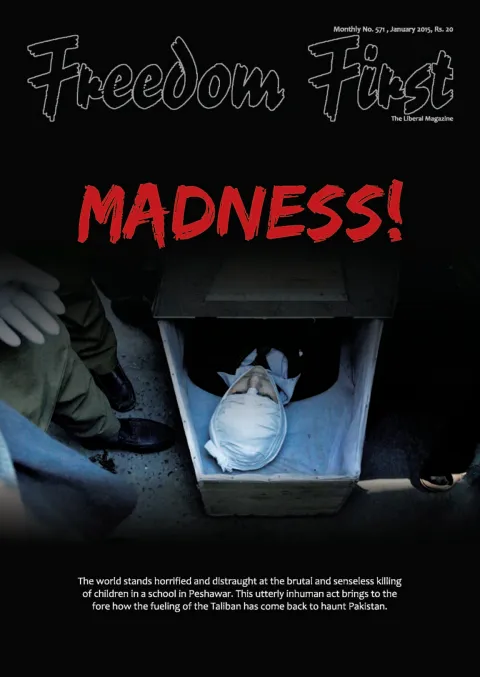
Freedom First No. 571 (January 2015), the Bombay-based classical-liberal monthly published by the Indian Committee for Cultural Freedom under editor S. V. Raju, opens under a stark “Madness!” cover mourning the December 2014 Taliban massacre of over 140 schoolchildren in Peshawar. The issue mixes reprinted institutional history (a 1951 Declaration on Cultural Freedom, reissued with a renewed appeal for reader feedback) with topical commentary on the first months of the Modi government: its “Act East”/“Link West” foreign policy, the Modi-Shah political partnership, the dissolution of the Planning Commission, and coalition politics in Maharashtra. Regular features carry the magazine’s characteristic mix of debate (Ashok Karnik’s “Point Counter Point” on the returnee jihadi Areeb Majid, the Baba Rampal siege, Mamata Banerjee, and the BJP-Shiv Sena alliance), watchdog journalism (threats to whistleblowing bureaucrats and reporters, judicial overreach and perceived corruption), a fifth instalment of a serialised study of agricultural indebtedness, three book reviews (on Parsi Bombay, Assam’s ULFA insurgency, and a 1971-war IAF prisoner-of-war memoir), an “Educating Adults” pair of features on legalising prostitution and RTI implementation failures, archival quotations from 1958-61, and a report on a Mumbai World Human Rights Day event marking 25 years since the Dalai Lama’s Nobel Peace Prize.
Essays
Declaration of Cultural Freedom
This opening item reprints, in full, the 1951 ‘Declaration on Cultural Freedom’ originally adopted by the Indian Committee for Cultural Freedom (ICCF) and first published in Freedom First’s inaugural issue of June 1952. A prefatory editorial note explains that the magazine had solicited reader responses to help update the six-decade-old Declaration for a present-day context marked by debates over the Arab Spring, digital-era privacy versus national security, and erosion of free speech even in established democracies — but reports that a planned conference to discuss revisions had to be shelved for lack of reader response, prompting this repeat appeal. The eight-point Declaration itself defines culture as both an individual and social phenomenon rooted in a free society, and frames the defence of cultural freedom as fundamentally the defence of a free society against the ‘gravest challenge’ posed by totalitarianism.
- Reprints the 1951 ICCF Declaration on Cultural Freedom, first carried in FF No. 1 (June 1952) and reprinted again in FF No. 558 (December 2013)
- Editorial note reports the planned reader conference to update the Declaration fell through due to lack of response
- Declaration’s eight numbered points define culture, free society, and the individual as the seat of cultural freedom
- Declaration frames totalitarianism as history’s gravest threat to cultural and spiritual freedom
Between Ourselves
By Editor
In the magazine’s regular editorial column, the editor recalls a November 2012 item celebrating Malala Yousafzai’s courage against religious extremism and notes she has since recovered and shared the 2014 Nobel Peace Prize with child-rights activist Kailash Satyarthi. Against that hopeful memory, the editor sets the issue’s grim cover story: the Peshawar school massacre in which more than 140 people, mostly children, were killed by Taliban gunmen. The column mourns the loss, questions whether the global outrage will translate into sustained action against the perpetrators, and closes by renewing the magazine’s year-old, still-unanswered appeal for reader input on updating the Cultural Freedom Declaration.
- Recalls Malala Yousafzai’s 2012 FF cover and notes her 2014 Nobel Peace Prize, shared with Kailash Satyarthi
- Reports the Peshawar school attack: over 140 killed, mostly schoolchildren, by Taliban gunmen
- Questions whether world outrage over Peshawar will lead to sustained action or fade
- Explains the cover was changed from a planned celebratory Malala-anniversary cover to the sombre ‘Madness!’ cover
- Renews the request for reader responses on the Cultural Freedom Declaration
From Our Readers
Four reader letters open the issue’s correspondence section. A Bangalore reader contrasts litter-strewn streets with the Swachh Bharat vision and calls for better bins, disposal systems and a plastics ban. A Mumbai reader diagnoses why litigation drags on for years, citing five recurring causes of adjournment from personal experience of a cheque-bounce case, and proposes capping postponements at three. A third letter derides the fractious regional parties descended from the old Janata Dal as ‘Jagada’ (quarrelling) Dals, arguing they splinter Indian society along caste and communal lines even as they now regroup to oppose the BJP. A fourth, from Secunderabad, urges India to emulate Germany’s Max Mueller Bhavans and China’s Confucius Institutes by establishing its own institutes of Indian culture abroad, named for Swami Vivekananda.
- Reader from Bangalore calls for systemic solid-waste management and a plastics ban to make Swachh Bharat real
- Reader from Mumbai lists five concrete reasons for chronic court adjournments and proposes a three-postponement cap
- Reader argues the various Janata Dal splinters are ‘Jagada’ (quarrelling) Dals that fragment Indian politics along caste lines
- Reader from Secunderabad proposes India build cultural-diplomacy institutes modelled on Germany’s Max Mueller Bhavans and China’s Confucius Institutes
Obituary: A Delayed Tribute to Two Outstanding Individuals
By Ed.
This delayed obituary column pays tribute to two figures associated with the magazine’s publishers, the ICCF, who died in 2014. A. D. (Aspi) Moddie, a former IAS officer and mountaineering conservationist who co-founded ICIMOD in Kathmandu, is remembered as a prolific writer and a spokesman of the liberal movement whose last FF article addressed the Cyrus Cylinder controversy shortly before his death at 93. Balraj Puri, a Jammu-based human-rights champion and political analyst who died at 86, is recalled for decades of work bridging communal and political divides in Kashmir — from the 1946 Quit Kashmir movement alongside Sheikh Abdullah to advising Jawaharlal Nehru and being consulted by Minoo Masani on Kashmir affairs, and helping conclude the 1974 Indira Gandhi-Sheikh Abdullah Accord. Puri’s honours included the Padma Bhushan and the Indira Gandhi Award for National Integration.
- A. D. Moddie (1921-2014), former IAS officer and Himalayan Club stalwart, co-founded ICIMOD and wrote several books including ‘Brahmanical Culture and Modernity’
- Moddie’s final FF contribution concerned the ‘Cyrus Cylinder’ exhibition in Mumbai, shortly before his death
- Balraj Puri (1928-2014) was a Jammu-based human-rights activist and political analyst active since the 1942 Quit India and 1946 Quit Kashmir movements
- Puri advised Nehru on Kashmir and helped conclude the 1974 Indira Gandhi-Sheikh Abdullah Accord
- Puri received the Padma Bhushan and the 24th Indira Gandhi Award for National Integration
Point Counter Point
By Ashok Karnik
Ashok Karnik’s recurring point-counterpoint feature stages four short debates on the month’s controversies. On the Kalyan youth Areeb Majid’s return from ISIS-held Iraq, one side condemns him as a self-confessed jihadi shielded by a weak justice system, while the other stresses the pull of online radicalisation and the strategic error ISIS made by holding visible territory. On Baba Rampal’s ten-day standoff in Hisar, one side blames blind faith and administrative timidity, the other defends the police’s caution and faults sensationalist media coverage. A third debate examines Mamata Banerjee’s clash with central agencies over the Saradha scam and Burdwan blast probes, and a fourth assesses the drawn-out, transactional BJP-Shiv Sena government formation in Maharashtra.
- Debates whether returnee jihadi Areeb Majid should be prosecuted despite an inconclusive investigation, and how ISIS recruits young Indians online
- Weighs whether the Haryana government’s ten-day, Rs. 26-crore operation to arrest godman Baba Rampal was excessive or necessary
- Examines Mamata Banerjee’s and the TMC’s handling of the Saradha chit-fund scam and Burdwan bomb-blast investigations
- Assesses the protracted, power-sharing BJP-Shiv Sena alliance talks in Maharashtra after Devendra Fadnavis became Chief Minister
- Closes with an external quote from a South African judge on equal justice for rich and poor
Foreign Relations in the 21st Century – “Look East” to “Act East” and “Link West”: New Direction and Dynamism in Indian Foreign Policy
By B. Ramesh Babu
B. Ramesh Babu surveys the ‘dynamism’ of Prime Minister Modi’s early foreign policy, tracing the shift from the older ‘Look East’ policy to a more energetic ‘Act East’ and a new ‘Link West’ orientation. He credits Vajpayee and, especially, P. V. Narasimha Rao for laying the groundwork, and reviews Modi’s November 2014 trip to Myanmar, Australia and Fiji, including his meeting with Aung San Suu Kyi, participation in the G-20 and free-trade talks with Australia, and outreach to the Indian diaspora and Pacific island states. The essay weighs Modi’s declared ‘Lakshman Rekhas’ with China and Pakistan against continuing border and terrorism frictions, notes a Chinese commentary inviting India into an ‘Indo-Pacific’ framework as a hedge against the US-Japan axis, and urges India to nurture its historic Russia relationship even while deepening ties with Washington, concluding that ‘Act East’ and ‘Link West’ have ‘come at the right time.’
- Traces Modi’s ‘Act East’/‘Link West’ foreign policy to the legacies of Vajpayee and P. V. Narasimha Rao
- Reviews Modi’s November 2014 visits to Myanmar (East Asia/ASEAN-India summits, meeting Aung San Suu Kyi), Australia (G-20, free trade) and Fiji
- Frames closer US ties as a hedge against China, alongside continuing China border tension (Chumar valley) and Pakistan-linked terrorism (Dec 5 J&K attacks)
- Notes a Chinese commentary proposing an ‘Indo-Pacific’ partnership with India as an alternative to the US-Japan ‘Asia Pivot’
- Urges India to sustain its historic Russia relationship (citing Putin’s planned December 2014 visit) even while pursuing ‘Link West’
Modi and his Alter-Ego
By Firoze Hirjikaka
Firoze Hirjikaka profiles the political partnership between Narendra Modi and Amit Shah as India’s new ‘Dynamic Duo,’ arguing Modi is ‘only halfway’ to his real goal of an outright BJP majority across the Rajya Sabha and the states. He credits the pair’s mastery of first-past-the-post arithmetic and Modi’s oratory for the Lok Sabha win despite under a third of the popular vote, and for the rapid marginalisation of the Congress — achieved, he argues, less through superior governance than through relentless messaging on corruption and black money and promises the author calls detached from common sense. He casts Shah as the enforcer who engineered the Maharashtra voice-vote trust motion and wore down Shiv Sena’s Uddhav Thackeray into a coalition on BJP’s terms, leaving Devendra Fadnavis as Chief Minister but Shah ‘calling the shots.’ The piece closes on the then-underway J&K assembly polls, read as a high-stakes symbolic test of Modi’s appeal in a Muslim-majority state.
- Frames Modi and Amit Shah as a political ‘Dynamic Duo’ exploiting first-past-the-post arithmetic to win a Lok Sabha majority with under a third of the popular vote
- Argues the BJP’s rout of Congress owed more to Modi’s oratory and messaging on corruption/black money than to a real performance gap between parties
- Describes Amit Shah’s tactics in engineering NCP’s ‘spontaneous’ voice-vote support and outlasting Shiv Sena in Maharashtra coalition talks
- Notes Modi’s promise to repatriate black money within 100 days and give Rs. 15 lakh to every Indian as an implausible but effective campaign pledge
- Reads the ongoing Jammu & Kashmir assembly election as a symbolically loaded test of Modi’s Mission 44/50 in a Muslim-majority state
Why China Wants to be a Full Member of SAARC
By Nitin G. Raut
Nitin G. Raut argues that China’s bid, backed by Sri Lanka, Bangladesh and Pakistan, to convert its observer status at SAARC into full membership is a calculated move to extend its regional hegemony rather than a benign gesture. He lays out the structural asymmetry of SAARC — India holds 70% of its landmass and five-sixths of its population — and argues that Chinese membership would give it a platform to link its Tibet rail/road network to the Bay of Bengal through the strategically sensitive ‘Chicken’s Neck’ corridor, dilute Indian leadership of the bloc, and offset ASEAN’s ties to Washington. He credits Modi’s outreach to Nepal, Bhutan and Pacific-island states, alongside deepened US strategic ties, as a hedge against Chinese ambitions.
- China, backed by Sri Lanka, Bangladesh and Pakistan, is pushing to upgrade from SAARC observer to full member status
- India dominates SAARC’s landmass (70%), population (5/6) and economy, but the bloc lacks a mechanism to resolve the India-Pakistan rivalry
- Chinese SAARC membership is read as a bid to link its Tibet rail network to the Bay of Bengal via the sensitive ‘Chicken’s Neck’ corridor and dilute Indian leadership
- China’s new BRICS Development Bank (Shanghai) and Asian Infrastructure Investment Bank are cited as parallel tools for regional monetary influence
- Recommends India use economic leverage to build a SAARC-ASEAN economic bloc that counters China while engaging it strategically
Constitution – As an Instrument of Governance
By B. N. Mehrish
B. N. Mehrish contrasts constitutional historian Granville Austin’s reading of the Indian Constitution as an instrument for social revolution with Dr. B. R. Ambedkar’s own vision as the Constitution’s chief architect, noting Ambedkar’s advocacy of state ownership of basic heavy industries alongside room for private enterprise. The essay pivots to Prime Minister Modi’s governance choices — his invocation of Swachh Bharat and Jan Dhan, praise for Martin Luther King’s civil-rights legacy, dissolution of the Planning Commission despite Ambedkar’s planning legacy, adoption of ‘Minimum Government, Maximum Governance,’ and plans for lateral entry of technocrats — reading these as steps toward the administrative overhaul Nehru himself once lamented failing to achieve.
- Contrasts Granville Austin’s account of the Constitution as a vehicle for social revolution with Ambedkar’s own vision of state-led heavy industry alongside private enterprise
- Notes Austin’s books have been cited by the Supreme Court in landmark judgments (Golaknath 1967, Kesavananda Bharati 1973)
- Reports Modi’s dissolution of the Planning Commission and its replacement with a ‘Think Tank,’ framed against Ambedkar’s planning advocacy
- Cites Modi’s declaration of December 25, 2014 (Vajpayee’s birthday) as ‘Good Governance Day’
- Closes on Nehru’s own admission that his greatest failure as PM was being unable to change India’s ‘colonial administration’
Threats to Upright Bureaucrats and the state of Investigative Journalism
By V. Krishna Moorthy
V. Krishna Moorthy uses the death of Washington Post editor Ben Bradlee and the decades-late 2005 unmasking of Watergate source ‘Deep Throat’ (FBI’s Mark Felt) as a frame for examining the perils facing whistleblowing Indian civil servants and journalists today. He surveys the harassment of Haryana bureaucrat Ashok Khemka and UP’s Shakti Nagpal before turning at length to Karnataka’s Rashmi Mahesh, Director General of the Administrative Training Institute in Mysore, who was manhandled and injured after her canteen-manager source — who had exposed a Rs. 100-crore scam at the institute — died in mysterious circumstances. The essay closes by invoking the UN’s 2012 Plan of Action on the Safety of Journalists and asks whether the Modi government will act to protect honest officers and reporters.
- Recalls the deaths of Washington Post editor Ben Bradlee (2014) and the 2005 unmasking of Watergate’s ‘Deep Throat’ as FBI official Mark Felt
- Cites the ANI journalists’ unlawful detention while questioning Robert Vadra about land deals as a recent press-freedom flashpoint
- Details Karnataka bureaucrat Rashmi Mahesh’s ordeal: assault, injuries, and a disciplinary notice after her whistleblowing source died mysteriously amid a Rs. 100-crore institute scam
- Cites the 2012 UN Plan of Action on the Safety of Journalists and Impunity, and November 2 as International Day to End Impunity for Crimes against Journalists
- Closes by asking whether the Modi government will reform All-India Services rules to protect honest civil servants
Some Thoughts on Our Judiciary and the Media
By H. R. Bapu Satyanarayana
H. R. Bapu Satyanarayana argues that while India’s assertive judiciary is broadly welcome, judges sometimes indulge in extra-judicial pronouncements that overreach their role, citing Chief Justice H. L. Dattu’s remarks on black-money disclosure and a court observation that cleaning the Ganga would take 200 years. He surveys perceptions of judicial corruption — from Prashant Bhushan’s 2010 claim that eight of sixteen past Chief Justices of India were corrupt, to Transparency International findings that 77% of Indians see the judiciary as corrupt — and quotes lawyer Indira Jaising’s Outlook essay on hereditary privilege and gender bias within the legal profession. Turning to the ‘Fourth Estate,’ the author credits India’s media with a largely positive record but criticises television’s addiction to manufactured ‘Breaking News’ and one-sided anchoring, and print media’s undisguised partisan alignment.
- Criticises judicial overreach and ‘extra-judicial pronouncements,’ citing CJI H. L. Dattu on black money and a court remark that cleaning the Ganga would take 200 years
- Cites Prashant Bhushan’s 2010 claim that 8 of 16 past CJIs were corrupt, and Transparency International data that 77% of Indians perceive the judiciary as corrupt
- Quotes Indira Jaising’s Outlook article on hereditary privilege, sycophancy and gender discrimination within the Indian judiciary and legal profession
- Praises Indian media’s overall vigour but faults TV’s ‘Breaking News’ culture and one-sided anchoring, and print media’s undisguised partisan bias
- A closing boxed excerpt (from Mint, Dec 9 2014) frames the Planning Commission’s demise as overdue given its curtailment of market forces since 1991
The Rural Perspective: Agriculture and Rural Indebtedness - V
By R. M. Mohan Rao
In the fifth instalment of his serialised study, R. M. Mohan Rao continues examining the cost structure and profitability of Indian agriculture. He reviews divergent official estimates of the farm terms of trade since the late 1970s, arguing that despite favourable macro policies, higher per-capita agricultural output has produced adverse terms of trade for farmers relative to manufacturing. Turning to technology, he credits Green Revolution-era advances for raising foodgrain output but faults their narrow focus on irrigated tracts and high-yield varieties for neglecting dryland regions, ‘orphan crops,’ small and marginal farmers, and post-harvest value addition. He extends this critique to agricultural extension and marketing, and closes on rural social infrastructure, arguing that poor-quality schools and underfunded health centres compound farmers’ debt burden.
- Farm terms-of-trade studies (1978-79 to 1999-2000) show that despite favourable macro policy, higher agricultural output produced worse terms of trade for farmers relative to manufacturing
- Green Revolution technologies boosted foodgrain output but neglected dryland areas, ‘orphan crops,’ post-harvest value addition and small/marginal farmers
- Agricultural extension services, designed for disseminating pre-set high-yield-variety practices, have struggled to serve diversified, rain-fed farming systems
- Regulated agricultural markets lack storage, grading and processing infrastructure, leaving commission agents and traders dominant and MSP poorly implemented
- Poor rural education and underfunded Primary Health Centres push farm families toward costly private alternatives, deepening rural indebtedness
Missing the Whole Picture
By Tsewang Sonam
Tsewang Sonam argues that Indian mainstream media covers Tibet only episodically — during border intrusions or major protests — missing the deeper story of Chinese media suppression and Tibetan resistance. He draws a parallel between the 2014 Hong Kong pro-democracy protests and the Tibetan movement, notes that 132 Tibetans have self-immolated in protest against Chinese rule and the exile of the Dalai Lama, and reports on the Tibetan government-in-exile’s rebuffed ‘Middle Way’ approach seeking autonomy rather than independence. Citing the Foreign Correspondents’ Club of China’s reporting on restricted access for foreign journalists, the essay calls for independent, in-depth reporting inside Tibet.
- Argues Indian media covers Tibet only opportunistically, around border intrusions or major protests, missing the underlying story
- Draws a direct parallel between the 2014 Hong Kong protests and the Tibetan freedom movement
- Reports 132 Tibetan self-immolations in protest against Chinese rule and demanding the Dalai Lama’s return
- Notes China’s rejection of the Tibetan government-in-exile’s ‘Middle Way’ autonomy proposal despite Western support
- Cites the Foreign Correspondents’ Club of China on continued restrictions for foreign journalists in Tibet
Book Reviews
By S. V. Raju; Brig. Suresh C. Sharma; K. S. Nair
Three books are reviewed in this issue. FF editor S. V. Raju reviews Sheryar Ookerjee’s ‘Altamont Road and Other True Stories’ (K. R. Cama Oriental Institute), a memoir-anthology of Parsi anecdotes centred on the Cursetjee family and Bombay’s Parsi elite. Brig. Suresh C. Sharma reviews Nani Gopal Mahanta’s ‘Confronting the State: ULFA’s Quest for Sovereignty’ (Sage), tracing the United Liberation Front of Assam’s origins in Assamese alienation over immigration, language and economic neglect, and its declining popular support after indiscriminate violence including the 2004 Dhemaji bombing that killed 14 schoolchildren. K. S. Nair reviews Dhirendra S. Jafa’s ‘Death Wasn’t Painful’ (Sage), a re-released 1971-war memoir of an Indian Air Force pilot shot down and held as a Pakistani prisoner of war.
- Reviews ‘Altamont Road and Other True Stories’ by Sheryar Ookerjee: Parsi-community anecdotes centred on the Cursetjee family, reviewed by S. V. Raju
- Reviews ‘Confronting the State: ULFA’s Quest for Sovereignty’ by Nani Gopal Mahanta: traces ULFA’s rise, its declining support after the 2004 Dhemaji bombing, and the Indian state’s conflict-suppression approach
- Reviews ‘Death Wasn’t Painful’ by Dhirendra S. Jafa: a 1971-war IAF pilot’s PoW memoir, compared with Faith Johnstone’s ‘Four Miles to Freedom’
- The ULFA review criticises the author for missing the issue of development-fund misuse by local leaders and calls for greater fiscal autonomy for Indian states
Educating Adults: Legalise Prostitution: Shift the Onus on the State
By Hina Manerikar
In the ‘Educating Adults’ feature, Hina Manerikar argues against legalising prostitution in India, framing it as a socio-economic problem rather than one of legality. She engages TISS professor Vijay Raghavan’s warning that legalisation could increase trafficking and hinder police access to premises used to exploit women, and questions whether licensing genuinely emancipates poverty-driven sex workers. Weighing Sweden’s asymmetric model — where selling sex is legal but buying it is criminalised — she cites researchers who admit the evidence for its success is inconclusive, partly because internet-based solicitation has changed the market independent of the law. She concludes that India’s weak enforcement machinery makes new legislation futile, and that patriarchy and neglect of the girl child are the deeper causes requiring civil-society and parental action.
- Argues prostitution is a socio-economic problem, not one solvable through legalisation or licensing
- Cites TISS professor Vijay Raghavan on the risk that legalisation increases trafficking and hampers police access to exploitative premises
- Raises the under-discussed question of male prostitution and whether legalisation debates should extend to it
- Examines Sweden’s model (selling legal, buying criminalised) and notes researchers’ own admission that its success is inconclusive amid rising internet-based solicitation
- Concludes that patriarchal attitudes and neglect of the girl child, not absence of legislation, are the root causes requiring civil-society and parental action
Educating Adults: Review of the Right to Information (RTI)
By N. S. Venkataraman
N. S. Venkataraman summarises a September 2014 Chennai meeting convened by the NGO Nandini Voice for the Deprived to review the Right to Information Act’s implementation. Participants identified systemic failures: the thirty-day reply deadline routinely ignored, appeals to Information Commissioners handled tepidly, no transparent process for appointing Information Commissioners or Public Information Officers, personal security threats to RTI activists after departments leak complainants’ identities, and Consumer Courts declining to entertain RTI-related grievances. The piece concludes that RTI activism has effectively become an unpaid full-time job, and that the Act’s poor implementation reflects broader deficiencies in governance quality.
- Summarises a Chennai meeting of RTI activists convened by Nandini Voice for the Deprived (September 21, 2014)
- Reports the thirty-day reply deadline is routinely missed and appeals to Information Commissioners are handled tepidly
- Notes the lack of transparent, expertise-based criteria for appointing Information Commissioners and Public Information Officers
- Highlights personal security threats to RTI activists after departments leak their identities to affected parties
- Concludes that poor RTI implementation reflects the broader quality of governance at both central and state levels
Many Voices – From the Past
This recurring feature compiles pointed quotations from FF’s archive and contemporary press dating between 1958 and 1961, on subjects ranging from Cold War non-alignment and the Sino-Indian border dispute to criticism of Krishna Menon and the Planning Commission. Quotes include Jayaprakash Narayan’s warning that Sarvodaya workers would find themselves ‘behind bars’ under communism, Nehru’s shifting statements on China before and after the 1962 war, sharp attacks on V. K. Krishna Menon’s conduct as Defence Minister, and Acharya Vinoba Bhave’s remark that India’s welfare state was in fact an ‘illfare state.’
- Compiles historical quotations from FF and the Indian press, dated 1958-1961
- Jayaprakash Narayan predicts communist India would jail Sarvodaya workers
- Nehru is quoted from 1954 and 1959 minimising the China threat, and again in 1961 endorsing the crushing of the Tibetan rebellion while distinguishing it from ‘repression’
- Sharp press attacks on Defence Minister V. K. Krishna Menon call for his removal from office
- Acharya Vinoba Bhave calls India’s welfare state an ‘illfare state’
World Human Rights Day
By Rohit Singh
Rohit Singh reports on a World Human Rights Day event held on 10 December at Sharada Hall, Dadar, jointly organised by Friends of Tibet’s Mumbai chapter and the Tibetan Sweater Sellers Association, marking the 25th anniversary of the Dalai Lama’s Nobel Peace Prize. FF editor S. V. Raju was chief guest and recalled having raised the issue of Chinese occupation of Tibet as early as 1955. Speakers included author Ajay Agarwal on Tibet’s pre-invasion history, Friends of Tibet coordinator C. A. Kallianpur on Tibet’s bearing on India’s border security, and poet-activist Tenzin Tsundue, who linked the Hong Kong ‘Umbrella Revolution’ to the Tibetan cause.
- Reports a Mumbai World Human Rights Day event (10 Dec) marking 25 years since the Dalai Lama’s Nobel Peace Prize
- Jointly organised by Friends of Tibet Mumbai and the Tibetan Sweater Sellers Association at Sharada Hall, Dadar
- FF editor S. V. Raju, chief guest, recalled raising the Tibet occupation issue as early as 1955
- Speakers included author Ajay Agarwal, Friends of Tibet’s C. A. Kallianpur, and poet-activist Tenzin Tsundue, who drew a parallel to Hong Kong’s ‘Umbrella Revolution’
Generated by the v1.5 extraction pipeline. Awaiting editorial review.
Metadata and summary are AI-extracted from the source PDF and reviewed for editorial accuracy. The original work is available via the Read PDF tab above (where present); paragraph-level citation inside the PDF is deferred to a future engagement.