
periodical issue
Freedom First
The Liberal Magazine
Edited by S. V. Raju
PUBLISHERS: Indian Committee for Cultural Freedom (ICCF) 3rd floor, Army & Navy Building, 148, Mahatma Gandhi Road, Mumbai 400001. PUBLISHED BY J. R. Patel for the ICCF and printed by him at Union Press, 13, Homji Street, Fort, Mumbai 400001. · Mumbai · 2015
36 pages
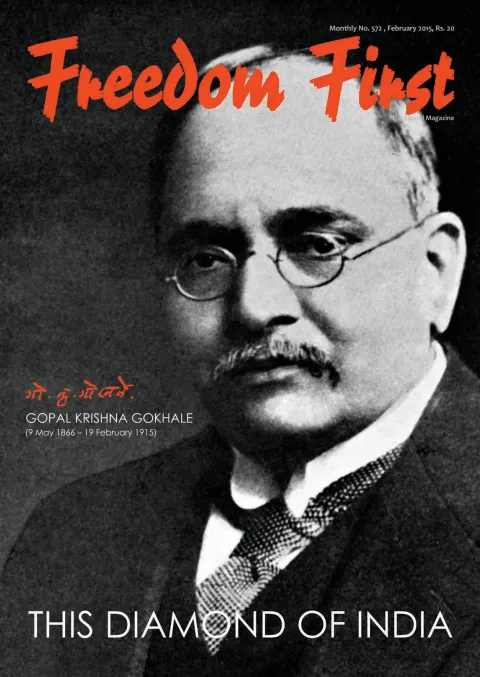
Freedom First
Summary
Freedom First No. 572 (February 2015) is a special issue dedicated to Gopal Krishna Gokhale on the centenary of his death (19 February 1915), timed around a day-long symposium on “Gokhale’s Legacy” held on 15 November 2014 by the Indian Committee for Cultural Freedom with the Project for Economic Education, the Indian Secular Society and LiberalsIndia for Good Governance. The bulk of the issue — an editorial note, an excerpted A. B. Shah foreword, and essays by S. P. Aiyar, Aroon Tikekar, Sunil Gokhale (Gokhale’s great-grandson), Prabha Ravi Shankar, Godrej N. Dotivala and R. Srinivasan, plus a student report on the symposium — traces Gokhale’s life, his mentorship under Mahadev Govind Ranade, his moderate constitutionalist politics against Tilak’s extremism, his founding of the Servants of India Society, his influence on Gandhi as ‘political guru’, and tributes from contemporaries such as Pherozeshah Mehta.
The remainder of the issue turns to current affairs: M. R. Venkatesh assesses whether Budget 2015 can deliver ‘Make in India’; Ashok Karnik’s ‘Point Counter Point’ debates the Bengaluru ISIS-tweeter case, the Peshawar school massacre, Hindutva overreach, and the Coast Guard’s sinking of a suspected Pakistani smuggling boat; B. Ramesh Babu analyses a shifting global balance of power towards renewed bipolarity; Firoze Hirjikaka and Bapu Satyanarayana both worry that Hindutva zealots within the BJP/RSS are undermining Narendra Modi’s development agenda; Ashish Punthambekar considers the Peshawar attack’s implications for Pakistan’s stability and NATO strategy; and a book review by Dr. Ali Khwaja covers Raphael Susewind’s study of Muslim peace workers in post-2002 Gujarat. The issue closes with symposium photographs and a back-cover ‘Je Suis Charlie’ tribute condemning the Charlie Hebdo killings.
Essays
New Publications
The editor’s note (“Between Ourselves”) explains that the issue is dedicated to Gopal Krishna Gokhale on his death centenary, recalling the 1966 ICCF birth-centenary lectures published as ‘Gokhale and Modern India’, and reports on the 15 November 2014 symposium on ‘Gokhale’s Legacy’ organised jointly by the ICCF, the Project for Economic Education, the Indian Secular Society and LiberalsIndia for Good Governance, chaired by Dr. Usha Thakkar with a keynote by Aroon Tikekar and talks by Sunil Gokhale, Dr. Vibhuti Patel, economists Sunil Bhandare and Dr. C. S. Deshpande, R. N. Bhaskar and Godrej Dotivala, attended by 85 students, academics and professionals.
- The issue is formally dedicated to Gopal Krishna Gokhale (1866-1915) on the centenary of his death.
- It recalls the 1966 ICCF birth-centenary lectures published as ‘Gokhale and Modern India’.
- It reports on the 15 November 2014 symposium ‘Gokhale’s Legacy’, chaired by Dr. Usha Thakkar with keynote by Aroon Tikekar.
- 85 students, academics, professionals and senior corporate executives attended the symposium.
Between Ourselves: Gopal Krishna Gokhale 1866-1915
By Editor
An excerpt from A. B. Shah’s 1966 foreword to ‘Gokhale and Modern India’ introduces Gokhale as a figure of reason and liberalism in Indian public life — modern but not estranged from his people, agnostic yet devoted to truth, patriotic without chauvinism — and frames him as the most important exponent of liberalism as the basis of a modern democratic welfare state.
- Shah situates Gokhale among a generation of nation-builders born in the second half of the 19th century.
- He characterises Gokhale as modern, agnostic, morally courageous and free of vanity.
- He frames Gokhale as the leading Indian exponent of reason and liberalism in public life.
The Legacy of Gopal Krishna Gokhale - Introduction
By A. B. Shah
S. P. Aiyar’s introduction to ‘Gokhale and Modern India’ surveys Gokhale’s 49-year life as one of grandeur and tragedy: his physical collapse under the strain of the Islington Commission, his moral inheritance from Ranade’s ‘humanise, equalise, spiritualise’ philosophy, his founding of the Servants of India Society, and his famous farewell address on leaving Fergusson College in 1902. It contrasts Gokhale’s confidence in reasoned persuasion and constitutional method with Gandhi’s and Tilak’s more radical approaches, noting that Gokhale feared passive resistance would erode the ‘foundations of public life’ and habituate the masses to disobedience, while still being revered by Gandhi as a ‘political guru’ despite an enduring philosophical gulf between them.
- Gokhale’s premature death in 1915 followed years of physical strain, including his work on the Islington Commission (1912).
- Ranade shaped Gokhale’s belief that progress requires simultaneous political, social and economic reform (‘a functioning synthesis’).
- Gokhale’s farewell address to Fergusson College (1902) is presented as one of his most moving personal statements.
- Gokhale and Gandhi diverged fundamentally on Western civilisation: Gokhale trusted Western science and institutions, Gandhi distrusted them.
- Gokhale feared that passive resistance/non-cooperation would teach the masses habits of disobedience and undermine constitutional government.
Laying the Foundation for a Modern India
By S. P. Aiyar
Aroon Tikekar’s essay, based on a speech at Fergusson College, argues for Gokhale’s continuing relevance as the ‘Gladstone of India’ and the greatest creation of Ranade’s liberal tradition. It surveys Gokhale’s European-style liberalism (individualism, constitutionalism, laissez faire), his refusal to perform ritual purification after sea voyages unlike Tilak, his relationships with Sarla Ray and other Poona contemporaries, and his enduring but paradoxical bond with Gandhi and Jinnah, both of whom sought his mentorship. It closes by noting that Tilak, Gokhale’s great rival, still eulogised him at his funeral as ‘this diamond of India’.
- Gokhale is presented as a product of Ranade’s liberal tradition, but of a purer European liberalism than Ranade’s own Indian-inflected version.
- Gokhale refused to perform suddhikaran (ritual purification) after his sea voyages to Britain, unlike Tilak.
- Sarla Ray, grandmother of Satyajit Ray, challenged Gokhale over wearing the sacred thread; he reportedly cut it in response.
- Both Gandhi and Mohammed Ali Jinnah sought to be seen as Gokhale’s political heirs, Jinnah aspiring to be the ‘Muslim Gokhale’.
- Tilak’s funeral tribute to Gokhale as ‘this diamond of India’ is presented as evidence of Gokhale’s stature even among rivals.
His Relevance Today
By Aroon Tikekar
Sunil Gokhale, the subject’s great-grandson, catalogues Gopal Krishna Gokhale’s ‘phenomenal achievements’ across a 31-year working life: an early Marathi arithmetic textbook, his role as India’s spokesman in the Imperial Legislative Council’s budget debates from 1901-1914, his pioneering 1891 call to reduce the Salt Tax decades before Gandhi’s Dandi March, his Elementary Education Bill (1910) and Indentured Labour Bill, and his continuing reputation abroad in former colonies such as Mauritius and Fiji. It closes on Gokhale’s insistence on unity in diversity and secularism, and his enduring but asymmetrical bond with Gandhi and Jinnah.
- At 30 Gokhale wrote a 450-page Marathi arithmetic textbook that earned him international royalties.
- Gokhale first proposed reducing the Salt Tax at a Congress session in 1891, decades before Gandhi’s 1930 Dandi March.
- His 1910 Elementary Education Bill and Indentured Labour Bill are presented as still-relevant achievements.
- Gokhale is remembered abroad: Mauritius has a Gokhale Hall and Fiji a Gokhale School.
- Despite deep mutual respect, Gandhi never joined Gokhale’s Servants of India Society and ultimately rejected his faith in Western institutions.
His Achievements
By Sunil Gokhale
Prabha Ravi Shankar reconstructs the second meeting of Gokhale and Gandhi, at Calcutta in late 1901-January 1902, when Gandhi stayed under Gokhale’s roof for over a month. It describes Gandhi’s two Albert Hall lectures on his South African experiences, Gokhale’s lavish public praise of Gandhi (which once made Gandhi visibly uncomfortable), and the personal intimacy Gandhi later described in his Autobiography, alongside their real temperamental differences over frugality, food and Western civilisation.
- Gandhi and Gokhale’s second meeting (Calcutta, late 1901) sealed a lifelong friendship after Gandhi lived under Gokhale’s roof for a month.
- Gokhale organised Gandhi’s Albert Hall lectures on Indian grievances and the Boer War ambulance corps.
- Gandhi found Gokhale’s public praise ‘too lavish and generous’ on at least one occasion.
- Gandhi’s Autobiography describes meeting Gokhale as ‘a case of love at first sight’.
- Gokhale persuaded Gandhi to return to India via England in August 1914, delaying his return until January 1915.
Gokhale and Gandhi - Their Second Meeting
By Prabha Ravi Shankar
Godrej N. Dotivala reproduces Sir Pherozeshah Mehta’s grief-stricken condolence speech at the 5 March 1915 Bombay Town Hall meeting for Gokhale, in which Mehta — himself elderly and having recently lost colleagues Telang, Ranade and Badruddin Tyabji — says words fail him to eulogise Gokhale, quotes Tennyson’s ‘the touch of a vanished hand’, and is described as receiving spontaneous, emotional applause led by Lady Willingdon.
- A public condolence meeting for Gokhale was held at Bombay Town Hall on 5 March 1915, presided over by Governor Lord Willingdon.
- Pherozeshah Mehta, ‘the Uncrowned King of India’, found himself too moved to give a conventional eulogy.
- Mehta laments the recent deaths of Telang and Ranade alongside Gokhale, evoking a passing generation of Bombay liberals.
- Mehta’s address was met with spontaneous applause, with Lady Willingdon clasping his hand in congratulation.
Sir Pherozeshah Mehta’s Tribute
By Godrej N. Dotivala
R. Srinivasan profiles six Poona-region intellectuals and reformers who were contemporaries of Gokhale and Ranade’s circle: Bal Shastri Jhamkedkar, Lokhitavadi Gopal Hari Deshmukh, Jotiba Phule, Vishnu Shastri Chiplunkar, Gopal Ganesh Agarkar, and D. K. Karve, describing their educational, journalistic and social-reform work. A closing boxed item (sourced to Wikipedia) profiles Rt. Hon. V. S. Srinivasa Sastri’s close, sometimes strained, relationship with Gandhi, including his editorial corrections to Gandhi’s autobiography.
- Jotiba Phule (1827-1889) is described as identifying Brahminism as the source of Dalit and women’s oppression while opposing all religious creeds.
- D. K. Karve married a child widow, faced social ostracism, and built institutions for women’s education, later winning the Padma Vibhushan (1955).
- Gopal Ganesh Agarkar and Tilak, once close, became bitter rivals editing rival papers Kesari and Maratha from the same New English School.
- The boxed sidebar on Srinivasa Sastri notes he opposed Gandhi’s non-cooperation movement and later advised against accepting Partition.
Some Contemporaries of Gokhale in Poona
By R. Srinivasan
Four Guru Nanak Khalsa College B.A. students report on the 15 November 2014 symposium, summarising its eight sessions (talks by Aroon Tikekar, Sunil Gokhale, Godrej Dotivala, Dr. Vibhuti Patel, R. N. Bhaskar, Sunil Bhandare and Dr. C. S. Deshpande) and recapping Gokhale’s biography from his birth in Katluk village (1866) through Fergusson College, the Servants of India Society, and his death in 1915, closing with Tilak’s funeral tribute.
- The symposium had eight sessions including a closing Q&A, chaired in the morning by Dr. Usha Thakkar.
- Dr. Vibhuti Patel’s session highlighted insufficient stress on women’s empowerment and participation in governance.
- R. N. Bhaskar’s talk on ‘Indian Strategy Blindness’ argued for developing sea transport to exploit India’s coastline cheaply.
- The report recaps Gokhale’s biography: born 1866 in Katluk (Ratnagiri district), Fergusson College co-founder, Servants of India Society founder (1905), died 1915.
- The students found the symposium changed their ‘mindsets’ about Gokhale’s importance to modern India.
The Symposium held on 15th November, 2014 - Report
M. R. Venkatesh questions whether Budget 2015 can deliver on ‘Make in India’, arguing that manufacturing’s 16% GDP share has stagnated since the 1980s despite successive government reports (2006 NMCC, 2011 report) diagnosing the same problems of infrastructure, regulation and skilled labour. He cites a large net capital-goods import bill (~USD 568 billion, 2007-14) and trade deficit (~USD 950 billion), notes China’s contrasting export-led success, and concludes the Finance Minister faces a genuine Hobson’s choice between import protection and unrestrained competition.
- Manufacturing’s share of India’s GDP has stagnated at roughly 16% since the 1980s.
- The 2006 NMCC strategy and a 2011 Government of India report both diagnosed the same structural problems without resolving them.
- India’s net capital-goods imports (2007-08 to 2013-14) totalled roughly USD 568 billion; the aggregate trade deficit over the same period was about USD 950 billion.
- China achieved a trade surplus of nearly USD 300 billion (matching India’s total annual exports) partly by systematically pursuing export competitiveness.
- Venkatesh calls for the Finance Minister to set a concrete roadmap and revisit targets quarterly rather than making distant 2025 promises.
Budget 2015 - Will it Ensure Make in India
By M. R. Venkatesh
Ashok Karnik’s recurring ‘Point Counter Point’ feature presents opposing viewpoints on four current issues: the radicalisation of educated ‘lone wolf’ jihadis such as Mehdi Mansoor Biswas; the Peshawar school massacre’s ‘unspeakable cruelty’; loose-cannon Hindutva activism (‘Loose Cannons’) since the BJP took power; and the Coast Guard’s sinking of a suspected Pakistani smuggling/terror boat off Gujarat.
- The Biswas case is framed as part of a wider ‘lone wolf’ terrorism phenomenon alongside the Ottawa and Sydney attacks.
- The Peshawar attack is presented as revenge by the Pakistani Taliban (TTP) against the army’s Zarb-e-Azb operation, targeting officers’ children.
- The ‘Loose Cannons’ section criticises pseudo-scientific claims about ancient Indian nuclear weapons and aircraft aired at the Indian Science Congress.
- The Ghar Wapsi reconversion campaign and RSS chief’s ‘Hindu Rashtra’ remarks are framed as self-defeating for the BJP’s development agenda.
- The Coast Guard boat-sinking incident is debated as either a vindicated anti-terror success or an unexplained overreaction.
Point Counter Point
By Ashok Karnik
B. Ramesh Babu (part one of a continuing series) argues the global power structure is shifting back towards bipolarity, driven by the not-so-peaceful rise of China and the political/economic decline of the US. He surveys the US-China-India trilateral, Modi’s efforts to strengthen ties with both the US (Obama’s planned Republic Day visit, US-Japan-India-Australia dialogue) and China/Russia (nuclear deals, trade), and the deepening China-Russia entente amid Western sanctions over Ukraine, concluding the piece ‘to be continued’.
- The essay identifies the US-China-India relationship as ‘the fulcrum of global politics in the 21st century’.
- Modi’s foreign policy is credited with reviving investor confidence and advancing the India-US-Japan-Australia strategic dialogue.
- China is described as responding cautiously to India’s tilt towards the US by proposing an alternative Indo-Pacific-Geo-Economic Plan.
- Western sanctions over Crimea have pushed Russia into a deepening energy and defence partnership with China, reversing their historic senior-junior roles.
- The article is explicitly presented as unfinished, ending ‘To be continued’.
Foreign Relations in the 21st Century - Global Power Structure in Transition: A New Bipolar World Underway?
By B. Ramesh Babu
Firoze Hirjikaka argues the BJP has a ‘split personality’ between Modi’s development-focused faction and RSS-anchored Hindutva zealots (Ghar Wapsi, VHP/Bajrang Dal cinema vandalism, ancient-glory pseudoscience) that is undermining ‘minimum government, maximum governance’. He criticises Modi’s parliamentary silence, Jaitley’s ordinance-driven reforms, and concludes the government ‘cannot have a leg in both camps’.
- The BJP is portrayed as split between Modi’s development-focused wing and an RSS-anchored Hindutva faction.
- Modi’s silence during Opposition attacks in the winter Parliament session is read as calculated confidence rather than weakness.
- Jaitley’s use of ordinances (coal-block auctioning, FDI in insurance) is criticised as hypocritical given the BJP’s past objections to the same tactic.
- Fringe RSS-linked pseudoscience claims (ancient nuclear weapons, aircraft) at the Indian Science Congress are cited as embarrassing ‘looniness’.
- The essay concludes the government must choose between its development agenda and tolerating Hindutva fringe elements.
Will the Real BJP Please Stand Up?
By Firoze Hirjikaka
Bapu Satyanarayana credits Modi with electoral successes across Haryana, Maharashtra, Jharkhand and Jammu & Kashmir, but argues near-daily provocative statements from RSS organisations and some BJP ministers (Sadhvi Niranjan Jyoti’s ‘Ramzaadas/Haramzaadas’ remark, Sakshi Maharaj calling Godse a patriot, Ghar Wapsi, Ashok Singhal’s ‘800-year lost empire’ comment) are creating disenchantment and threatening to derail his development agenda, while an unauthenticated report suggested Modi himself felt undermined by the zealotry.
- Modi’s government is credited with electoral wins in Haryana, Maharashtra (with Shiv Sena), Jharkhand and strong J&K results.
- Congress is accused of obstructionist tactics forcing the government toward rule by ordinance.
- Named provocations include Sadhvi Niranjan Jyoti’s ‘Ramzaadas and Haramzaadas’ remark and Sakshi Maharaj calling Gandhi’s assassin Nathuram Godse a patriot.
- An unauthenticated Marathi press report claimed Modi had threatened to quit over the damage done by right-wing zealots.
- The essay frames Modi’s ‘domestic image’ as the ultimate key to his government’s popularity and stability.
Right-Wing Zealots Are Derailing Modi’s Push for a Development Agenda
By Bapu Satyanarayana
Ashish Punthambekar argues the Peshawar school massacre has permanently cost the Taliban Pakistani public support, giving NATO/the West a rare opening to recognise Balochistan and Sindh as independent states. He presents a ‘binary choice’ facing Pakistan — continue sponsoring terrorism and fail slowly, or disengage and risk a bloody civil war with Sindh/Baloch secession — and predicts an externally driven, NATO-led ‘failure oriented strategy’ toward a fragmenting Pakistan, illustrated with a map of a hypothetical 2020 partition.
- The Peshawar attack is compared to the 2004 Beslan school siege in Russia, which similarly cost Chechen militants public support.
- A 2012 US House bill calling for Balochistan’s independence is cited as a sign such a process could accelerate.
- Pakistan is said to face a ‘false binary’: continue supporting militants and fail, or disengage and risk civil war and Sindh/Baloch secession.
- The essay predicts the West will eventually see no strategic reason to keep Pakistan unified once its usefulness against militants ends.
- An accompanying map depicts a hypothetical 2020 Pakistan split into independent Balochistan, Sindh and Punjab, with NWFP/FATA/PoK ‘reunited’ with Afghanistan/India.
The Peshawar Attack on School Kids
By Ashish Punthambekar
Dr. Ali Khwaja reviews Raphael Susewind’s ‘Being Muslim and Working for Peace: Ambivalence and Ambiguity in Gujarat’ (Sage, 2013), praising its bias-free, deeply researched portrait of secular-NGO and faith-based Muslim peace workers rebuilding trust after the 2002 Gujarat riots. The review highlights the book’s attention to language and religious ambivalence, its account of women’s emancipation through peace work and micro-credit, and closes by quoting an interviewee’s hopeful reframing of division as ‘good and bad people’ rather than Hindu or Muslim.
- The book studies Muslim peace workers who helped restore normalcy in Gujarat after the 2002 riots, split into secular-NGO and Faith Based Organisation (FBO) categories.
- The German author’s fieldwork is praised for being free of bias against Hindus, Muslims, or the perpetrators of the riots.
- The book documents Muslim women’s emancipation through peace activism and micro-credit schemes.
- The review closes with an interviewee’s hopeful reframing of communal division as a matter of ‘good and bad people’, not religion.
Generated by the v1.5 extraction pipeline. Awaiting editorial review.
Metadata and summary are AI-extracted from the source PDF and reviewed for editorial accuracy. The original work is available via the Read PDF tab above (where present); paragraph-level citation inside the PDF is deferred to a future engagement.