
periodical issue
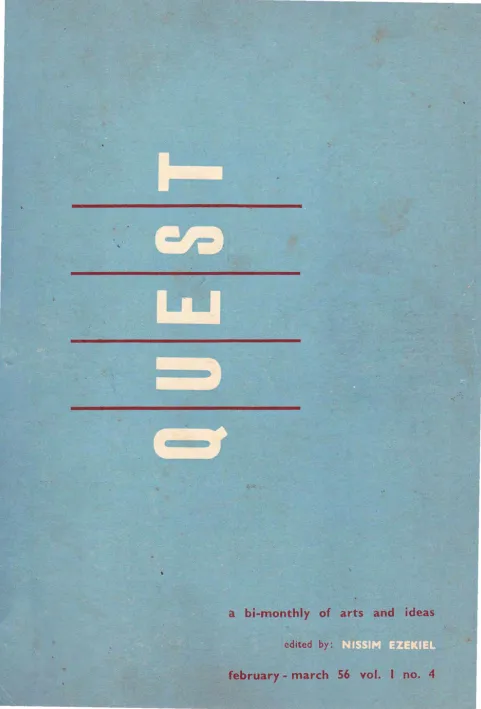
Quest
a bi-monthly of arts and ideas
By Satindra Singh, Hamdi Bey, Tomoo Otaka, D. G. Nadkarni, S. Ookerjee, Rene Tavernier, Roop Kathak, Krishan Sondhi, Uma Anand, Sadanand Bhatkal, Foy Nissen, A. Subbiah, S. S. Saha, S. P. Sethna
QUEST is published once every two months ... at Army & Navy Building, 148, Mahatma Gandhi Road, Bombay 1. · Bombay · 1956
76 pages
QUEST
Summary
QUEST Vol. I No. 4 (February-March 1956), edited by Nissim Ezekiel for the Indian Committee for Cultural Freedom, opens with an unsigned editorial worrying at the line between legitimate ‘agitation’ and mob rule in the wake of the States Reorganisation Commission report and the Bengal-Bihar merger controversy, then runs six articles (on the prospects of Indian democracy against Communism, the ethical thinness of the Indian novel, the peculiar non-totalitarian shape of Japanese authoritarianism, a satirical dispatch from a Marathi literary conference at Pandharpur, a mocking account of the 1955 Indian Philosophical Congress, and Rene Tavernier’s regular political-cultural letter from France), a short story translated from the Marathi, a theatre/dance/cinema section (Bharat Natyam and Kathak, the Kerala dance-form Ottam-Thullal, the 1955 Frankfurt Book Fair, and Satyajit Ray’s Pather Panchali), ten book reviews, and three letters on Tamil Brahmin/non-Brahmin linguistics, Indian dress, and a Marie Seton film seminar. Contributors are a mix of journalists, academics and the magazine’s own reviewers-in-house (several signing only with initials), and the issue’s argumentative centre of gravity is anti-Communist, pro-democratic and cosmopolitan, consistent with its sponsorship by the Cold War-era Congress for Cultural Freedom network — made explicit in an unlisted back-of-book note reporting the Indian Committee for Cultural Freedom’s Third Annual General Meeting (with Nicolas Nabakov of the parent Congress for Cultural Freedom as guest of honour, and Minoo Masani, Philip Spratt and Jayaprakash Narayan among the newly elected Executive Committee). Beyond the printed contents page, the issue also carries two tipped-in photographic/art plates not listed anywhere in the TOC: portraits from a Marathi Literary Conference, and — the kind of unlisted art portfolio this cataloguing pass was asked to hunt for — two sculptures (‘Finding of Moses’ in teak, ‘Torso’ in pink Agra sandstone) by A. M. Davierwalla.
Essays
Prospects of Indian Democracy
By SATINDRA SINGH
Satindra Singh surveys whether India will ‘go Communist’ and concludes the pessimists overstate the danger. He runs through the standard alarmist case — Communist control of a quarter of the world’s territory, a unified command against sixty divided democracies, Comintern infiltration — and rebuts it point by point: the 1952 general election gave the Communists and allies only 7.7% of votes and 246 of 580 contested seats against Congress’s much larger tally; India’s administration, army loyalty and communications remain sound; and the intelligentsia’s flirtation with Communism is ‘sentimental and opportunistic’, not ideological conviction. He argues Marxist philosophy is fundamentally alien to Indian metaphysics (which treats the world as illusion/Maya and seeks detachment rather than the Marxist ‘recognition of necessity’), and that authoritarian regimes in Russia and China have paid in millions of lives for gains no longer looking as impressive against Western living standards. The real danger, he concludes, is economic distress and unemployment, which the Five-Year Plan and continued US aid must address; India’s task is to build ‘bulwarks of resistance’ on the strength of its own democratic and nationalist traditions rather than panic or complacency.
- Rebuts the pessimist case on Communist strength by citing 1952 election results: only 7.7% of votes and 246/580 seats against Congress’s 2,228 State and 363 House of the People seats.
- Argues Marxist philosophy is incompatible with Indian metaphysics: Marxism holds consciousness determined by material conditions, whereas Indian thought treats the world as Maya (illusion) and seeks detachment, not ‘recognition of necessity’.
- Cites Soviet mass terror (25-30 million dead 1926-1939) and post-Stalin liberalising concessions as evidence the Communist model is losing its shine even among fellow-travellers.
- Identifies the educated middle class’s attraction to Communism as sentimental and opportunistic rather than ideological, rooted in revolt against ‘encrusted values’ of the past.
- Frames Communism as ‘the twin brother of economic distress’ and calls for rapid industrialisation, foreign aid, and vigilance rather than either panic or complacency.
Dilemma of the Indian Novelist
By HAMDI BEY
Hamdi Bey argues the Indian novel remains a ‘curious image of Indian life viewed through Western spectacles’ because it borrowed a European art-form without confronting the underlying difference in ethics: the Indian novelist has never resolved whether his characters are free agents or merely instances of teleological, karma-bound archetypes, and so his characters do not grow, change or exercise real freedom of choice. He contrasts a supposed Indian ethic of collective/karmic destiny with a Western ethic in which immorality is ‘an offence against the doer himself… against his own conscience’, arguing this internalised conscience is what allows Western fiction to build character through genuine moral conflict. No post-war Indian novel, he says, has taken on the universal, civilizational-scale problems tackled by writers like Camus, Koestler, Vercors or C. P. Snow; Indian novelists instead attack minor social ‘windmills’ (child marriage, dowry) while leaving the deeper question of individual freedom unexamined, producing sincerity-starved fiction because, per Freud, genius and sincerity are close kin and Indian novelists have not lived out their own social protest.
- Argues the Indian novel is technically Western (borrowed ‘art-form’) but ethically confused because it has never assimilated a coherent, examined ethic of its own.
- Contrasts an Indian idea of character as ‘god-given’ (fixed virtues/vices per birth/karma) against a Western idea of character built through free, examined moral choice.
- Claims no Indian novel has addressed universal, civilization-scale problems the way Camus’s The Plague, Koestler’s The Age of Longing, or C. P. Snow’s The New Men do.
- Criticises Indian novelists for attacking safe ‘institutional boils’ (child marriage, dowry, widow celibacy) while never questioning basic personal freedoms (whom to love, whether to have children).
- Invokes D. H. Lawrence and Freud to argue that sincerity in fiction requires the novelist to have lived out his own social protest, which Indian novelists have not done.
Authoritarianism in Japan
By TOMOO OTAKA
Tomoo Otaka traces Japanese authoritarianism from the Tokugawa feudal hierarchy (1600-1868), through the Meiji Restoration’s paradoxical combination of modernisation and Tenno-deification, to its collapse under the postwar Occupation and constitution. His central argument is that Japanese authoritarianism differed structurally from Italian Fascism or German Nazism: there was no Duce or Fuhrer with personal charismatic rule (the Tenno’s authority was ‘nominal’, wielded by whoever occupied his name), no single fascist party, and no concentration-camp system, because the whole society was already ‘all-embracing’ under Tenno-worship and had no room for organised resistance in the first place. He explains Japan’s rapid postwar acceptance of democratisation as resulting from two forces: a genuine liberal undercurrent since the Meiji era, and — more paradoxically — the very cultural habit of obedience to authority, now simply redirected toward the Occupation’s orders. He closes by arguing that authoritarianism’s real root is economic distress, and that only the cultivation of an empirical, fact-respecting cast of mind, plus economic stability, safeguards against its return — explicitly warning that postwar left-wing radicalism among Japanese students mirrors the very charismatic-authority psychology (replacing the Tenno with Marx and Lenin as ‘infallible’ prophets) that produced prewar right-wing ultranationalism.
- Distinguishes Japanese authoritarianism from European Fascism/Nazism: no personal dictator (the Tenno’s will was constructed by whoever held power in his name), no single ruling party, and no concentration-camp system.
- Attributes Meiji-era ‘deification of the Tenno’ to the practical need for recentralised authority after the Tokugawa feudal breakup, not to the Tenno system alone.
- Explains postwar democratisation’s surprising success partly by a long liberal undercurrent since the Meiji era, and partly (paradoxically) by the Japanese habit of obedience simply redirecting toward new Occupation authority.
- Draws a direct parallel between prewar ultranationalist students who worshipped the Tenno and postwar radical Communist students who worship Marx and Lenin as equally uncriticised ‘charismatic’ authorities.
- Concludes authoritarianism is ‘the twin brother of economic distress’ and can only be durably prevented by empirical/factual habits of thought plus economic stability.
Pilgrimage to Pandharpur
By D. G. NADKARNI
In a wry, personal-essay account, D. G. Nadkarni describes travelling to the Marathi Sahitya Sammelan (Literary Conference) at Pandharpur over New Year 1955-56, contrasting it unfavourably with the previous year’s staid, over-politicised Delhi Sammelan. He is sardonic throughout about the conference’s ceremonial excess — a President’s thirty-six-page inaugural address, a Samyukta Maharashtra resolution turned into a political rally by Congress politician N. V. Gadgil, and pilgrims of ‘Parnassus’ mixing with pilgrims of the god Vithoba. The essay’s real interest is two symposia: one on new trends in the Marathi short story, chaired by the critic Gangadhar Gadgil (no relation to the politician), in which Nadkarni himself speaks and observes short-story writer Vyankatesh Madgulkar being praised without having to speak; and a ‘strictly feminine’ session on women writers chaired by novelist Malati Bedekar, which Nadkarni dismisses as sentimental and old-fashioned. He closes with vignettes of local organisers (Shri Dingre, D. M. Mirasdar) and an impromptu argument with a student defending his own short story against charges of obscenity.
- Describes the Pandharpur Marathi Sahitya Sammelan (Dec 1955-Jan 1956) as devotional pageantry mixed with literary politics, unfavourably compared to the 1954 Delhi Sammelan.
- Reports Shri N. V. Gadgil’s overtly political speech in support of the Samyukta Maharashtra (united-Maharashtra) resolution, which passed unanimously.
- Covers a short-story symposium chaired by critic Gangadhar Gadgil, featuring Mukundrao Kirloskar’s ‘art for life’s sake’ speech and a largely silent Vyankatesh Madgulkar.
- Dismisses a parallel symposium on women writers, chaired by novelist Malati Bedekar, as sentimental and behind the times.
- Ends with the author defending a recent short story of his own, condemned by some as obscene, in an impromptu discussion with local students.
Appearance and Reality
By S. OOKERJI
S. Ookerji gives a satirical account of the December 1955 Indian Philosophical Congress at Nagpur, mocking both the ceremonial pomposity of its inaugural addresses (a Governor’s confused remarks on ‘Natural Philosophy’, the President’s claim that only Indian wisdom truly looks inward) and the actual quality of its academic debate. His centrepiece is a symposium on ‘The Nature of Error’, where most of thirteen additional speakers — including one of the four official symposiasts — entirely missed the philosophical topic, instead offering lists of historical errors, spiritual homilies, or, in one case, ‘a lecture on Death’; the chairman closed the session congratulating everyone on its peacefulness, missing that there had been ‘no heat… because there was no contact between the speeches’. Ookerji uses this as evidence that Indian academic philosophy has become ‘a menace and a mockery’, producing muddle-headed reasoning dressed up as spiritual profundity, and driving talented students away from a discipline that rewards verbosity over rigour.
- Describes the December 1955 Indian Philosophical Congress at Nagpur as long on ceremony (Governor, Chief Minister, Vice-Chancellor on the dais) and short on rigorous argument.
- Singles out inaugural rhetoric claiming Indian philosophy alone ‘turns man’s eye inward’ as prejudging the East-West philosophical debate before discussion even began.
- Recounts a symposium on ‘The Nature of Error’ in which most speakers, including a symposiast, misunderstood the topic entirely, some delivering irrelevant lectures or jokes instead.
- Notes the chairman praised the session’s lack of ‘heat’, when in fact there had been no real engagement between speakers at all.
- Concludes that if the Congress represents Indian philosophy today, ‘philosophy among us has become a menace and a mockery’.
Letter from France
By RENE TAVERNIER
Rene Tavernier’s regular column surveys French political and cultural life at the end of 1955: the Sultan’s return to Morocco and the more intractable settler crisis in Algeria; the January 2, 1956 legislative elections fought among four blocs (Communists, Mendes-France’s Republican Front, the governing centre of Edgar Faure and Antoine Pinay, and the new hard-right Poujadist movement); and a wave of company-union wage agreements modelled on the American Reuther/General Motors precedent. On culture, he reports the Goncourt Prize going to Roger Ikor’s Mingled Waters over Louis Pauwels’s The Monster Love, laments the commercialisation of literary prizes, praises Bernard Franck’s The Comic Illusion as genuinely alive writing, notes the deaths of composers Guy Ropartz and Arthur Honegger, and singles out Rene Clair’s film Army Manoeuvres as the season’s one notable release.
- Covers the Sultan’s return to Morocco and the harder Algerian settler crisis as the two live North African questions for France at end-1955.
- Analyses the January 2, 1956 French legislative elections as a four-way contest: Communists, Mendes-France’s Republican Front, the Faure-Pinay centre, and the new Poujadist hard right.
- Reports new company/union wage agreements (echoing the US Reuther-General Motors model) at Renault and elsewhere as a hopeful social development.
- Reviews the year’s literary prizes, criticising the Goncourt jury for favouring ‘traditional and even outmoded forms of art’ in Roger Ikor over Louis Pauwels.
- Notes the deaths of composers Guy Ropartz and Arthur Honegger and reviews Rene Clair’s film Army Manoeuvres as the season’s standout cinema.
Bindo
By ROOP KATHAK
A short story, translated from the Marathi, narrating a first-person narrator’s changing relationship with Bindo, a milkwoman married to Monsi, whom he first observes being tattooed unflinchingly in the bazaar at Lakheri. He initially hires her as his milk-seller out of curiosity/suspicion; when he hints crudely at wanting more than milk, Bindo calls his bluff by stripping off her choli and daring him to ‘tell me frankly what you want’, shaming him into honesty. Chastened, he agrees to a straightforward milk arrangement, and the story ends with Bindo becoming a regular, teasing presence who has made him ‘forget all that had gone before’.
- Introduces Bindo through her unflinching endurance while being tattooed in the bazaar, established as a point of local gossip and admiration.
- The narrator, newly posted to Lakheri, hires Bindo as his milk-seller partly out of a prurient interest sparked by the bazaar scene.
- Bindo confronts his implied improper motive directly and physically, stripping off her choli and demanding he ‘tell me frankly what you want’.
- The narrator is shamed into treating her plainly and fairly, closing the transactional/moral tension of the opening.
- The story ends on a note of ordinary, teasing familiarity, with Bindo becoming simply ‘the milk-woman’ rather than an object of scandal.
Bharat Natyam and Kathak
By KRISHAN SONDHI
Krishan Sondhi reviews recent Bombay performances by Shanta Rao (Bharat Natyam) and Gopi Kishen (Kathak), using the pairing to draw out a broader contrast: Bharat Natyam is a ‘masculine’ dance form traditionally performed by women and rooted in Shiva-worship, exalting the dignity of woman even as it depicts male divine power, while Kathak is a ‘feminine’ dance traditionally performed by men, centred on Radha’s emotional submission to Krishna, and historically driven off the stage for women by the added sensuality introduced during Mughal-era revival. He praises Shanta Rao’s exuberant footwork and rhythm but criticises her weak ‘abhinaya’ (facial expression) and the fact that dance items go unexplained to lay audiences, and closes arguing the two forms are complementary and should learn from each other — Bharat Natyam gaining expressive softness, Kathak gaining Bharat Natyam’s poise and variety.
- Contrasts Bharat Natyam (‘masculine’ theme, performed by women, South Indian, Shiva-centred) with Kathak (‘feminine’ theme, performed by men, North Indian, Radha-Krishna-centred).
- Traces the difference to social history: South Indian matriarchal inheritance versus the loss of female performers in Kathak after Mughal-era ‘sensuality’ was added to the form.
- Praises Shanta Rao’s vigour and rhythm but criticises her weak abhinaya (expressive facial performance) and the harshness of her accompanying singer.
- Criticises Bharat Natyam performances generally for using untranslated South Indian-dialect songs that lose North Indian audiences.
- Argues the two dance forms are complementary and should borrow from one another for a stronger, unified national dance tradition.
Ottam-Thullal
By UMA ANAND
Uma Anand profiles Ottam-Thullal, a roughly two-century-old Kerala dance form created by the drummer-performer Nambiar (a single-generation art whose creative development ended with its creator’s death), on the occasion of a rare Bombay performance by P. K. Poduwal during the Keraleeya Samaj’s Cultural Festival. She argues Thullal never fully matured into a ‘classic’ art form like the older Kathakali, but that its core innovation — performance in the spoken Malayalam vernacular, on immediately topical social and political subjects — was genuinely valuable and has since been lost, occasionally abused instead for Communist propaganda. The bulk of the review is a sharp complaint about the festival’s shoddy staging: a cramped, badly lit five-foot platform, drab curtains, singers in Western shirts and cufflinks bawling into microphones, and no minimal backstage comfort for performers — evidence, she argues, that supposed ‘cultural revival’ events are often really tamashas staged to flatter political guests rather than to serve the art.
- Introduces Ottam-Thullal as a roughly 200-year-old Kerala dance form created single-handedly by the performer-drummer Nambiar, evolved from Chakkiar-Koothu and Kathakali mime.
- Argues Thullal’s core value was performance in spoken Malayalam on immediately topical social/political satire — a value largely lost since Nambiar’s death.
- Notes Communists have ‘occasionally employed’ the form for political propaganda, which Anand calls an abuse rather than proper use of the art.
- Sharply criticises the staging of the Keraleeya Samaj’s Cultural Festival: a cramped five-foot stage, drab curtains, amplified singers in Western dress, no backstage comfort for artists.
- Frames poor staging at ‘cultural revival’ events generally as tamasha — performance used to court political guests rather than to honour the tradition.
The Frankfurt Book Fair
By SADANAND BHATKAL
Sadanand Bhatkal, who organised India’s first-ever stall at the 1955 Frankfurt Book Fair, reports on both the Fair’s scale (685 stands, 1,149 publishers including 599 foreign, some 48,500 books exhibited, 50,000-60,000 visitors) and the practical lessons for Indian publishing. He credits West Germany’s postwar book-trade recovery and Frankfurt’s rise to replace Iron-Curtain Leipzig as Europe’s book-fair centre, notes India exhibited for the first time alongside Japan, Russia, Yugoslavia, Poland and Czechoslovakia, and reports that German-standard production quality outstripped Indian books generally, though some Indian titles won real admiration. He closes with a concrete action plan: publicise available Indian titles abroad, build a comprehensive export catalogue, seek translation-rights deals, and set up a dedicated exporters’ organisation, all as part of ‘breaking through national frontiers’ into the wider world book market.
- Reports Frankfurt 1955 hosted 685 stands and 1,149 publishers (599 foreign) exhibiting ~48,500 books, with 50,000-60,000 visitors over six days.
- Notes 1955 was the first year India, Japan, Russia, Yugoslavia, Poland and Czechoslovakia exhibited at the Fair.
- Credits West Germany’s rapid postwar book-trade recovery and explains Frankfurt displaced Leipzig as the Fair’s home after Leipzig went behind the Iron Curtain.
- Concedes German book production (jacket design, typography, binding) generally outclassed Indian books, though some Indian titles drew real praise.
- Recommends India build an export catalogue, pursue translation-rights deals, and establish a dedicated book-exporters’ organisation.
Pather Panchali
By FOY NISSEN
Foy Nissen reviews Satyajit Ray’s Pather Panchali (from Bibhutibhushan Bandopadhyay’s novel) as ‘perhaps the first consistently cinematic treatment of Indian feature film’, arguing it converts the sentimental tradition of Indian dramatic narrative into disciplined technical control rather than indulgence. He praises the film’s visual intelligence — its refusal of merely picturesque imagery in favour of images that carry ‘the bitter significance of meaning’ — and its structure of expanding audio-visual motifs (a haunting musical score by Ravi Shankar, deliberate use of silence, the monsoon as recurring symbol) rather than plot alone. He summarises the plot (poverty, the children Durga and Apu, the grandmother’s and then Durga’s deaths, the father’s search for work, the family’s eventual departure from the village) and concludes Ray achieves ‘a maturity far in advance of contemporary usage’ in Indian cinema, remarkable for a director’s first feature.
- Calls Pather Panchali ‘perhaps the first consistently cinematic treatment of Indian feature film’, crediting Ray with converting sentimental material into disciplined visual control.
- Highlights the film’s use of physical/symbolic proximities (Durga-grandmother, Durga-Apu) to convey family relations without expository dialogue.
- Praises the score (music director Ravi Shankar) and the deliberate use of silence and recurring motifs like the monsoon.
- Summarises the plot: poverty, the grandmother’s death, Durga’s death, the father’s search for work in town, and the family’s eventual departure from the village.
- Judges the film’s development is carried by ‘expanding symbols rather than… the plot’, marking a technical maturity ahead of contemporary Indian cinema.
Asia and Western Dominance by K. M. Panikkar
By N. J. N.
N.J.N. reviews K. M. Panikkar’s Asia and Western Dominance as a pioneering attempt to narrate the history of Asia-West relations (1498-1945) from an Asian rather than a Eurocentric vantage point, praising Panikkar’s scholarship while pushing back on his central thesis that Western contact caused a ‘qualitative break’ with Asia’s past. The reviewer argues Japan’s Meiji Restoration was less a clean break than a restoration of an indigenous Shinto-based anti-Shogunate current that predated Perry’s 1853 arrival, and that Asian traditional values (invoked via Okakura, Noguchi and Tagore) have persisted far more robustly than Panikkar’s framework allows. The review also disputes Panikkar’s claim that anti-colonial Asian leadership was uniformly ‘Western-trained’, noting Japan’s modernisers were a clear counterexample, and closes suggesting Panikkar stops just short of endorsing an uninhibitedly modern, tradition-free vision of the new Asia.
- Credits Panikkar’s Asia and Western Dominance as a pioneering Asian-perspective history of Asia-West relations from Vasco da Gama (1498) to 1945.
- Challenges Panikkar’s thesis of a ‘qualitative break’ with the past, arguing Japan’s Meiji Restoration continued a pre-existing indigenous Shinto/anti-Shogunate current rather than starting from a clean slate.
- Cites Okakura Kakuzo’s ‘cultural Asianism’ and enduring ‘basic concepts of patriotism, family loyalties and traditional values’ as evidence Asian traditions persisted despite modernisation.
- Disputes Panikkar’s claim that anti-colonial Asian leadership was generally Western-educated, citing Japan’s modernising leaders as a clear counterexample.
- Suggests Panikkar implicitly favours an ‘uninhibitedly modern’ Asia stripped of past values, without stating this preference outright.
The Future of English in India by A. R. Wadia
By T. R. A.
T.R.A. reviews A. R. Wadia’s The Future of English in India unfavourably, agreeing with Wadia that the language problem is intrinsically simple but made ‘needlessly difficult by pseudo-patriotism and parochialism’, and that India’s unity (paradoxically a British-era legacy later undermined by British-encouraged provincialism) must be preserved. The reviewer summarises Wadia’s three-stage scheme (regional language at primary level, continued regional-plus-compulsory-English at secondary level, English displaced eventually by Hindi at university level) but calls it self-defeating — ‘a classic case of Jack of all languages but master of none’ — and accuses Wadia of undermining his own stated conclusion (that English must be displaced) through constant admiring asides about English’s virtues, plus irrelevant digressions into legal-system description and cotton-mill statistics. The review closes that ‘the cause for which Prof. Wadia writes is not much furthered by this book’.
- Agrees the Hindi-vs-English/regional-language problem is intrinsically simple but politically inflamed by ‘pseudo-patriotism and parochialism’.
- Summarises Wadia’s three-stage language scheme: regional language at primary level, regional-plus-compulsory-English at secondary level, eventual Hindi displacement of English at university level.
- Criticises the scheme as internally self-defeating, forcing students to learn three languages ‘not one of them perfectly’.
- Accuses Wadia of undercutting his own argument for displacing English through constant admiring digressions on English’s virtues.
- Faults the book for irrelevant tangents, e.g. a ‘tedious account’ of the English legal system’s gown-and-bands and cotton-mill production statistics.
To Whom She Will by R. Prawer Jhabvala
By LAEEQ FUTEHALLY
Laeeq Futehally reviews R. Prawer Jhabvala’s novel To Whom She Will very favourably, arguing it stands apart from the wave of exoticised or dramatised accounts of Indian life by Indian women writers because it renders westernised middle-class Delhi Indians with plain, unvarnished, comic accuracy rather than colour or melodrama. She singles out the novel’s precisely observed contradictions — casual acceptance of inter-caste but not inter-class marriage, professed belief in women’s freedom that dissolves when it is one’s own daughter, tea-party matchmaking rituals — and its vividly typed characters (the retired judge Pandit Ram Bahadur, the modern-but-undermined heroine Amrita, the spineless ‘modern’ Hari, the returned-from-England professor Krishna). She closes comparing Jhabvala’s achievement to Jane Austen’s for eighteenth-century England: the book ‘immortalizes our foibles’.
- Praises To Whom She Will for depicting westernised middle-class Delhi Indians plainly and accurately, without exoticising or dramatising for foreign readers.
- Highlights the novel’s comic precision about class/caste contradictions: openness to inter-caste marriage but not inter-class, and theoretical vs. actual belief in women’s emancipation.
- Details memorable character types: the retired judge Pandit Ram Bahadur, heroine Amrita (a modern woman undermined by inherited modesty), the outwardly modern but spineless Hari, and professor Krishna.
- Notes the novel even satirises the ‘European friend’ figure through the pompous Prof. Hoch.
- Compares Jhabvala’s social comedy to Jane Austen’s, saying the novel ‘immortalizes our foibles’.
Man of Everest
By AAMIR ALI
Aamir Ali reviews Tenzing Norgay’s autobiography Man of Everest (told to James Ramsey Ullman), tracing Tenzing’s path from Himalayan porter to world-famous mountaineer and situating his 1953 Everest summit within his long prior reputation, built especially through his close partnership with Raymond Lambert on the 1952 Swiss expedition. The review defends Tenzing against post-Everest controversies — disputes over who reached the summit first, and Western critics who unfairly judged his Alpine climbing (a fundamentally different discipline from Himalayan climbing) against his Everest fame — attributing much of the criticism to ‘political’ journalists and misunderstanding. Ali closes admiring Tenzing’s unaffected character despite global adulation and his subsequent work at the Himalayan Mountaineering Institute training young Indian climbers.
- Traces Tenzing’s rise from Himalayan porter/cowherd to world-famous mountaineer, crediting his prior reputation (especially the 1952 Swiss expedition with Raymond Lambert) rather than sudden fame from the 1953 summit alone.
- Highlights the close bond between Tenzing and Raymond Lambert, including Tenzing’s Everest summit-day gesture of wearing Lambert’s scarf.
- Defends Tenzing against post-Everest press controversies, attributing the ‘who-reached-first’ dispute and Alps-climbing criticism to journalistic mischief and a misunderstanding of the different disciplines of Himalayan versus Alpine climbing.
- Credits Tenzing’s fame with helping establish the Himalayan Mountaineering Institute, where he trains young Indian climbers.
- Closes admiring that despite worldwide adulation, Tenzing ‘is the same old Tenzing’ — unaffected by fame.
This Civilization by P. R. Kaikini
By IQBAL LUKMANI
Iqbal Lukmani gives a mock-scathing review of P. R. Kaikini’s poetry collection This Civilization (first published 1937, dedicated to Nehru), arguing it fails by every normal negative test of bad poetry — unbeautiful, meaningless, formless, unmusical — while also failing the positive test of the ‘literature of revolt’ its publishers claim it belongs to, since ‘it revolts’ the reader instead. He quotes several excruciating verses (including lines that garble D. H. Lawrence’s own imagery) to argue Kaikini’s real, if unintended, achievement is having ‘murdered the English language’, suggesting the publishers should have printed a warning: ‘Caution. Not to be taken on an empty stomach.’
- Reviews P. R. Kaikini’s This Civilization (1937 poems, dedicated to Jawaharlal Nehru) as bad on every conceivable poetic criterion: unbeautiful, meaningless, formless, unmusical.
- Argues the book also fails to earn its publisher-claimed status as ‘literature of revolt’ — ‘it revolts’ the reader in the ordinary sense instead.
- Quotes specific bad verses, including one that clumsily echoes D. H. Lawrence’s own more skilled imagery.
- Concludes Kaikini’s real contribution to Indian independence was inadvertent: ‘he has murdered the English language.’
- Closes with a mock warning the publishers should have printed on the cover.
The King and the Corpse by Heinrich Zimmer
By S. OOKERJI
S. Ookerji reviews Heinrich Zimmer’s The King and the Corpse (edited by Joseph Campbell) together with Campbell’s own The Hero with a Thousand Faces as companion volumes arguing that myth and fairy-tale symbolism — dismissed by a scientific, democratic age as products of a ‘barbarous’ past — still speak directly to modern psychological experience, filling the role once played by the medicine-man in guiding the ‘hero in each of us’ through crisis. He walks through several of Zimmer’s retold tales (the king and the jewel-bearing beggar, the Minotaur, the frog-prince, Conn-eda, St. John Goldenmouth, Abu Kasem’s slippers) to show how they dramatise self-completion through confronting one’s own ‘lower animal nature’ rather than through external tests of virtue, while noting a real tension in Zimmer’s claim that ‘no one but the sinner can become a saint’.
- Frames Zimmer’s and Campbell’s shared thesis: myth and fairy-tale symbolism still address real psychological needs in a supposedly rational, myth-free modern age.
- Retells the parable of the king and the jewel-bearing fruit as an image of ordinary life’s hidden significance going unnoticed until ‘some playful touch… amounts to the opening of a destiny’.
- Discusses the Minotaur and Daphne myths as images of the dangers of refusing or fleeing a psychological ‘call’.
- Notes the tension in Zimmer’s claim that ‘no one but the sinner can become a saint’, illustrated by the story of St. John Goldenmouth.
- Frames the hero’s ultimate task as self-completion through mastering, not suppressing, the unconscious/instinctual self.
The Hero with a Thousand Faces by Joseph Campbell
By S. OOKERJI
Continuing the same combined review, Ookerji turns to Part II of Campbell’s The Hero with a Thousand Faces, covering Campbell’s treatment of Cosmogonic Cycles and the recurring myth of Spirit imprisoned in the body seeking return to a heavenly home; he finds Campbell finds these patterns so ‘profoundly suggestive’ that he nearly proposes substituting them for science and metaphysics, and mildly criticises Campbell’s prose as ‘sometimes over lush’ with ‘a fondness for the purple patch’, contrasting it with Zimmer’s more limpid style. He praises the book’s 24 photographs and illustrations while regretting they aren’t more fully explained for the lay reader, and closes quoting Zimmer’s own delightful telling of the Abu Kasem slippers story as the collection’s finest passage.
- Summarises Campbell’s Part II treatment of Cosmogonic Cycles and the myth of Spirit imprisoned in matter seeking its heavenly return.
- Notes Campbell treats these mythic patterns as so ‘profoundly suggestive’ he seems to propose substituting them for science and metaphysics.
- Criticises Campbell’s prose style as ‘over lush’ with ‘a fondness for the purple patch’, contrasted with Zimmer’s more limpid writing.
- Praises the book’s 24 photographs/illustrations but regrets insufficient explanation for lay readers.
- Singles out Zimmer’s telling of the Abu Kasem slippers parable as the two books’ most delightful passage.
The Little Black Box by Shakuntala Srinagesh
By RANI SINHA
Rani Sinha reviews Shakuntala Shrinagesh’s novel The Little Black Box, a diary-form study of a bedridden, dying, embittered invalid whose ‘small hate’ dominates and corrodes everyone around her in a shabby Indian hospital ward. Sinha admires the characterisation as genuinely compelling — prompting the reader to psychoanalyse the heroine despite (or because of) her repellent qualities — while criticising the diary form for preventing the detached narrative perspective needed to build real sympathy, and objecting to passages where the author states emotions (‘I said pompously’) rather than letting them emerge implicitly. She singles out a forthright, slovenly aunt as the book’s one genuinely likeable character, and closes noting the title’s ‘black box’ is finally opened ‘like Pandora’s, to loose its ills, and possibly its benefits, upon the world’.
- Summarises the novel as a diary-form portrait of a bedridden, dying, embittered invalid whose bitterness dominates a shabby Indian hospital ward.
- Praises the heroine’s characterisation as compelling enough to provoke reader psychoanalysis, calling this ‘consummate proof that the characterisation is superb’.
- Criticises the diary form for blocking the detached narrative view needed to build sympathy for the heroine.
- Objects to bald emotional stage directions (‘I said pompously’) as less effective than showing emotion implicitly.
- Highlights a forthright, ‘slovenly’ aunt as the book’s one warm, likeable character amid the surrounding bitterness.
A History of South India by K. A. Nilakanta Sastri
By J. N. BHAT
J. N. Bhat reviews K. A. Nilakanta Sastri’s A History of South India as filling a genuine gap — South Indian history’s long neglect relative to a North-Indian, Sanskrit- and Aryan-centred historiographical tradition — and praises the book’s sixteen-chapter structure covering sources, geography, Aryanization, the Mauryas, Satavahanas, and the Chola/Chera/Pandya/Vijayanagar dynasties, with the last four chapters on social/economic life, literature, religion and art singled out as the most valuable. Bhat pushes back on one specific claim, that ancient Indian states ‘looked to the state for very little’, arguing this understates that most ancient states worldwide (with rare exceptions like Greece and Rome) were essentially limited ‘police states’ offering security against disorder and invasion rather than a distinctively Indian minimalism.
- Frames South Indian history as historiographically neglected relative to North Indian/Aryan-centred narratives, citing Vincent Smith’s call for ‘due regard… to the non-Aryan elements’.
- Summarises the book’s 16-chapter structure: sources and geography, Aryanization of the South, the Mauryas and Satavahanas, then the political history of the Cholas, Cheras, Pandyas, Bahmanis and Vijayanagar.
- Praises the final four chapters on social/economic conditions, literature, religion/philosophy and art/architecture as the book’s most valuable material.
- Criticises the political-history chapters as sometimes overloaded with ‘intricate details of political events, dates, deaths and successions’.
- Disputes Nilakanta Sastri’s claim that ancient Indian states ‘looked to the state for very little’, arguing this was true of most ancient states worldwide, not a distinctively Indian trait.
Gautama by Shakuntala Masani
By L.F.
L.F. (signed ‘J. F.’ in print) reviews Shakuntala Masani’s Gautama, the Story of Lord Buddha, illustrated by Nena von Leyden, welcoming it as one of the first signs that Indian children’s-book publishing is catching up with the physical production quality (paper, typography, illustration) that American publishers over-emphasise and Indian publishers have historically neglected. The reviewer praises Masani’s clear, simple storytelling but raises a mild concern that the book doesn’t clearly mark the line between historical fact and legend, before concluding that children are ‘always cleverer than one thinks’ and can likely sift myth from reality themselves.
- Welcomes Gautama as a sign Indian children’s-book publishing is finally matching production quality (paper, typography, illustration) to literary quality.
- Contrasts American children’s-book publishers (too focused on visual attractiveness) with the historical Indian tendency to neglect physical production.
- Praises Shakuntala Masani’s clear, simple prose style as accessible to young readers.
- Raises a mild reservation that the book doesn’t clearly separate historical fact from legend in telling the Buddha’s story.
- Concludes children are likely capable of distinguishing myth from reality themselves despite this blurring.
Cultural Conflicts in Tamil Nad
By A. SUBBIAH
A. Subbiah closes out a correspondence exchange (responding to a Mr. Ramiah, referencing his own earlier article in Quest Vol. I No. 2) on Brahmin attitudes to Tamil versus Sanskrit. He softens his earlier ‘sweeping’ claim of Brahmin hostility to Tamil while still defending its substance, quoting K. A. Nilakanta Sastri’s History of South India (‘the magic wand of whose touch alone raised each of these languages from the level of patois’) as an example of persisting ‘racial and linguistic fanaticism’, and countering it with quotations from Suniti Kumar Chatterji (‘over twelve annas in the Rupee is of non-Aryan origin’) and V. R. Ramachandra Dikshitar on Dravidian civilisation’s independent depth. He concedes younger-generation Tamil Brahmins show a welcome shift and closes hoping Quest continues hosting frank debate on such divisive issues.
- Responds to a correspondent (Mr. Ramiah) softening his earlier claim of Brahmin ‘hostility’ to Tamil while maintaining it existed historically.
- Quotes K. A. Nilakanta Sastri’s History of South India describing Sanskrit’s ‘magic wand’ as having raised Tamil/Dravidian languages from ‘patois’, calling this ‘racial and linguistic fanaticism’.
- Counters with quotations from Suniti Kumar Chatterji and V. R. Ramachandra Dikshitar affirming the independent depth of Dravidian civilisation and language.
- Concedes a welcome generational shift among younger Tamil Brahmins toward greater regard for Tamil.
- Closes hoping Quest continues to provide a forum for frank debate on divisive cultural-political issues; an editor’s note marks the correspondence closed.
Dress and Decency
By S. S. SAHA
S. S. Saha responds to an earlier Quest article (‘Dress and Decency’ by Prema Anand) defending traditional Indian dress against calls to adopt Western clothing, arguing the turban, sari, and salwar-kameez have passed ‘the test of time’ as climate-appropriate designs (better heat insulation via loose folds and air gaps than tighter Western clothing), comparing them to similarly-shaped traditional Arab dress. He argues dress is ‘no impediment to the mind of man’, citing Buddha and Gandhi as figures who achieved greatness in minimal traditional dress, and contrasts India’s continued progress in retaining traditional attire against Afghanistan’s and Turkey’s decision to fully westernise their national dress, concluding dress is a ‘symbol of the nation’s culture and outlook’ worth preserving.
- Responds to a prior Quest piece (‘Dress and Decency’) defending traditional Indian dress (turban, sari, salwar-kameez) as climate-tested and functionally superior to Western clothing.
- Compares Indian dress favourably to traditional Arab dress as another example of loose, sun-protective clothing suited to a hot climate.
- Argues dress is ‘no impediment to the mind of man’, citing Buddha and Gandhi as examples of achievement in minimal traditional attire.
- Contrasts India’s retention of traditional dress alongside continued progress against Afghanistan and Turkey’s full adoption of Western dress.
- Concludes dress is a ‘symbol of the nation’s culture and outlook’ that India has no reason to abandon.
Marie Seton and the Film Seminar
By S. P. SETHNA
S. P. Sethna sharply criticises a Quest report by Smt. Arati Mukerji on filmmaker/critic Marie Seton’s Bombay lectures on film’s ‘social and political implications’, arguing this whole framing is wrong: a film’s greatness has nothing to do with carrying a message, citing Chaplin’s Limelight as a failed ‘socially conscious’ film against Clouzot’s morally neutral but technically brilliant Wages of Fear. He argues film is fundamentally ‘a completely mechanical medium’ whose great works (Eisenstein/Pudovkin’s Potemkin, Pabst’s Kameradschaft, Children of Hiroshima) endure for their imaginative camera technique, not their propaganda content, and extends this to Indian cinema, arguing K. A. Abbas’s ‘progressive’ films fail dramatically while Bimal Roy’s studio film Parineeta succeeds on pure acting intensity. He closes accusing Seton of contradicting herself across interviews and mocking the report’s uncritical ‘message’ from Seton as making Quest ‘a conduit for prophetic gas’.
- Rejects the premise (attributed to Marie Seton and reporter Arati Mukerji) that a film’s value lies in carrying a social/political ‘message’.
- Contrasts Chaplin’s failed ‘socially conscious’ Limelight against Clouzot’s Wages of Fear as proof technical brilliance, not message, makes a film great.
- Argues great propagandist films (Eisenstein/Pudovkin’s Potemkin, Pabst’s Kameradschaft) endure for their camera technique, not their ideological content — and that the Odessa Steps sequence bored Seton’s own audience.
- Applies the same standard to Indian cinema: K. A. Abbas’s ‘progressive’ films (Children of the Earth, Rahi) fail dramatically, while Bimal Roy’s Parineeta succeeds through acting intensity rather than message.
- Accuses Marie Seton of contradicting herself across interviews and mocks the uncritical closing ‘message’ the original report solicited from her.
Essay 25
[Not on the printed contents page.] An unsigned lead editorial (editorial voice of the magazine, whose masthead editor is Nissim Ezekiel) argues that the ‘disturbances’ following the States Reorganisation Commission report raise a permanent, not merely crisis-driven, question about the proper forms of political struggle in a democracy: legitimate ‘direct action’ should be a last resort after debate, legislative process and delegation have failed, and orderly mass meetings/processions are a necessary safety-valve for popular participation rather than a threat to democracy. It condemns ‘goonda’ violence around the Bombay/Maharashtra dispute while cautioning against blaming an entire community for it, and criticises the Bengal-Bihar merger proposal as an emotional ‘bid for a dramatic, imaginative reversal of social processes’ (quoting Mounier’s ‘sin of angelism’) rather than a genuine solution, arguing linguistic-cultural states reorganisation should aim to make political boundaries correspond more closely to real cultural units, including Mr. Rajagopalachari’s suggestion that the ultimate solution might need to be postponed for reconciliation to mature.
- Argues democratic ‘direct action’ is legitimate only as a last resort after debate, legislative and party-political channels have been exhausted.
- Defends orderly mass meetings and processions as a necessary safety-valve for popular political participation, not a threat to democratic institutions.
- Discusses ‘goonda’ violence around the Bombay/Maharashtra boundary dispute, arguing eliminating criminal elements, not assigning blame by community, is the real need.
- Criticises the proposed Bengal-Bihar merger as an emotional overcorrection — quoting Mounier’s ‘sin of angelism’ — rather than a genuine solution to integration.
- Argues states reorganisation should make political boundaries correspond more closely to real linguistic/cultural units, citing Rajagopalachari’s suggestion that full resolution might need to wait for reconciliation to mature.
Essay 26
[Not on the printed contents page.] A one-page house feature, ‘to our readers’, reprints press and reader testimonials praising Quest’s first four issues (from Thought Delhi, Mysindia Bangalore, The Aryan Path, The Times of India Delhi, Nagpur Times, Aesthetics Bombay, German Ambassador Dr. E. W. Meyer, Bengali writer Narendra Mitra, British photographer Richard Lannoy, Loksatta, and American dancer Jean Erdman), soliciting reader support and contributions to help Quest ‘promote… on a world-wide scale’.
- Reproduces press and reader praise for Quest’s first four issues from Indian outlets (Thought, Mysindia, The Aryan Path, The Times of India, Nagpur Times, Aesthetics, Loksatta) and international figures.
- Quotes the German Ambassador Dr. E. W. Meyer, Bengali writer Narendra Mitra, British photographer Richard Lannoy, and American dancer Jean Erdman on the magazine’s quality and international reach.
- Frames critics’ feedback as equally welcome as praise, inviting both ‘destructive’ and constructive suggestions.
- Solicits reader help to promote Quest worldwide and to recruit contributors from India and abroad.
Essay 27
[Not on the printed contents page; unlisted photographic plate, no printed folio.] A tipped-in photo plate carries three captioned portraits tied to the Pandharpur article: D. G. Nadkarni addressing the Marathi Literary Conference; Gangadhar Gadgil, who chaired the short-story discussion; and Vyankatesh Madgulkar, described as a noted Marathi short-story writer who ‘specialises in a detached treatment of rural life’.
- Unnumbered photo plate inserted between printed pages 32 and 33, not listed on the contents page.
- Shows D. G. Nadkarni addressing the Marathi Literary Conference at Pandharpur, captioned as tying to his article elsewhere in the issue.
- Shows Gangadhar Gadgil, captioned as having presided over the short-story discussion at the Conference.
- Shows Vyankatesh Madgulkar, captioned as a noted Marathi short-story writer ‘specialising in a detached treatment of rural life’.
Essay 28
[Not on the printed contents page; unlisted art plate, no printed folio — an art portfolio in the sense the cataloguing brief asked to look for.] A tipped-in art plate reproduces two sculptures by A. M. Davierwalla: ‘Finding of Moses’ (height 14 inches, Indian teak wood, February 1955) and ‘Torso’ (height 10 inches, pink Agra sandstone, June 1955). Neither the sculptures nor the sculptor are mentioned anywhere on the printed contents page or in the body text of any article.
- Unnumbered art plate inserted between printed pages 32 and 33, entirely absent from the printed contents page — an unlisted art portfolio comparable to the Husain/Laxman Pai plates found in QT001.
- Reproduces ‘Finding of Moses’, a 14-inch Indian teak wood sculpture dated February 1955.
- Reproduces ‘Torso’, a 10-inch pink Agra sandstone sculpture dated June 1955.
- Both works are credited to sculptor A. M. Davierwalla, who does not appear as a contributor anywhere else in the issue.
Essay 29
[Not on the printed contents page; unlisted photographic plate, no printed folio.] A tipped-in photo plate shows Nicolas Nabakov, Secretary General of the (international) Congress for Cultural Freedom, addressing a Writers’ Meeting organised by Quest on December 21, 1955; a second photograph on the same plate shows the Indian Stall at the Frankfurt Book Fair, cross-referenced to the Frankfurt Book Fair article on printed page 41.
- Unnumbered photo plate inserted between printed pages 48 and 49, not listed on the contents page.
- Shows Nicolas Nabakov, Secretary General of the Congress for Cultural Freedom, addressing a Writers’ Meeting organised by Quest on December 21, 1955.
- Shows the Indian Stall at the Frankfurt Book Fair, explicitly cross-referenced (‘See page 41’) to Sadanand Bhatkal’s Frankfurt Book Fair article.
Essay 30
[Not on the printed contents page; unlisted photographic plate, no printed folio.] A full-page photograph of dancer Martha Graham, captioned as having ‘toured India recently with her dance company’, with a note that ‘an assessment of her impact on Indian audiences will appear in the next issue of Quest’.
- Unnumbered photo plate inserted between printed pages 48 and 49, not listed on the contents page.
- Full-page photograph of Martha Graham performing with her dance company.
- Caption notes Graham ‘toured India recently’ and promises a fuller assessment of her impact on Indian audiences in Quest’s next issue.
Essay 31
[Not on the printed contents page.] A society note, ‘amongst ourselves’, reports on the Indian Committee for Cultural Freedom’s Third Annual General Meeting held in Bombay on December 17-18, 1955: an inaugural session at the Jehangir Art Gallery chaired by Asoka Mehta with an address by Nicolas Nabakov of the Congress for Cultural Freedom, a resolution of solidarity with the Sarva Seva Sangh’s Sampattidan conference, and a business session passing resolutions cautioning against centralised economic planning imported with ‘a totalitarian outlook’ and against the political exploitation of children, plus support for the Congress for Cultural Freedom’s move to recognise underdeveloped-region intellectuals. It lists the newly elected Executive Committee, including Rukmini Devi Arundale, Jayaprakash Narayan, Minoo Masani, Philip Spratt, Asoka Mehta and others.
- Reports the Indian Committee for Cultural Freedom’s Third AGM, Bombay, December 17-18, 1955, chaired by Asoka Mehta with Nicolas Nabakov (Congress for Cultural Freedom) as guest.
- Records a resolution of solidarity with the Sarva Seva Sangh’s Sampattidan conference at Vijayawada.
- Reports a resolution warning that economic-planning risks are ‘greatly increased when a totalitarian outlook is imported into the framing of the plan’ and calling for wider popular participation in planning.
- Reports a resolution against the political exploitation of children and ‘undesirable tendencies… to glorify systems that are inimical to the free way of life’.
- Lists the newly elected Executive Committee: Rukmini Devi Arundale, R. Benipuri, M. Bhaktavatsalam, Eric da Costa, Jaipal Singh, Jayaprakash Narayan, Tarkateerth Laxman Shastri Joshi, V. B. Karnik, Minoo Masani, Asoka Mehta, Ram Singh, Philip Spratt, Sampurnanand, Ka. Na. Subramaniam, and J. B. H. Wadia.
Essay 32
[Not on the printed contents page.] A ‘contributors to this issue’ page gives short biographical notes on nine of the issue’s contributors: Satindra Singh (Indian Express Delhi editorial staff; represents the Israeli paper Lamerhav), Hamdi Bey (The Statesman, Calcutta, editorial staff), Tomoo Otaka (his Japan paper was presented to the Milan Conference on the Future of Freedom, Congress for Cultural Freedom), D. G. Nadkarni (recently published his first Marathi novel and short-story volume), S. Ookerji (Professor of Philosophy, Wilson College, Bombay), Roop Kathak (a pen-name for a well-known Marathi short-story writer), Uma Anand (free-lance journalist, runs All India Radio Bombay’s women’s programme), and Sadanand Bhatkal (Hon. Secretary, Federation of Publishers’ and Booksellers’ Associations in India).
- Identifies Satindra Singh as Indian Express (Delhi) editorial staff who also represents the Israeli daily Lamerhav.
- Identifies Hamdi Bey as on the editorial staff of The Statesman, Calcutta.
- Notes Tomoo Otaka’s article was originally presented to the Congress for Cultural Freedom’s Milan Conference on the Future of Freedom.
- Reveals ‘Roop Kathak’ as a pseudonym for ‘a well-known Marathi short-story writer’, and notes D. G. Nadkarni had just published his first Marathi novel and story collection.
- Identifies S. Ookerji as Professor of Philosophy at Wilson College, Bombay, and Sadanand Bhatkal as Hon. Secretary of the Federation of Publishers’ and Booksellers’ Associations in India.
Generated by the v1.5 extraction pipeline. Awaiting editorial review.
Metadata and summary are AI-extracted from the source PDF and reviewed for editorial accuracy. The original work is available via the Read PDF tab above (where present); paragraph-level citation inside the PDF is deferred to a future engagement.
People in this work
- Satindra Singhauthor
- Hamdi Beyauthor
- Tomoo Otakaauthor
- D. G. Nadkarniauthor
- S. Ookerjeeauthor
- Rene Tavernierauthor
- Roop Kathakauthor
- Krishan Sondhiauthor
- Uma Anandauthor
- Sadanand Bhatkalauthor
- Foy Nissenauthor
- A. Subbiahauthor
- S. S. Sahaauthor
- S. P. Sethnaauthor
- Nissim Ezekiel
- Laeeq Futehally
- Indu P. Saraiya
- Aamir Ali
- Iqbal Lukmani
- Rani Sinha
- J. N. Bhat
- A. M. Davierwalla
- Jawaharlal Nehru
- Karl Marx
- Rabindranath Tagore
- Mahatma Gandhi
- C. Rajagopalachari
- Jayaprakash Narayan