periodical issue
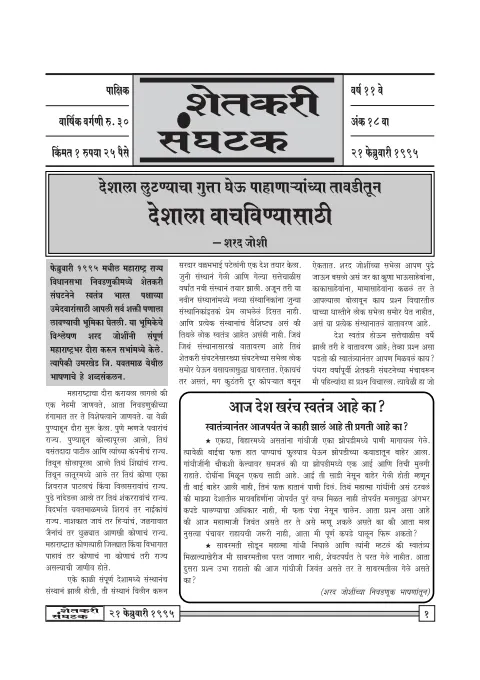
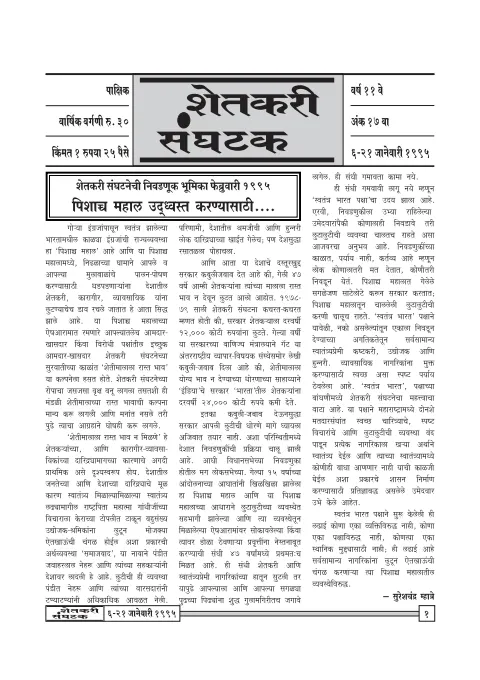
शेतकरी संघटक
राजकीय भूमिकेचे दशक सन १९८४ ते १९९४ — नागपूर अधिवेशन विशेषांक
Shetkari Sanghatak
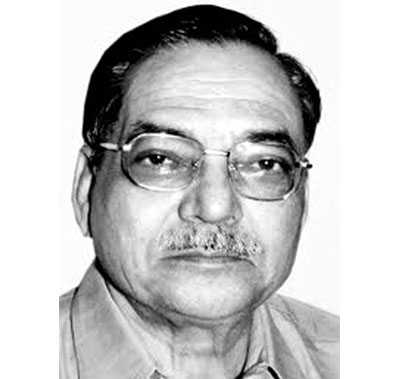
By sharad-joshi
शेतकरी संघटक · 1994
44 pages
शेतकरी संघटक
Summary
This is the 6 November 1994 issue of Shetkari Sanghatak (Marathi: शेतकरी संघटक), the fortnightly mouthpiece of Sharad Joshi’s Shetkari Sanghatana, published as a special number (विशेषांक) for the joint Nagpur Adhiveshan of the Sanghatana and the Shetkari Mahila Aghadi held on 12 November 1994. Subtitled राजकीय भूमिकेचे दशक: सन १९८४ ते १९९४ (“Decade of the Political Stance: 1984 to 1994”), the issue is a curated retrospective: it reprints the organisation’s earlier editorial statements, candidate-selection circulars, and post-mortems on every major electoral cycle since the movement first decided to step from agitation into the ballot — the 1984 cooperative-society polls, the 1984 Lok Sabha, the 1985 Maharashtra Vidhan Sabha, the 1987 Nanded by-election, the 1989 and 1991 Lok Sabha contests, the 1987 panchayati-raj framework, and the 1992 panchayat polls fought by the Shetkari Mahila Aghadi.
The volume’s argumentative centre, set in editor Sureshchandra Mhatre’s foreword and Sharad Joshi’s open letter to Dainik Lokmat (गच्छ सूकर। भद्रं ते।), is that the Sanghatana’s contested decade of electoral engagement was the necessary political extension of its ‘अर्थवादी’ (economy-first) movement for remunerative agricultural prices — and that the chief enemy of that economy-first politics has been जातीयवाद (caste/communal politics), wielded both by the Congress system and by Hindu-Muslim communal mobilisations to fracture farmer solidarity. The retrospective frames Shetkari Sanghatana’s electoral interventions as a refusal of cadre-party machinery in favour of issue-driven, single-plank campaigning around शेतीमालाचा भाव (the price of agricultural produce), and uses the 1985 Vidhan Sabha results to argue that this plank, not any candidate, was “the most effective winning candidate” of the decade.
Key points
-
This special Nagpur Adhiveshan number, dated 6 November 1994, is subtitled “Decade of the Political Stance: 1984 to 1994” and was published for the joint sixth Shetkari Sanghatana and fourth Shetkari Mahila Aghadi convention held on 12 November.
-
Editor Sureshchandra Mhatre’s foreword explains that the issue reprints editorial statements, candidate-selection circulars and post-mortems from every major electoral cycle the Sanghatana fought between 1984 and 1994.
-
Mhatre argues that although the central government formally accepted an open economy after 1991, state machinery and the political class still resist genuine liberalisation of agriculture.
-
Sharad Joshi’s open letter to the editor of Lokmat responds to an October 1994 editorial and defends the right to criticise Mahatma Gandhi and the Nehru lineage even on Gandhi’s 125th birth anniversary.
-
Joshi argues the Indira Gandhi years marked a deeper break from the freedom movement’s legacy than is conventionally admitted, and accuses a clique of courtiers of weaponising the family’s symbolic capital to sustain the Congress.
-
A reprinted 1984 article explains why the Sanghatana, until then purely an agitational body, decided to contest that year’s cooperative-society elections in Maharashtra.
-
The article treats sugar and cotton cooperatives as the chief patronage instrument by which the political class extracted surplus from cultivators, and reprints a seven-point manifesto pledge demanding price-floor guarantees and transparent levies.
-
The retrospective also covers the Sanghatana’s 1985 Vidhan Sabha campaign, the 1987 Nanded by-election, the 1989 and 1991 Lok Sabha contests, and the 1992 panchayat polls fought by the Shetkari Mahila Aghadi.
Essays
बळीराजाच्या शोधात संघटकेकेचा खारीचा वाटा
Editor Sureshchandra Mhatre’s foreword to the Nagpur Adhiveshan special issue. He announces the joint 6th Shetkari Sanghatana and 4th Shetkari Mahila Aghadi convention scheduled for 12 November 1994 at Nagpur, and explains why this issue takes the form of a retrospective: in the three years since the central government formally announced its acceptance of the खुली अर्थव्यवस्था (open economy), the यंत्रणा (state machinery) and political class still resist any genuine liberalisation of agriculture, and the Sanghatana’s decade of electoral interventions from 1984 to 1994 is the record that lets cadre and outsiders alike understand why a farmers’ movement was forced to enter politics at all.
Mhatre argues that the volume should be read alongside Sharad Joshi’s existing writings and the resolutions of the joint convention, so that the Sanghatana’s political conduct over the decade can be evaluated on its own terms rather than by the conventional yardsticks of party politics. He signs off on 6 November 1994.
- Issue is the official Nagpur Adhiveshan special number, dated 6 November 1994 for a 12 November 1994 joint convention.
- Frames the entire volume as a documentary retrospective on Shetkari Sanghatana’s राजकीय भूमिका (political stance) from 1984 to 1994.
- Reads the post-1991 ‘open economy’ announcement as incomplete because state controls on agriculture persist.
- Treats the Sanghatana’s electoral entries as forced extensions of its economic agitation, not a turn to party politics.
गच्छ सूकर । भद्रे ते ।
Sharad Joshi’s open letter to the editor of the Nagpur daily Lokmat, reprinted here as a polemic against the Nehru-Gandhi family’s continuing hold on Indian politics. Written in response to an editorial titled वाढता भाषा (“The rising language”), Joshi defends the right to criticise Mahatma Gandhi and the Nehru lineage even on Gandhi’s 125th birth anniversary, on the ground that uncritical reverence has become a substitute for political thought.
Joshi argues that the Indira Gandhi years were a deeper deformation of the freedom-movement legacy than is conventionally admitted, and that what is sustained today in the name of “Gandhian” and “Nehruvian” inheritance is a small clique of दरबारी (courtiers) who weaponise the family’s symbolic capital to keep the Congress in business. The headline phrase गच्छ सूकर। भद्रं ते। (“Begone, pig — and bless you”) is offered as Joshi’s farewell to the Nehru dynasty, framed as a clean rather than a hostile dismissal.
- Letter responds to a 21 October 1994 Lokmat editorial वाढता भाषा.
- Argues uncritical reverence for Mahatma Gandhi has become an obstacle to political thought, not a guarantee of it.
- Reads Indira Gandhi as the real break with the freedom-movement legacy, not as its continuation.
- Coins गच्छ सूकर। भद्रं ते। as a deliberately clean send-off to the Nehru-Gandhi dynasty.
निवडणूक आंदोलनाची सुरुवात — सहकारी संस्था निवडणुका : १९८४
A reprint from Shetkari Sanghatak of 4 May 1984 explaining why the Sanghatana, until then an agitational body, decided to contest the सहकारी संस्था निवडणुका (cooperative-society elections) of 1984. The piece argues that sugar and cotton cooperatives in Maharashtra had become the principal patronage instrument by which the political class extracted surplus from cultivators while granting itself protected sinecures.
The Sanghatana’s intervention is presented as a corrective: not a takeover of cooperatives but a discipline imposed on them through a published जाहिरनामा (manifesto) demanding price-floor guarantees, transparent levies, and a five-year freeze on directors’ salaries. The article reprints the seven-point pledge that candidates aligned with the Sanghatana were required to sign, and concludes that even losing such elections is useful if it forces the existing co-operative leadership to defend its conduct.
- First Sanghatana electoral entry was the 1984 cooperative-society polls, not a general election.
- Sugar and cotton cooperatives are treated as the structural lever by which the political class controls farmers.
- Candidates were bound by a seven-point manifesto, reproduced verbatim, on prices, purchase-tax, and director austerity.
- Even electoral defeat is reframed as movement-building if it exposes the cooperative leadership’s record.
अर्थवादी चळवळींना जातीयवादाचा बडगा — लोकसभा निवडणूक १९८४
A reprint from Shetkari Sanghatak of 14 December 1984, drawn from a Pune कार्यकारिणी (executive committee) resolution dated 22 November 1984, explaining the Sanghatana’s posture in the December 1984 Lok Sabha election that followed Indira Gandhi’s assassination. The committee resolves that the organisation will not field its own candidates but will call on every farmer to vote against communalism — refusing both the Congress (I)‘s appeal to consolidate the Hindu vote and the rival communal mobilisations of other parties.
The accompanying essay reads the post-assassination polarisation as a deliberate trap for the अर्थवादी (economy-first) movement: by recasting the election as a contest between caste and religious blocs, the political class hopes to extinguish a politics organised around remunerative prices. Historical analogues are pulled in — English rule in India, the failure to read peasant grievance in religious terms — to argue that farmers across Hindu, Muslim and Sikh identities share an objective economic interest that communal politics is designed to suppress. The Punjab crisis is reread through this frame, with the खालिस्तानी movement diagnosed as the political failure of agrarian economics, not as a sui generis religious problem.
- Executive-committee resolution from 22 November 1984 instructs members to oppose communal mobilisation in the 1984 Lok Sabha poll.
- The Sanghatana declines to nominate its own candidates and treats the campaign as an anti-communalism exercise.
- Diagnoses post-Indira polarisation as a manufactured distraction from agricultural-price politics.
- Rereads the Punjab/Khalistan crisis as a downstream effect of farmer impoverishment under government procurement policy.
- Argues farmer interests across Hindu, Muslim and Sikh identities are economically aligned and politically suppressed.
निवडणूक आणि शेतकरी आंदोलनाचे तंत्र — विधानसभा निवडणूक १९८५ : भूमिकेची प्रस्तावना
A short prelude, reprinted from Shetkari Sanghatak of 22 February 1985, setting up the Sanghatana’s logic for contesting the 1985 Maharashtra Vidhan Sabha election. The essay argues that elections are at best one technique among several for an issue-based movement, and that the test of an electoral entry is not whether a seat is won but whether the campaign forces the established parties to argue on the movement’s terms.
It warns that a movement which makes electoral wins the measure of itself will gradually be absorbed into the existing party system; conversely, a disciplined refusal to chase office is what allows a farmer organisation to expand its mass base without losing its अर्थवादी content. The piece closes by signalling that the next article in the issue will analyse the actual Vidhan Sabha results against this framework.
- Electoral contestation is one tactic for a movement, not its purpose.
- Success is measured by whether established parties adopt the movement’s vocabulary, not by seats won.
- Warns of the gravitational pull of party politics on issue movements.
- Sets up the more detailed Vidhan Sabha 1985 post-mortem in the next article.
सर्वात प्रभावी विजयी उमेदवार – शेतीमालाचा भाव — विधानसभा निवडणूक १९८५ : भूमिकेचे विश्लेषण
A reprint from Shetkari Sanghatak of 15 March 1985, compiled by Rajendra Basenkar from Sharad Joshi’s writings, analysing the results of the 1985 Maharashtra Vidhan Sabha election. The piece argues that although the Sanghatana itself did not contest, every winning candidate — from any party — who polled well had been forced to take up some version of the Sanghatana’s demand for remunerative शेतीमालाचा भाव (agricultural commodity prices). The verdict is summarised in the title: the most effective winning candidate of 1985 was not a person but the price-of-produce plank.
Joshi moves from there to an account of why the Rajiv Gandhi government’s response to farmer demand has so far been hollow: subsidised inputs and writeoffs are not equivalent to a real terms-of-trade correction. The essay reads the post-Indira Congress’s tactical alliances with breakaway state leaders (the Shivajirao Patil Nilangekar–Vasantdada equilibrium in Maharashtra) as evidence that procurement-price politics is structurally beyond the reach of a Congress that depends on cooperative-sugar money. It closes with the proposition that राजकीय भूमिका (a political stance) is unavoidable for an economic movement, but must remain instrumental to the underlying agitation.
- Frames शेतीमालाचा भाव — agricultural commodity price — as the single plank that decided the 1985 Vidhan Sabha contests.
- Argues every effective winner across parties was compelled to absorb that plank.
- Reads Rajiv Gandhi’s farmer-relief measures as cosmetic substitutes for terms-of-trade reform.
- Diagnoses the Maharashtra Congress’s cooperative-sugar dependence as the structural reason procurement reform is blocked.
- Reaffirms that the Sanghatana’s electoral interventions are instrumental, not constitutive.
आमच्या जाती जाती आज जळून गेल्या राख झाल्या — नांदेड : लोकसभा मतदार संघ पोटनिवडणूक, मार्च १९८७
A reprint (from the Shetkari Sanghatak Nanded Adhiveshan Special, 10/11/12 March 1989) of the Sanghatana’s stand during the March 1987 Lok Sabha by-election in Nanded. The piece is addressed in the direct voice of Sharad Joshi — माझ्या भावांनो आणि माय बहिणींनो (my brothers and sisters) — calling on farmers to ignore the by-election entirely on the ground that the Sanghatana fights elections only when there is a substantive economic question at stake, and Nanded offers none.
The essay argues that turning out for an empty by-election only rehabilitates the local Congress machine and the कुणी आमदार (some MLA), कुणी मुख्यमंत्री (some chief minister), कुणी केंद्रीय मंत्री (some Union minister) — the rotation of dignitaries that is the substance of dynastic politics. Joshi makes a wider point: farmers’ poverty is not a problem of inadequate representation but of structural extraction, and electoral participation that does not target that extraction is wasted political effort. The article continues past page 20.
- Sanghatana’s instruction for the March 1987 Nanded Lok Sabha by-election was active abstention.
- Frames by-election turnout as cost-free legitimation of the Congress machine.
- Joshi writes in direct second-person voice to cadre rather than as institutional editor.
- Reasserts the economy-first criterion: contest only where the question is structural, not symbolic.
Generated by the v1.5 extraction pipeline. Awaiting editorial review.
Metadata and summary are AI-extracted from the source PDF and reviewed for editorial accuracy. The original work is available via the Read PDF tab above (where present); paragraph-level citation inside the PDF is deferred to a future engagement.