
speech
The Future of Free Enterprise in India
Published by M. R. Pai for the Forum of Free Enterprise, 235, Dr. Dadabhai Naoroji Road, Bombay 1, and Printed by Michael Andrades at the Bombay Chronicle Press, Horniman Circle, Bombay-1. · Bombay · 1961
12 pages
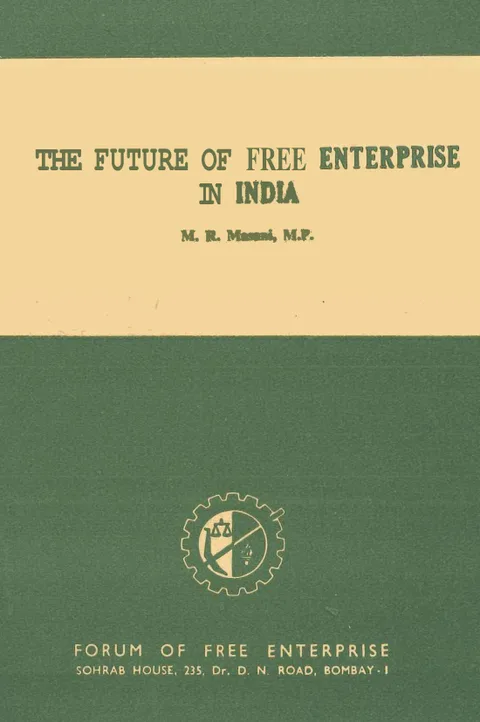
The Future of Free Enterprise in India
By M. R. Masani, M.P.
Summary
In this Forum of Free Enterprise booklet, M. R. Masani, M.P., delivers a sustained defence of the joint-stock company and free enterprise against what he sees as a hostile climate in early-1960s India. Opening from his week observing the Companies Amendment Bill debate in Parliament, he argues that government and a section of members treat the joint-stock company as a ‘necessary evil’ to be tolerated, in contrast to America, Germany, Sweden, Japan or England, where it is regarded as a desirable form of organisation. Masani frames the live question not as one of detail but of the very existence of free enterprise, and warns that the drift toward ‘monopoly State Capitalism of the Soviet/Chinese kind’ threatens to displace private competition entirely.
He offers two principal arguments for free enterprise. The first is economic: free enterprise delivers goods more cheaply and productively than the State, illustrated through agricultural yield comparisons (private plots vastly out-producing collectivised farms in the USSR) and the inefficiency of State trading monopolies in iron ore and insurance. The second is political: only private, autonomous economic centres can sustain an effective opposition and therefore individual liberty, because under a single universal State employer ‘he who does not work neither shall he eat’ becomes ‘he who does not obey, neither shall he eat.’
Masani then turns to what Indian business must do to put ‘its house in order’ — adopt a code of conduct and the principle of trusteeship vis-a-vis consumers, employees and the community (citing Gandhi and Ludwig Erhard’s ‘Prosperity Through Competition’), stand up publicly and be counted in the Companies Bill debate, and engage in public affairs the way American managements do through political education and grass-roots civic work. An appended essay, ‘The Philosophy of Joint-Stock Enterprise,’ restates the case that shareholders as owner-citizens, not bureaucrats, are the best judges of their enterprises, and that the constitutional safeguards of private property must be defended against the ‘totalitarian wedge’ of the State knowing better how people should spend their money.
Key points
-
Masani argues the joint-stock / free enterprise system is under challenge in India ‘not in regard to any details, but to its very existence.’
-
He contrasts the Indian government’s treatment of the joint-stock company as a ‘necessary evil’ with its acceptance as ‘an affirmative good’ in the West.
-
Economic case: private enterprise out-produces the State, shown via agricultural yield data and the inefficiency of State trading monopolies in iron ore and life insurance.
-
Political case: only autonomous private economic centres can sustain a real opposition and individual liberty; a single State employer turns ‘he who does not work’ into ‘he who does not obey, neither shall he eat.’
-
He warns against drift toward ‘monopoly State Capitalism of the Soviet/Chinese kind’ and cites Djilas’s ‘The New Class.’
-
Prescriptions for Indian business: adopt a code of conduct and trusteeship (Gandhi, Erhard), stand up and be counted in the Companies Bill debate, and engage in civic/public affairs as American managements do.
-
An appended essay, ‘The Philosophy of Joint-Stock Enterprise,’ defends shareholder-owners as better judges than bureaucrats and warns of a ‘totalitarian wedge’ against private property.
-
Published by the Forum of Free Enterprise, Bombay, 1961; bears FFE’s standard disclaimer that views are the author’s own.
Generated by the v1.5 extraction pipeline. Awaiting editorial review.
Metadata and summary are AI-extracted from the source PDF and reviewed for editorial accuracy. The original work is available via the Read PDF tab above (where present); paragraph-level citation inside the PDF is deferred to a future engagement.
People in this work
Related across the archive
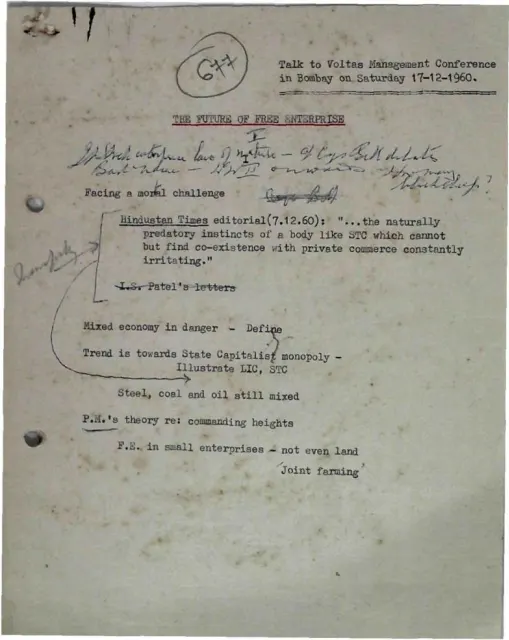 Primary workTHE FUTURE OF FREE ENTERPRISE IN INDIA
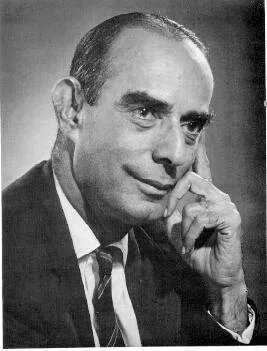 ExcerptPlanning by Minoo Masani
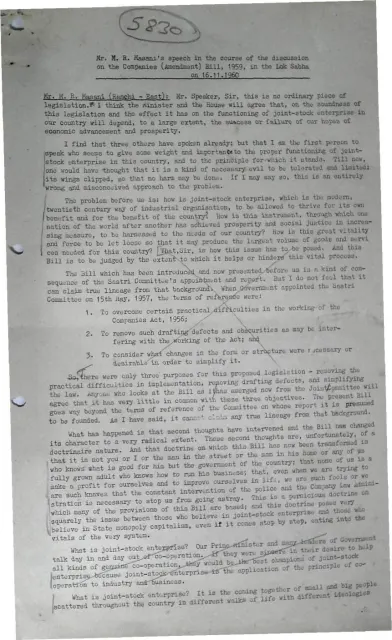 Primary workMr. M. R. Masani's speech in the course of the discussion on the Companies (Amendment) Bill, 1959, in the Lok Sabha on 16.11.1960
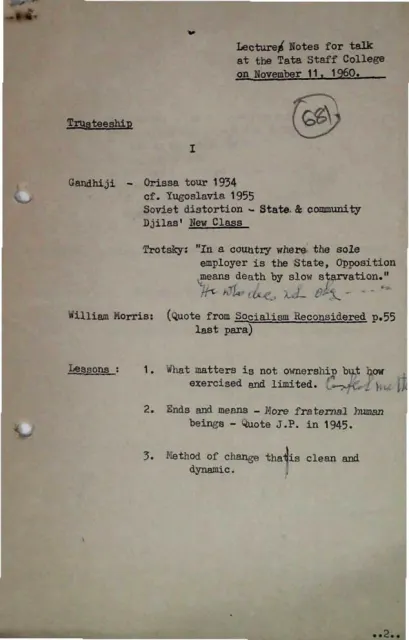 Primary workLectures Notes for talk at the Tata Staff College on November 11, 1960.
 ExcerptSTATE MONOPOLIES AND THE CITIZEN IN A DEMOCRACY