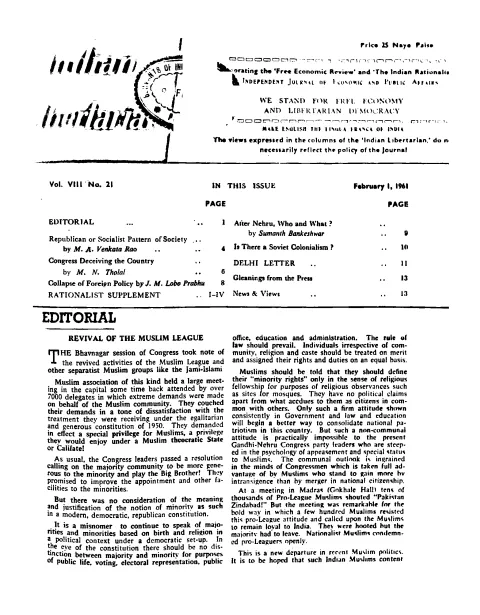
periodical issue
The Indian Libertarian
Independent Journal of Free Economy and Public Affairs
By By WILLIAM HENRY CHAMBERLIN, m-n-tholal, By S. Ramanathan, By Dr. J. V. Dubig, By Colin McCall, —Don Werkheiser, Shri P. J. Saheir, M.A., LL.B., M. R. NAYYAR
published by him [D. M. Kulkarni] at the office of the Libertarian-Publishers (Private) Ltd., 26, Durgadevi Road, Bombay 4. · Bombay · 1961
18 pages
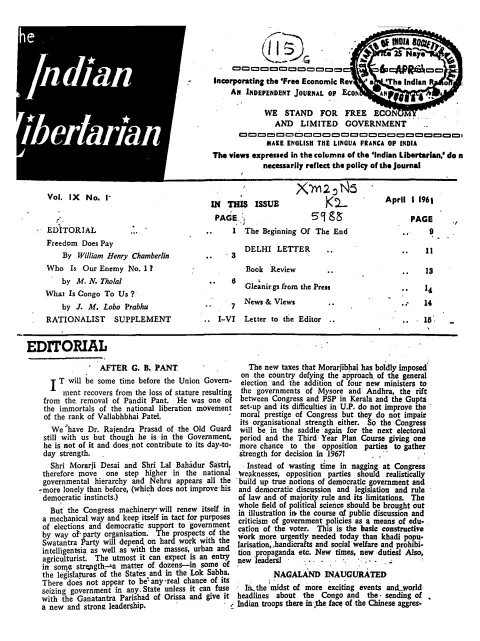
The Indian Libertarian
Summary
The 1 April 1961 issue of The Indian Libertarian (Vol. IX, No. 1) is a sixteen-page Bombay fortnightly edited by D. M. Kulkarni for Libertarian Publishers Private Ltd., carrying the masthead slogan “We Stand For Free Economy and Limited Government.” The issue opens with an unsigned editorial on the death of Union Home Minister Govind Ballabh Pant and the depletion of Congress’s Old Guard, then runs three signed political essays — William Henry Chamberlin’s case for American prosperity as proof that economic freedom pays, M. N. Tholal’s reckoning of whether Pakistan or Communist China is now India’s principal adversary, and a fortnightly Delhi Letter on Soviet alignment with Peking after Pant’s exit. The four-page Rationalist Supplement, edited at the Indian Rationalist Association’s national headquarters, contains S. Ramanathan on the movement’s new building, J. V. Duhig on parallels between Communism and Catholicism, and a Colin McCall essay on Darwin’s intellectual legacy. The issue closes with a report on King Mahendra’s dissolution of Nepal’s parliament, a book review of Buddha And Buddhism, gleanings from the press, news and views, a reader’s letter on Lincoln and statism, and house advertisements for Libertarian Publishers and Duncan Road Flour Mills.
Key points
-
The 1 April 1961 issue of The Indian Libertarian (Vol. IX, No. 1) is a sixteen-page Bombay fortnightly edited by D. M. Kulkarni, carrying the slogan ‘We Stand For Free Economy and Limited Government’.
-
The unsigned lead editorial mourns Govind Ballabh Pant as one of Congress’s last ‘Old Guard’ figures and weighs the succession contest between Morarji Desai and Lal Bahadur Shastri.
-
William Henry Chamberlin’s essay ‘Freedom Does Pay’ contrasts the post-war recovery of West Germany under Ludwig Erhard with the stagnation of the Soviet bloc as evidence for economic freedom.
-
M. N. Tholal’s essay ‘Who Is Our Enemy No. 1?’ names Communist China, not Pakistan, as India’s principal adversary because the territorial and ideological stakes are larger.
-
Tholal warns that Communists in Kerala and elsewhere could form a fifth column amplifying external pressure should relations with China deteriorate further.
-
The four-page Rationalist Supplement, edited at the Indian Rationalist Association’s headquarters, carries S. Ramanathan’s call for Indian rationalists to acquire permanent premises like the new American Humanist Association headquarters at Yellow Springs, Ohio.
-
The Rationalist Supplement also includes J. V. Duhig on parallels between Communism and Catholicism and a Colin McCall essay on Darwin’s intellectual legacy.
-
The issue closes with a report on King Mahendra’s dissolution of Nepal’s parliament, a review of Buddha And Buddhism, and a reader’s letter on Lincoln and statism.
Essays
EDITORIAL (After G. R. Pant; The Muslim Tension; President’s Commission; Nagaland Inaugurated)
The unsigned lead editorial mourns Govind Ballabh Pant as one of the last “immortals” of the national liberation movement of Vallabhbhai Patel’s rank and predicts the Union Government will not recover his stature for half a century. The piece weighs the succession question inside the Congress — Morarji Desai’s seniority against Lal Bahadur Shastri’s more recent rise — and surveys the political fallout: the reorganised states’ reactions in Andhra and Mysore, the Congress Working Committee’s wrangling over election strategy against Swatantra and the communalists, and the President’s Commission on Pakistan’s persecution of Hindus. A coda on Nagaland’s inauguration as a separate state worries that conceding to ethnic agitation merely incentivises further fragmentation.
- Frames Pant’s death as the loss of one of Congress’s last “Old Guard” liberators of Patel’s stature
- Reads the succession contest between Morarji Desai and Lal Bahadur Shastri as a test of Congress’s centre of gravity
- Treats Swatantra as the principal extra-Congress force the working committee must now negotiate with on candidate selection
- Notes the President’s Commission’s findings on the persecution of Hindus in Pakistan
- Warns that Nagaland’s elevation may invite further linguistic and ethnic fragmentation
Freedom Does Pay
By WILLIAM HENRY CHAMBERLIN
William Henry Chamberlin’s signed essay argues that the citizen of the United States is materially better off from infancy to old age than counterparts in any country where private initiative is hobbled or the dynamic forces of the market restricted. He contrasts the post-war recovery of West Germany under Ludwig Erhard, France, and Italy — economies released from controls — with the stagnation of East Germany and the Soviet bloc, and reproduces a “Four Freedoms” inventory (movement, occupation, enterprise, exchange) which he says nineteenth-century liberalism took for granted and which the welfare and planning states of the twentieth have steadily eroded.
- Treats post-war West German recovery under Erhard as a controlled experiment in market liberalisation
- Contrasts the standard of living of the United States with the Soviet bloc as an empirical test of economic systems
- Identifies four “freedoms” of nineteenth-century liberalism — of movement, occupation, enterprise, and exchange — as the casualties of twentieth-century planning
- Argues that the war state and the welfare state share a common appetite for restricting market exchange
Who Is Our Enemy No. 1?
By M. N. Tholal
M. N. Tholal asks whether Communist China or Pakistan should now be regarded as India’s principal adversary and concludes that the threat from Peking is the larger, structural one — territorial, ideological, and backed by a great-power patron — while the Pakistan quarrel, however bitter, is bilateral and in principle negotiable. He surveys the Muslim position in Kashmir, the running argument over a plebiscite, and the alignment of pro-Communist parties in Kerala and elsewhere, and warns that domestic Communists may make common cause with external pressure if relations with China sour further. A pendant page of “Thoughts on Liberty” reprints aphorisms from Diderot, Lao Tze, Goethe and others, and a short anecdote (“Why ‘Tiger’?”) closes the section.
- Names Communist China — not Pakistan — as India’s enemy number one because the territorial and ideological stakes are larger
- Reads the Kashmir plebiscite question as one Pakistan can in principle be negotiated out of, unlike Peking’s frontier claims
- Sees the Indian Communist Party in Kerala and elsewhere as a fifth column that could amplify any external pressure
- Brackets the political argument with a reprinted page of liberty aphorisms from Diderot, Lao Tze and Goethe
RATIONALIST SUPPLEMENT — Our National Head Quarters
By S. Ramanathan
Opening the four-page Rationalist Supplement, S. Ramanathan reports on the new American Humanist Association headquarters at Yellow Springs, Ohio — a “Humanist House” built on twenty acres — and uses it to argue that Indian rationalists must also acquire physical premises if their movement is to outlast its founders. He surveys the present Indian organisational landscape, in which Rationalist and Humanist groups, the Radical Humanist constituency of M. N. Roy, and assorted local atheist societies all rent borrowed space, and pleads for a national centre at which a library, lecture hall, and exchange-of-ideas room can be permanently established.
- Treats the new American Humanist Association building at Yellow Springs as a model for Indian rationalists
- Argues that the absence of dedicated premises caps the reach of every Indian rationalist body
- Names the M. N. Roy stream of radical humanism as one of the constituencies a national centre would have to accommodate
Communism And Catholicism
By Dr. J. V. Dubig
Dr. J. V. Duhig argues that Communism is best understood as a religion — a vast organisation upholding political power against critical thought, with a creed, a saint-list, a clergy and an excommunication machinery — and that the closest analogue in form is not Protestant Christianity but the Roman Catholic Church. He runs the parallels through Party congresses functioning as ecumenical councils, the Politburo as curia, the rehabilitation and the show-trial as analogues of canonisation and the auto-da-fé, and concludes that the two systems share enough institutional DNA that liberals must guard against both even as they remain analytically distinct.
- Reads Communism as a religion in organisational form, not merely a secular ideology
- Treats the Roman Catholic Church, not Protestantism, as its closest structural analogue
- Maps Politburo to curia, Party congresses to ecumenical councils, and the show-trial to the auto-da-fé
The Door Darwin Opened
By Colin McCall
Colin McCall reviews the long shadow cast by Darwin’s Origin of Species, arguing that evolution is now so much the common sense of biology that even theologians have been forced to absorb it, but that the metaphysical door Darwin opened — naturalism, the absence of design, the kinship of human and animal — remains a live argument. He surveys Darwin’s nineteenth-century reception (Wallace, Lyell, Spencer), the Scopes controversy in America, and the persistence of literalist “fundamentalist” objection, and closes with a short editorial on mature intellectual methods signed by Don Werkheiser.
- Treats Darwin’s Origin of Species as the decisive opening of a naturalist worldview
- Notes the rapid co-option of Wallace, Lyell and Spencer into the evolutionary consensus
- Reads continuing fundamentalist objection as evidence of the cultural stakes of biological naturalism
- Pairs the essay with a Werkheiser checklist for mature intellectual method
Mature Intellectual Methods
By —Don Werkheiser
An unsigned essay reads a recently published booklet — “How Parliament Can Play A Revolutionary Part in the Transition to Socialism,” by a Czechoslovak Communist National Assembly member — as the Communist movement’s tacit concession that the parliamentary road can no longer be dismissed. Setting that against Khrushchev’s post-Twentieth-Congress doctrine of peaceful coexistence and the new Communist line on national fronts, the piece argues that the Soviet bloc is now openly hedging Marx’s and Lenin’s revolutionary catechism and that the consequences for Communist parties in democracies — including India’s — will be visible at the next election cycle.
- Reads a Czechoslovak Communist booklet on parliamentary revolution as a doctrinal pivot
- Connects the pivot to Khrushchev’s post-Twentieth-Congress peaceful-coexistence line
- Predicts the new national-front strategy will reshape Communist electoral conduct in India and elsewhere
The Beginning Of The End
The fortnightly Delhi Letter (“From Our Correspondent”) reads the recent flow of Soviet diplomacy as a quiet but unmistakable tilt toward Peking at India’s expense after the death of Govind Ballabh Pant. The piece tracks army promotions and dismissals, a Lal Bahadur Shastri intervention, and the staffing of the late Pant’s portfolio, and treats them as signals that the Soviet bloc has decided to back China’s frontier line in any future crisis. A second item, “Nepal King Means Business,” reports on King Mahendra’s dissolution of parliament and his arrest of B. P. Koirala and reads it against Indian indulgence of constitutional violations on the country’s northern border.
- Reads post-Pant Soviet diplomacy as a quiet tilt toward Peking
- Treats Lal Bahadur Shastri’s brief as a stress-test of the inherited Home portfolio
- Frames King Mahendra’s coup against Koirala’s government as a test of Indian constitutionalism in its sphere of influence
DELHI LETTER (Russia Backs Up China; Army Promotions and Politicians; Nepal King Means Business)
By From Our Correspondent
A short review of “Buddha And Buddhism” by Shri P. J. Saheb (M.A., LL.B.) commends the book as an accessible introduction to the Buddha’s life and the Four Noble Truths, drawing on the Great Epic of the Maha Bharat. The reviewer praises Saheb’s philosophy as scrupulously non-sectarian, notes his command of comparative extracts from Christian and Muslim devotional traditions, and ends with two short notices: a Hoshte Forum lecture series and a Press Institute warning on the dangers of state-mediated journalism.
- Frames Buddha And Buddhism as an entry-level guide to the Four Noble Truths
- Praises the book’s non-sectarian use of Christian and Muslim comparative material
- Pairs the review with notice of an R. L. Hostel forum lecture programme
Book Review — Buddha and Buddhism
By Shri P. J. Saheir, M.A., LL.B.
The closing pages bundle short-form items: “Gleanings From The Press” (mainly excerpts from Swatantra and the Bombay dailies on Maharashtra study circles, banking reorganisation, and food-policy debates), a News & Views column flagging the Patil–Krishna Menon manoeuvres and a Russi Mody appointment, and a Letter to the Editor from M. R. Nayyar that uses Lincoln to argue that statism, planning and war-economy each tend to expand government’s grip on private life. Two house advertisements — Libertarian Publishers’ booklist (Bakunin, Proudhon, Von Mises) and Duncan Road Flour Mills — close the issue.
- Excerpts Swatantra and Bombay dailies on Maharashtra study-circle activity and food policy
- Flags the Patil–Krishna Menon political manoeuvres and a Russi Mody appointment
- Carries M. R. Nayyar’s Lincoln-citing letter linking statism, planning and the war economy
- Closes with a Libertarian Publishers booklist (Bakunin, Proudhon, Von Mises, Bilgram, Borsodi, Goel)
Generated by the v1.5 extraction pipeline. Awaiting editorial review.
Metadata and summary are AI-extracted from the source PDF and reviewed for editorial accuracy. The original work is available via the Read PDF tab above (where present); paragraph-level citation inside the PDF is deferred to a future engagement.