periodical issue
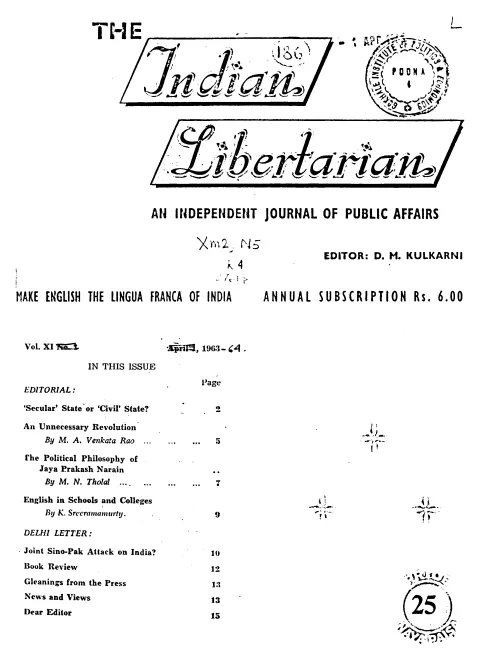
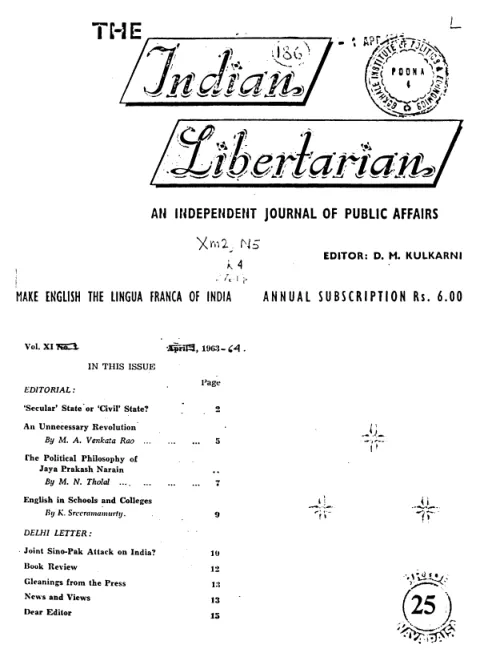
The Indian Libertarian
An Independent Journal of Public Affairs
Edited by D. M. Kulkarni, B.A., LL.B., for the Libertarian Publishers Private Ltd.. Printed by G. N. Lawande, at States' People Press, Janmabhoomi Bhavan, Ghoga Street, Fort, Bombay-1, and, published by him at the office of the Libertarian Publishers (Private) Ltd., 26, Durgadevi Road, Bombay-4. · Bombay · 1963
16 pages
The Indian Libertarian
Summary
This April 1, 1963 issue (Vol. XI) of The Indian Libertarian, edited by D. M. Kulkarni and published by Libertarian Publishers Pvt. Ltd. from Bombay, gathers an editorial, three signed essays, a Delhi Letter, a book review, and the regular Gleanings/News/Dear Editor sections. The argumentative centre is two-fold: a defence of classical-liberal politics against both Nehruvian ‘secularism’ (which the editorial recasts as a ‘civil state’) and against communist-style revolution in the wake of the Sino-Indian crisis. M. A. Venkata Rao attacks the Russian and Chinese revolutions as economically unnecessary and humanly destructive; M. N. Tholal contests Jayaprakash Narayan’s advocacy of nonviolent resistance to Chinese aggression; K. Sreeramamurty defends English as the medium of higher education; the Delhi Letter assesses the danger of a joint Sino-Pakistani attack on India; the news pages survey U.S. aid (Galbraith, Morarji Desai), Rajaji’s call for national leadership, and Nehru’s policies on Hindi.
Key points
-
The editorial proposes replacing Nehru’s ‘Secular State’ formulation with a ‘Civil State’, arguing India is neutral toward creeds without being hostile to religion, unlike Pakistan’s avowedly Muslim state.
-
It invokes the Vijayanagar empire, Mughal rule and Shivaji to argue that protecting Hindus and other communities from religious imposition is a legitimate civic concern.
-
M. A. Venkata Rao argues the Russian and Chinese communist revolutions were historically unnecessary, since they failed to raise living standards above those in capitalist Western states.
-
He compares Tsarist Russia’s pre-1917 trajectory and pre-Meiji Japan to argue gradual industrial reform, not Bolshevik or Maoist seizure of property, was the rational path.
-
M. N. Tholal contests Jayaprakash Narayan’s Rajasthan University address urging nonviolent resistance to Chinese aggression, arguing unarmed civilian resistance against a Communist invader would produce mass killings rather than moral victory.
-
K. Sreeramamurty defends English as the medium of higher education, welcoming Andhra Pradesh’s introduction of English from Standard III and citing Nobel laureate I. I. Rabi on science requiring English.
-
The Delhi Letter assesses the danger of a joint Sino-Pakistani attack on India following the 1962 border war and reports on Sino-Pakistani border talks and Indo-Pakistani negotiations over Kashmir.
-
The news pages survey U.S. aid discussions involving Galbraith and Morarji Desai, Rajaji’s call for national leadership, and Nehru’s policies on Hindi.
Essays
Essay 0
No summary was extracted for this article. Listed for completeness.
‘Secular’ State or ‘Civil’ State?
By MA Venkata Rao
The lead editorial argues that Nehru’s use of the term ‘Secular State’ is loose and confused, and proposes the term ‘Civil State’ as a more accurate description of an India in which the state is neutral towards creeds but not hostile to religion. The editor distinguishes India’s situation from Pakistan, characterised as an avowedly Muslim theocratic state, and draws on Indian history (the Vijayanagar empire, Mughal rule, Shivaji) to argue that protection of Hindus and other communities from religious imposition is a legitimate civic concern. The editorial closes by warning that confused secular rhetoric leaves majority cultural-religious life politically defenceless.
- The Prime Minister’s invocation of ‘Secular State’ lacks a clear definition and is politically unstable.
- A ‘Civil State’ formulation better captures equal civic standing without erasing religious identity.
- Pakistan is treated as the contrasting case: an openly Muslim state, not a civil one.
- Indian history is read as showing the costs of state-sponsored religious dominance.
- The Indian Liberal Group is urged to enter the secular-vs-civil debate as an active voice.
An Unnecessary Revolution
By M. A. Venkata Rao
M. A. Venkata Rao argues that the Russian and Chinese communist revolutions were historically ‘unnecessary’ — they did not produce economic equality, did not raise the common person above living standards in capitalist Western states, and destroyed the security and liberty their own peoples enjoyed. He compares Tsarist Russia’s pre-1917 trajectory with that of the British and Japanese economies and contends that piecemeal reform under industrial discipline, not Bolshevik or Maoist seizure of property, was the rational path. The essay closes with a numbered statement of ‘Anarchist Principles’ drawn from classical liberal and individualist anarchist sources, defending private property, voluntary association and free competition against socialist planning.
- The Bolshevik and Maoist revolutions failed on their own equality test.
- Living standards under ‘Workers’ States’ lag those of capitalist West.
- Tsarist Russia and pre-Meiji Japan illustrate that gradual industrial reform was available.
- The ‘paradise’ of Russian and Chinese communism is one the poor flee at risk of death.
- Classical-liberal / individualist-anarchist principles are restated as a positive alternative.
The Political Philosophy of Jaya Prakash Narain
By M. N. Tholal
M. N. Tholal takes apart Jayaprakash Narayan’s address at the Convocation of Rajasthan University, in which JP urged a doctrine of nonviolent resistance even to Chinese aggression. Tholal argues that JP’s prescription mistakes the situation: an unarmed civilian resistance against a Communist invader would lead to mass killings, not the moral victory Gandhian nonviolence achieved against the British. He invokes the late Acharya Narendra Dev and the early socialist tradition to show that JP has migrated away from political realism toward a sentimental Sarvodaya idealism that cannot answer the security question India faces after 1962.
- JP’s Rajasthan University convocation address advocates nonviolent resistance to Chinese aggression.
- Tholal judges the doctrine unworkable against a totalitarian invader.
- Gandhi’s experience against the British is not transferable to Mao’s China.
- JP’s drift from socialist political realism toward Sarvodaya is criticised.
- Acharya Narendra Dev is cited as a contrast point inside JP’s own tradition.
English in Schools and Colleges
By K. Sreeramamurty
K. Sreeramamurty defends the place of English in Indian schools and colleges. He welcomes the Andhra Pradesh government’s decision to introduce English from the third standard and argues that a working knowledge of English is indispensable for the present generation of students, who will become India’s future leaders. He draws on the example of universities (Andhra, Lucknow, Allahabad, Patna, Baroda) where English remains the medium of instruction and cites the Nobel laureate I. I. Rabi on the difficulty of pursuing modern science without English.
- Andhra Pradesh’s introduction of English from Standard III is endorsed.
- English is treated as a practical and intellectual necessity, not a colonial residue.
- Several Indian universities still teach in English; replacing it is impractical.
- Nobel laureate I. I. Rabi is cited to support keeping English in science education.
- Premature switch to regional-language instruction would degrade higher learning.
DELHI LETTER: Joint Sino-Pak Attack on India?
By (From Our Correspondent)
The Delhi Letter (from ‘Our Correspondent’) assesses the prospect of a coordinated Chinese-Pakistani attack on India following the 1962 border war. It reports on Sino-Pakistani border talks, Pakistani diplomatic moves around Kashmir, and Indo-Pakistani negotiations in which the Indian side is described as making concessions whose strategic worth is unclear. The correspondent reads American policy through Ambassador Galbraith’s interventions and President Kennedy’s signals, and worries that a Pacific-Pact or Anglo-Saxon-Federation approach is not materialising fast enough to deter a two-front threat.
- A coordinated Sino-Pakistani military move on India is a live concern after 1962.
- Indo-Pak Kashmir talks are diplomatically lopsided in Pakistan’s favour.
- Galbraith and Kennedy’s positioning is parsed for its limits.
- A regional security architecture (Pacific Pact / Anglo-Saxon Federation) is invoked as a possible answer.
- The Indian establishment is judged slow to absorb the security implications.
Book Review
By MA Venkata Rao
A short notice reviews Patterns of Culture by Ruth Benedict, situating the book within American cultural anthropology and recommending its comparative-anthropology approach to readers interested in the foundations of social order. The reviewer summarises Benedict’s argument that cultures are integrated wholes whose values cohere across institutions, and treats the book as a useful corrective to crude evolutionary or universalist readings of human social life.
- Ruth Benedict’s Patterns of Culture is recommended for Indian readers.
- The book is treated as a classic of comparative anthropology.
- Cultures are presented as integrated configurations of value.
- The review highlights the book’s continued relevance decades after its first edition.
Gleanings from the Press
Under ‘Gleanings from the Press,’ M. A. Venkata Rao reflects on the ‘peacockery’ of the Indian government — the gap between official self-image and substantive achievement — and on the way prestige politics distorts policy choices. He links this critique to the Nehruvian planning state’s habits of public display.
- Government ‘peacockery’ is identified as a recurrent vice of Indian public life.
- Prestige-driven projects are distinguished from substantive policy.
- The Nehruvian style is read as encouraging this habit.
association in Ahmedabad pushing for English from the fifth standard; Nehru
The News & Views columns string together brief items from across India and the world: Khrushchev’s diplomacy with Peking; the announcement of the largest U.S. interest-free loan ($240 million) to India, signed by Morarji Desai and Ambassador John Kenneth Galbraith with L. K. Jha for the finance ministry; a parents’ association in Ahmedabad pushing for English from the fifth standard; Nehru’s worries about Hindi-Tamil conflict; Aldous Huxley’s pessimism about overpopulation in underdeveloped nations; H. M. Patel urging India to accept Western defence aid; Rajaji declaring readiness to lead the nation; and Y. B. Chavan’s defence record being praised.
- U.S. signs the largest-ever interest-free loan to India: $240 million.
- Morarji Desai and Ambassador Galbraith head the signing ceremony.
- Aldous Huxley forecasts gloom for underdeveloped nations.
- Rajaji signals willingness to lead a national alternative.
- Nehru is reported as wary of Hindi-vs-regional-language conflict.
News and Views
The ‘Dear Editor’ page collects short reader letters on Prohibition and on what one correspondent calls ‘Nehru’s Tragedy’ — the argument that the Prime Minister’s administration has not lived up to its early promise and that the Daily press is failing to hold it to account.
- Reader letters address Prohibition policy and Nehru’s record.
- The ‘Nehru’s Tragedy’ letter argues that the press has been too deferential.
- Letters reflect the magazine’s liberal, government-critical readership.
Generated by the v1.5 extraction pipeline. Awaiting editorial review.
Metadata and summary are AI-extracted from the source PDF and reviewed for editorial accuracy. The original work is available via the Read PDF tab above (where present); paragraph-level citation inside the PDF is deferred to a future engagement.