periodical issue
The Indian Libertarian
An Independent Journal of Economic and Public Affairs
By MA Venkata Rao, M. N. Tholal
The Libertarian Social Institute, Ayra Bhuvan, Sandhurst Road, Bombay 4 · Bombay · 1959
24 pages
The Indian Libertarian
Summary
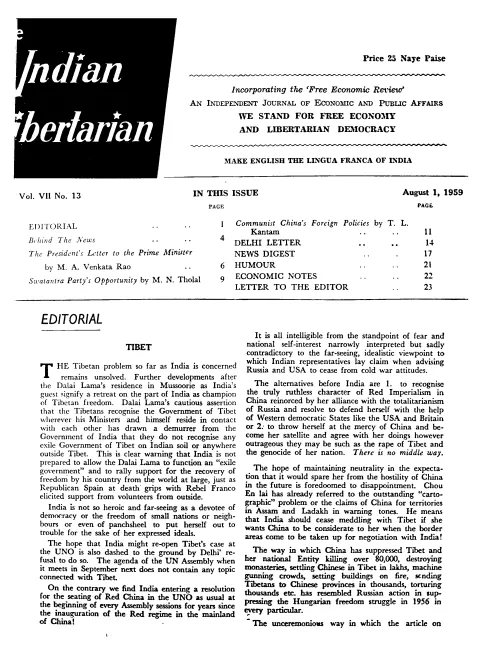
This August 1, 1959 issue of The Indian Libertarian (Vol. VII No. 13) is built around the Tibet crisis, the launch of the Swatantra Party, and a sustained critique of Nehruvian planning. The unsigned editorial casts India’s foreign-policy options on Tibet and Red China as a binary between Western-aligned resistance and de facto satellite status. M. A. Venkata Rao’s reading of C. Rajagopalachari’s open letter to the Prime Minister supplies the issue’s economic spine, attacking heavy-industry-first planning and confiscatory taxation. M. N. Tholal urges the new Swatantra Party to seize its opening, and T. L. Kantam supplies a long survey of Communist China’s foreign policy from 1949 onward. A Delhi Letter on Kerala and the Constitution, a wide-ranging News Digest, and a ‘Did You Know’ feature by Scio fill out the issue.
Key points
-
The unsigned editorial frames India’s Tibet policy as a stark choice between recognising and resisting Red Chinese imperialism alongside Western democracies or accepting de facto satellite status.
-
The editorial notes Delhi has never let the Dalai Lama exercise any governmental function in exile and has refused to raise the Tibet question again at the United Nations.
-
M. A. Venkata Rao reads C. Rajagopalachari’s open letter to Nehru, published in the Hindustan Times, as the founding economic statement of the new Swatantra Party.
-
Venkata Rao argues the Third Plan’s reliance on confiscatory taxation and forced loans to raise thousands of crores is incompatible with democratic procedure, and that its heavy-industry bias repeats Soviet planning errors.
-
M. N. Tholal urges the newly launched Swatantra Party not to squander its moment, crediting Rajagopalachari’s prestige while diagnosing why Acharya Kripalani’s KMPP and Subhas Bose’s earlier breakaways failed to dent Congress dominance.
-
Tholal treats the succession question opened by Rafi Ahmed Kidwai’s death and Pratap Singh Kairon’s Punjab as case studies in Congress organisational politics.
-
T. L. Kantam traces Communist China’s foreign policy from the 1949 founding of the People’s Republic through the deterioration of Sino-Indian relations after the Tibet crisis.
-
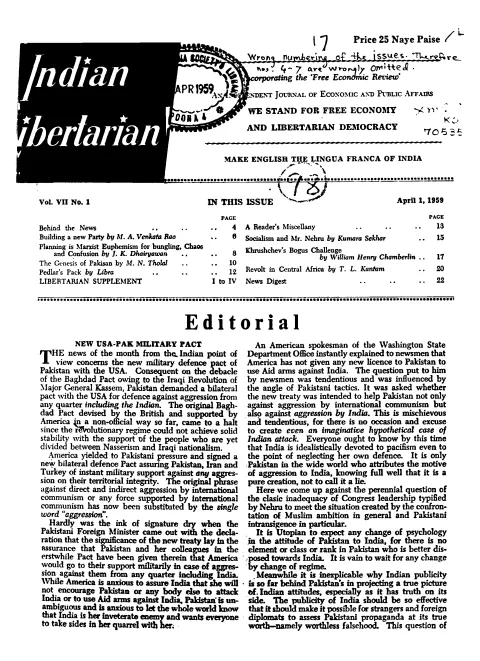
The “Behind the News” column reads the Tyagi Committee’s judicial-reform proposals, a Communist-allied turn in Indonesian politics, and American military aid to Pakistan as instances of India’s reactive and ideologically muddled foreign policy.
Essays
EDITORIAL
The editorial opens with Tibet: India has neither recognised an exile Tibetan government nor allowed the Dalai Lama any political function from Indian soil, and Delhi has refused to re-open Tibet’s case at the UN. The editor argues this passivity flows from fear and a narrow reading of national self-interest dressed up as panchsheel. Russia and the United States may now urge each other to drop Cold War postures, but India’s real choice is sharper: either recognise Red Imperialism in China and resist it alongside the Western democracies, or accept satellite status and condone outrages such as the ‘rape of Tibet’. The piece then surveys reactions and entanglements in Pakistan, Iraq, Bhutan, Nepal, Burma and the United Arab Republic under Nasser.
- Delhi will not let the Dalai Lama exercise any governmental function in exile and refuses to raise Tibet at the UN.
- The editor reads India’s panchsheel posture as a retreat dressed up as principle.
- Frames Indian foreign policy as a binary choice between Western-aligned resistance and de facto submission to Red China.
- Connects the Tibet question to wider Indian neighbourhood policy across Pakistan, Iraq, Bhutan-Nepal-Burma, and Nasser’s UAR.
- Treats the People’s Liberation Army’s conduct in Tibet as comparable in scale to the 1956 Hungarian suppression.
Behind the News
An unsigned news roundup covering the Tyagi Committee’s proposals on judicial reform, the political situation in Indonesia, the Vienna Youth Festival, India’s relations with Nepal, and American military aid to Pakistan. The column treats each subject as one more instance of the same complaint that animates the issue’s editorial: Indian policy is reactive, ideologically muddled, and chronically slow to defend its own interests against neighbouring authoritarianisms.
- Discusses the Tyagi Committee’s recommendations and their reception.
- Notes a Communist-allied turn in Indonesian politics.
- Surveys the Vienna Youth Festival as a Cold War cultural battleground.
- Examines the implications of US military aid to Pakistan for Indian security.
- Frames Indo-Nepalese relations as a test of Indian regional credibility.
The President’s Letter to the Prime Minister
By MA Venkata Rao
M. A. Venkata Rao treats C. Rajagopalachari’s open letter to Prime Minister Nehru — published in the Hindustan Times — as a foundational statement of the new Swatantra Party’s economic doctrine. He argues that the letter punctures the assumptions of the Third Plan: that mobilising thousands of crores by confiscatory taxation and forced loans is incompatible with democracy, and that the Nehru-Mahalanobis preference for heavy industry over consumer goods replicates the central error of Soviet planning. Venkata Rao endorses Rajaji’s call for warnings to small artisans and farmers about cooperativisation, and reads the letter as a manifesto that organisations such as the Forum of Free Enterprise, the All India Agricultural Federation and journals like The Indian Libertarian and the Libertarian Social Institute should make their own.
- Treats Rajaji’s letter to Nehru as the Swatantra Party’s opening economic statement.
- Argues that the Third Plan’s revenue targets are incompatible with democratic procedures.
- Reads the heavy-industry bias of Indian planning as a repeat of Soviet errors.
- Defends small artisans and peasants against forced cooperativisation.
- Calls on liberal organisations and journals to circulate the letter as a manifesto.
Swatantra Party’s Opportunity
By M. N. Tholal
M. N. Tholal welcomes the Swatantra Party and presses it not to squander its moment. He credits C. Rajagopalachari with the standing required to make a viable alternative-Government party, and revisits earlier breakaways — Acharya Kripalani’s and Subhas Bose’s — to argue why they failed to dent Congress dominance. The article then critiques what Tholal calls the socialist whims and fancies that have hardened around Nehruvian planning, surveys the succession question opened by Rafi Ahmed Kidwai’s death, and treats Pratap Singh Kairon’s Punjab as a case study in Congress organisational politics.
- Reads Rajaji’s prestige as the indispensable asset of any non-Congress challenger.
- Diagnoses why Kripalani’s KMPP and Subhas Bose’s earlier exits failed.
- Attacks socialist ‘whims and fancies’ inside the Congress fold.
- Treats the Kidwai succession question as a window on Congress factionalism.
- Reads Pratap Singh Kairon’s Punjab as a test case for Congress organisational machinery.
Communist China’s Foreign Policies
By T. L. Kantam
T. L. Kantam traces Communist China’s foreign policy from the 1949 proclamation of the People’s Republic under a Soviet-modelled provisional constitution through the late 1950s. He examines the Moscow-Peking Axis, China’s standoff with the United States, and the rapid deterioration of Sino-Indian relations after the Tibet crisis. Kantam reads China today as a totalitarian state ‘dedicated in purpose, confident in its successes, Machiavellian in its foreign relations and ruthless in employing political and military techniques’, and warns that Indian goodwill cannot constrain Beijing’s territorial appetite. The closing sections consider the betrayal of Tibet, the future of Indo-Chinese relations, and the prospects of containing Chinese expansion through cooperation with the rest of Asia.
- Dates the new Chinese state’s foreign policy from 8 October 1949 and a Soviet-style provisional constitution.
- Treats the Moscow-Peking Axis as a strategic alliance rooted in shared interest, not just ideology.
- Reads China’s American policy as one of permanent hostility punctuated by tactical openings.
- Argues that Indian Panchsheel diplomacy cannot constrain Chinese territorial ambition.
- Calls Tibet’s annexation a betrayal that India ought to have anticipated and resisted.
DELHI LETTER
The Delhi Letter walks through the constitutional debate around the imposition of President’s Rule in Kerala and the dismissal of the E. M. S. Namboodiripad Communist ministry. The columnist surveys the textual basis for the Centre’s action, the disputed scope of the President’s reserved powers, and the political consequences of dissolving an elected state government. A separate item on the same pages reports a Bombay lecture by Rev. J. Owens defending an ‘Anglo-Saxon’ reading of religion and society, used here to underline the author’s view that liberal politics needs an organising worldview as much as it needs constitutional machinery.
- Sets out the constitutional grounds invoked for President’s Rule in Kerala.
- Discusses the scope and limits of the President’s reserved powers.
- Weighs the political consequences of dismissing an elected Communist ministry.
- Reproduces Rev. J. Owens’s lecture on religion as part of a broader cultural argument.
NEWS DIGEST
The News Digest aggregates short reports across the issue’s running concerns: India’s economic position, a Swatantra-PSP leaders’ meeting, Delhi Foundation grants, the Bombay Swatantra one-crore fund, the Kerala Liberation Movement, the Bhoodan campaign, a Pakistan-Portugal pact and public dissatisfaction with the Government’s economic record. The ‘Expert Opinion’ item carries Ludwig Erhard’s verdict on India after a tour: too much trading, too little production, and an obsession with giant plants that the masses cannot identify with. The ‘Did You Know’ column by Scio supplies popular-science items, and the final page advertises A. Ranganathan’s new book on the language question.
- Reports a Swatantra-PSP leadership meeting and the Bombay one-crore fund drive.
- Notes the Kerala Liberation Movement’s expansion under the Bombay Kerala Body.
- Carries Ludwig Erhard’s post-tour verdict on Indian planning and industrial scale.
- Surveys the Bhoodan campaign’s new push and the Pakistan-Portugal pact.
- Closes with an advertisement for A. Ranganathan’s ‘English or Linguistic Chaos’.
Generated by the v1.5 extraction pipeline. Awaiting editorial review.
Metadata and summary are AI-extracted from the source PDF and reviewed for editorial accuracy. The original work is available via the Read PDF tab above (where present); paragraph-level citation inside the PDF is deferred to a future engagement.