periodical issue
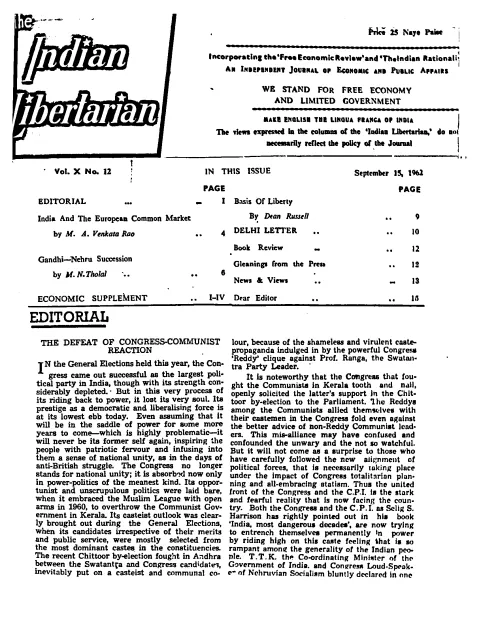
The Indian Libertarian
Independent Journal of Free Economy and Public Affairs
By MA Venkata Rao, M. N. Tholal
Libertarian Publishers (Private) Ltd., 26, Durgadevi Road, Bombay 4 · Bombay · 1962
16 pages
The Indian Libertarian
Summary
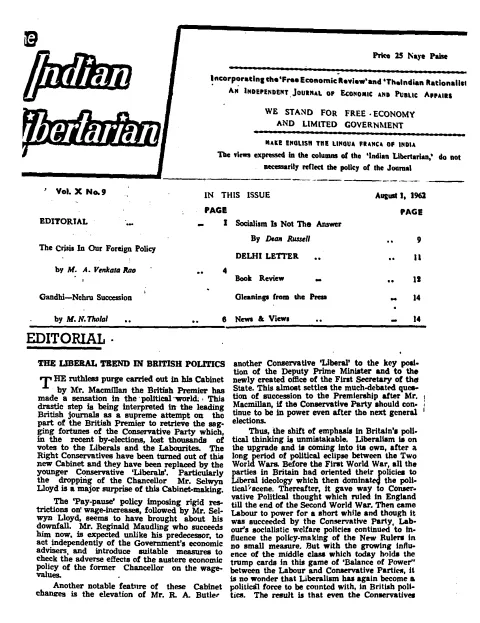
Vol. X No. 9 of The Indian Libertarian (1 August 1962), edited by D. M. Kulkarni and published by Libertarian Publishers Private Ltd., Bombay, anchors itself on three substantial pieces — an editorial titled ‘The Liberal Trend in British Politics’ that reads Macmillan’s Cabinet purge as evidence Liberalism has ‘again become a political force to be counted with’ in Britain; M. A. Venkata Rao’s foreign-policy essay ‘The Crisis In Our Foreign Policy’ decrying India’s invitation to Russian MIGs at Krishna Menon’s prompting as a betrayal of non-alignment; and the second instalment of M. N. Tholal’s ‘Gandhi—Nehru Succession’, a long meditation on whether Nehru could be considered Gandhi’s spiritual heir. The issue then runs Dean Russell’s reprinted polemic ‘Socialism Is Not The Answer’, a Delhi Letter on the China-India border puzzle, a book review of ‘Understanding Profits’ by Kenneth McFarland and Elmer L. Winter, and the regular departments ‘Gleanings from the Press’ and ‘News & Views’.
The collection’s argumentative center is a classical-liberal worry about both ends of the Cold War: it celebrates the revival of British Liberalism as a check on Conservative drift, condemns Indian flirtation with Soviet supply lines, and recycles Frédéric Bastiat’s distinction of three kinds of government on the back cover. Across pieces, the magazine stands ‘FOR FREE ECONOMY AND LIMITED GOVERNMENT’ and treats socialism, central planning, and Krishna-Menon-style defence procurement as variants of the same plunder.
Key points
-
Vol. X No. 9 of The Indian Libertarian (1 August 1962), edited by D. M. Kulkarni for Libertarian Publishers Private Ltd., Bombay, stands ‘FOR FREE ECONOMY AND LIMITED GOVERNMENT’.
-
The unsigned editorial reads Harold Macmillan’s July 1962 Cabinet purge, including the dropping of Chancellor Selwyn Lloyd, as proof that Liberalism has regained a ‘balance of power’ role in British politics.
-
M. A. Venkata Rao’s essay ‘The Crisis In Our Foreign Policy’ attacks the Krishna Menon-backed plan to manufacture Soviet MiG fighter planes in India under licence as a break from non-alignment.
-
Venkata Rao argues that Western withdrawal from Goa removed any rational ground for India to lean toward Moscow, and warns Soviet ground personnel would give Moscow a foothold in Indian aviation.
-
M. N. Tholal’s essay ‘Gandhi—Nehru Succession — II’ argues Nehruvian socialism owes more to Marx and to Mussolini-style statism than to Gandhi’s village-centric, voluntarist ethic.
-
Tholal names M. N. Roy, Subhas Bose, Jayaprakash Narayan and Acharya Patwardhan as the radicals whose marginalisation by Nehru defined the true line of Gandhian succession.
-
Dean Russell’s reprinted essay ‘Socialism Is Not The Answer’ argues that thinly disguised socialist policies such as minimum wages and rent control undermine a free economy.
-
A Delhi Letter, ‘The Chinese Puzzle’, addresses the China-India border question, and the back cover recycles Frédéric Bastiat’s distinction of three kinds of government.
Essays
Conservative Liberals
The unsigned editorial reads Harold Macmillan’s July 1962 Cabinet purge — the dropping of Chancellor Selwyn Lloyd, the elevation of R. A. Butler to Deputy Prime Minister and First Secretary of State, and the promotion of younger ‘Conservative Liberals’ — as proof that the political center of gravity in Britain has shifted decisively toward Liberalism. The editorial argues that after a long eclipse between the wars, Liberal ideology has regained its ‘balance of power’ role: with the middle class holding the trump cards, neither Labour nor the Conservatives can govern without absorbing Liberal economic and constitutional principles, and the ‘pay-pause’ wage-restriction policy of the deposed Chancellor is cited as the kind of statist overreach that triggered the realignment.
- Reads Macmillan’s Cabinet shake-up as a ‘major surprise’ that confirms Liberalism’s revival as a serious force in British politics.
- Treats the dropping of Selwyn Lloyd and the ‘pay-pause’ wage policy as repudiation of statist Conservative drift.
- Frames the long inter-war Liberal eclipse as now reversed by middle-class voters holding ‘balance of power’ between Labour and Conservative.
- Positions younger ‘Conservative Liberals’ as the ideological winners of the reshuffle.
EDITORIAL — The Crisis In Our Foreign Policy
By M. A. Venkata Rao
M. A. Venkata Rao’s signed essay ‘The Crisis In Our Foreign Policy’ attacks the Defence Ministry’s proposal to manufacture Soviet MiG fighter planes in India under licence. He treats the move — pressed publicly by Krishna Menon and quietly accepted by the Cabinet — as a step that drags India out of non-alignment and into the Soviet orbit at exactly the moment when the West, by quitting Goa, has ‘freed India’ of any reason to lean toward the USSR. He surveys the regional fallout (Pakistan’s deepening alignment with the U.S., Portuguese-American naval cooperation, a possible joint Pak-Chinese front against Bangalore-based industries), and warns that the MiG deal will give Soviet technicians, advisers and ground staff a ‘foothold of an unsuspected and ominous character’ in India’s military aviation infrastructure.
- Reads the Krishna Menon–backed plan to build Soviet MiG-21s in India as a fundamental break from non-alignment.
- Argues that British and American withdrawal from Goa removed any rational ground for tilting toward Moscow.
- Lists ripple effects: Pakistan-U.S. alignment, Portuguese sympathy for Pakistan on Kashmir, and a possible joint Sino-Pak threat to Bangalore.
- Warns that Soviet ground personnel embedded in Indian aircraft factories constitute a strategic ‘foothold of an unsuspected and ominous character’.
- Frames the J. P. Nehru government’s choice as a betrayal of the ‘cherished policy of non-alignment’ it publicly professes.
Gandhi—Nehru Succession
By MA Venkata Rao
M. N. Tholal’s ‘Gandhi—Nehru Succession — II’ is the second instalment of a long polemical essay weighing whether Jawaharlal Nehru can credibly be called the heir of Mahatma Gandhi. Tholal argues that Gandhi’s ‘tortured’, non-violent freedom struggle is being domesticated by Nehru’s Congress into a top-down, semi-socialist state-building project that owes more to Mussolini and Karl Marx than to Gandhi’s village-centric, voluntarist ethic. He revisits the 1922 Bardoli suspension, the 1942 Quit India movement, and the elevation of Sardar Patel to argue that Gandhi’s true political successors were the radicals (M. N. Roy, Subhas Bose, Jayaprakash Narayan, Acharya Patwardhan) Nehru pushed aside.
- Treats Nehru’s claim to Gandhi’s mantle as ideologically hollow: Nehruvian socialism is closer to Marx and to fascist statism than to Gandhian voluntarism.
- Rehearses the 1922 Bardoli suspension and Quit India to argue Gandhi’s politics were principled and non-violent in a way Nehru’s are not.
- Names M. N. Roy, Subhas Bose, J. P. Narayan, and Acharya Patwardhan as the radicals whose marginalisation defined the actual line of succession.
- Reads ‘spinning’ and the rural ideal as Gandhi’s core programmatic legacy, betrayed by the Planning-Commission state.
Socialism Is Not The Answer
By Dean Russell
Dean Russell’s reprinted essay ‘Socialism Is Not The Answer’ argues that thinly disguised socialist policies — minimum wages, rent control, compulsory union membership, government housing — all rest on the conceit that ‘government must provide’ and end by destroying the competitive system that produced the standard of living the planners want to redistribute. Russell uses his own experience moving from rural Virginia to Washington as a parable: state-built apartments, cheap subsidies, and bureaucratic ‘fair shares’ shrink personal responsibility, produce sub-standard goods, and shift the meaning of freedom from self-direction to dependency. He closes with a warning that the very people clamouring for socialist guarantees would rebel against the regimentation that genuine socialism requires.
- Frames most modern Western policy as undiagnosed socialism dressed as welfare.
- Uses a personal Washington-housing anecdote to show that subsidised supply degrades quality and erodes responsibility.
- Argues that ‘government must provide’ is the slogan that ends competitive economy and individual initiative.
- Closes with the warning that real socialism’s regimentation would be rejected by the very voters now demanding its benefits.
DELHI LETTER — The Chinese Puzzle
By From Our Correspondent
An unsigned Delhi Letter (‘From Our Correspondent’) titled ‘The Chinese Puzzle’ surveys the way the Nehru government, the External Affairs Ministry and the Prime Minister himself have been forced by Chinese intransigence on the border to abandon their preferred posture of withdrawal and reluctance. The correspondent reports debates inside the Ministry, the role of Krishna Menon, and the politically awkward fact that Indian schools and Anglo-Indian institutions are increasingly involved in the wider Cold-War posture. The letter closes with notes on Indo-Pak diplomacy and the Pakistan Constitution.
- Reports the Ministry of External Affairs is being dragged off its preferred low posture by Chinese pressure on the border.
- Singles out Krishna Menon’s external role as a complicating factor.
- Connects domestic education policy (Anglo-Indian schools) to the broader Sino-Indian strategic question.
- Briefly evaluates the Pakistani Constitution as a political instrument.
Book Review — Understanding Profits
The Book Review section, captioned ‘UNDERSTANDING PROFITS’, notices the Asia Publishing House Indian edition of Kenneth McFarland and Elmer L. Winter’s defence of profits, recommending it as an accessible primer on why profit-seeking firms — rather than state plans — best serve consumers and workers. The reviewer reads the volume as a useful counter to the dominant Indian intellectual mood, which assumes profit is exploitative.
- Notices the Indian edition of McFarland and Winter’s ‘Understanding Profits’ published by Asia Publishing House.
- Reads it as a defence of profits as the engine of consumer welfare, not a sign of exploitation.
- Recommends it to Indian readers as antidote to anti-business orthodoxy.
Gleanings from the Press
‘Gleanings from the Press’ clips short notices from contemporary papers, including coverage of Indo-Chinese tension, a Peking-Tokyo meeting, and other foreign-policy items the editors think their classical-liberal readership ought to mark. The section serves as a curated index of how mainstream Indian newspapers are framing the foreign-policy crises the journal’s longer essays attack head-on.
- Clip-style notices on Indo-Chinese tension and East-Asian diplomacy.
- Functions as a curated press scan for the journal’s classical-liberal readership.
News & Views
The ‘News & Views’ column highlights Mr. Duncan Sandys’s address on India’s economic progress before the British Chambers of Commerce, the contribution of insurance and banking to industrial finance, and contested questions of equity-sharing and managing-agency reform. A second item reports on educational news from Andhra (Telugu vs. English as medium of instruction in colleges) and university affairs in Bhaktavatsalam’s domain. The page closes with the journal’s standing notes on Indian liberal events.
- Reports Duncan Sandys’s London speech on the importance of private capital in India’s growth.
- Notices debates over equity-sharing and managing-agency rules in Indian companies.
- Carries a regional notice on Telugu-medium colleges in Andhra Pradesh.
Generated by the v1.5 extraction pipeline. Awaiting editorial review.
Essay 8
No summary was extracted for this article. Listed for completeness.
Metadata and summary are AI-extracted from the source PDF and reviewed for editorial accuracy. The original work is available via the Read PDF tab above (where present); paragraph-level citation inside the PDF is deferred to a future engagement.