periodical issue
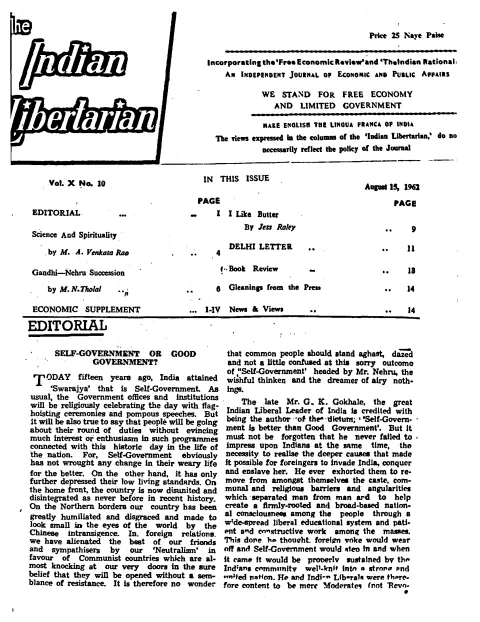
The Indian Libertarian
An Independent Journal of Economic and Public Affairs — Vol. X No. 10, August 15, 1962
By MA Venkata Rao, M. N. Tholal
Edited by D. M. Kulkarni B.A.,LL.B., for the Libertarian Publishers Private Ltd. Printed by G. N. Lawande, at G. N. Printers, Indra Bhuwan, Tadwadi, Bombay 2, and published by him at the office of the Libertarian Publishers (Private) Ltd., 26, Durgadevi Road, Bombay 4. · Bombay · 1962
20 pages
The Indian Libertarian
Summary
The August 15, 1962 issue of The Indian Libertarian (Vol. X, No. 10) marks the fifteenth anniversary of Indian independence with a sharply critical editorial that contrasts mere ‘Self-Government’ with the ‘Good Government’ the Liberals say has eluded India under Nehru. The issue mixes signed political commentary (M. A. Venkata Rao on science and spirituality, M. N. Tholal on the Gandhi–Nehru succession), a four-page Economic Supplement carrying reprints by American free-market writers Prof. G. Carl Wiegand and S. G. Hart, a ‘Delhi Letter’ on the deteriorating border situation and the Akali split, a review of P. T. Bauer’s Indian Economic Policy and Development, and the standard Gleanings and News & Views columns. The argumentative center is a classical-liberal indictment of statism at home (planning, public-sector expansion, monopoly Congress) coupled with anxiety about Chinese intransigence on the frontier, supplemented by imported American libertarian theory presenting capitalism, decentralised enterprise and the ‘forgotten’ taxpayer as alternatives to state-led modernisation.
Key points
-
Marking the fifteenth anniversary of independence, the editorial ‘Self-Government or Good Government?’ contrasts the ‘Self-Government’ India has attained with the ‘Good Government’ the journal says has eluded it under Nehru.
-
It reads Nehru’s foreign-policy ‘Neutralism’ as tilting toward the Communist bloc and argues that Gokhale’s dictum favouring self-government over good government has been misused to excuse low-quality rule.
-
The editorial calls for liquidating the remaining French and Portuguese enclaves and attacks prohibition and other state-imposed moralism as anti-liberty policy.
-
M. A. Venkata Rao’s ‘Science And Spirituality’ argues that science and spirituality are compatible, attacking Marxist materialism as both theoretically incoherent and politically tyrannical.
-
Venkata Rao links the dignity of the individual and the rights of the citizen to a non-materialist, spiritualist conception of personality rather than to dialectical materialism.
-
M. N. Tholal’s serial ‘Gandhi–Nehru Succession—III’ treats the real post-1947 contest as one between Patel and Nehru, tracing Purushottam Das Tandon’s ouster from the Congress presidency and Govind Ballabh Pant’s rise to the Home portfolio.
-
The four-page Economic Supplement carries Prof. G. Carl Wiegand’s ‘The Real Path of Economic Development’, which contrasts failed large-state industrialisation programmes in Latin America with the dispersed, decentralised capitalist growth of the United States.
-
The issue also runs a review of P. T. Bauer’s ‘Indian Economic Policy and Development’ and a Delhi Letter on the deteriorating border situation and the Akali split.
Essays
EDITORIAL — Self-Government or Good Government?
The unsigned editorial uses the fifteenth anniversary of independence to argue that India has obtained Swarajya without Good Government. It contrasts the official festivities with the country’s actual condition: depressed living standards, a disunited and disintegrated polity on the home front, humiliation by Chinese intransigence on the northern borders, and alienation of foreign friends by a Nehruvian ‘Neutralism’ the editor reads as a tilt toward the Communist bloc. Invoking Gokhale’s dictum that Self-Government is better than Good Government, the editorial insists Gokhale never meant that even bad self-government would do; he wanted moderate, broad-based liberal nation-building. By contrast, the editorial accuses Nehru of being a ‘wishful thinker and dreamer of airy nothings’ presiding over a sorry outcome. Subsequent columns (‘Liquidate These Small Pockets’, ‘Here and There’, ‘Food for Thought’) call for ending residual French and Portuguese enclaves, criticise prohibition and food/cloth shortages, and warn against state moralism dressed up as policy.
- Frames the 15th anniversary as an occasion to indict ‘Self-Government’ divorced from ‘Good Government’
- Reads Nehru’s Neutralism as alienating India’s natural friends in favour of Communist powers
- Claims Gokhale’s dictum has been misused: he wanted a strong liberal foundation, not low-quality self-rule
- Notes humiliation by Chinese ‘intransigence’ on the northern frontier
- Calls for liquidation of remaining French (Pondicherry) and Portuguese (Goa/Daman/Diu) pockets through dialogue
- Attacks prohibition and other state-imposed moralism as anti-liberty
Science And Spirituality
By MA Venkata Rao
M. A. Venkata Rao tackles Pandit Nehru’s appeal for a ‘scientific spirit’ by arguing that science and spirituality are not in conflict — both rest on a metaphysical commitment to an ordered intelligible reality. He attacks the materialist reading of science associated with Marxism and dialectical materialism, insisting that the assumption of order is itself an article of faith and that consciousness cannot be reduced to matter. He then turns to political philosophy, arguing that the Russian leaders’ adoption of materialist monism leads logically to subjugation of the individual to the state, whereas a spiritualist conception of personality grounds the rights and freedoms of the citizen. The article positions itself against communism by linking liberal individualism to a religious-spiritual metaphysic and to the political requirement of decentralised, voluntary cooperation.
- Argues Nehru’s call for a scientific spirit is welcome but must not be confused with materialism
- Defends a spiritual metaphysic as compatible with — even required by — modern science
- Reads dialectical materialism as theoretically incoherent and politically tyrannical
- Links the dignity of the individual to a non-materialist conception of personality
- Treats liberty and decentralised cooperation as derivative of the spiritualist position
Gandhi—Nehru Succession—III
By M. N. Tholal
Part III of M. N. Tholal’s serial examines the question of who would succeed Jawaharlal Nehru after the early death of Sardar Patel. Tholal sketches the long contest between Patel and Nehru inside Congress, the politics around Purushottam Das Tandon’s election as Congress president and Nehru’s subsequent move to dislodge him, and the eventual rise of Pandit Govind Ballabh Pant to the Home portfolio. He treats the Patel–Nehru rivalry as the genuine spine of post-1947 Indian politics, arguing that Patel was the natural bridge to the older Liberal and conservative interests and that Nehru’s victory in the succession struggle entrenched a leftward, statist Congress.
- Frames the Gandhi–Nehru succession as in practice a Patel–Nehru contest
- Reads the Tandon presidency and his ouster as a decisive moment in Nehru’s consolidation
- Treats Pant’s elevation to Home as confirming the post-Patel Nehruvian settlement
- Argues Patel would have served as a bridge to liberal/conservative opinion
ECONOMIC SUPPLEMENT — The Real Path of Economic Development
By Prof. G. Carl Wiegand
Prof. G. Carl Wiegand of Southern Illinois University offers a polemical primer for the Economic Supplement: real economic development, he argues, has come not from doctrinaire industrialisation programmes but from cumulative, decentralised growth combining agriculture, industry, services and credit. He contrasts the failures of large-state programmes in Latin America with the dispersed capitalist development of the United States, and warns India that simply transplanting heavy industry without a productive agriculture, a competent labour force and consumer goods will produce inflation, capital waste and political brittleness. The piece is openly polemical against central planning and the cult of the steel mill as a development shortcut.
- Few nations have industrialised by central planning; most by decentralised capitalist growth
- Cites Latin America as the cautionary case of state-led industrialisation without agricultural base
- Argues that agriculture, services and credit develop together with industry, not after it
- Reads heavy-industry-first strategies as inflationary and capital-wasting
- Implicit warning to Indian planners pursuing the same path
ECONOMIC SUPPLEMENT — The Forgotten Man
By S. G. Hart
S. G. Hart’s ‘The Forgotten Man’ revives W. G. Sumner’s classical-liberal figure: the quiet, productive citizen who pays for every scheme of state benevolence and is never consulted. Hart marshals Adam Smith, John Stuart Mill and a Shakespearean tag to argue that government interventions advertised as moral or compassionate work in practice as transfers from the unseen taxpayer to noisy organised interests. He uses examples from Britain, the United States and Australia — restrictions on personal liberty, the spread of moral and trade restrictions, expanding regulatory revenue — to warn that the Forgotten Man’s freedoms and earnings are silently shrunk by a government convinced it must intervene wherever it sees a problem.
- Revives W. G. Sumner’s ‘Forgotten Man’ as the unseen citizen who funds every state scheme
- Reads Adam Smith and J. S. Mill as classical authorities for the limited-state position
- Treats expanding ‘moral’ and trade regulation as transfers from quiet payers to organised interests
- Draws on British, American and Australian examples to argue the trend is general
I Like Butter
By Jess Raley
Jess Raley’s light essay ‘I Like Butter’ is a humorous reflection on the small pleasures and idiosyncrasies of ordinary life — preferences for butter over margarine, observances and holidays, the things that quietly make up a settled bourgeois existence. Reprinted in the magazine as comic relief between heavier political essays, the piece reads as a gentle defence of personal taste and private satisfaction against the levelling impulse of grand programmes. A companion short, ‘Supporting Our Youth’ (credited to The Freeman), continues the libertarian register with a brief argument about adult responsibility and the limits of state programmes for the young.
- Humorous defence of small private preferences over grand designs
- Reprinted to lighten an otherwise polemical issue
- The accompanying ‘Supporting Our Youth’ from The Freeman extends the libertarian tone
DELHI LETTER — Who Wants To Defend Our Borders?
By From Our Correspondent
The unsigned ‘Delhi Letter’ reports two stories from the capital. ‘Who Wants To Defend Our Borders?’ describes an Opposition push to embarrass the Prime Minister over the deteriorating Sino-Indian border situation, with the Prime Minister parrying that the major adjustments lie in foreign policy rather than military deployment. The second strand covers the Akali split: Master Tara Singh’s loss of authority, the rise of Sant Fateh Singh, and the manoeuvres of the Pradesh Congress Committee around Punjabi politics — concluding that the Akali agitation has played itself out and that the Congress will absorb the realignment.
- Opposition uses border deterioration to corner the Prime Minister in Parliament
- Government parries by reframing the issue as foreign-policy adjustment, not military reorganisation
- Reports the Akali split between Master Tara Singh and Sant Fateh Singh
- Reads the Pradesh Congress’s manoeuvres as the de-facto end of the Akali agitation
Book Review — Indian Economic Policy and Development (by P. T. Bauer)
An unsigned book review of P. T. Bauer’s Indian Economic Policy and Development (George Allen and Unwin, London, 1961). The reviewer endorses Bauer’s classical-liberal critique of Indian planning: the over-reliance on state enterprise, the neglect of private initiative, and the suppression of the price mechanism. The review is friendly to Bauer’s contention that the Indian record refutes the planners’ premises and aligns the journal with his call for a more market-friendly path.
- Endorses Bauer’s classical-liberal critique of Indian planning
- Highlights Bauer’s argument that state enterprise has crowded out private initiative
- Aligns the magazine with a market-oriented alternative path
News & Views
The combined ‘Gleanings from the Press’ and ‘News & Views’ columns string together short clippings: a ‘Russia’s Vain Boast’ piece deflating a Khrushchev interview’s claims about Soviet living standards; a paragraph on a former officer urging a NATO-style front to deter China; a note on Jamaican decolonisation (‘Jamaica Is Free’); calls for an ultimatum to China; brief notes on price-for-peace deals with China; and a short statement on the right to test in the context of Soviet supply of MiGs to India. The cumulative effect is a cold-war, classical-liberal selection of news fragments hostile to both Soviet and Indian planning establishments.
- Khrushchev’s claims about Soviet living standards are deflated as boast
- A retired officer’s call for a NATO-style front against China is highlighted
- Jamaican independence noted approvingly under decolonisation
- Calls for an ultimatum to China collected from Indian Opposition voices
- Brief notice on Soviet MiG supply to India and the right-to-test debate
Generated by the v1.5 extraction pipeline. Awaiting editorial review.
Metadata and summary are AI-extracted from the source PDF and reviewed for editorial accuracy. The original work is available via the Read PDF tab above (where present); paragraph-level citation inside the PDF is deferred to a future engagement.