periodical issue
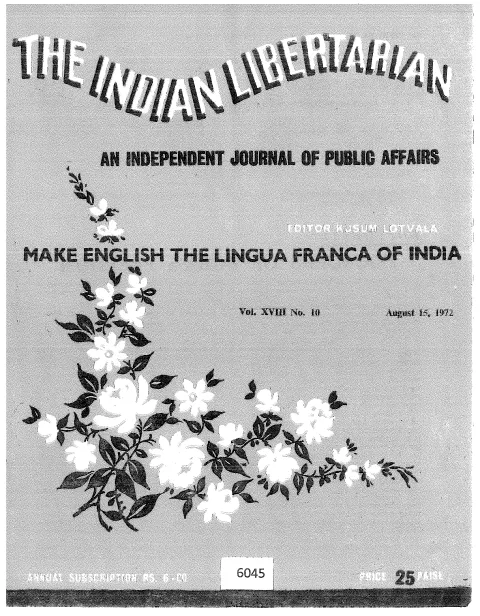
The Indian Libertarian
An Independent Journal of Public Affairs
Edited by Miss K. R. Lotvala, for the Libertarian Publishers Private Ltd. Printed by Miss K. R. Lotwalla, at States' People Press, Janmabhoomi Bhavan, Ghoga Street, Fort, Bombay 1, and published by her at the office of the Libertarian Publishers (Pvt.) Ltd., Arya Bhuvan, First Floor, Sandhurst Road, (West) Bombay 4. · Bombay · 1972
20 pages
The Indian Libertarian
Summary
This Silver Jubilee number of The Indian Libertarian (Vol. XVIII, No. 10, 15 August 1972) brackets the twenty-fifth anniversary of Indian independence with an editorial homage to the founding generation of liberal nationalists and a sheaf of contemporary commentaries that read 1947’s economic and political promises against present discontents. The unsigned editorial ‘Founders of India’s Freedom’ lauds Dadabhai Naoroji, Mahadev Govind Ranade, Pherozeshah Mehta, Gokhale, Shrinivas Shastri, Tejbahadur Sapru and their successors as scholar-statesmen who fused nationalist passion with constitutional restraint and economic realism. A. Ranganathan revisits the language question, M. N. Tholal reports on Vinoba Bhave’s and Jayaprakash Narayan’s role in the Chambal Valley dacoit surrender, K. Kumara Sekhar files a Delhi Letter and a separate Silver Jubilee meditation on India’s ‘overrating’ of freedom-as-an-end, S. R. Mohan Das attacks bonus as an ad hoc ‘anarchic’ compensation method, Dr. R. S. Nigam analyses Britain’s E.E.C. entry and its sterling-area fallout, K.S. pillories Bombay’s policing of the National Anthem, M. Ruthnaswamy reports on a Delhi seminar on scientific research and rural reconstruction, and John A. Sparks defends free-market pricing against the textbook fiction of the rapacious ‘monopolist’. P. Kodanda Rao counsels remembering British liberal allies alongside Gen. Dyer, and an ‘Observer’ note assesses the Monopolies and Restrictive Trade Practices Act of 1969 against the Mahalanobis, Hazari and Dutt enquiry reports. The argumentative centre is the contrast between classical-liberal first principles and the planned, statist trajectory of post-Independence India.
Key points
-
This Silver Jubilee number of The Indian Libertarian (Vol. XVIII, No. 10, 15 August 1972) marks the twenty-fifth anniversary of Indian independence with an unsigned editorial celebrating Dadabhai Naoroji, Mahadev Govind Ranade, Pherozeshah Mehta and Gokhale as the founding ‘galaxy of profoundly wise men’.
-
The editorial indicts the post-Independence ‘partial socialisation’ of the economy, the suppression of cooperative enterprise and the bureaucratic capture of the state, while treating Mrs Indira Gandhi’s December 1971 war leadership as a measured tribute rather than an endorsement of her domestic programme.
-
A. Ranganathan revisits the language question, defending English as the pan-Indian medium of administration and scholarship while arguing Sanskrit never became a popular tongue, and citing Ambedkar’s drafting role and Suniti Kumar Chatterji’s linguistic authority.
-
M. N. Tholal reports on the Chambal Valley dacoit surrender and the credit dispute between Madhya Pradesh Chief Minister Sethi and Jayaprakash Narayan, quoting Vinoba Bhave’s warning against victimising jailed dacoits.
-
S. R. Mohan Das attacks the bonus system as an ad hoc and ‘anarchic’ method of compensation, while Dr. R. S. Nigam analyses Britain’s entry into the European Economic Community and its fallout for the sterling area.
-
John A. Sparks defends free-market pricing against what he calls the textbook fiction of the rapacious ‘monopolist’, and an ‘Observer’ column assesses the Monopolies and Restrictive Trade Practices Act of 1969 against the Mahalanobis, Hazari and Dutt enquiry reports.
-
K. Kumara Sekhar contributes a Delhi Letter and a separate Silver Jubilee meditation on India’s tendency to ‘overrate’ freedom as an end in itself rather than a means to further reform.
-
P. Kodanda Rao urges readers to remember Britain’s liberal allies of the independence struggle alongside figures such as General Dyer, while a column by ‘K.S.’ criticises Bombay’s policing of the National Anthem.
Essays
s freedom owed more to a
The unsigned editorial uses the Silver Jubilee occasion to argue that India’s freedom owed more to a ‘galaxy of profoundly wise men’ than to mass agitation alone. It celebrates Dadabhai Naoroji as the ‘Father of Indian Nationalism’ and propounder of the Drain theory, Mahadev Govind Ranade as a foundational economic thinker and social reformer, and Pherozeshah Mehta, Madan Mohan Malaviya, Gokhale, Shrinivas Shastri, and Tejbahadur Sapru as constitutional liberals who never lost sight of administrative realities. Their style is contrasted with the later, more populist Gandhian phase and with Mrs. Indira Gandhi’s recent assertiveness during the December war with Pakistan.
The editorial then turns critical: while the country has retained democratic forms and the secular character of its politics, it has failed to honour the founders’ liberal economic vision. It indicts the post-Independence ‘partial socialisation’ of the economy, the suppression of cooperative enterprise, the strangling of small producers by monopolistic regulation, and the bureaucratic capture of the state by privileged castes, lamenting that ‘auromondo on current problems’ — i.e., the founders’ warnings — has gone unheeded.
- Frames the Silver Jubilee through a celebration of pre-Gandhian liberal nationalists.
- Names Naoroji, Ranade, Pherozeshah Mehta, Malaviya, Gokhale, Sapru and Shastri as the foundational ‘galaxy of profoundly wise men’.
- Distinguishes a constitutional, economically literate liberalism from later mass politics.
- Indicts post-Independence ‘partial socialisation’ and bureaucratic privilege as betrayals of liberal first principles.
- Uses Mrs. Indira Gandhi’s December 1971 war leadership as a measured tribute, not an endorsement of her domestic programme.
EDITORIAL: Founders of India’s Freedom
A. Ranganathan revisits the language question on India’s twenty-fifth anniversary and argues, against post-1947 linguistic nationalism, that English remains the only truly pan-Indian medium of administration, scholarship and modern science. He traces the history of Sanskrit as a once-living scholarly language that nonetheless ‘never became the popular tongue of the people’, contrasts this with the fertility of vernaculars like Bengali and Tamil, and surveys the rise of national languages in Renaissance Europe (French, English, German) through writers like Petrarch, Boccaccio, Chaucer, Spenser and Luther. The implication is that an artificially imposed Hindi cannot, by official decree alone, become India’s working medium.
Ranganathan defends English as ‘a window on the world’ and as the language of Indian higher education, of nationalist mobilisation, and of the Constitution itself. He cites Dr. Ambedkar’s drafting role and Dr. Suniti Kumar Chatterji’s linguistic authority to argue that the country’s modern intellectual life is bilingual by structure, and that to displace English in favour of a single regional tongue would impoverish both administration and scholarship. The essay closes by recommending that English be retained as a working national link language alongside the regional languages.
- Frames Independence Day reflection through the language question.
- Argues Sanskrit’s scholarly prestige never made it a living popular tongue.
- Uses European Renaissance parallels (Petrarch, Boccaccio, Chaucer, Spenser, Luther) to show how vernaculars matured organically.
- Defends English as the de facto pan-Indian medium of higher learning and constitutional life.
- Cites Ambedkar’s drafting and Suniti Kumar Chatterji’s scholarship to argue for bilingual realism.
Twenty Five Years of Freedom
By A Ranganathan
M. N. Tholal reports on the Chambal Valley dacoit surrender and on the political quarrel between Madhya Pradesh Chief Minister Mr. Sethi and Jayaprakash Narayan over credit for the operation. Tholal quotes Acharya Vinoba Bhave’s warning that ‘new dacoit gangs will spring up if the Madhya Pradesh Government, in its concern with issues of prestige on the surrender of more than 400 dacoits, allows the jailed dacoits to be victimised’, and reproduces Jayaprakash Narayan’s own disclaimer of credit: ‘I do not believe it is in my power or my sacrifice that has brought this about and I have no doubt it is a divine miracle.’
The piece sharply criticises Chief Minister Sethi for publicly attacking Narayan, charging him with ‘breach of trust’, and for treating Sarvodaya workers as ‘publicity seekers’. Inspector-General K. M. Rustomji’s allegation that the workers ‘made heroes of the dacoits’ is presented as evidence of an administration unwilling to credit the moral mediation that made the surrender possible. Tholal closes by noting that Sarvodaya workers have been stopped from visiting the jail where the dacoits are held, jeopardising their welfare and the broader miracle.
- Reports a public quarrel between MP CM Sethi and Jayaprakash Narayan over credit for the Chambal dacoit surrender.
- Foregrounds Vinoba Bhave’s warning that mistreated surrendered dacoits will re-form gangs.
- Quotes Jayaprakash Narayan disavowing personal credit and calling the surrender ‘a divine miracle’.
- Documents the M.P. administration’s resentment of Sarvodaya mediation.
- Argues that visiting restrictions on Sarvodaya workers threaten the operation’s success.
The Chambal Valley Miracle
By M. N. Tholal
An unsigned Delhi Letter, ‘Peace Under Duress’, surveys ratification politics in the wake of the December 1971 war and the Simla accord. Filed by ‘Our Correspondent’, it reports the Lok Sabha’s procedural debate, Uttar Pradesh Chief Minister Kamalapati Tripathi’s intervention in the legislature, and the centre’s attempts to project the peace as durable while opposition voices and a section of the press warn that ratification has been obtained under conditions of political pressure rather than open argument. The piece is brief — a single page — and functions as an editorial gloss on the gap between government communiqués and the texture of legislative consent.
- Frames the post-Simla peace ratification as procedurally compelled rather than freely embraced.
- Reports the Lok Sabha debate and UP CM Kamalapati Tripathi’s role.
- Reads the central government’s projection of durable peace against opposition and press scepticism.
- Highlights the journal’s interest in parliamentary procedure as a test of liberal politics.
DELHI LETTER: Peace Under Duress
By (From Our Correspondent)
K. Kumara Sekhar uses the Silver Jubilee occasion to argue that India has spent twenty-five years ‘overrating freedom’ as an end in itself when freedom is properly only a means to constructive national life. He targets the cult of ‘liberation’ — a word, he writes, that has been given ‘an oversize place in our perspective, so as to cloud our vision of future’ — and contrasts the elaborate symbolism of post-1947 nationalism with the unfulfilled economic and civic substance that should have followed it. The opening tribute to Nehru’s ‘tryst with destiny’ speech is read against the ledger of the next quarter-century: stagnation, mass poverty and an Afro-Asian elite that mistakes ‘liberation fights’ for the harder work of nation-building.
The essay closes with an indictment of the ‘leaders of tomorrow’ — those who ‘have no incentive to see to it that the people experience the same intoxicating sense of achievement and fulfilment’ as the constructive activity of the founding moment — and argues that genuine independence requires no longer ‘over-valuing political independence’ or ‘under-valuing economic independence’.
- Frames the Silver Jubilee as a moment to confront a ‘wrong set of values’.
- Indicts the post-1947 cult of ‘liberation’ as substituting symbol for substance.
- Argues that Afro-Asian states mistook the means (freedom) for the end (constructive life).
- Reads Nehru’s ‘tryst with destiny’ against the bleak ledger of poverty and stagnation.
- Calls for less ‘over-valuing political independence’ and more ‘economic independence’.
Silver Jubilee of Independence
By K. Kumar Sekhar
S. R. Mohan Das attacks the institution of bonus as it has evolved in Indian labour relations, arguing that it is an ‘ad hoc anarchic’ supplement bolted onto an industrial wage system that already ought to be ‘organised and structured’. He traces the history of bonus from its origin as an ex gratia gesture by employers — ‘galling to the pride and status of citizens in a democratic system’ — to its conversion into a profit-sharing concept via INTUC-led semantic ingenuity, and finally to a statutory entitlement codified through the Bonus Act, the Bonus Review Committee, and a stream of L.I.C.-style litigation in which ‘no matter what happens, the Government shall not reduce its share of statutory return’.
For Mohan Das the bonus regime is structurally illogical: it presupposes that profits exist and are ‘shared’, but treats bonus as compulsory even when no profits arise; it claims to compensate for sub-subsistence wages but does so through one-off lump sums rather than wage reform; and it inevitably leads to imitative demands across the central and state services and the municipal sector. The piece concludes that the ‘parasitic aspect’ of bonus has now made it a permanent fixture of agitation politics, and that only a rational, structured wage and salary system can dissolve the contradictions the Bonus Act has institutionalised.
- Identifies bonus as an ‘ad hoc’ patch onto a wage system that ought to be structurally complete.
- Traces the historical drift from ex gratia gesture to profit-sharing concept to statutory entitlement.
- Argues INTUC’s profit-sharing definition was a ‘semantic acrobatic’ that obscures the real problem of sub-subsistence wages.
- Predicts public-sector employees (State and Central offices, Zilla Parishads, Municipal Councils) will inevitably demand parity.
- Concludes that only a ‘structured wage and salary system’ will dissolve the contradictions.
Bonus—An Anarchic Compensation Method
By S. R. Mohan Das
Dr. R. S. Nigam analyses the implications for India of the United Kingdom’s entry into the European Economic Community alongside Denmark, Ireland and Norway, with the Treaty of Accession signed at Brussels. He outlines the immediate consequences for the Commonwealth sugar preference regime, for sterling balances, and for the Indian export basket — particularly tea, jute, leather and textiles — and reads the Kennedy Round tariff reductions and the Generalised Scheme of Preferences against the loss of Imperial preferences that British EEC membership entails.
Nigam argues that the EEC enlargement is ‘pieces of a mosaic’ constructing a multilateral framework which, alongside UNCTAD, GATT, OECD, IMF, IBRD and the like, will determine the developing world’s terms of trade for the next decade. He invokes Paul Prebisch’s ‘infant industry’ argument as the developing-country counter-claim against reciprocity-based market access, and recommends that India use the next ten years to position itself for full G.S.P. utilisation, evolve a coordinated commercial policy with other developing economies, and prepare for the global shift from sectoral Commonwealth trade arrangements to a ‘global arrangement’ of trade and aid.
- Reads UK accession to the EEC against the unwinding of Commonwealth preferences.
- Analyses consequences for Indian tea, jute, leather, textiles and the sterling balances.
- Frames the GSP and Kennedy Round against Prebisch’s ‘infant industry’ argument.
- Names UNCTAD, GATT, OECD, IMF, IBRD as the new institutional matrix.
- Urges Indian commercial-policy coordination with other developing economies over the coming decade.
British Entry Into E.E.C. Its Impact on India
By Dr. R. S. Nigam
K. Kumara Sekhar (‘K.S.’) opens with a sarcastic indictment of Mrs. Indira Gandhi’s habit of ‘distributing her congratulatory “kation”’ to subordinates while the substantive grievances of Indian women — domestic legal disabilities, the impotence of the women’s wing of the Congress Party, the bureaucratised tokenism of public office — go unaddressed. The piece argues that the women’s movement has been captured by party politicking and by the prestige economy of ‘action’ without thought, and that the genuine emancipation of Indian women would require dismantling the legal and customary constraints that no ministerial photo-op can dislodge.
In the second half Sekhar broadens the argument to cover the general post-Independence preference for symbolic over substantive politics — what he glosses as ‘action with little thought’ — and reads it as a defect of the same ‘overrating freedom’ tendency he diagnoses in his Silver Jubilee piece. Real reform, he argues, would require the kind of liberal-procedural temperament that the founding generation embodied but their successors have lost.
- Indicts Mrs. Indira Gandhi’s preference for ceremonial congratulation over substantive reform.
- Argues the women’s wing of the Congress Party has substituted protocol for emancipation.
- Treats post-1947 politics as a syndrome of ‘action with little thought’.
- Reads Indian women’s status as a structural test of the founders’ liberal promise.
- Ties the critique back to the Silver Jubilee meditation on overrating political freedom.
Only Action: Little Thought
By K. S.
An unsigned editorial item — signed ‘K.S.’ at the foot — attacks the Bombay Police Commissioner for arresting ‘dozens of persons for walking out of theatres while the national anthem is being sung’. The author argues that the Commissioner has fundamentally misread the offence: the substance of disrespect is intentional dishonour, not the ceremonial fact of leaving a hall before a recorded tune ends. The piece marshals the Victor Hugo allusion to ‘Javert’ in Les Misérables — the policeman who serves the form of the law against its purpose — to indict an administration that arrests citizens for routine civil behaviour and trivialises a ‘great and beautiful national anthem’ by playing it ‘at the end of even film shows’.
The argument is a small but pointed defence of civil liberty in public space, and against the abuse of patriotic ritual as a pretext for police harassment.
- Reports the Bombay Police Commissioner’s mass arrests for walking out during the National Anthem.
- Argues ‘dishonour’ requires intent, not merely premature departure.
- Indicts the trivialisation of the Anthem by its use at the end of every film show.
- Invokes Victor Hugo’s ‘Javert’ as the type of the form-obsessed policeman.
- Reads the episode as a free-speech and civil-liberty issue.
Scientific Research and Rural Reconstruction
By Rathanaswamy
M. Ruthnaswamy reports on a New Delhi seminar of about fifty ‘eminent scientists’ convened under the chairmanship of the Union Scientific Adviser to consider how scientific research can be applied to rural reconstruction. He surveys the seminar’s prescriptions — coordinated village agricultural extension, financial resources for State Agriculture and Veterinary Universities, the involvement of newly established State and Central financial institutions, and the creation of small research clusters in ‘compact areas’ built around an Agricultural University — and weighs the political-economy difficulties of getting Central and State governments to fund such a programme at a time when ‘lavish expenditure on financial institutions’ has crowded out applied research budgets.
The piece argues that the institutional plumbing exists — IDBI, IFCI, the National Agricultural Bank, the State Agricultural Universities — but that the country’s research priorities remain skewed toward defence and high-prestige metropolitan science. Rural reconstruction is treated as the genuine test of Indian science’s social usefulness, and the article ends on a cautious, half-pessimistic note about the willingness of the political class to commit funds to it.
- Reports the New Delhi seminar of scientists on rural reconstruction.
- Lists the proposed institutional mechanisms — coordinated extension, agricultural universities, financial institutions.
- Identifies funding politics, not technical knowledge, as the binding constraint.
- Critiques the skew of Indian science toward defence and metropolitan prestige.
- Treats rural reconstruction as the test of Indian science’s social usefulness.
Can Monopolist Charge Anything?
By John A. Sparks
John A. Sparks defends free-market pricing against what he treats as the textbook fiction of the ‘monopolist who can charge anything he wants’. He argues that the popular caricature — drawn from the economic-principles classroom — confuses ownership of supply with control of demand, and that no producer, however dominant, can extract a price independent of what consumers are willing and able to pay. A so-called monopolist who pushes price above the demand schedule simply fails to sell; one who supplies a non-essential good is constrained by substitutes; one who supplies an essential good must reckon with the long-run entry of competitors.
The essay is a compressed primer in subjective-value economics: it treats prices as discovery mechanisms, not as administered rents, and it argues that ‘monopoly pricing’ as the textbook describes it has ‘never existed’ in the unhampered market and exists in real economies only where the state enforces it. Sparks’s polemical aim is to puncture the analytic premise behind the M.R.T.P. Act and its like.
- Targets the economics-textbook caricature of the all-powerful monopolist.
- Argues no producer can fix price independent of consumer demand.
- Distinguishes essential and non-essential goods to show different long-run constraints.
- Treats prices as discovery mechanisms rather than administered rents.
- Implicitly polemicises against the analytic basis of the M.R.T.P. Act.
Essay 11
No summary was extracted for this article. Listed for completeness.
Essay 12
P. Kodanda Rao argues, against a reported government plan to include a reference to the Jallianwala Bagh massacre in the Silver Jubilee commemoration, that such a reference would be a ‘great pity’ — likely to provoke anti-British sentiment ‘on this joyous occasion’. He recalls the long line of British liberals who acted as allies of Indian self-government — Macaulay, Lord Bentinck, Lord Ripon, A. O. Hume, Sir William Wedderburn, Sir Henry Cotton, E. S. Montagu and Annie Besant — and quotes Bal Gangadhar Tilak’s tribute to the British rule for the ‘inestimable benefit’ of ‘bringing together the different nationalities and races of India, so that a United Nation may grow together’. The piece ends with a plea to ‘recall with gratitude the good that British rule and British friends had rendered to India and forget Gen. Dyer and his like’.
- Opposes a planned Jallianwala Bagh reference in the Silver Jubilee.
- Lists British liberal allies of Indian self-rule from Macaulay to Annie Besant.
- Quotes Tilak in praise of the unifying effect of British rule.
- Frames imperial history through the lens of liberal Anglo-Indian friendship.
- Counsels remembering benefactors and ‘forgetting Gen. Dyer and his like’.
Essay 13
Writing under the pseudonym ‘Observer’, the columnist traces the history of the Monopolies and Restrictive Trade Practices Act of 1969 from Nehru’s 1959 decision to set up an enquiry committee on ‘who had benefited from the additional income that had been generated in the country by the development efforts of the first two Five Year Plans’. The article walks through the chain of enquiries — the Mahalanobis Committee, the Monopolies Inquiry Commission (1965), the Hazari Committee (1967) and the Dutt Committee (1969) — that culminated in the MRTP Act of 1970, and argues that the Act has ‘virtually closed the door for big business to expand’ outside core industries (coal, iron and steel, heavy engineering, basic chemicals).
‘Observer’ criticises the legislation for treating concentration of economic power as a self-sufficient cause for restriction, ‘without investigating whether this concentration has been used for the public good or to the public detriment’. The Dutt Committee’s own finding that only 3 of 73 sample industrial houses had misused industrial licences is cited as evidence that the MRTP framework over-reaches relative to the actual record of abuse.
- Traces the MRTP Act of 1969 back to Nehru’s 1959 enquiry decision.
- Names the Mahalanobis, Hazari and Dutt committees as the institutional chain.
- Cites the Dutt finding that 3 of 73 industrial houses misused licences.
- Argues the Act treats concentration as automatically harmful, without a public-interest test.
- Contends the legislation effectively bars big business expansion outside core industries.
Generated by the v1.5 extraction pipeline. Awaiting editorial review.
Metadata and summary are AI-extracted from the source PDF and reviewed for editorial accuracy. The original work is available via the Read PDF tab above (where present); paragraph-level citation inside the PDF is deferred to a future engagement.