periodical issue
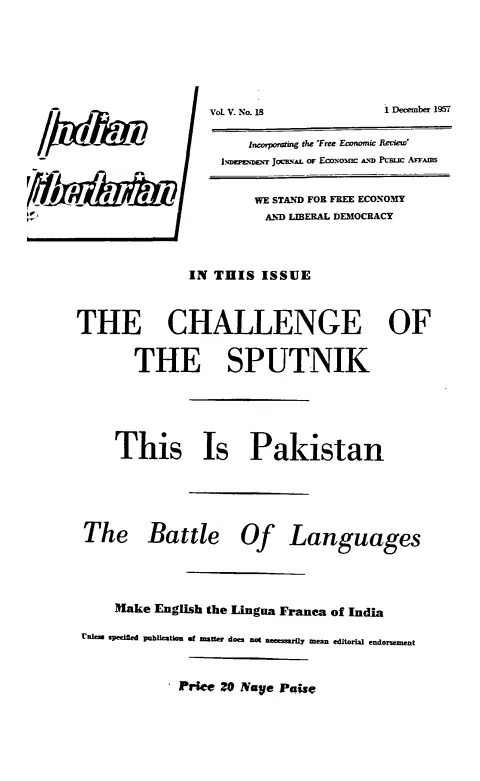
Indian Libertarian
Independent Journal of Economic and Public Affairs
The Indian Libertarian, Independent Journal of Economic and Public Affairs, Edited by Miss Kusum Lotwala, Published on the 1st and 15th of Each month, Arya Bhuvan, Sandhurst Road, Bombay 4. · Bombay · 1957
28 pages
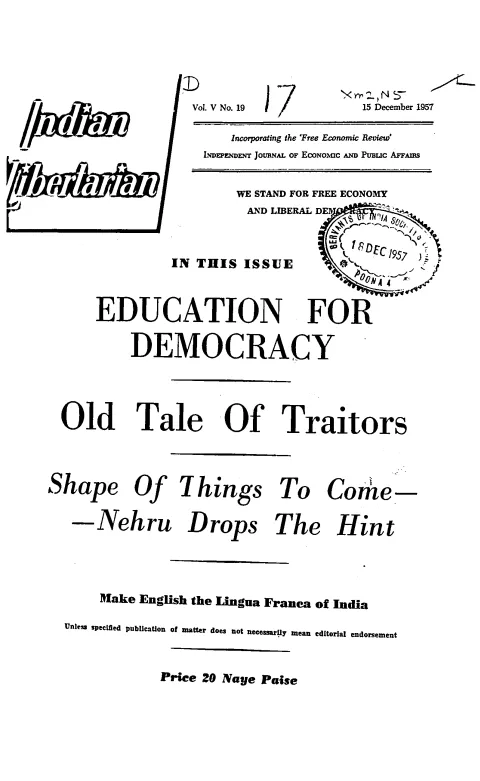
Indian Libertarian
Summary
The 15 December 1957 issue of The Indian Libertarian, the Bombay-based ‘Independent Journal of Economic and Public Affairs’ edited by Miss Kusum Lotwala, runs an editorial that ranges across Kashmir at the UN Security Council, India’s worsening foreign-exchange and food situation, the West’s failure to extend material backing, the North African crisis, the dangers of two-camp Cold War alignment, and Dr Taraka Nath Das’s warnings of a plot against the country. Three signed pieces anchor the issue: M. A. Venkata Rao argues that an imported parliamentary democracy will not survive without a deliberate programme of civic education; Baburao Patel republishes the substance of a 1952 prophecy on Sheikh Abdullah’s ‘perfidy’ to claim vindication after the Sheikh’s dismissal and arrest in Kashmir; and a ‘Lal’ continues an earlier polemic on Jinnah and Gandhi by reading the Khilafat alliance and Maulana Mohammad Ali’s joint-electorate scheme as a strategic dead end for Hindu–Muslim unity. F. G. Clark attacks steeply progressive income tax as a Prohibition-style corrupter of taxpayers and administrators; the Hungarian student refugee Alpar Bujdoso marks the first anniversary of the 1956 revolution; and a ‘Shape of Things to Come’ dispatch reads Nehru’s seminar remark about an ‘increasing conflict’ between parliamentary democracy and full-blooded private enterprise as an admission against interest. The chunk closes mid-way through the ‘On the News Front’ roundup, with the issue’s book reviews and letters to the editor falling past the rendered pages.
Key points
-
The 15 December 1957 issue of The Indian Libertarian (Vol. V No. 19), edited by Miss Kusum Lotwala, runs an editorial on Kashmir at the UN Security Council and India’s worsening foreign-exchange and food situation.
-
The editorial notes that Krishna Menon secured another adjournment of the Kashmir question at the UN, with Dr Graham returning as mediator after Soviet delegate Mr Sobolev’s supportive intervention.
-
M. A. Venkata Rao’s essay ‘Education for Democracy’ argues India’s borrowed parliamentary constitution cannot sustain itself without deliberate civic education, tracing the Western pedigree from Plato through Marx.
-
Baburao Patel republishes the substance of a 1952 prophecy on Sheikh Abdullah’s ‘perfidy’ to claim vindication after the Sheikh’s dismissal and arrest in Kashmir.
-
Writing as ‘Lal’, an essay on ‘Jinnah and Gandhi’ reads the Khilafat alliance and Maulana Mohammad Ali’s joint-electorate scheme, reserving fifteen per cent of seats for Muslims, as a strategic dead end.
-
F. G. Clark attacks steeply progressive income tax as a Prohibition-style corrupter of both taxpayers and the administrators who enforce it.
-
Hungarian student refugee Alpar Bujdoso contributes a piece marking the first anniversary of the 1956 Hungarian revolution against Soviet rule.
-
A ‘Shape of Things to Come’ dispatch reads Nehru’s seminar remark about an ‘increasing conflict’ between parliamentary democracy and private enterprise as an admission against interest.
Essays
EDITORIAL
The editorial sweeps across India’s foreign- and domestic-policy front in late 1957. It opens at the UN Security Council, where Krishna Menon has secured another adjournment of the Kashmir question and the return of Dr Graham as mediator after the Russian delegate Mr Sobolev’s supportive intervention. The editor then catalogues a chain of pressures: a worsening foreign-exchange position; lukewarm Western responses to India’s economic needs; the journal’s standing critique of Indian leadership for failing to extract concrete backing from London and Washington; the North African community question; the case for treating the West rather than the Soviet bloc as India’s natural partner; and a section on the alleged plot against India flagged by Dr Taraka Nath Das. A closing note on Tarakeshwari Sinha presses the line that internal party politics is part of, rather than separate from, the external pressure on Indian liberalism.
- Frames the UN Security Council’s Kashmir adjournment as another Indian diplomatic deferral rather than a settlement.
- Reads India’s foreign-exchange and food situation as evidence that planning-era leadership cannot deliver material results.
- Argues that the West, not the Soviet bloc, is India’s natural partner in any liberal-democratic settlement.
- Treats Dr Taraka Nath Das’s warnings of a ‘plot against India’ as worth public attention.
- Uses domestic party manoeuvres around Tarakeshwari Sinha to underline the journal’s anti-Congress monopoly line.
Education for Democracy
By MA Venkata Rao
M. A. Venkata Rao argues that the constitutional architecture India borrowed from the West — a parliamentary system, fundamental rights, an interpretive Supreme Court — cannot sustain itself without a deliberate programme of civic education. Tracing the Western pedigree from Plato and Aristotle down through Locke, Bentham, the Mills and Marx, and recalling the role of poets and essayists in cultivating English democratic temper, he insists that public opinion is the real soil in which any constitution must root itself. The essay then turns to India’s own task: to inculcate a clear and systematic consciousness of personal freedom, of the bounds of the State, and of the participatory habits without which a Western-modelled democracy will be captured either by demagogues or by the planning bureaucracy.
- India’s parliamentary democracy and Fundamental Rights rest on an imported tradition that must be deliberately taught.
- Civic education is the means by which abstract constitutional values become a ‘personal possession’ of the citizen.
- The English liberal temperament was cultivated by poets and philosophers as much as by legislators.
- Democracy in India risks degenerating into demagogy or bureaucratic rule without a literate, participating public.
- Rao reads liberal education as itself a defence against socialist and totalitarian capture of the State.
Jinnah and Gandhi
By Lal
Writing under the by-line ‘Lal’, this instalment defends an earlier piece that argued Gandhi’s embrace of the Khilafat cause damaged rather than served Hindu–Muslim unity. The author reviews what the Khilafat meant — the institution of the Caliph as the Prophet’s successor — and reads Gandhi’s alliance with Mohammad Ali and Shaukat Ali as a tactical mistake whose communal after-effects long outlived the campaign. The continuation on page 14 reproduces Maulana Mohammad Ali’s own ‘solution’ to the communal question — a joint-electorate scheme reserving a minimum of fifteen per cent of seats for Muslims — which Lal treats as a formula Congress would never accept and as evidence that even the most sincere Muslim nationalist of that generation could not square mass politics with majority rule. The piece ends on a note about individual freedom as a faculty that any honest national settlement would have to protect.
- Reaffirms that the Khilafat alliance was a strategic error for Hindu–Muslim unity.
- Reconstructs Maulana Mohammad Ali’s ‘joint electorate with 15 per cent reservation’ scheme as the high-water mark of liberal Muslim nationalism.
- Argues that the formula failed because Congress would not accept it and the Muslim leadership could not enforce it.
- Treats individual freedom — not communal mathematics — as the only durable settlement.
An Old Tale of Traitors
By Baburao Patel
Baburao Patel reprints — and claims vindication for — an article he had published on 13 April 1952, sixteen months before Sheikh Abdullah’s dismissal and arrest as Prime Minister of Kashmir. Patel treats the Sheikh’s career as the central case of a regional Muslim leader exploiting Nehru’s personal affection while playing communal cards, and details the charges of ‘deception, espionage, corruption, maladministration and establishment of foreign contacts of a kind dangerous to peace and prosperity of the state’. The piece moves through the politics of the Kashmir succession (Bakshi Ghulam Mohammad), the Sheikh’s earlier flights to Karachi, a reading of his agitation in idiom drawn from Muslim history, and a final indictment of Indian national policy for repeatedly mistaking religious-political adventurers for nationalist statesmen.
- Republishes a 1952 piece, ‘Bring The Hand That Feeds’, as a sixteen-month-early prophecy of Sheikh Abdullah’s downfall.
- Lists the formal charges against the Sheikh — espionage, corruption, foreign contacts — as evidence the journal’s earlier line was correct.
- Reads Abdullah’s politics through the rhetoric of ‘Muslim history’ rather than as ordinary regional grievance.
- Treats Nehru’s personal attachment to the Sheikh as the structural weakness in Indian Kashmir policy.
- Ends with a general warning against confusing communal mobilisers with nationalist leaders.
Some Thoughts on Progressive Income Tax
By F. G. Clark
F. G. Clark, in an extract from his book The Economic Facts of Life, attacks steeply progressive income tax as a moral and administrative disaster. He compares the modern tax code to American Prohibition: a law that no honest citizen consents to obey makes a nation of unrepentant cheats, corrupts both administrators and the administered, and rewards only the most ruthless tax planner. Encouragement to cheating, he argues, is woven into the structure of the levy itself, and the only honest remedy is to give up the principle that any given rupee of income can be taxed at rates an individual would refuse to pay voluntarily. The piece is short and largely aphoristic, with a closing note that an individual’s freedom from confiscatory taxation is part of the same bundle of liberties as civil and political freedom.
- Compares progressive income tax to Prohibition as a law society refuses to obey.
- Argues that high rates corrupt both administrators and taxpayers.
- Reads encouragement to cheating as a structural — not personal — feature of the tax.
- Frames freedom from confiscatory taxation as part of the same liberty bundle as civil and political rights.
Reflections of a Revolutionary of Our Times
By Alpar Bujdoso
Writing as a Hungarian student refugee, Alpar Bujdoso marks the first anniversary of the 1956 Hungarian Revolution. He recalls the fierce October days of popular uprising, the Soviet reconquest, and the long shadow they have cast over those forced into exile, and uses the date to argue that the rising was not a failed adventure but a moral turning point in the post-war Communist world. The piece moves between personal memory and political reading: the revolution is presented as evidence that freedom is a universal demand rather than a Western or material problem, and as a reproach to those in the West who would now treat the Hungarian case as closed.
- Treats the Hungarian Revolution as the moral turning point of the Communist post-war period.
- Reads freedom as a universal demand of personal liberty, not a regional or material concern.
- Reproaches Western publics for letting the Hungarian case slide off the agenda.
The Shape of Things to Come
A short editorial dispatch reads Nehru’s recent speech at the second seminar on Parliamentary Democracy, held in the central hall of Parliament, as a quiet admission against interest. Nehru is reported to have said that there was going to be ‘increasing conflict’ between the idea of parliamentary democracy and full-blooded private enterprise. The journal treats the remark as proof that the Prime Minister himself now concedes the antagonism between the planning regime he has built and the liberal-economic order the Indian Libertarian defends, and uses it to flag the political risk of further nationalisation, panchayati-raj-driven state expansion, and what it calls a ‘scandal of the pencillin factory’ as evidence of the same drift.
- Reads Nehru’s seminar remark as a public concession that planning and parliamentary liberty are incompatible.
- Frames the speech as a warning rather than a programme.
- Connects the speech to current cases — the penicillin factory, judicial-appointment politics — said to illustrate the same drift.
ON THE NEWS FRONT
A roundup of short news items. The rendered chunk includes a University Grants Commission committee warning against hasty replacement of English as the medium of higher instruction, dispatches on a reign of terror in Pakistan-occupied Kashmir, an election petition charging M. N. Roy’s nominee, searches at European tea-estate managers’ houses, a Jai Prakash Narayan note on the ‘German tangle’, a note on Pakistan support to Portugal over Goa, and short items on State Trading Corporation experience with the Soviet bloc and the eviction of ‘bhoods’ from East Pakistan. The roundup runs beyond the rendered pages, so the rest of the news front and the issue’s Book Reviews and Letters columns are not yet seen.
- UGC committee under Dr C. R. Kamath warns against hasty replacement of English at the universities.
- Reports of fresh violence in Pakistan-administered Kashmir.
- Jayaprakash Narayan offered as voice on the German question.
- Pakistan reported to be backing Portugal on Goa, against the Indian position.
- Notes on State Trading Corporation’s ‘bitter experience’ with Soviet Russia as cautionary data for planning advocates.
Generated by the v1.5 extraction pipeline. Awaiting editorial review.
Metadata and summary are AI-extracted from the source PDF and reviewed for editorial accuracy. The original work is available via the Read PDF tab above (where present); paragraph-level citation inside the PDF is deferred to a future engagement.