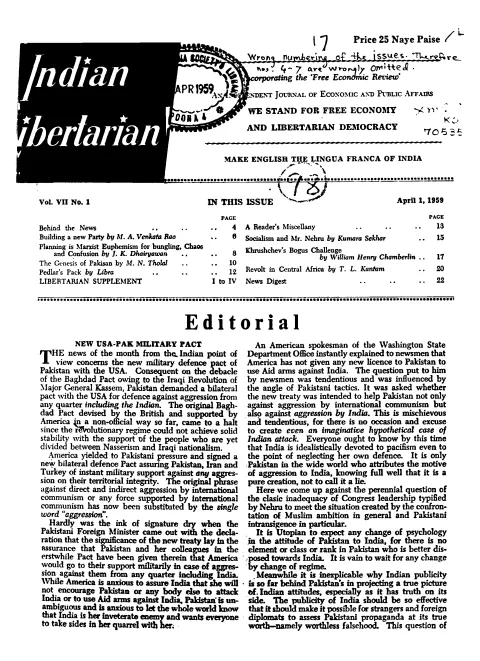
periodical issue
The Indian Libertarian
An Independent Journal of Economic and Public Affairs — Incorporating the Free Economic Review
By MA Venkata Rao, M. N. Tholal, G N Lawande
The Indian Libertarian — Independent Journal of Free Economy and Public Affairs, Arya Bhuvan, Sandhurst Road, Bombay 4 · Bombay · 1959
28 pages
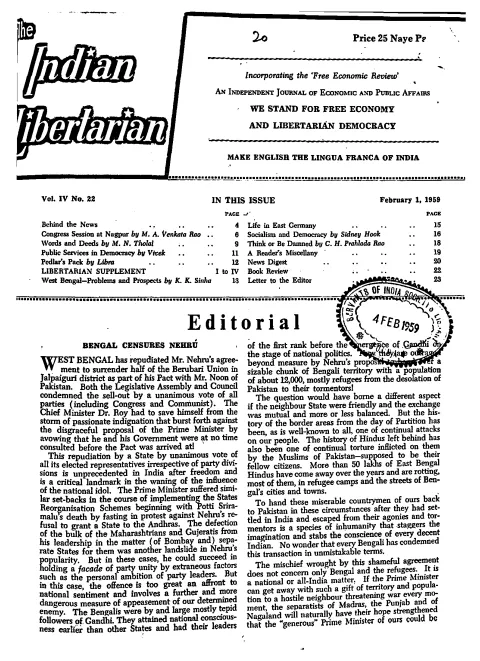
The Indian Libertarian
Summary
This 1 February 1959 issue of The Indian Libertarian (Vol. IV No. 22) opens with an editorial bloc on the West Bengal Assembly’s unanimous censure of Nehru’s agreement to cede half of the Berubari Union to Pakistan, paired with a sceptical reading of the Indus Canal Waters negotiation; the editorial argues the Central Government has consistently misjudged Pakistani intransigence and that Indian assets are being bartered away under World Bank pressure. A ‘Behind the News’ section assesses C. Rajagopalachari’s call for an all-India opposition and his coining of ‘non-violent socialism’ as a slogan to rally anti-Congress forces, and turns a sharp eye on the new Gandhi Peace Foundation. The body of the issue carries longer essays by M. A. Venkata Rao on the Nagpur Congress session’s socialist resolutions, M. N. Tholal on the gap between Congress words and deeds, Vivek on the politicisation of the public services, K. K. Sinha on West Bengal’s prospects after the 1957 elections, an anonymous report on the suppression of intellectual life in East Germany, and Sidney Hook on the compatibility of socialism with democracy. A ‘Libertarian Supplement’ bundles four economic-policy pieces — G. N. Lawande on family planning inside the Plan, M. B. Roshan Premji on state trading in food-grains, an ‘Observer’ essay on planning and unemployment, and Rasul J. Turagvewala on the economic effects of Indian taxation. The collective argumentative centre of the issue is a libertarian critique of the Nagpur Congress turn toward joint cooperative farming and statist planning, framed against the touchstones of property rights, civil liberty, and democratic accountability.
Key points
-
The editorial backs the West Bengal Assembly’s unanimous censure of Nehru’s agreement to cede half of the Berubari Union to Pakistan and criticises the Indus Canal Waters settlement as a surrender of Indian assets under World Bank pressure.
-
It cites the discovery of Pakistani agents in Saurashtra as evidence that New Delhi’s conciliatory posture is being read in Karachi as weakness.
-
The ‘Behind the News’ section reads C. Rajagopalachari’s call for an all-India opposition under the slogan ‘non-violent socialism’ as a tactical device unlikely to unite liberals, Swatantra-minded businessmen and dissenting socialists.
-
It also treats the newly formed Gandhi Peace Foundation with suspicion, suggesting it will function as a Congress publicity organ rather than an independent moral force.
-
M. A. Venkata Rao’s ‘Congress Session at Nagpur’ reads the Nagpur resolutions on joint cooperative farming and land-holding ceilings as a doctrinal, not merely pragmatic, turn toward socialism.
-
Venkata Rao calls for a liberal opposition that defends private property and individual initiative as preconditions for democracy rather than negotiating over rates of socialisation.
-
M. N. Tholal’s ‘Words vs Deeds’ contrasts the ceremonial veneration of Gandhian principles with the gap between Congress rhetoric and its actual governing practice.
-
A ‘Libertarian Supplement’ bundles four economic-policy pieces, including G. N. Lawande on family planning within the Plan and Rasul J. Turagvewala on the economic effects of Indian taxation.
-
The issue also carries K. K. Sinha’s assessment of West Bengal’s prospects after the 1957 elections and Sidney Hook’s essay on the compatibility of socialism with democracy.
Essays
Editorial
The unsigned editorial pairs two themes: West Bengal’s repudiation of Nehru’s agreement to surrender half of the Berubari Union to Pakistan, and the Indus Canal Waters dispute. On Berubari, the editors back the Bengal Assembly’s unanimous censure and argue that the Central Government has consistently misread Pakistani intentions, surrendering national territory to a hostile neighbour without need. On the Canal Waters question, they trace the slow surrender of Indian rights through the long-running negotiation under World Bank auspices, contending that India has paid for Pakistan’s share of replacement works while receiving nothing in return.
A companion section catalogues continued Pakistani intransigence on the border, the discovery of Pakistani agents in Saurashtra, and the financing of a new canal — all marshalled as evidence that New Delhi’s conciliatory posture is being read in Karachi as weakness.
- West Bengal Legislative Assembly and Council unanimously refused the Berubari cession.
- Nehru’s government is charged with misreading Pakistani intransigence as something negotiable.
- The Canal Waters settlement is framed as a transfer of Indian assets under World Bank auspices.
- Pakistani agents discovered in Saurashtra are cited as evidence of hostile activity, not goodwill.
- The editorial frame is libertarian-nationalist: national property and civil rights are being bartered, not defended.
Behind the News
‘Behind the News’ opens with a sceptical analysis of C. Rajagopalachari’s call for an all-India opposition to Congress under the banner of ‘non-violent socialism’. The editors welcome Rajaji’s anti-Congress turn but doubt that the slogan can do the work of rallying liberals, Swatantra-minded businessmen, peasant proprietors, and dissenting socialists into a single front. A second piece, ‘The Pact in the Making’, reads the Nehru–Suhrawardy diplomatic exchange as another step in the wrong direction. The section closes with a wary appraisal of the new Gandhi Peace Foundation, which the editors suspect will function as a publicity organ for Congress rather than as an instrument of moral pressure on the state.
- Rajagopalachari’s ‘non-violent socialism’ is read as a tactical slogan, not a coherent doctrine.
- The piece doubts that a single opposition front can hold liberals, businessmen, and dissenting socialists together.
- The Gandhi Peace Foundation is treated as politically tethered to Congress, not independent.
- The section reinforces the issue’s overall scepticism of Nehruvian conciliation, internal and external.
Congress Session at Nagpur
By MA Venkata Rao
M. A. Venkata Rao argues that the resolutions passed at the Nagpur session stamp the Congress as a properly socialist party, not merely a vague reformist one. He reads the joint cooperative farming resolution, the call for ceilings on land holdings, and the deepening commitment to state industry as a coordinated lurch toward a command economy on the Soviet model. His argument is that the Congress’s drift cannot any longer be excused as pragmatic improvisation; it now has the formal shape of doctrine, and its consequences for property, peasant proprietorship, and civil liberty must be reckoned with on those terms.
The essay treats Nagpur as a moment of revelation that should provoke a serious opposition response — one that defends private property and individual initiative as preconditions for democracy, rather than haggling over rates of socialisation. Venkata Rao positions liberal-democratic resistance as the only honest answer to Nagpur, and warns that without it the Congress will carry the country across a threshold from which retreat is politically costly.
- Reads the Nagpur resolutions as a doctrinal — not pragmatic — turn toward socialism.
- Joint cooperative farming and ceilings on holdings are singled out as the most consequential moves.
- Argues that a liberal opposition must defend property and individual initiative on principle, not on tactics.
- Frames Nagpur as a threshold moment beyond which retreat becomes politically costly.
Words vs Deeds
By M. N. Tholal
M. N. Tholal contrasts the ceremonial veneration of Gandhian principles — symbolised by lakhs of rupees spent on spreading ‘Gandhian ideology’ — with the actual direction of policy under Nehru. The Gandhian inheritance, he argues, is being invoked as cover for a programme that violates its premises: an expanding state, regimented production, and a political class that has stopped listening to peasant proprietors and small traders. The essay reaches back to Tilak as the touchstone of a nationalism that respected ordinary livelihoods, and treats present Congress practice as a betrayal of that line.
- Tholal sets up Gandhian rhetoric and Nehruvian practice as opposed forces.
- Argues that public money spent on ‘Gandhian ideology’ subsidises the inversion of Gandhian economics.
- Invokes Tilak as the genuine nationalist standard against which current policy is judged.
- Frames the Congress as having lost contact with peasant proprietors and small traders.
Public Services in Democracy
By Vivek
Writing under the pen-name ‘Vivek’, the author argues that nothing matters more for the working of a democratic state than how the government treats its own servants. The civil service must be insulated from party politics, secure against arbitrary dismissal, and protected by clear rules of conduct. Where political masters use service postings and disciplinary proceedings as patronage or punishment, the state quietly loses its capacity for impartial administration. The essay draws examples from recent disputes — including charges that Congress organisations in Bombay, Bengal, and Uttar Pradesh have leaned on civil servants for political purposes — and proposes a sharper statutory line between executive command and political instruction.
- Treats the civil service as a structural precondition for, not an accessory to, democracy.
- Identifies political patronage in postings and disciplinary action as the principal threat.
- Cites recent state-level disputes as evidence the problem is general, not local.
- Calls for sharper statutory separation between executive command and party direction.
Pedlar’s Pack
The Libertarian Supplement gathers four short economic-policy essays. G. N. Lawande’s ‘Family Planning and Plan’ argues that India’s Five Year Plans cannot raise living standards without serious demographic policy, and reviews the modest place given to family planning in the First and Second Plans. M. B. Roshan Premji’s ‘State Trading in Food-grains’ warns that the new monopoly procurement powers will reproduce the failures of older controls — black markets, hoarding, and rent-seeking by intermediaries. The ‘Observer’ essay ‘Planning and Unemployment’ argues that Plan investment patterns are mismatched to the structure of Indian labour supply and are themselves a cause of underemployment. Rasul J. Turagvewala’s ‘The Implications and Economic Effects of Taxation in India’ contends that high marginal rates are sterilising savings and capital formation while delivering little to the exchequer.
- Lawande: family planning must be inside the Plan, not treated as adjacent welfare work.
- Roshan Premji: state trading in food-grains will reproduce the pathologies of the controls it replaces.
- ‘Observer’: planning is itself generating unemployment by misallocating investment.
- Turagvewala: high taxes erode savings and capital formation more than they raise revenue.
Libertarian Supplement — Family Planning and Plan
By Prof. G. N. Lawande, M.A.
K. K. Sinha reads the 1957 General Election results in West Bengal as evidence that the Congress has consolidated its rural base while losing ground in the cities to the Communists. He argues that the CPI’s urban gains rest less on doctrine than on Congress administrative failure — labour grievances, food prices, refugee resettlement — and that a liberal counter-strategy must address those grievances on its own terms rather than through anti-Communist rhetoric. The essay proposes specific institutional reforms for state administration in Bengal and warns that without them the next election will hand the Communists more than a protest vote.
- 1957 election results show Congress strong in countryside, weak in Bengal’s cities.
- CPI gains attributed to administrative failure, not ideology.
- Argues against anti-Communist rhetoric as a substitute for governance reform.
- Calls for specific institutional reforms in state administration.
Libertarian Supplement — State Trading in Food-Grains
By M. R. Roshan Pramji
An unsigned piece reports on the Congress for Cultural Freedom’s new Centre in West Berlin, established the previous September, as a refuge for intellectuals fleeing East Germany. The author records first-hand accounts of how academic life is being reshaped in the DDR — pressure on teachers, ideological vetting of students, discriminatory practices against those with Western family ties — and reads the Centre as a small but real liberal answer to the larger problem of intellectual suppression behind the Iron Curtain.
- Reports on a new West Berlin Centre opened by the Congress for Cultural Freedom in September 1958.
- Documents pressure on East German teachers and students.
- Frames the Centre as a concrete liberal response to intellectual suppression.
- Connects domestic Indian debates on civil liberty to the Cold War landscape.
Libertarian Supplement — Planning and Unemployment
By Observer
Sidney Hook takes up the question of whether socialism — defined classically as social ownership of the chief means of production — is compatible with democracy. He distinguishes the Marxist definition from later, looser usages, and argues that socialism is neither sufficient for democracy (a socialist state can be tyrannical) nor strictly incompatible with it (democratic socialism is a real possibility). The real test, for Hook, is institutional: whether the structures of political competition, civil liberty, and judicial independence survive the socialisation of property.
- Distinguishes the strict Marxist definition of socialism from looser modern usages.
- Denies that socialism is automatically democratic or automatically tyrannical.
- Locates the test of compatibility in institutions, not in property forms.
- Implies that the relevant question for India is institutional survival, not ideological label.
Generated by the v1.5 extraction pipeline. Awaiting editorial review.
Metadata and summary are AI-extracted from the source PDF and reviewed for editorial accuracy. The original work is available via the Read PDF tab above (where present); paragraph-level citation inside the PDF is deferred to a future engagement.