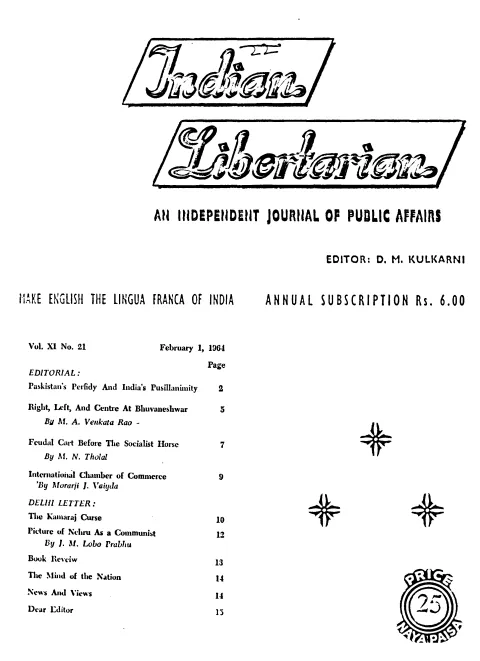
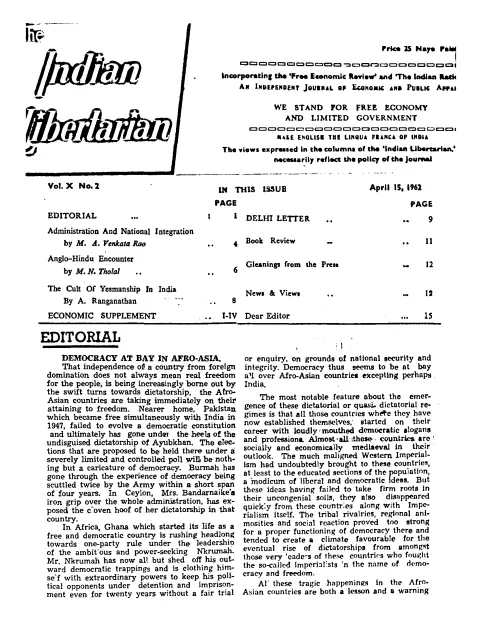
periodical issue
The Indian Libertarian
An Independent Journal of Public Affairs
By A Ranganathan, M. N. Tholal
Edited by Miss K. R. Lotvala, for the Libertarian Publishers Private Ltd. Printed by Miss K. R. Lotwalla, at States' People Press, Janmabhoomi Bhavan, Ghoga Street, Fort, Bombay 1; and published by her at the office of the Libertarian Publishers (Pvt.) Ltd., Arya Bhuvan, First Floor, Sandhurst Road, (West) Bombay 4. · Bombay · 1973
20 pages
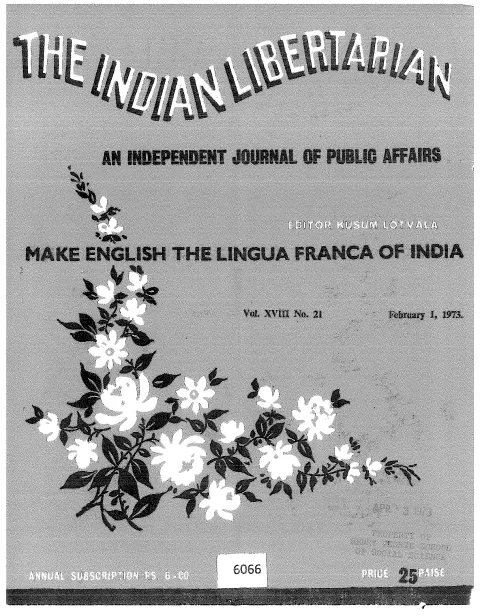
The Indian Libertarian
Summary
The Indian Libertarian, Vol. XVIII No. 21 (1 February 1973), edited by Kusum Lotvala and published fortnightly from Bombay by Libertarian Publishers, is a classical-liberal journal of public affairs. The lead editorial ‘Pie in the Sky Again’ attacks the Indira Gandhi government’s stubborn attachment to Soviet-style five-year planning after the famines and shortages it produced, arguing that Nehru’s prestige still trumps any willingness to revise course. The issue also carries an obituary essay ‘Restored Balance in Indian Politics’ on the death of C. Rajagopalachari, M. N. Tholal’s polemic faulting the Swatantra Party for its conciliatory posture toward Bhutto’s Pakistan, a short ‘India and the CIA’ note arguing that only a competent ‘rightist fifth column’ inside India can effectively counter foreign subversion, a Delhi Letter on P. N. Haksar’s sudden retirement and Akali charges of corruption against Mrs. Gandhi’s ministers, G. Vijayam’s long report on the first World Atheist Meet at Vijayawada, A. Ranganathan’s science feature on chemotherapy, I. Satya Sundaram’s diagnosis of India’s price spiral, and James A. Weber’s libertarian rejoinder to US population-control advocacy.
Key points
-
The 1 February 1973 issue, Vol. XVIII No. 21, edited by Kusum Lotvala, leads with ‘Pie in the Sky Again’, arguing Soviet-modelled Indian planning has repeatedly failed to deliver goods, noting even Russia imports grain from capitalist countries.
-
The editorial accuses Mrs. Indira Gandhi’s government of clinging to the planning framework because Nehru’s posthumous prestige and the careers of Congressmen like Morarji Desai depend on it, despite the Fourth Plan’s disastrous close.
-
The editorial holds up the First Five-Year Plan’s agricultural focus as the pragmatic alternative to what it dismisses as reckless, planning-driven ‘growthmanship’.
-
An obituary essay signed ‘K. Kumara’ frames C. Rajagopalachari’s death as the loss of the figure who restored balance to Indian politics after it drifted leftward under Nehru, calling him a sworn enemy of Karl Marx.
-
A. Ranganathan’s science feature traces chemotherapy from Paracelsus and the iatrochemists through Ehrlich’s salvarsan, Domagk’s prontosil, and Fleming’s 1929 discovery of penicillin, noting the new problem of bactericidal resistance it opened up.
-
M. N. Tholal’s Delhi Letter accuses the Swatantra Party leadership of ‘suicidal mania’ for its conciliatory posture toward Z. A. Bhutto’s Pakistan, arguing it sacrifices principle for tactical respectability.
-
The issue also carries a Delhi Letter on P. N. Haksar’s sudden retirement and Akali charges of corruption against Mrs. Gandhi’s ministers, alongside G. Vijayam’s report on the first World Atheist Meet at Vijayawada.
Essays
Pie in The Sky Again
The unsigned editorial ‘Pie in the Sky Again’ opens by arguing that India’s economic planning, modelled on the Soviet template from the Second Five-Year Plan onward, has repeatedly failed to deliver goods to the common man. Even Russia, the editorial says, has had to borrow grain from capitalist countries, and China has fared worse, yet India’s Moscow-leaning planners have learnt nothing. The editorial accuses Mrs. Indira Gandhi’s government of clinging to the framework because Nehru’s posthumous prestige and the careers of Morarji Desai and other senior Congressmen depend on it, even though the Fourth Plan period closed in disaster. It calls for replacing ‘growthmanship’ with the pragmatism of the First Five-Year Plan, which prioritised agriculture, and ends by predicting that patience and the wisdom of the Indian voter will eventually bear fruit against the ‘make-believe’ of socialist promises.
- Indian planning copied from the Soviet pattern has consistently failed to feed the common man
- Russia itself has had to import grain from capitalist countries while China has fared worse
- Mrs. Gandhi’s government clings to planning because Nehru’s prestige and Congress careers depend on it
- The First Five-Year Plan’s agricultural focus is held up as the pragmatic alternative to ‘growthmanship’
- Welfare socialism has been absorbed into Western capitalist democracies without their abandoning courage to face economic realities
Chemistry in The Conquest of Disease
By A Ranganathan
Signed ‘By K. Kumara’ and subtitled ‘(A rebel to the last)’, this column treats C. Rajagopalachari’s recent death as the loss of the man who ‘restored balance in Indian politics’ after Gandhi’s assassination, when Nehru’s leadership had left the country ‘leaning left and left, with its right side almost paralysed’. Kumara presents Rajaji as the rare entrepreneurial, classically liberal voice in the Indian elite, a sworn enemy of Karl Marx whose Swatantra Party gave political shape to an alternative philosophy of limited government. The piece dwells on Rajaji’s wit, his weekly journalistic columns, and his refusal to abandon his views even as the Swatantra Party suffered electoral setbacks, presenting his death-pangs as not merely those of a man but of an Indian liberal politics that has ‘now lost its Field Marshal’.
- Rajaji’s death is framed as the loss of Indian liberalism’s leading rebel against socialist orthodoxy
- He is credited with ‘restoring balance’ to politics that had drifted leftward under Nehru
- His self-sufficient and entrepreneurial outlook is presented as a singular economic philosophy in Indian politics
- He is described as a sworn enemy of Karl Marx and a relentless critic of Nehruvian leftism
- The author treats Rajaji’s death as a setback for Indian liberalism, but takes consolation in his combative spirit
President Bhutto and his Style
By A Ranganathan
A. Ranganathan’s science essay surveys the long evolution of chemotherapy from medieval alchemy to mid-twentieth-century pharmacology. Beginning with Paracelsus and the iatrochemists, the piece traces the discovery of methylene blue’s anti-bacterial action by Ehrlich, his salvarsan against syphilis, Domagk’s prontosil, the French elucidation of sulphanilamide, and Fleming’s discovery of penicillin. Ranganathan catalogues the practical conquests these chemical advances enabled — pneumonia, meningitis, tonsillitis, gonorrhoea, syphilis, malaria (with atebrin, plasmoquine and paludrine), prostate cancer (with diethylstilboestrol), and rheumatoid arthritis (with cortisone) — while also noting the new problems of bactericidal resistance and radiation sickness opened up by the same advances.
- Modern chemotherapy is traced from Paracelsus and the alchemists to twentieth-century pharmacology
- Ehrlich’s salvarsan and methylene blue are presented as the start of targeted chemical attack on disease
- Domagk’s prontosil and the French isolation of sulphanilamide are credited as the breakthrough into sulpha drugs
- Fleming’s 1929 paper on penicillin’s accidental discovery is treated as the foundational moment of antibiotics
- The author concedes that bactericidal resistance and radiation sickness are the unresolved frontiers of chemical medicine
DELHI LETTER: Where Accused Is The Judge
M. N. Tholal’s polemic accuses the Swatantra Party’s leadership of ‘suicidal mania’ for the conciliatory line it has taken toward Z. A. Bhutto’s Pakistan. Tholal argues that the party is sacrificing classical liberal principle for short-term tactical respectability, becoming unpopular in India without winning anything substantive from Pakistan. He links Pakistan’s intransigence to the deeper problem of Islamic identity politics: Muslims in Pakistan have confronted Kafirs who do not believe in Mohammed as the last prophet, and they have therefore turned on minorities. The closing pages report on Piloo Mody’s press conference with Bhutto, charging Bhutto with using India’s hospitality to evade questions on the release of prisoners of war and the recognition of Bangla Desh, and warning that India should remain patient but vigilant.
- The essay accuses Swatantra Party leaders of self-defeating naïveté toward Bhutto’s Pakistan
- It links Pakistan’s hostility to Islamic identity politics centred on the status of Kafirs
- Mr. Mody is faulted for inviting Bhutto without securing a clear position on POWs or Bangla Desh recognition
- Bhutto is described as a man whose style hides a refusal to risk political capital at home for peace abroad
- India is urged to wait patiently and not concede recognition of Bangla Desh’s claim without consent of Dhaka
World Atheist Meet
By G. Vijayam
A short column signed ‘K. S.’ argues that during the Nehru regime any mention of CIA activity in India was officially denied, but that with serious press reports and PM-level acknowledgement of foreign-power activity it is now no longer possible to pretend. Yet, the author writes, shame at admitting India’s inability to handle subversion stops the government from naming the United States. The piece’s polemical climax is the recommendation that India needs its own competent ‘rightist fifth column’ — an efficient counterpart to the leftist columns serving Soviet and Chinese intelligence — capable of using the system’s own money and personnel against subversion.
- Past denials of CIA activity in India during the Nehru regime are presented as having been knowingly false
- Mrs. Gandhi’s open fears of American intervention are taken as the new official line
- The author argues that pride and shame prevent India from publicly naming the United States
- The remedy proposed is an efficient ‘rightist fifth column’ inside India to counter Soviet and Chinese intelligence networks
- Government ineffectiveness against subversion is held to be the real threat to freedom and security
Anatomy of Price Spiral
By I. Satya Sundaram
The Delhi Letter, ‘From Our Correspondent’, is built around the sudden retirement of P. N. Haksar as the Prime Minister’s Principal Private Secretary and the political fallout in early 1973. It treats Haksar’s exit as a calculated stage-managed move to elevate his anti-Communist successor while leaving the planning ministry (under D. P. Dhar) still pro-Communist. The column then turns to Morarji Desai’s speech at the Jan Palach memorial, which used the Czech student’s self-immolation to attack the drift toward Soviet-style government in India; to Balraj Madhok’s claim that India is already a satellite of the Soviet Union; and to the Akali Party’s memorandum charging four Central Ministers, including Bansilal, with corruption. It ends on the political consequences of Andhra disturbances over the Mulki Rules, which the correspondent reads as a serious puncture in Indira Gandhi’s national popularity.
- Haksar’s premature retirement is read as a managed move to shore up the Prime Minister’s anti-Communist flank
- D. P. Dhar’s continuing grip on planning is treated as a sign that pro-Communist influence survives at the policy core
- Morarji Desai’s Jan Palach memorial speech is reported as a direct attack on Soviet-style government drift in India
- The Akali Party’s memorandum names central ministers including Bansilal in corruption allegations
- Andhra disturbances over the Mulki Rules are read as evidence that Indira Gandhi’s popularity is no longer unassailable
The Population Question
By James A. Weber
G. Vijayam reports on the first World Atheist Meet, held at the Atheist Centre, Patamata, Vijayawada, from 22-26 December 1972, with 120 delegates and observers from India and two from the USA. The piece presents the conference as an unprecedented international gathering of rationalists, humanists, free thinkers and secularists, and prints fraternal messages from Nigel Sinnoughtt of The Free Thinker, Khorean Arisian of the New York Society for Ethical Culture, James Hervery Johnson of the American Association for the Advancement of Atheism, the Atheist Society of Australia, and the Humanist Association of Bangla Desh. Gora’s keynote sets atheism against theism as the choice between human freedom and divinely sanctioned hierarchies, arguing that every prophet has been more atheistic than his contemporaries and that atheism is the master key to dignity, equality and a positive alternative to the present corrupt social, political and economic system. The report closes by listing the regional and national bodies that formed under the meet’s umbrella and the resolutions passed against caste, untouchability, religious patronage and apartheid.
- First World Atheist Meet, held at Vijayawada 22-26 December 1972 with 120 delegates
- Conference draws international fraternal messages from rationalist, humanist and ethical-culture associations
- Gora’s keynote frames atheism as the affirmation of free will and human freedom against theism’s reliance on circumstance
- Atheism is presented as a positive social programme against caste, untouchability and apartheid, not mere unbelief
- Reaction within theistic traditions — Buddha, Jesus, Mohammed — is treated as a recurrent atheistic impulse later compromised
Essay 8
I. Satya Sundaram’s continuing analysis of India’s inflationary price spiral argues that successive Plan periods have fallen far short of industrial-growth targets, with industrial growth in 1971-72 only one per cent against a Fourth Plan target of nine per cent. He maintains that monsoon failures alone cannot explain the chronic rise in foodgrain and consumer-good prices, since money supply is being stepped up without a matching increase in essential-goods production. He attacks the Food Corporation of India’s failure to perform its primary function of controlling foodgrain prices and the proliferation of black money under wasteful ‘parallel economy’ conditions. He proposes a wage-stabilisation policy linking wages to productivity, the diversion of capital from non-essential to essential goods sectors, a clamp-down on conspicuous consumption, and the political will to take the country into the Prime Minister’s confidence about the real causes of inflation.
- Industrial growth in 1971-72 hit only one per cent against a target of nine per cent
- Money supply is stepped up without matching increases in essential-goods production
- Black money and the parallel economy are presented as the structural drivers of speculation
- The Food Corporation of India is faulted for failing its primary price-control function
- Sundaram urges wage stabilisation linked to productivity and a war-footing approach to inflation
Essay 9
James A. Weber’s essay from the Foundation for Economic Education’s tradition argues that the United States was founded on the principle of limited government, but is now flirting with the opposite — limited people. He cites demographers including Donald J. Bogue, who once predicted runaway US population growth but now revises projections downward, to argue that population follows an ‘S’ curve and is already levelling off naturally. He attacks the standard population-control case on pollution, crime, overcrowding and resource depletion, drawing on Barry Commoner’s data that the surge in pollution since 1946 owes only twelve to twenty per cent to population growth and the rest to new production technologies. He insists per capita income rises with population because productivity grows faster than people, and concludes that population control is a ‘simplistic nonsense’ that diagnoses the human condition as a problem to be engineered away.
- The piece frames US population-control policy as a direct contradiction of the founding principle of limited government
- Donald J. Bogue’s revised demographic projections are presented as evidence that population growth is already levelling off
- Barry Commoner’s pollution data are used to attribute only 12-20% of pollution growth since 1946 to population
- Crime, congestion and resource use are argued not to be straightforward functions of population size
- Population control is dismissed as ‘simplistic nonsense’ that treats people as a problem rather than a resource
Generated by the v1.5 extraction pipeline. Awaiting editorial review.
Metadata and summary are AI-extracted from the source PDF and reviewed for editorial accuracy. The original work is available via the Read PDF tab above (where present); paragraph-level citation inside the PDF is deferred to a future engagement.