periodical issue
The Indian Libertarian
An Independent Journal of Economic and Public Affairs
By MA Venkata Rao, M. N. Tholal
The Indian Libertarian, Arya Bhuvan, Sandhurst Road, Bombay 4 · Bombay · 1962
16 pages
The Indian Libertarian
Summary
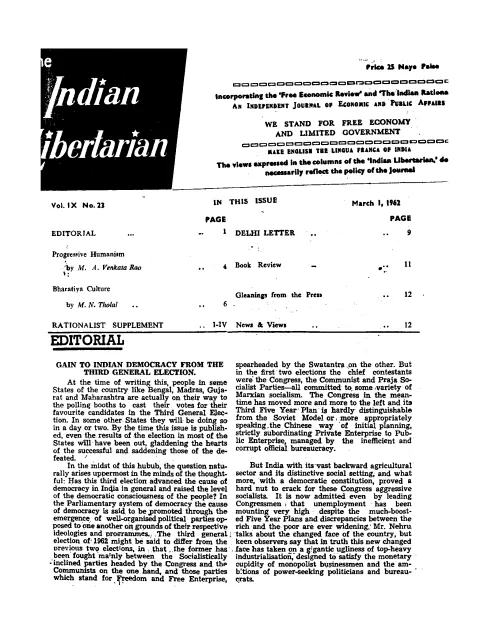
This March 1, 1962 issue (Vol. IX No. 23) of The Indian Libertarian appears just as India’s Third General Election is being held. The lead editorial, ‘Gain to Indian Democracy from the Third General Election,’ welcomes the deepening of democratic consciousness while warning that the chief contestants — Congress, Communists and Praja Socialists — are all committed to some variety of Marxian socialism, leaving the parties of ‘Freedom and Free Enterprise,’ spearheaded by the Swatantra, to crack a hard nut. The signed articles continue the journal’s classical-liberal project: M. A. Venkata Rao’s ‘Progressive Humanism’ contrasts a humanism grounded in liberty with the Marxist programme, and M. N. Tholal’s ‘Bharatiya Culture’ takes up the question of India’s cultural output and its place in the modern world. A ‘Delhi Letter’ on an opposition flop and the journal’s regular Rationalist Supplement round out the issue.
Key points
-
This 1 March 1962 issue, Vol. IX No. 23, appears during India’s Third General Election, and its lead editorial frames the contest as socialist Congress and Communists against the Freedom-and-Free-Enterprise Swatantra Party.
-
The editorial argues that Congress’s own Third Five Year Plan is hardly distinguishable from the Soviet model and notes rising unemployment and a widening rich-poor gap despite successive plans.
-
M. A. Venkata Rao’s Progressive Humanism offers a constructive alternative to Marxist socialism, critiquing the Marxist theory of the state as an instrument of class domination.
-
Venkata Rao grounds his humanism in liberty and the dispersion of property and economic power, defending private enterprise against concentration of power in the state.
-
M. N. Tholal’s Bharatiya Culture, prompted by a fellow journalist’s confusion over an earlier article, weighs Indian against Western culture through figures such as Tilak and Gandhi.
-
A Delhi Letter, An Opposition Flop Worries Mr. Nehru, reports Nehru’s unease that the opposition has failed to take root, surveying Hindu Sabha and Jan Sangh candidate strength before the poll.
-
The Delhi correspondent treats the thinness of the opposition as itself a danger to the health of Indian democracy, alongside coverage of the Pakistan crisis.
Essays
Editorial
The editorial, ‘Gain to Indian Democracy from the Third General Election,’ written as polling proceeds across Bengal, Madras, Gujarat and Maharashtra, asks whether the election has advanced the cause of democracy and raised the democratic consciousness of the people. It argues that in the parliamentary system democracy is promoted by well-organised parties opposed to one another on grounds of ideology and programme, and that the 1962 contest is mainly between the socialistically-inclined Congress and Communists on one side and the parties of Freedom and Free Enterprise, led by the Swatantra, on the other. The editor laments that even Congress’s own Third Five Year Plan is hardly distinguishable from the Soviet model, subordinating private enterprise to an inefficient and corrupt official bureaucracy, and notes that unemployment and the gap between rich and poor keep widening despite the plans.
- Written during polling for the Third General Election
- Treats well-organised, ideologically-opposed parties as the engine of parliamentary democracy
- Frames the contest as socialist Congress/Communists vs. the Freedom-and-Free-Enterprise Swatantra
- Argues the Third Five Year Plan is hardly distinguishable from the Soviet model
- Notes rising unemployment and a widening rich-poor gap under the plans
Progressive Humanism
By MA Venkata Rao
M. A. Venkata Rao’s ‘Progressive Humanism’ takes a close look at the current world-wide clash of doctrines in social philosophy and reveals the outlines of a progressive humanism offered as a constructive alternative to Marxist socialism and communism. He examines the Marxist account of the State as an instrument of class domination and the role of human antagonism in history, and argues against the Marxist programme by setting against it a humanism rooted in liberty, in which property and the opportunity to acquire it are dispersed rather than concentrated. The essay defends private enterprise and the dispersion of economic power as the social basis of a free and humane order.
- Offers ‘progressive humanism’ as a constructive alternative to Marxist socialism and communism
- Critiques the Marxist theory of the State as an instrument of class domination
- Grounds humanism in liberty and the dispersion of property and economic power
- Defends private enterprise against concentration of power in the State
Bharatiya Culture
By M. N. Tholal
M. N. Tholal’s ‘Bharatiya Culture’ is a CCS-style monthly polemic — provoked, he says, by a fellow journalist’s wish to know why he was unable to understand the last portion of an earlier article in The Indian Libertarian — that turns into a reflection on Indian culture and its modern output. Tholal weighs Indian and Western culture, the place of figures like Tilak and Gandhi, and the relation between cultural inheritance and the demands of a progressive society, pressing the question of what India’s culture has actually produced.
- Occasioned by a fellow journalist’s confusion over an earlier Libertarian article
- Reflects on the nature and ‘output’ of Bharatiya (Indian) culture
- Weighs Indian against Western culture and the place of national figures
- Connects cultural inheritance to the demands of a progressive society
Delhi Letter
The ‘Delhi Letter’ from the journal’s own correspondent, headed ‘An Opposition Flop Worries Mr. Nehru,’ reports on the eve of the general election that Nehru is uneasy that the opposition has failed to take root, leaving a one-sided contest. It surveys the Hindu Sabha’s tally of candidates, the Jan Sangh, and the prospects in particular constituencies, and turns to the Pakistan crisis, quoting reactions to the changed political temper. The correspondent reads the thinness of the opposition as itself a danger to the health of Indian democracy.
- Reports Nehru’s unease that the opposition has failed to take root before the election
- Surveys Hindu Sabha and Jan Sangh candidate strength and constituency prospects
- Treats a weak opposition as a danger to democratic health
- Turns to the Pakistan crisis and the changed political temper
Generated by the v1.5 extraction pipeline. Awaiting editorial review.
Metadata and summary are AI-extracted from the source PDF and reviewed for editorial accuracy. The original work is available via the Read PDF tab above (where present); paragraph-level citation inside the PDF is deferred to a future engagement.